
中文词条原文链接(无法从中国内地访问):点击这里访问。
英文词条原文链接(无法从中国内地访问):点击这里访问。
本文基于英文词条的线索,并补充部分来自中文词条的内容(在二者冲突时,以更晚更新者为准)。辽观搬运时进行了必要的合规化处理,以使其能够在中国内地上传。维基百科(Wikipedia)是美国维基媒体基金会的互联网百科项目(点击这里了解更多),其内容可能受到立场、信息来源等因素影响,请客观看待。正文内容不代表译者观点。
辽观提供的翻译仅供参考。文中可能包含无法从中国内地访问的链接。
辽观所搬运的词条文本与原维基百科文本同样遵循CC-BY-SA 4.0协议,在符合协议要求的情况下您可以免费使用其内容(包括商用)。 图片可能遵循不同的共享协议,详见:本文涉及的共享协议
封面图片:Van Gogh – Trauernder alter Mann(梵高 – 《哀悼的老头》。)
封面系辽观裁切的部分画面。
图片作者:文森特·梵高 此图片属于公共领域
维基百科的官方提示:维基百科中的医学内容仅供参考,并不能视作专业意见。如需获取医疗帮助或意见,请咨询专业人士。详见医学声明。

0. 概述
辽观注:此标题是我们在搬运、翻译、整合过程中添加的。
0.1 文字说明
辽观注:此标题是我们在搬运、翻译、整合过程中添加的。
重性抑郁障碍[7][8](major depressive disorder, MDD,台湾译严重忧郁疾患[9]),又译重度抑郁症[10](简称重郁症[9]),也译抑郁症[11][注 1],是一种精神疾患,特征为超过两周的大多数时间都抑郁不已。常常伴随着没有精神、对一般休闲活动没有兴趣、没来由的疼痛及自尊心低落。患者可能会有妄想或者出现幻觉[1]。有些患者的抑郁症发作时期分为好几年,可能有段期间与常人无异,但其他时间一直出现抑郁症症状[3]。重度抑郁症会对日常生活、工作、教育、睡眠、饮食习惯与整体健康造成负面影响[1][3]。在成年的抑郁症患者中,有2至8%死于自杀[2];而大约半数的自杀身亡者患有抑郁症或其他情感障碍[13]。
据信此症的成因是遗传、环境及心理因素的综合体。危险因子有家族病史、某些药物、药物滥用、慢性健康问题以及生活中的重大变动[1][3],有约四成的危险因子与遗传有关[3]。诊断是基于患者陈述的经历与精神状态检查结果[8];此症没有实验室检验的方法[3],但是可以透过测验排除类似症状的病症[8]。重度抑郁比生活的悲伤情绪严重得多,持续时间也更长[3]。美国预防服务工作小组(USPSTF)建议十二岁以上者进行抑郁症筛检[9][10],但是考科蓝合作组织发现常规的筛检问卷对发现或治疗此症几乎没有帮助[11]。
一般的治疗方式是对患者进行心理咨商或提供抗抑郁药[1]。药物是有效的,但效果可能只对严重的患者较显著[12][13]。药物是否影响自杀风险尚无定论[14]。可以使用的心理咨商类型包含认知行为疗法(简称为 CBT)与人际取向心理治疗[1][15]。若其他治疗措施都无效,可能考虑采用电休克疗法[1]。若病例有自伤风险,住院可能是必要措施,在某些情况下甚至可能采用强制送医的方式[16]。
重度抑郁症好发于 20 多岁至 30 多岁者之间,女性患者的比率是男性的两倍[3][4]。1980年,美国精神医学学会将此症纳入精神疾病诊断与统计手册第三版(DSM-III),在第二版(DSM-II)中,原本将此症视为神经症的分支,在当时那一版,神经症也包含了持续性抑郁症和适应障碍症[18]。刚患病或有病史的患者可能会遭到污名化[19]。
Major depressive disorder is believed to be caused by a combination of genetic, environmental, and psychological factors,[1] with about 40% of the risk being genetic.[5] Risk factors include a family history of the condition, major life changes, certain medications, chronic health problems, and substance use disorders.[1][5] It can negatively affect a person’s personal life, work life, or education, and cause issues with a person’s sleeping habits, eating habits, and general health.[1][5] Major depressive disorder affected approximately 163 million people (2% of the world’s population) in 2017.[8] The percentage of people who are affected at one point in their life varies from 7% in Japan to 21% in France.[4] Lifetime rates are higher in the developed world (15%) compared to the developing world (11%).[4] The disorder causes the second-most years lived with disability, after lower back pain.[14]
参考译文:抑郁症被认为是由遗传、环境和心理因素的组合引起的,约40%的发病风险是遗传性的。 风险因素包括家族病史、重大生活变化、某些药物、慢性健康问题和物质滥用等。 它可以对一个人的个人生活、工作生活或教育产生负面影响,并导致一个人的睡眠习惯、饮食习惯和整体健康问题。 抑郁症影响了大约1.63亿人(占世界人口的2%),2017年。 患病率在不同国家之间有所不同,从日本的7%到法国的21%不等。 在发达国家,终身患病率更高(15%),而在发展中国家则较低(11%)。 抑郁症导致了第二多的残疾年数,仅次于腰痛。
| 同义词 | Other names | 临床抑郁症(Clinical depression)、 重度抑郁症(Major depression)、 单极性抑郁症(unipolar depression)、 复发型抑郁(recurrent depression) |
| 症状 | Symptoms | 抑郁、自尊心低落、丧失原有的兴趣、缺乏活力、疼痛但找不到明确的原因[1] |
| 医学专科 | Specialty | Psychiatry(精神病学), clinical psychology(临床心理学) |
| 并发症 | Complications | 自我伤害、自杀[2] |
| 常见始发于 | Usual onset | 20–30岁[3][4] |
| 病程 | Duration | > 2 周[1] |
| 类型 | 抑郁性障碍、情绪抑郁、疾病 |
| 肇因 | Causes | Environmental (adverse life experiences, stressful life events), genetic and psychological factors[5] 环境因素(不良生活经历、压力生活事件)、遗传和心理因素 |
| 风险因子 | Risk factors | 家族病史、生活遭遇巨变、某些药物的副作用、慢性病、物质滥用[1][3] |
| 相似疾病或共病 | Differential diagnosis | 躁郁症、注意力不足过动症(ADHD)、悲伤[3] |
| 治疗 | Treatment | 心理治疗、抗抑郁药、电休克疗法、运动[1][5] transcranial magnetic stimulation(经颅磁刺激) |
| 盛行率 | Frequency | 163 million (2017)[8] 1.63亿(2017)[8] |
表2:分类和外部资源
| ICD–11 | 6A70 |
| ICD–9-CM | 296.30、296.20、296.2、296.3 |
| OMIM | 608520、608691 |
| DiseasesDB | 3589 |
| MedlinePlus | 003213 |
| eMedicine | 286759 |
1. 症状和体征 | Symptoms and signs

图片说明:An 1892 lithograph of a woman diagnosed with melancholia(一幅1892年的平版画,画的是一个被诊断患有忧郁症的女人)
图片来源:https://wellcomeimages.org/indexplus/obf_images/e4/7b/13622efb4fa8a60a617248709dae.jpg

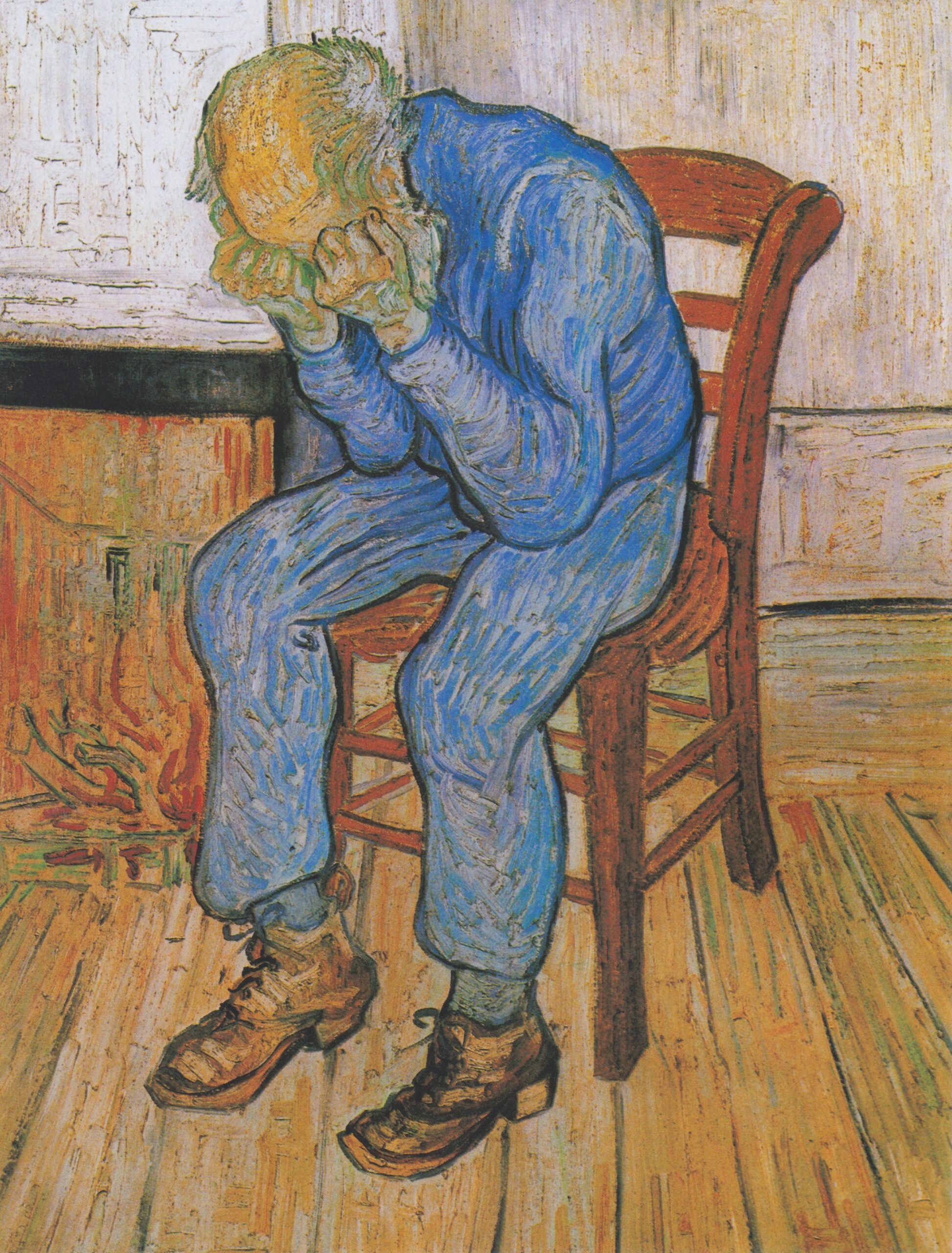
图片说明:Van Gogh – Trauernder alter Mann(梵高 – 《哀悼的老头》)
图片作者:Vincent van Gogh
重度抑郁症是一种对患者家庭、人际关系、工作、学习、日常饮食与睡眠,以及其他身体功能产生负面影响的严重疾病。它对人体功能与生活质量的影响可以与糖尿病等慢性生理疾病相提并论。
重度抑郁症发作的最典型的症状包括:患者长期处于极度抑郁的情绪状态中,对以前感到有趣的活动失去兴趣甚至失去自身的身体活动力(例如:难以自己穿脱衣服、进食等等),无法正面思考为患者最明显的特征,认为生活是种痛苦,认为自己的人生毫无价值、极度的罪恶感、对人事物的懊悔感、无助感、对未来感到绝望和自暴自弃[20]。有时患者会感到难以集中注意力和记忆力减退、时间感变慢(尤其是忧郁型和精神病性抑郁症)[21]。患者还表现出回避社交场合和社交活动、性冲动减退、有自杀念头或反复想到死亡等症状。失眠也是一种常见症状,而睡眠周期也会有所混乱,早醒最为常见,有时也会有嗜睡的情况,但这种情况相对少见[22]。没有食欲、体重降低也是常见症状,但是偶尔也有食欲增加、体重增加的情况[20]。患者还可能会感到一些生理方面的症状,尤其是发展中国家的患者可能会有疲劳、头痛和肠胃问题发生[23]。患者的亲友还可能会注意到患者躁动不安或无精打采[22]。
A depressed person may report multiple physical symptoms such as fatigue, headaches, or digestive problems; physical complaints are the most common presenting problem in developing countries, according to the World Health Organization‘s criteria for depression.[24] Appetite often decreases, resulting in weight loss, although increased appetite and weight gain occasionally occur.[25] Family and friends may notice agitation or lethargy.[19] Older depressed people may have cognitive symptoms of recent onset, such as forgetfulness,[26] and a more noticeable slowing of movements.[27]
【参考译文】一个抑郁症患者可能会报告多种身体症状,比如疲劳、头痛或消化问题;根据世界卫生组织对抑郁症的诊断标准,在发展中国家,身体症状是最常见的抑郁症症状。食欲通常会减退,导致体重减轻,尽管有时也会出现食欲增加和体重增加的情况。家人和朋友可能会注意到患者的焦躁不安或者倦怠无力。年长的抑郁症患者可能会出现认知症状,如记忆力减退,并且动作明显减缓。
Major depression significantly affects a person’s family and personal relationships, work or school life, sleeping and eating habits, and general health.[36] Family and friends may notice agitation or lethargy.[29] Older depressed people may have cognitive symptoms of recent onset, such as forgetfulness,[37] and a more noticeable slowing of movements.[38]
【参考译文】重度抑郁症会显著影响一个人的家庭与私人关系、工作或学业、睡眠与饮食习惯,以及整体健康状况[36]。家人和朋友可能会察觉到患者表现出焦躁不安或精神萎靡[29]。患有抑郁症的老年人可能会出现近期发作的认知症状,比如健忘[37],以及更明显的动作迟缓[38]。
老年新发病的患者可能会伴有认知方面的问题,比如健忘[21]或者明显的移动缓慢[24]。抑郁症经常与老年患者中常见的生理疾病同时存在,比如中风,其他心血管疾病、帕金森病或慢性阻塞性肺病[25]。
在严重的病例中,患者从自觉思觉失调转而到失控妄想,比如认为自己的一个小小行为对不起别人,乃至对不起全世界。或加入拟真(通常令人不快的)幻觉[26],比如认为自己的肠子不活动,乃至腹内空无一物。
儿童患者则一般表现出急躁易怒(易激惹)而不是抑郁心境[20]。不同年龄和不同情况的儿童患者会表现出不同症状[27],最常见的是对学校失去兴趣和学习成绩下降、过分依赖、充满不安全感[22]。由于这些症状常常被认为是普通的情绪低落,所以可能造成延误诊断甚至漏诊[20]。抑郁症可能与注意力不足过动症同时发生,这使得两种疾病的诊断和治疗都变得更复杂[28]。
2. 病因 | Cause
Further information: Biology of depression and Epigenetics of depression
【另见:抑郁症的生物学与抑郁症的表观遗传学】

图片题注:A cup analogy demonstrating the diathesis–stress model that under the same amount of stressors, person 2 is more vulnerable than person 1, because of their predisposition[42]
参考译文:一张用以阐释‘素质-压力模型’的杯子类比图:在承受同等程度的压力源时,由于个体2本身具有易感性(即先天素质/ predisposition),因此比个体1更脆弱(更容易‘溢出’或崩溃)[42]。
图片来源:Blacktc
引起严重抑郁症的原因尚不清楚。但已经提出生物心理社会模式,这指出生物学,心理学和社会学因素在引起抑郁症中都起着重要作用。素质-应激模式则指出了当一个预先存在且易受伤害的脆弱体质或身体素质,被极其紧张的生活事件所激活,抑郁症就会发生。预先存在易受伤的身体素质可以是遗传的,意味着在自然与养育之间相互作用,或造因于童年时期对世间的观念。童年时期被虐待,不论是身体虐待,性虐待或心理上的虐待都是引起抑郁症的危险因素。其他如焦虑和药物滥用是可以共同发生的其他精神问题。儿童时期的创伤也与抑郁症的严重程度,对治疗缺乏反应和患病时间长有关。童年受创伤后更容易引发精神疾病如抑郁症。也提出了各种基因控制易患病性。[35]
素质-应激模式则认为抑郁症是患者的既有易感性(素质)被生活中的应激事件激活。患者的这种易感性可以是由于遗传所造成的[36][37],从而涉及到先天与后天的相互作用,或者是一种图式,患者在儿时通过学习所得到的特定认知模式[38]。以上这两种互动模式都得到了实验的支持。例如,新西兰的研究人员采用预测法研究抑郁症。实验中研究人员长时间跟踪一群原本健康的人,并记录与抑郁症有关的情况。最终研究人员得出结论,人体内5-羟色胺转运体(5-HTT)基因影响到人们是否在应对应激事件时持续体验到抑郁。他们特别指出:抑郁症更容易发生在有一个或二个5-羟色胺转运体的短等位基因的人身上[36]。
一项瑞典的研究估计了抑郁症的遗传几率,对女性来说大约为40%,对男性约为30%[39]。演化心理学家认为使人们患抑郁症的基因早已存在于自然选择的历史中。如果患者长期服用精神类药物,例如长期使用镇静剂和安眠药,也会产生类似于重度抑郁症的症状。这些症状是由药物的副作用或者药物的戒断反应引起的,被称为精神活性物质所致精神障碍,而不属于重度抑郁症[40][41]。

图片题注:素质-应激模式预测当人们本身的倾向与应激加在一起,超过一定水平就会发病。
图片来源:Blacktc
2.1 基因 | Genetics
Further information: Behavioural genetics and Genetic epidemiology【另见:行为遗传学 与 遗传流行病学】
Genes play a major role in the development of depression.[52] Family and twin studies suggest that genetic factors account for nearly 40% of the variation in risk for major depressive disorder. Like most psychiatric disorders, major depression is likely shaped by a combination of many individual genetic influences.[53] In 2018, a genome-wide association study discovered 44 genetic variants linked to risk for major depression;[54] a 2019 study found 102 variants in the genome linked to depression.[55] However, it appears that major depression is less heritable compared to bipolar disorder and schizophrenia.[56][57] Research focusing on specific candidate genes has been criticized for its tendency to generate false positive findings.[58] There are also other efforts to examine interactions between life stress and polygenic risk for depression.[59]
【参考译文】基因在抑郁症的发生发展中起着重要作用[52]。家族和双胞胎研究表明,遗传因素解释了重度抑郁症患病风险中近40%的差异。像大多数精神疾病一样,重度抑郁症很可能是由许多独立的遗传影响共同塑造的[53]。2018年,一项全基因组关联研究(GWAS)发现了44个与重度抑郁症风险相关的遗传变异;2019年的一项研究则发现了基因组中102个与抑郁症相关的变异[54][55]。不过,与双相情感障碍和精神分裂症相比,重度抑郁症的遗传性似乎相对较低[56][57]。以往针对特定候选基因的研究因容易产生假阳性结果而受到批评[58]。目前,也有其他研究致力于探讨生活压力与抑郁症多基因风险之间的相互作用[59]。
2.2 其他健康问题 | Other health problems
Depression can also arise after a chronic or terminal medical condition, such as HIV/AIDS or asthma, and may be labeled “secondary depression”.[60][61] It is unknown whether the underlying diseases induce depression through effect on quality of life, or through shared etiologies (such as degeneration of the basal ganglia in Parkinson’s disease or immune dysregulation in asthma).[62] Depression may also be iatrogenic (the result of healthcare), such as drug-induced depression. Therapies associated with depression include interferons, beta blockers,[63] isotretinoin,[64] contraceptives,[63] cardiac agents,[65] anticonvulsants,[66] and hormonal agents.[67] Celiac disease is another possible contributing factor.[68]
【参考译文】抑郁症也可能继发于某些慢性或绝症性的躯体疾病之后,例如 HIV/AIDS(艾滋病)或哮喘,这种情况通常被称为“继发性抑郁症”[60][61]。目前尚不清楚这些基础疾病究竟是因为降低了患者的生活质量而引发抑郁,还是因为它们与抑郁症有着共同的病因(例如帕金森病中的基底神经节退化,或哮喘中的免疫失调)[62]。抑郁症也可能是医源性的(即由医疗行为导致的),比如药物诱发的抑郁症。与抑郁症相关的药物疗法包括干扰素、β受体阻滞剂[63]、异维A酸[64]、避孕药[63]、心脏药物[65]、抗惊厥药[66]以及激素类药物[67]。乳糜泻(Celiac disease)也可能是另一个潜在的诱因[68]。
Substance use in early age is associated with increased risk of developing depression later in life.[69] Depression occurring after giving birth is called postpartum depression and is thought to be the result of hormonal changes associated with pregnancy.[70] Seasonal affective disorder, a type of depression associated with seasonal changes in sunlight, is thought to be triggered by decreased sunlight.[71] Vitamin B2, B6 and B12 deficiency may cause depression in females.[72]
【参考译文】早年滥用物质(如酒精或毒品)与日后患上抑郁症的风险增加有关[69]。分娩后出现的抑郁症被称为产后抑郁症,人们认为这与怀孕相关的激素变化有关[70]。季节性情感障碍(SAD)是一种与日照随季节变化相关的抑郁症,其触发因素被认为是阳光照射减少[71]。维生素B2、B6和B12的缺乏可能会导致女性患上抑郁症[72]。
酗酒或者过度饮酒明显增加了患这种综合征的几率[102][103][104]。长期使用苯二氮䓬类药物(一类用于治疗失眠、焦虑和肌肉痉挛的常见药物,例如安定)也会增加患病风险[105]。慢性的严重抑郁症状可能是长期使用苯二氮䓬类药物的结果或者是长期的戒断综合征[41][106][107][108]。
A 2025 study found that, among more than 172,500 adults in the UK aged 39 and older, those with a history of depression experienced the onset of chronic illnesses approximately 30% earlier than those without depression.[73]
【参考译文】一项2025年的研究发现,在对英国超过17.25万名39岁及以上的成年人进行调查后,有抑郁症病史的人患上慢性疾病的时间,比没有抑郁症的人平均提前了约30%[73]。
A meta-analysis linking depression to elevated levels of C-reactive protein (CRP) cites research indicating that inflammation might contribute to depression.[74]
【参考译文】一项将抑郁症与C反应蛋白(CRP)水平升高联系起来的荟萃分析指出,有研究表明炎症可能是导致抑郁症的一个因素[74]。
2.3 人格或认知心理学方面的因素
人格与人格发展的许多方面构成了抑郁的发作与持续[67][68]。抑郁发作与负面事件之间有直接关联,受个人的性格所影响、应对负面事件的方式可能与他们的抑郁发作有关[69]。低自尊心、自暴自弃或者歪曲的认识可能与抑郁症有关。抑郁症在笃信宗教的人身上更不容易发生并且更容易消除[70]。哪些心理因素造成了抑郁症或者对抑郁症造成影响现在还不是完全清楚,但是纠正思维模式后,患者的心境与自尊心都会改善[71]。
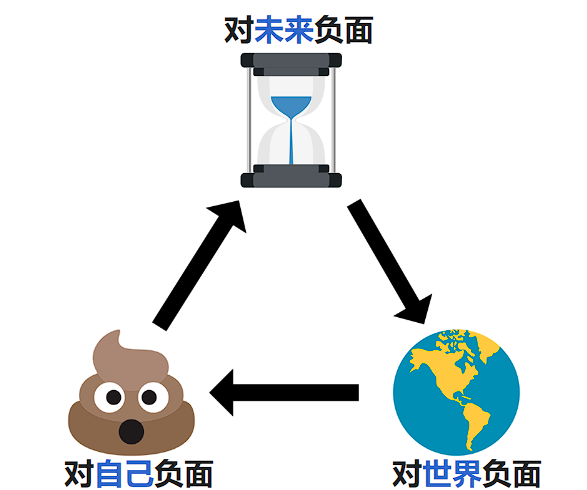
图片题注:抑郁认知三角
图片来源:Blacktc
美国心理学家艾伦·贝克于1960年代初发展了现在被称为抑郁的认知模式的理论。他主张三个观念引起了抑郁症:一、认知三合一模式——关于自己,关于周围世界,关于自己的未来的消极认知;二、反复的消极认知模式或图式;三、歪曲的信息处理[72]。根据这一理论,他发展了系统化的治疗方法——认知行为疗法[73]。而根据美国心理学家马汀·塞利格曼(Martin Seligman),人类的抑郁症状与实验室动物的习得性失助类似[74]。
患者经常因为消极的事件而责怪自己[75];与之对应的是,1993年一项针对因抑郁症住院的青少年的研究显示,即使事情有积极的结果他们也并不感到满意[76],这显示出典型的抑郁素质或悲观主义[75]。根据加拿大心理-社会心理学家阿尔伯特·班杜拉(Albert Bandura)的社会学习理论:基于失败的经历、对失败的社会模型的观察、缺乏社会支持和他们自己的身体和情感状态(包括紧张和压力),抑郁症患者对自己产生消极的认识。这造成了消极的自我概念和自我效能感的缺失,即患者不相信他们能对事物产生影响或者达成目标[77][78]。
一项女性抑郁症的调查显示,心理易感因素如早年丧母、缺乏值得信任的关系、负责照看更年幼的孩子以及失业可以和生活紧张性刺激互相影响增加患抑郁症的风险[79]。对于老年人,易感因素往往是健康问题、与子女或配偶转换角色(由照顾者变为被照顾者)、重要伙伴的逝世、因朋友的健康问题所造成的社会关系改变等[80]。
精神分析学、存在主义心理学、人本主义心理学也有关于抑郁症本质的理论。根据奥地利精神病专家西格蒙德·弗洛伊德的经典精神分析理论,抑郁症或精神忧郁症可能与人际关系丧失[81][82]和早年经历有关[83]。存在主义心理学家则把抑郁症与现时存在意义[84]和未来愿景的缺失相联系[85][86]。存在主义心理学的奠基人——美国心理学家亚伯拉罕·马斯洛则认为当人们无法满足需求或者自我实现以认识到自己的潜力时,抑郁症可能发作[87][88]。
2.4 环境因素 | Environmental
Adverse childhood experiences (incorporating childhood abuse, neglect and family dysfunction) markedly increase the risk of major depression, especially if more than one type.[75] Childhood trauma also correlates with severity of depression, poor responsiveness to treatment and length of illness.[76] Some are more susceptible than others to developing mental illness such as depression after trauma, and various genes have been suggested to control susceptibility.[77] Couples in unhappy marriages have a higher risk of developing clinical depression.[78]
【参考译文】不良的童年经历(包括童年时期的虐待、忽视和家庭功能失调)会显著增加患重度抑郁症的风险,尤其是当这些经历不止一种时[75]。童年创伤还与抑郁症的严重程度、对治疗的反应不佳以及病程长短有关[76]。有些人在经历创伤后比其他人更容易患上抑郁症等精神疾病,目前已有多种基因被认为与这种易感性有关[77]。此外,处于不幸婚姻中的夫妻患上临床抑郁症的风险也更高[78]。
There appears to be a link between air pollution and depression and suicide. There may be an association between long-term PM2.5 exposure and depression, and a possible association between short-term PM10 exposure and suicide.[79]
【参考译文】空气污染与抑郁症及自杀之间似乎存在关联。长期暴露于PM2.5可能与抑郁症有关,而短期暴露于PM10则可能与自杀存在潜在关联[79]。
In a review, people who lived alone were found to have a 42% greater risk of depression.[6]
【参考译文】在一项综述研究中,独居人群被发现患抑郁症的风险要高出42%[6]。
2.5 进化论视角 | Evolutionary
Main article: Evolutionary approaches to depression【主条目:抑郁症的进化论研究】
Further information: Evolutionary medicine, Evolutionary psychiatry, and Evolutionary psychology
【另见:进化医学、进化精神病学 与 进化心理学】
Evolutionary explanations propose that low mood may sometimes represent an adaptive response, such as conserving energy during adverse circumstances or promoting rumination on complex problems.[80][81] Other models emphasize the potential social functions of depressive symptoms, including signaling a need for support. Recent reviews highlight both the heuristic value and limitations of these perspectives, noting that empirical support remains mixed.[82]
【参考译文】进化论的解释提出,低落的情绪有时可能是一种适应性的反应,例如在逆境中保存能量,或促使人们反复思考(反刍)复杂的问题[80][81]。另一些模型则强调了抑郁症状潜在的社会功能,包括向外界发出“需要支持”的信号。近期的综述指出,这些观点既具有启发性的价值,也存在一定的局限性,且目前的实证支持仍然是好坏参半的[82]。
从演化心理学的观点来看,有些重度抑郁症的产生可能是为了促进个体的繁殖的能力。抑郁症的进化论观点和演化心理学认为基于抑郁症的高遗传性和高流行性,抑郁症的某些部分可能有一定的环境适应性[96],例如与依附和社会阶级有关的部分[97]。由此,该理论认为抑郁症的基因可能已经被整合进人类基因库。患者的行为可以被解释为对人际关系和资源管理的适应,尽管结果往往是与当今环境不适应[98]。
从咨询心理学的角度看,治疗师可以不把抑郁症看成是生物化学方面的疾病或障碍,而是把它看作是“一套由一个种群进化的、几乎总是由一种观念激活的、造成个体总是过度消极和能力严重降低的情感程序,有时它与罪恶感、羞愧感和孤立感相关”[99]。这套程序可能显示了在人类过去的狩猎时期,因为狩猎能力衰退而被边缘化的老龄猎手,可能以被疏远的成员的身份继续在当今社会存在,这种被边缘化而产生的无用感可能提示患者需要来自朋友和家人的支持。另外,考虑到躯体疼痛被进化来阻止造成进一步伤害的行为,一种相似的行为——“心理疼痛”可能被进化来阻止患者对恶劣环境的草率和不适应的反应[100]。
2.6 社会因素
贫穷和与社会孤立通常会提高患精神问题的风险[68]。儿时遭受虐待(身体、情感、性或者被忽视)会提高往后患上抑郁障碍的风险[89];家庭功能受损,例如父母(尤其是母亲)患抑郁症、严重的夫妻冲突或离婚、失去双亲或者其他使家庭功能受损的情况都是患病的风险因素[68]。在成年以后,生活应激事件与重性抑郁发作有很强的联系[90][91]。尤其第一次发作比复发更容易由生活应激事件引发[92]。
是缺乏社会支持造成了应激事件增加进而引发抑郁症,或者是社会支持的缺乏直接引发抑郁症,生活应激事件与社会支持之间的关系尚有争议[93]。犯罪或违禁药物造成的不和谐的邻里关系是发病的危险因素,而融洽宜人的邻里关系则是防止抑郁症的保护因素[94]。尽管各种各样的因素交错混杂,但是恶劣的工作条件,特别是费力且只有很少的自主决定权的工作,可能与抑郁症有关[95]。
3. 病理生理学 | Pathophysiology
Further information: Biology of depression and Epigenetics of depression
【另见:抑郁症的生物学 与 抑郁症的表观遗传学】
The pathophysiology of depression is not completely understood, but current theories center around monoaminergic systems, the circadian rhythm, immunological dysfunction, HPA-axis dysfunction, and structural or functional abnormalities of emotional circuits.
【参考译文】抑郁症的病理生理学尚未被完全阐明,但目前的理论主要围绕以下几个核心展开:单胺能系统、昼夜节律、免疫功能失调、HPA轴(下丘脑-垂体-肾上腺轴)功能异常,以及情绪神经回路在结构或功能上的异常。
3.1 单胺
Derived from the effectiveness of monoaminergic drugs in treating depression, the monoamine theory posits that insufficient activity of monoamine neurotransmitters is the primary cause of depression. Evidence for the monoamine theory comes from multiple areas. First, acute depletion of tryptophan—an amino acid and a necessary precursor of the monoamine serotonin—can cause depression in those in remission or relatives of people who are depressed, suggesting that decreased serotonergic neurotransmission is important in depression.[83] Second, the correlation between depression risk and polymorphisms in the 5-HTTLPR gene, which codes for serotonin receptors, suggests a link.[84]
【参考译文】基于单胺类药物在治疗抑郁症中的有效性,单胺假说(monoamine theory)提出,单胺类神经递质的活性不足是导致抑郁症的主要原因。支持单胺假说的证据来自多个领域。首先,急性耗竭色氨酸(一种氨基酸,也是单胺类神经递质5-羟色胺的必需前体)会导致正处于缓解期的患者或抑郁症患者的亲属出现抑郁症状,这表明5-羟色胺能神经传递的减弱在抑郁症中起着重要作用[83]。其次,抑郁症风险与5-HTTLPR基因(负责编码5-羟色胺受体)的多态性之间存在相关性,这也暗示了两者之间的关联[84]。
Third, decreased size of the locus coeruleus, reduced activity of tyrosine hydroxylase, increased density of alpha-2 adrenergic receptors, and evidence from rat models suggest decreased adrenergic neurotransmission in depression.[85] Furthermore, decreased levels of homovanillic acid, altered response to dextroamphetamine, responses of depressive symptoms to dopamine receptor agonists, decreased dopamine receptor D1 binding in the striatum,[86] and polymorphism of dopamine receptor genes implicate dopamine, another monoamine, in depression.[87][88]
【参考译文】第三,蓝斑核(locus coeruleus)体积缩小、酪氨酸羟化酶活性降低、α2-肾上腺素受体密度增加,以及来自大鼠模型的证据,都表明抑郁症中存在去甲肾上腺素能神经传递的减弱[85]。此外,高香草酸(homovanillic acid)水平降低、对右旋苯丙胺(dextroamphetamine)的反应异常、抑郁症状对多巴胺受体激动剂的反应、纹状体中多巴胺D1受体结合的减少[86],以及多巴胺受体基因的多态性,这些也都表明另一种单胺类物质——多巴胺,与抑郁症有关[87][88]。
Lastly, increased activity of monoamine oxidase, an enzyme that degrades monoamines, has been associated with depression.[89] However, the monoamine theory is inconsistent with observations that serotonin depletion does not cause depression in healthy persons, that antidepressants instantly increase levels of monoamines but take weeks to work, and the existence of atypical antidepressants which can be effective despite not targeting this pathway.[90]
【参考译文】最后,单胺氧化酶(一种负责降解单胺类物质的酶)的活性增加,也与抑郁症有关[89]。然而,单胺假说与以下几点观察结果存在矛盾:首先,5-羟色胺的耗竭并不会在健康人群中引发抑郁症;其次,抗抑郁药物虽然能迅速提高单胺类物质的水平,但却需要数周时间才能发挥疗效;此外,还存在一些并不针对该通路却依然有效的非典型抗抑郁药物[90]。
研究人员发现,大多数已知的抗抑郁药会增加一种或多种单胺类神经递质在脑内的水平。单胺类神经递质包括:血清素、去甲肾上腺素和多巴胺。抗抑郁药会提高这些物质在大脑神经元之间(突触)的水平。也有一些药物直接影响神经元之间的感受器,从而起到相同的作用。
研究人员认为,在单胺类神经递质中,血清素被用来调节其他神经递质系统,血清素活性降低会导致这些系统处于失调状态[42],因此当血清素水平降低时,会造成正肾上腺素水平降低,而正肾上腺素水平降低会使人产生抑郁的感觉(“允许性假说”)[43]。已经观察到一些已知的抗抑郁药会直接提高去正肾上腺素水平,其他一些抗抑郁药物会提高多巴胺的水平。根据以上观察结果,研究人员提出了单胺假说,按当时刚提出的说法就是:“一种神经递质的减少对应着一些抑郁症的症状,即甲肾上腺素可能与人的警觉和能量有关,同时也与焦虑、注意力和对生活的兴趣有关;(缺乏)血清素则对应焦虑、强迫观念和行为;多巴胺对应注意力、积极性、愉悦和奖赏机制,同时也与患者对生活的兴趣有关。”[44]这种假说的支持者提出:患者应当针对最突出的症状选择有特殊机理的抗抑郁药,即焦虑与暴躁的病人应该选择选择性5-羟色胺再摄取抑制剂(SSRIs)或者5-羟色胺和去甲肾上腺素再摄取抑制剂(SNRIs),感到能量丧失和生活无趣的病人应选择能提高多巴胺和正肾上腺素水平的药物。[44]

图片题注:一个神经元的轴突和另一个神经元的树突之间的突触示意图。突触是神经元之间一种特殊的间隙。动作电位到达轴突的终端触发化学信息包——神经递质的释放。这些神经递质扩散穿过突触的间隙到达临近树突的受体,引发突触后电位。电位一旦释放神经递质会被迅速代谢或者被泵回收。抗抑郁药会影响这些过程以改善抑郁症状。
原作者:Nrets 译者:Alsatia – 来源:http://en.wikipedia.org/wiki/File:Synapse_Illustration2_tweaked.svg 经简体中文化

在过去的20年里,单胺假说的局限性越来越突出。它无法对以下观察到的各种现象提供充分的解释[45]:人们早就知道噻萘普汀和奥匹哌醇有抗抑郁作用,但是前一种药物属于单胺类神经递质回收增强剂(会降低单胺类神经递质的水平),而后者对单胺类神经递质系统无影响。一些药物会减少单胺类神经递质,但是这类药物并没有在健康人身上造成抑郁症,也没有恶化抑郁症患者的病情。这些观察结果使得单胺假说在精神病学领域内受到质疑。尽管如此,抗抑郁药确实需要完整的单胺类神经递质系统来取得临床效果[46]。
One proposed explanation for the therapeutic lag, and further support for the deficiency of monoamines, is that a desensitization of self-inhibition in raphe nuclei by the increased serotonin, mediated by antidepressants, occurs before the therapeutic efficacy of the drugs can be realized.[91] However, disinhibition of the dorsal raphe has been proposed to occur as a result of decreased serotonergic activity in tryptophan depletion, resulting in a depressed state mediated by increased serotonin.
【参考译文】对于治疗滞后现象,一种旨在进一步支持单胺缺乏的解释是:抗抑郁药物增加了5-羟色胺(血清素)水平,从而介导了中缝核(raphe nuclei)自我抑制机制的脱敏,而这一脱敏过程的发生要先于药物真正发挥疗效之前[91]。然而,也有观点提出,色氨酸耗竭会导致5-羟色胺能活性降低,进而引发背侧中缝核的去抑制,最终通过5-羟色胺的增加反而导致了抑郁状态。
Further countering the monoamine hypothesis is the fact that rats with lesions of the dorsal raphe are not more depressive than controls; the finding of increased jugular 5-HIAA in people who are depressed that normalized with selective serotonin reuptake inhibitor (SSRI) treatment, and the preference for carbohydrates in people who are depressed.[92] Already limited, the monoamine hypothesis has been further oversimplified when presented to the general public.[93] A 2022 review found no consistent evidence supporting the serotonin hypothesis linking serotonin levels and depression.[94]
【参考译文】进一步反驳单胺假说的事实还包括:与对照组相比,背侧中缝核受损的大鼠并没有表现出更强的抑郁倾向;在抑郁症患者体内发现了颈静脉5-HIAA(5-羟吲哚乙酸,5-羟色胺的代谢产物)水平升高,且经过选择性5-羟色胺再摄取抑制剂(SSRI)治疗后该水平会恢复正常;以及抑郁症患者对碳水化合物的偏好[92]。单胺假说本身证据就已经有限,而在向大众科普时,它更是被进一步过度简化了[93]。2022年的一项综述研究发现,没有一致的证据支持将5-羟色胺水平与抑郁症联系起来的“5-羟色胺假说”[94]。
3.2 其他理论
核磁共振扫描显示患者的大脑与健康人的大脑结构有所不同。尽管结论有矛盾之处,元分析显示有足够的证据表明患者脑内海马体体积减小[47],脑部高信号异常增加[48]。这些高信号与晚年发病有关,这一观察结论促进了血管性抑郁的相关理论的发展[49]。
重度抑郁症可能与海马体(大脑中的情绪与记忆中心)的神经发生有关[50]。有些患者身的海马体神经元减少,这有可能造成了记忆力受损和心境抑郁。抗抑郁药物会通过提高5-羟色胺在脑内的水平,可能由此刺激了神经发生,导致海马体的质量增加并最终可能使患者恢复正常的心境与记忆力[51][52]。抑郁症与大脑内的前扣带皮层中调整情绪的区域也有类似关系[53]。脑源性神经营养因子是负责神经发生的神经营养因子之一。与健康人相比,抑郁症患者血浆中的脑源性神经营养因子急剧减少(减少逾3倍),抗抑郁药能提高这种营养因子的血浓度,从而有助患者康复。尽管这种现象也在许多其他精神障碍中被发现,但是有证据表明脑源性神经营养因子与抑郁症的发作和抗抑郁药的机理有关[54]。
重度抑郁症可能还与过分活跃的下丘脑-垂体-肾上腺轴有关。患者HPA轴的活动与神经-内分泌系统对应激的反应类似。研究显示患者的皮质醇水平上升、脑垂体和肾上腺增大,提示内分泌系统的紊乱可能在包括重度抑郁症在内的一些精神障碍中扮演了一定的角色。下丘脑对促肾上腺皮质释放激素的过多释放被认为导致了这种现象,并且与认知和觉醒有关的症状有联系[55]。
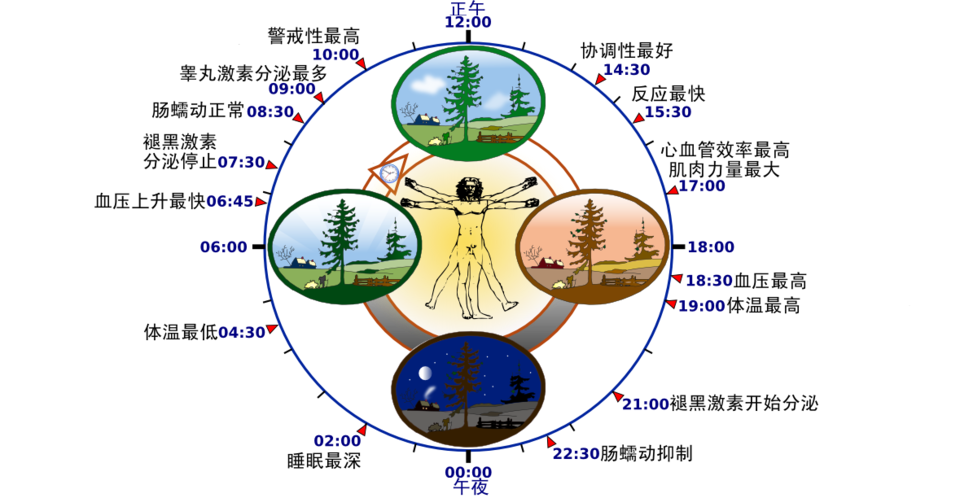
图片题注:抑郁症可能和大脑中控制睡眠觉醒周期的机制有关。
图片来源:YassineMrabet 本PNG 位图使用Inkscape创作 .

重度抑郁症可能与不正常的昼夜节律(生物钟)有关。例如,患者更快达到快速动眼期(梦发生在快速动眼期)并且更强烈。快速动眼期必须在脑干中的5-羟色胺水平降低时才能达到,并受到能提高脑干中5-羟色胺水平的化合物(例如抗抑郁药)的影响。总体上,5-羟色胺系统在睡眠时最不活跃,在清醒时最活跃。睡眠剥夺导致的长时间清醒会激活5-羟色胺能神经元,造成与选择性5-羟色胺再摄取抑制剂之类的抗抑郁药相似的疗效。在一晚上的睡眠剥夺之后患者可能感到情绪明显变得轻松。选择性5-羟色胺再摄取抑制剂可能依靠增加中枢神经5-羟色胺能传导来取得疗效,这个系统也与睡眠觉醒周期有关[56]。
关于光照疗法对季节性情绪失调的疗效的研究提示光照剥夺与5-羟色胺能系统活动降低和睡眠周期异常(特别是失眠)有关。光照使得5-羟色胺系统,这一在抑郁症中可能扮演着重要角色的系统的作用增强[57]。睡眠剥夺与光照疗法以及抗抑郁药都针对相同的脑源性神经营养因子和脑部区域。现在这些疗法已被用在临床治疗当中[58]。光照疗法、睡眠剥夺和睡眠时间移置(睡眠周期提前疗法)被联合应用来快速打破住院患者的深度抑郁[57]。
抑郁发作的风险在青春期之后和怀孕期间增加,而在更年期之后降低提示高雌激素水平可能与抑郁症有关。相反地,经期前和产后的低雌激素水平也与抑郁发作的风险增加有关。尽管一些规模较小的试验显示雌激素的运用有希望预防或治疗抑郁症,但是这种疗法的运用尚在研究之中,其疗效的证据依然不充足。雌激素替代疗法对改善更年期的心境有效,但是否仅仅是更年期症状有所改善还有待观察[59]。
其他研究发现一些与细胞功能有关的物质:细胞因子和必要的营养素可能与抑郁症有关。重度抑郁症患者的症状和病态行为(当免疫系统在抗击感染时的身体反应)很相似[60]。这增大了抑郁症是一种异常病态行为的可能性,这种行为由细胞因子非正常循环所造成[61][62][63]。缺乏一些特定的营养,特别是钴胺素和叶酸也与抑郁症有关[64]。其他营养素,例如铜和镁[65]以及维生素A也与抑郁症有一定的关系[66]。
HPA-axis abnormalities have been suggested in depression given the association of CRHR1 with depression and the increased frequency of dexamethasone test non-suppression in people who are depressed. However, this abnormality is not adequate as a diagnosis tool because its sensitivity is only 44%.[95] These stress-related abnormalities are thought to be the cause of hippocampal volume reductions seen in people who are depressed.[96] Furthermore, a meta-analysis yielded decreased dexamethasone suppression, and increased response to psychological stressors.[97] Further abnormal results have been obscured with the cortisol awakening response, with increased response being associated with depression.[98]
【参考译文】鉴于 CRHR1(促肾上腺皮质激素释放激素受体1)与抑郁症的关联,以及抑郁症患者在地塞米松抑制试验中不抑制的频率增加,人们推测抑郁症中存在 HPA 轴(下丘脑-垂体-肾上腺轴)的异常。然而,这种异常并不足以作为诊断工具,因为其敏感性仅为 44%[95]。这些与压力相关的异常被认为是导致抑郁症患者海马体体积缩小的原因[96]。此外,一项荟萃分析得出了地塞米松抑制作用减弱,以及对心理压力源的反应增强的结论[97]。在皮质醇觉醒反应(CAR)方面,也发现了进一步的异常结果,其反应增强与抑郁症有关[98]。
There is also a connection between the gut microbiome and the central nervous system, otherwise known as the gut–brain axis, which is a two-way communication system between the brain and the gut. Experiments have shown that microbiota in the gut can play an important role in depression, as people with MDD often have gut-brain dysfunction. One analysis showed that those with MDD have different bacteria in their guts. Bacteria Bacteroidetes and Firmicutes were most affected in people with MDD, and they are also impacted in people with irritable bowel syndrome (IBS).[99] Another study showed that people with IBS have a higher chance of developing depression, which shows the two are connected.[100] There is even evidence suggesting that altering the microbes in the gut can have regulatory effects on developing depression.[99]
【参考译文】肠道微生物群与中枢神经系统之间也存在一种联系,这通常被称为“肠-脑轴”(gut–brain axis),即大脑与肠道之间的一个双向通讯系统。实验表明,肠道内的微生物群在抑郁症中可能扮演着重要角色,因为重度抑郁症(MDD)患者通常存在肠-脑功能紊乱。一项分析显示,重度抑郁症患者肠道内的细菌构成与常人不同。厚壁菌门(Firmicutes)和拟杆菌门(Bacteroidetes)在重度抑郁症患者体内受到的影响最为显著,而这两种菌群在肠易激综合征(IBS)患者体内同样也会受到影响[99]。另一项研究表明,肠易激综合征患者患上抑郁症的几率更高,这也印证了两者之间存在关联[100]。甚至有证据表明,改变肠道内的微生物群可能对抑郁症的发生起到调节作用[99]。
Theories unifying neuroimaging findings have been proposed. The first model proposed is the limbic-cortical model, which involves hyperactivity of the ventral paralimbic regions and hypoactivity of frontal regulatory regions in emotional processing.[101] Another model, the cortico-striatal model, suggests that abnormalities of the prefrontal cortex in regulating striatal and subcortical structures result in depression.[102] Another model proposes hyperactivity of salience structures in identifying negative stimuli and hypoactivity of cortical regulatory structures resulting in a negative emotional bias and depression, consistent with emotional bias studies.[103]
【参考译文】目前,学界已经提出了一些旨在整合神经影像学发现的理论模型。第一个被提出的模型是“边缘-皮质模型”,它认为在情绪处理过程中,腹侧旁边缘区域会出现过度活跃,而负责调控的额叶区域则表现出活跃不足[101]。另一个模型是“皮质-纹状体模型”,该模型认为,前额叶皮层在调控纹状体和皮层下结构时出现异常,从而导致了抑郁症[102]。还有一个模型提出,负责识别负面刺激的“显著性网络结构”过度活跃,而皮层调控结构则活跃不足,最终导致了负面情绪偏差和抑郁症,这与关于情绪偏差的研究结果是一致的[103]。
3.3 抑郁症的免疫发病机制理论 | Immune pathogenesis theories on depression
Main article: Depression and immune function【主条目:抑郁症与免疫功能】
The newer field of psychoneuroimmunology, the study between the immune system and the nervous system and emotional state, suggests that cytokines may impact depression.
【参考译文】新兴的“心理神经免疫学”领域,主要研究免疫系统、神经系统与情绪状态之间的相互作用,该领域指出细胞因子可能会对抑郁症产生影响。
Immune system abnormalities have been observed, including increased levels of cytokines—cells produced by immune cells that affect inflammation—involved in generating sickness behavior, creating a pro-inflammatory profile in MDD.[104][105][106] Some people with depression have increased levels of pro-inflammatory cytokines and some have decreased levels of anti-inflammatory cytokines.[107] Ketamine infusion may rapidly reduce depressive symptoms in treatment-resistant depression by modulating proinflammatory cytokines.[108] With this, in MDD, people will more likely have a Th1-dominant immune profile, which is a pro-inflammatory profile. This suggests that there are components of the immune system affecting the pathology of MDD.[109]
【参考译文】研究中观察到了免疫系统的异常,包括细胞因子(由免疫细胞产生、影响炎症反应的信号分子)水平升高,这些细胞因子会引发“疾病行为”,并在重度抑郁症(MDD)中形成一种促炎状态[104][105][106]。部分抑郁症患者体内的促炎细胞因子水平升高,而另一些患者体内的抗炎细胞因子水平则有所降低[107]。氯胺酮(Ketamine)输注可以通过调节促炎细胞因子,迅速缓解难治性抑郁症的抑郁症状[108]。因此,在重度抑郁症中,患者更有可能呈现出一种以Th1为主导的免疫特征,也就是一种促炎特征。这表明,免疫系统的某些成分确实会影响重度抑郁症的病理过程[109]。
Another way cytokines can affect depression is in the kynurenine pathway, and when this is overactivated, it can cause depression. This can be due to too much microglial activation and too little astrocytic activity. When microglia get activated, they release pro-inflammatory cytokines that cause an increase in the production of COX2. This, in turn, causes the production of PGE2, which is a prostaglandin, and this catalyzes the production of indolamine, IDO. IDO causes tryptophan to get converted into kynurenine, and kynurenine becomes quinolinic acid.[110] Quinolinic acid is an agonist for NMDA receptors, so it activates the pathway. Studies have shown that the post-mortem brains of patients with MDD have higher levels of quinolinic acid than people who did not have MDD. With this, researchers have also seen that the concentration of quinolinic acid correlates to the severity of depressive symptoms.[111]
【参考译文】细胞因子影响抑郁症的另一种途径是“犬尿氨酸通路”(kynurenine pathway),当这条通路被过度激活时,就可能引发抑郁症。这种情况通常是由于小胶质细胞(microglia)过度活化,而星形胶质细胞(astrocytic)的活性不足所导致的。当小胶质细胞被激活时,会释放出促炎细胞因子,进而导致COX2(环氧化酶2)的产生增加。这反过来又会促使PGE2(一种前列腺素)的生成,而PGE2会催化吲哚胺(indolamine)生成IDO(吲哚胺2,3-双加氧酶)。IDO会促使色氨酸(tryptophan)转化为犬尿氨酸(kynurenine),随后犬尿氨酸进一步转化为喹啉酸(quinolinic acid)[110]。喹啉酸是NMDA受体(N-甲基-D-天冬氨酸受体)的激动剂,因此会激活该通路。研究表明,重度抑郁症(MDD)患者死后的大脑中,喹啉酸的水平高于未患重度抑郁症的人。基于此,研究人员还发现,喹啉酸的浓度与抑郁症状的严重程度呈正相关[111]。
4. 诊断 | Diagnosis
4.1 临床评估 | Assessment
Further information: Rating scales for depression【另见:抑郁症评定量表】
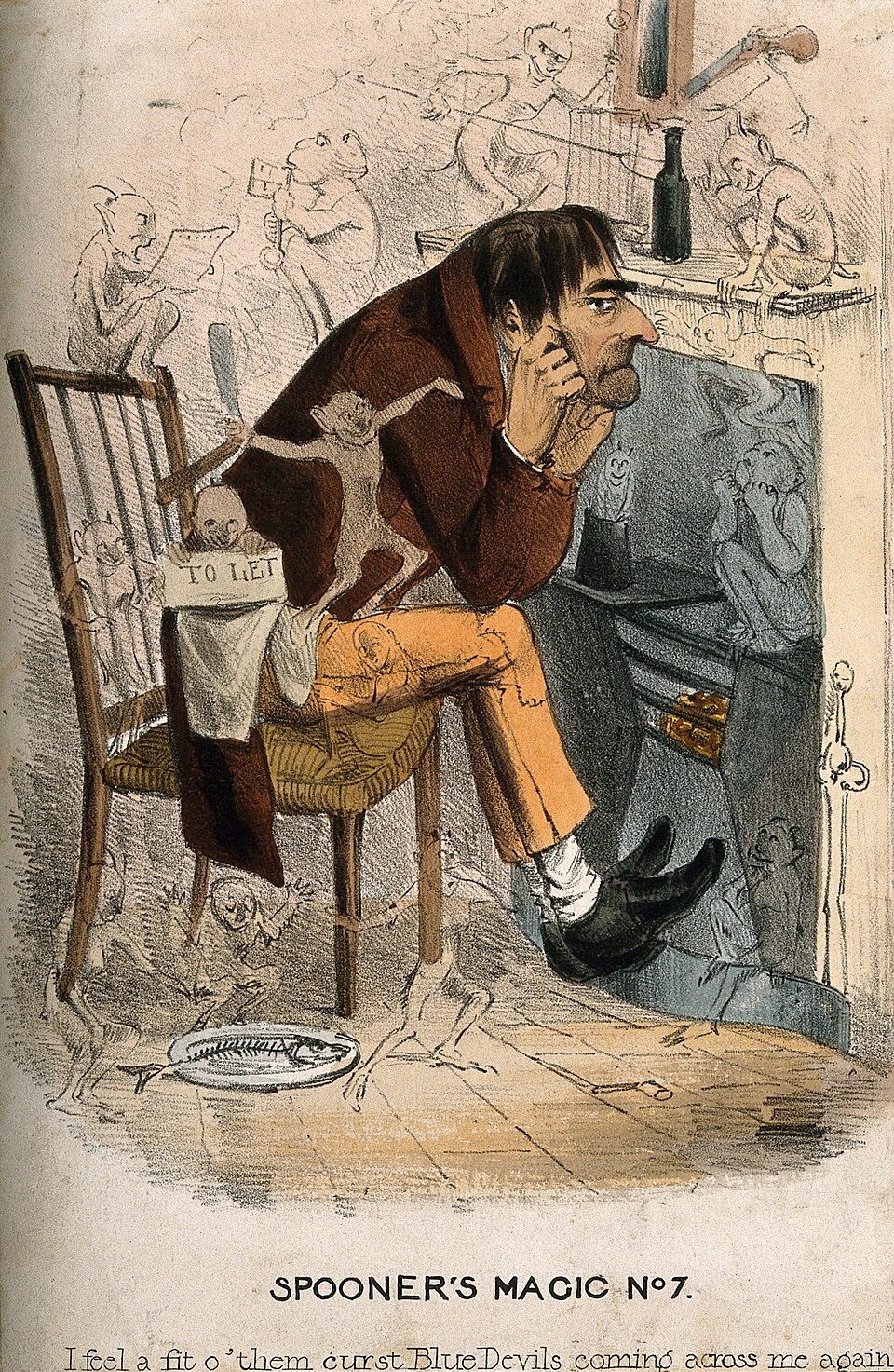
图片题注:Caricature of a man with depression
图片来源:[London?] : [W. Spooner], [between 1830 and 1839?]
临床评估可以由家庭医生、精神科医生或临床心理学家作出。临床评估需要记录病人的当前状况、病史和症状,还要记录家庭病史以了解病人家庭成员是否有过情感障碍,并且讨论病人是否有酒精或药物滥用。临床评估也包括了精神状态评估(用来评估病人的情绪和思想,特别是病人是否绝望或悲观主义,是否有自残或自杀倾向,是否缺乏积极的想法或计划)[109]。在农村地区,专业的心理健康服务十分缺乏,诊断和控制病情主要依赖于基层医生[110]。这种现象在发展中国家更加严重[111]。单一评定量表的评分不能用来确诊抑郁症,但是它的确提供了关于一段时间内症状严重程度的指标,所以对于评分高于某一定点的人可以更多地考虑确诊为抑郁症。有几种评定量表被用于这个目的[112]。尽管有人提倡对抑郁症进行广泛筛查,但是有证据表明广泛筛查并不能提高检出率也不能改善治疗效果或结果[113]。
初级保健医生和其他非精神科医生往往对诊断抑郁症力不从心。非精神科医生漏诊三分之二的病人,并且治疗其他不需要治疗的病人[114]。
Primary-care physicians have more difficulty with underrecognition and undertreatment of depression compared to psychiatrists. These cases may be missed because for some people with depression, physical symptoms often accompany depression. In addition, there may also be barriers related to the person, provider, or the medical system. Non-psychiatrist physicians have been shown to miss about two-thirds of cases, although there is some evidence of improvement in the number of missed cases.[118]
【参考译文】与精神科医生相比,基层医生在抑郁症的识别不足和治疗不足方面面临更多困难。这些病例可能会被漏诊,因为对部分抑郁症患者而言,身体症状往往会伴随着抑郁情绪一同出现。此外,还可能存在来自患者、医生或医疗体系方面的障碍。非精神科医生大约会漏诊三分之二的病例,尽管有一些证据表明漏诊率有所改善[118]。
在开始诊断重度抑郁症之前,医生通常会对患者进行一次体检和一些特定的检查来排除其他造成相似症状的疾病。这些检查包括血液检测:检查促甲状腺激素和甲状腺素来排除甲状腺机能减退;检查基本电解质和血钙来排除代谢紊乱,做一次全血细胞计数包括红细胞沉降率来排除系统性感染或慢性疾病[115],同时也要排除药物或者其他物质滥用的因素,另外还需要检查睾酮水平以诊断性腺功能低下症,这种疾病会引起男性抑郁[116]。
老年患者可能会主观描述认知方面的问题,但是这也可能是痴呆(例如阿兹海默病)发作的先兆[117]。抑郁是常见的痴呆初期症状[118]。认知测试和脑部成像可以把痴呆从抑郁症中鉴别开来[119]。对于精神病性的,快速发病的或者有罕见症状的,需要CT扫描以排除大脑病变[120]。但没有生物学测试可以直接确诊重度抑郁症[121]。除非有医学上的迹象,否则在以后的复发周期中不再进行详细检查。
4.2 DSM-IV-TR和ICD-10诊断标准 | DSM and ICD criteria
The most widely used criteria for diagnosing depressive conditions are found in the American Psychiatric Association‘s Diagnostic and Statistical Manual of Mental Disorders (DSM) and the World Health Organization‘s International Statistical Classification of Diseases and Related Health Problems (ICD). The latter system is typically used in European countries, while the former is used in the US and many other non-European nations,[127] and the authors of both have worked towards conforming one with the other.[128] Both DSM and ICD mark out typical (main) depressive symptoms.[129] The most recent edition of the DSM is the Fifth Edition, Text Revision (DSM-5-TR),[130] and the most recent edition of the ICD is the Eleventh Edition (ICD-11).[131]
【参考译文】目前,诊断抑郁症最广泛使用的标准,分别出自美国精神医学学会的《精神障碍诊断与统计手册》(DSM)和世界卫生组织的《国际疾病与相关健康问题统计分类》(ICD)。后者(ICD)通常在欧洲国家使用,而前者(DSM)则主要在美国及许多其他非欧洲国家使用[127]。这两套标准的制定者一直在努力推动两者的相互统一[128]。DSM和ICD都明确列出了典型的(主要)抑郁症状[129]。目前最新版的DSM是第五版修订文本(DSM-5-TR)[130],而最新版的ICD是第十一版(ICD-11)[131]。
Under mood disorders, ICD-11 classifies major depressive disorder as either single episode depressive disorder (where there is no history of depressive episodes, or of mania) or recurrent depressive disorder (where there is a history of prior episodes, with no history of mania).[132] ICD-11 symptoms, present nearly every day for at least two weeks, are a depressed mood or anhedonia, accompanied by other symptoms such as “difficulty concentrating, feelings of worthlessness or excessive or inappropriate guilt, hopelessness, recurrent thoughts of death or suicide, changes in appetite or sleep, psychomotor agitation or retardation, and reduced energy or fatigue.”[132]
【参考译文】在“心境障碍”(Mood disorders)的分类下,ICD-11 将重度抑郁障碍分为“单次发作性抑郁障碍”(即没有抑郁发作史,也没有躁狂史),或者是“复发性抑郁障碍”(即有既往发作史,且没有躁狂史)[132]。ICD-11 的症状标准要求这些症状在至少两周内几乎每天都会出现,主要表现为情绪低落或快感缺失(anhedonia),并伴随其他症状,例如“注意力难以集中、感到自己毫无价值或产生过度或不恰当的内疚感、绝望、反复出现死亡或自杀的念头、食欲或睡眠改变、精神运动性激越或迟滞,以及精力减退或感到疲劳”[132]。
These symptoms must affect work, social, or domestic activities. The ICD-11 system allows further specifiers for the current depressive episode: the severity (mild, moderate, severe, unspecified); the presence of psychotic symptoms (with or without psychotic symptoms); and the degree of remission if relevant (currently in partial remission, currently in full remission).[132] These two disorders are classified as “Depressive disorders”, in the category of “Mood disorders”.[132]
【参考译文】这些症状必须对患者的工作、社交或家庭生活造成影响。ICD-11 系统允许对当前的抑郁发作进行更细致的分类说明:包括严重程度(轻度、中度、重度、未特定);是否存在精神病性症状(伴或不伴精神病性症状);以及如果相关的话,缓解的程度(目前处于部分缓解期、目前处于完全缓解期)[132]。这两种障碍都被归类在“心境障碍”这一大类下的“抑郁障碍”中[132]。
According to DSM-5, at least one of the symptoms is either depressed mood or loss of interest or pleasure. Depressed mood occurs nearly every day as subjective feelings like sadness, emptiness, and hopelessness or observations made by others (e.g. appears tearful). Loss of interest or pleasure occurs in all, or almost all activities of the day, nearly every day. These symptoms, as well as five out of the nine more specific symptoms listed, must frequently occur for more than two weeks (to the extent in which it impairs functioning) for the diagnosis.[133] Major depressive disorder is classified as a mood disorder in the DSM-5.[134] The diagnosis hinges on the presence of single or recurrent major depressive episodes.[135] Further qualifiers are used to classify both the episode itself and the course of the disorder. The category Unspecified Depressive Disorder is diagnosed if the depressive episode’s manifestation does not meet the criteria for a major depressive episode.[134]
【参考译文】根据 DSM-5 的标准,(确诊的)症状中必须至少包含情绪低落或丧失兴趣或乐趣中的其中一项。情绪低落几乎每天都会出现,表现为悲伤、空虚、绝望等主观感受,或者由他人观察到的表现(例如看起来经常流泪)。丧失兴趣或乐趣则表现为几乎每天、在一天中几乎所有活动里都提不起劲。为了做出诊断,这些症状以及下面列出的九项更具体的症状中的五项,必须频繁出现超过两周(且严重程度达到了影响正常功能的程度)[133]。在 DSM-5 中,重度抑郁障碍被归类为一种心境障碍[134]。该诊断的核心在于是否存在单次或反复的“重度抑郁发作”[135]。此外,还会使用进一步的限定词来对发作本身以及病程进行分类。如果抑郁发作的表现没有完全达到重度抑郁发作的标准,则会被诊断为“未特定的抑郁障碍”[134]。
4.2.1 重度抑郁发作 | Major depressive episode
Main article: Major depressive episode【主条目:重度抑郁发作】
A major depressive episode is characterized by the presence of a severely depressed mood that persists for at least two weeks.[35] Episodes may be isolated or recurrent and are categorized as mild (few symptoms in excess of minimum criteria), moderate, or severe (marked impact on social or occupational functioning). An episode with psychotic features—commonly referred to as psychotic depression—is automatically rated as severe.[134] If the person has had an episode of mania or markedly elevated mood, a diagnosis of bipolar disorder is made instead. Depression without mania is sometimes referred to as unipolar because the mood remains at one emotional state or “pole”.[136]
【参考译文】重度抑郁发作的特征是存在持续至少两周的严重抑郁情绪[35]。这种发作可能是孤立的,也可能是反复出现的,并被分为轻度(超出最低标准的症状较少)、中度或重度(对社交或职业功能有显著影响)。如果发作伴有精神病性特征(通常被称为“精神病性抑郁症”),则会自动被评定为重度[134]。如果一个人曾经有过躁狂发作或情绪显著高涨的经历,则会被诊断为双相情感障碍。没有躁狂症状的抑郁症有时被称为“单相抑郁”,因为其情绪始终停留在一种情绪状态或“单极”上[136]。
Bereavement is not an exclusion criterion in the DSM-5, and it is up to the clinician to distinguish between normal reactions to a loss and MDD. Excluded are a range of related diagnoses, including dysthymia, which involves a chronic but milder mood disturbance;[137] recurrent brief depression, consisting of briefer depressive episodes;[138][139] minor depressive disorder, whereby only some symptoms of major depression are present;[140] and adjustment disorder with depressed mood, which denotes low mood resulting from a psychological response to an identifiable event or stressor.[141]
【参考译文】在 DSM-5 中,丧亲(即亲人离世带来的悲伤)不再是排除标准,因此由临床医生来区分正常的丧亲反应与重度抑郁症(MDD)。此外,还排除了一系列相关的诊断,包括:恶劣心境(dysthymia),表现为一种慢性但程度较轻的情绪障碍[137];复发性短暂抑郁障碍(recurrent brief depression),由更短暂的抑郁发作组成[138][139];轻度抑郁障碍(minor depressive disorder),即仅表现出部分重度抑郁的症状[140];以及伴有抑郁心境的适应障碍(adjustment disorder with depressed mood),指的是由可识别的事件或压力源引发的心理反应所导致的低落情绪[141]。
4.2.2 亚型 | Subtypes
The DSM-5 recognizes six further subtypes of MDD, called specifiers, in addition to noting the length, severity and presence of psychotic features:
【参考译文】除了注明病程长短、严重程度以及是否存在精神病性特征外,DSM-5 还承认重度抑郁症(MDD)有以下六种进一步的亚型,称为“特定标注”:
- “Melancholic depression” is characterized by a loss of pleasure in most or all activities, a failure of reactivity to pleasurable stimuli, a quality of depressed mood more pronounced than that of grief or loss, a worsening of symptoms in the morning hours, early-morning waking, psychomotor retardation, excessive weight loss (not to be confused with anorexia nervosa), or excessive guilt.[142]
【参考译文】“忧郁型抑郁症”(Melancholic depression):其特征是几乎在所有活动中都丧失乐趣,对令人愉悦的刺激缺乏反应(即即使发生好事也高兴不起来),抑郁情绪的性质比一般的悲伤或失落感更为严重,症状在早晨会加重,清晨早醒,精神运动性迟滞,体重显著下降(需与神经性厌食症区分),或产生过度的内疚感[142]。 - “Atypical depression” is characterized by mood reactivity (paradoxical anhedonia) and positivity, significant weight gain or increased appetite (comfort eating), excessive sleep or sleepiness (hypersomnia), a sensation of heaviness in limbs known as leaden paralysis, and significant long-term social impairment as a consequence of hypersensitivity to perceived interpersonal rejection.[143]
【参考译文】“非典型抑郁症”(Atypical depression):其特征是心境具有反应性(即遇到好事心情会暂时好转,这被称为矛盾性快感缺失)并表现出积极性,体重显著增加或食欲大增(情绪化进食),睡眠过多或嗜睡,肢体有沉重感(被称为“灌铅样麻痹”),以及由于对感知到的人际拒绝过度敏感,导致长期且显著的社会功能受损[143]。 - “Catatonic depression” is a rare and severe form of major depression involving disturbances of motor behavior and other symptoms. Here, the person is mute and almost stuporous, and either remains immobile or exhibits purposeless or even bizarre movements. Catatonic symptoms also occur in schizophrenia or in manic episodes, or may be caused by neuroleptic malignant syndrome.[144]
【参考译文】“紧张型抑郁症”(Catatonic depression):这是一种罕见且严重的重度抑郁症形式,涉及运动行为和一系列其他症状的紊乱。在这种情况下,患者会保持缄默且几乎处于木僵状态,要么一动不动,要么表现出无目的甚至怪异的运动。紧张症症状也可能出现在精神分裂症或躁狂发作中,或者可能是由抗精神病药恶性综合征引起的[144]。 - “Depression with anxious distress” was added into the DSM-5 as a means to emphasize the common co-occurrence between depression and anxiety, as well as the risk of suicide of depressed individuals with anxiety.[145]
【参考译文】“伴焦虑痛苦的抑郁症”(Depression with anxious distress):这一亚型被加入 DSM-5 是为了强调抑郁症与焦虑症之间常见的共病现象,以及伴有焦虑的抑郁症患者所面临的自杀风险[145]。 - “Depression with peri-partum onset” refers to the intense, sustained and sometimes disabling depression experienced by women after giving birth or while a woman is pregnant. DSM-IV-TR used the classification “postpartum depression”, but this was changed not to exclude cases of depressed women during pregnancy. Depression with peripartum onset has an incidence rate of 3%–6% among new mothers. The DSM-5 mandates that to qualify as depression with peripartum onset, onset occurs during pregnancy or within one month of delivery.[146]
【参考译文】“伴围产期发作的抑郁症”(Depression with peri-partum onset):指的是女性在分娩后或怀孕期间所经历的强烈、持续且有时令人极度衰弱的抑郁状态。DSM-IV-TR 曾使用“产后抑郁症”这一分类,但后来进行了更改,以便将怀孕期间情绪低落的案例也纳入其中。伴围产期发作的抑郁症在初产妇中的发生率约为 3%–6%。DSM-5 规定,要符合伴围产期发作的抑郁症标准,其发作必须发生在怀孕期间或分娩后的一个月内[146]。 - “Seasonal affective disorder” (SAD) is a form of depression in which depressive episodes come on in the autumn or winter, and resolve in spring. The diagnosis is made if at least two episodes have occurred in colder months with none at other times, over a two-year period or longer.[147]
【参考译文】“季节性情感障碍”(Seasonal affective disorder, SAD):这是一种抑郁症形式,其抑郁发作在秋季或冬季出现,并在春季消退。如果在过去两年或更长时间内,寒冷月份至少发生过两次发作,而在其他时间没有发生过,即可做出此诊断[147]。
4.3 鉴别诊断 | Differential diagnoses
Main article: Differential diagnoses of depression【主条目:抑郁症的鉴别诊断】
To confirm major depressive disorder as the most likely diagnosis, other potential diagnoses must be considered, including dysthymia, adjustment disorder with depressed mood, or bipolar disorder. Dysthymia is a chronic, milder mood disturbance in which a person reports a low mood almost daily over a span of at least two years. The symptoms are not as severe as those for major depression, although people with dysthymia are vulnerable to secondary episodes of major depression (sometimes referred to as double depression).[137] Adjustment disorder with depressed mood is a mood disturbance appearing as a psychological response to an identifiable event or stressor, in which the resulting emotional or behavioral symptoms are significant but do not meet the criteria for a major depressive episode.[141]
【参考译文】为了确诊重度抑郁症是最可能的诊断,必须考虑并排除其他可能的诊断,包括恶劣心境、伴有抑郁心境的适应障碍,或双相情感障碍。恶劣心境是一种慢性、程度较轻的心境障碍,患者在至少两年的时间里几乎每天都会感到情绪低落。其症状没有重度抑郁症那么严重,不过恶劣心境患者很容易继发重度抑郁发作(有时被称为“双重抑郁”)[137]。伴有抑郁心境的适应障碍是一种心境紊乱,表现为对某种可识别的事件或压力源产生的心理反应,其引发的情绪或行为症状虽然显著,但并未达到重度抑郁发作的诊断标准[141]。
Other disorders need to be ruled out before diagnosing major depressive disorder. They include depressions due to physical illness, medications, and substance use disorders. Depression due to physical illness is diagnosed as a mood disorder due to a general medical condition. This condition is determined based on history, laboratory findings, or physical examination. When the depression is caused by a medication, non-medical use of a psychoactive substance, or exposure to a toxin, it is then diagnosed as a specific mood disorder (previously called substance-induced mood disorder).[148]
【参考译文】在确诊重度抑郁症之前,还需要排除其他疾病。这些疾病包括由躯体疾病、药物以及物质使用障碍引起的抑郁。由躯体疾病引起的抑郁被诊断为“由一般医学状况所致的心境障碍”。这种状况是根据病史、实验室检查结果或体格检查来确定的。当抑郁是由药物、精神活性物质的非医疗用途或接触毒素引起时,则被诊断为特定的心境障碍(以前称为“物质所致的心境障碍”)[148]。
5. 筛查与预防 | Screening and prevention
Preventive efforts may result in decreases in rates of the condition of between 22% and 38%.[149] Since 2016, the United States Preventive Services Task Force (USPSTF) has recommended screening for depression among those over the age of 12, provided that it would be diagnosed accurately, treated efficiently, and followed-up as needed;[150][151][152] though a 2005 Cochrane review found that the routine use of screening questionnaires has little effect on detection or treatment.[153] Screening the general population is not recommended by authorities in the UK or Canada for similar reasons, citing insufficient data.[154][152]
【参考译文】预防性的努力可能会使该病症的发生率降低 22% 到 38%[149]。自 2016 年起,美国预防服务工作组(USPSTF)建议对 12 岁以上的人群进行抑郁症筛查,前提是必须能够做出准确的诊断、进行有效的治疗,并在必要时进行后续跟进[150][151][152];不过,2005 年的一项科克伦(Cochrane)综述发现,常规使用筛查问卷对抑郁症的发现或治疗并没有太大影响[153]。出于类似的原因(援引数据不足),英国或加拿大的权威机构并不推荐对普通人群进行常规筛查[154][152]。
Behavioral interventions, such as interpersonal therapy and cognitive behavioral therapy, are effective at preventing new-onset depression.[149][155][156] Because such interventions appear to be most effective when delivered to individuals or small groups, it has been suggested that they may be able to reach their large target audience most efficiently through the Internet.[157]
【参考译文】行为干预措施,例如人际心理治疗和认知行为疗法,在预防新发抑郁症方面是有效的[149][155][156]。由于这类干预措施在针对个人或小团体进行时似乎效果最佳,因此有人提出,通过互联网可能能够最有效地覆盖其庞大的目标受众[157]。
The Netherlands’s mental health care system provides preventive interventions, such as the “Coping with Depression” course (CWD) for people with sub-threshold depression. The course is claimed to be the most successful of psychoeducational interventions for the treatment and prevention of depression (both for its adaptability to various populations and its results), with a risk reduction of 38% in major depression and an efficacy as a treatment comparing favorably to other psychotherapies.[155][158]
【参考译文】荷兰的心理健康护理体系提供预防性干预措施,例如针对阈下抑郁(sub-threshold depression,指症状未达到完整抑郁症诊断标准)人群的“应对抑郁”课程(CWD)。据称,该课程是治疗和预防抑郁症的心理教育干预中最成功的(无论是对不同人群的适应性还是其效果),它能将重度抑郁症的发生风险降低 38%,且作为治疗手段,其疗效优于其他心理疗法[155][158]。
6. 管理与治疗 | Management
Main article: Management of depression【主条目:抑郁症的管理】
The most common and effective treatments for depression are psychotherapy, medication, and electroconvulsive therapy (ECT); a combination of treatments is the most effective approach when depression is resistant to treatment.[159] American Psychiatric Association treatment guidelines recommend that initial treatment should be individually tailored based on factors including severity of symptoms, co-existing disorders, prior treatment experience, and personal preference. Options may include pharmacotherapy, psychotherapy, exercise, ECT, transcranial magnetic stimulation (TMS) or light therapy. Antidepressant medication is recommended as an initial treatment choice in people with mild, moderate, or severe major depression, and is often given to people with severe depression unless ECT is planned.[160] There is evidence that collaborative care by a team of health care practitioners produces better results than routine single-practitioner care.[161]
【参考译文】抑郁症最常见且有效的治疗方法包括心理治疗、药物治疗以及电休克疗法(ECT);对于难治性抑郁症(即对常规治疗反应不佳的抑郁症),综合性的治疗方案效果最佳[159]。美国精神医学学会的治疗指南建议,初始治疗方案应根据症状的严重程度、共病情况(即同时存在的其他疾病)、既往治疗经历以及个人偏好等因素进行个性化定制。可选的方案包括药物治疗、心理治疗、运动、电休克疗法(ECT)、经颅磁刺激(TMS)或光照疗法。对于轻度、中度或重度重度抑郁症患者,推荐使用抗抑郁药物作为初始治疗选择;除非计划进行电休克疗法,否则抗抑郁药通常也会用于重度抑郁症患者[160]。有证据表明,由多名医疗从业者组成的团队协作护理模式,比常规的单人医生诊疗能取得更好的效果[161]。
Psychotherapy is the treatment of choice (over medication) for people under 18;[162] and cognitive behavioral therapy (CBT), third-wave CBT and interpersonal therapy may help prevent depression.[163] The UK National Institute for Health and Care Excellence (NICE) 2004 guidelines indicate that antidepressants should not be used for the initial treatment of mild depression because the risk–benefit ratio is poor. The guidelines recommend that antidepressant treatment in combination with psychosocial interventions should be considered:[162]
【参考译文】对于 18 岁以下的人群,心理治疗是首选疗法(优于药物治疗)[162];此外,认知行为疗法(CBT)、第三浪潮认知行为疗法以及人际心理治疗,都有助于预防抑郁症的发生[163]。英国国家健康与临床卓越研究所(NICE)2004 年的指南指出,抗抑郁药不应作为轻度抑郁症的初始治疗手段,因为其“风险-收益比”并不理想。该指南建议,在以下情况中,应考虑将抗抑郁药物治疗与心理社会干预相结合:[162]
- For people with a history of moderate or severe depression
【参考译文】对于有中度或重度抑郁症病史的人群 - For those with mild depression that has been present for a long period
【参考译文】对于轻度抑郁症但持续时间较长的人群 - As a second-line treatment for mild depression that persists after other interventions
【参考译文】作为轻度抑郁症在其他干预措施后仍持续存在的二线治疗方案 - As a first-line treatment for moderate or severe depression.
【参考译文】作为中度或重度抑郁症的一线治疗方案
The guidelines further note that antidepressant treatment should be continued for at least six months to reduce the risk of relapse, and that SSRIs are better tolerated than tricyclic antidepressants.[164]: 305–450
【参考译文】指南进一步指出,抗抑郁药物治疗应至少持续六个月,以降低复发的风险;此外,选择性5-羟色胺再摄取抑制剂(SSRIs)通常比三环类抗抑郁药(TCAs)更容易被患者耐受[164]: 305–450。
Treatment options are more limited in developing countries, where access to mental health staff, medication, and psychotherapy is often difficult. Development of mental health services is minimal in many countries; depression is viewed as a phenomenon of the developed world despite evidence to the contrary, and not as an inherently life-threatening condition.[165] There is insufficient evidence to determine the effectiveness of psychological versus medical therapy in children.[166]
【参考译文】在发展中国家的治疗选择则更为有限,因为在这些地区,获得心理健康专业人员、药物以及心理治疗的机会往往十分困难。许多国家的心理健康服务发展极为滞后;尽管有证据表明事实并非如此,但抑郁症仍常被视为一种“发达国家才有的现象”,而不是一种本质上可能危及生命的疾病[165]。目前,尚没有足够的证据来判定心理治疗与药物治疗在儿童群体中的疗效孰优孰劣[166]。
6.1 生活方式 | Lifestyle
Further information: Neurobiological effects of physical exercise § Major depressive disorder
【更多信息请参见: 体育锻炼的神经生物学效应 § 重度抑郁症】
Physical exercise has been found to be effective for major depression, and may be recommended to people who are willing, motivated, and healthy enough to participate in an exercise program as treatment.[167][168] It likely reduces depressive symptoms compared with no treatment, with effects roughly similar to psychological therapy and antidepressants, though the overall certainty of evidence is low to moderate and long-term outcomes are uncertain.[169] In older people it also appears to decrease depression.[170] Sleep and diet may also play a role in depression, and interventions in these areas may be an effective add-on to conventional methods.[171] In studies, smoking cessation has benefits in depression.[172]
【参考译文】研究发现,体育锻炼对重度抑郁症是有效的。对于那些有意愿、有动力且身体状况足以参与运动项目的人,可以将其作为一种治疗手段来推荐[167][168]。与完全不进行治疗相比,体育锻炼很可能会减轻抑郁症状。其效果大致与心理治疗和抗抑郁药物相当,不过目前相关证据的整体确定性仅为低至中等,且长期的效果尚不确定[169]。在老年人群体中,运动似乎同样能减轻抑郁[170]。睡眠和饮食也可能在抑郁症中扮演重要角色,针对这些方面的干预措施,可以作为常规治疗手段的有效补充[171]。此外,多项研究表明,戒烟对改善抑郁症状也有益处[172]。
6.2 谈话疗法 | Talking therapies
Main article: Psychotherapy【主条目:心理治疗】
See also: Behavioral theories of depression【另见:抑郁症的行为理论】
心理治疗可以对个人或者一组人实施。它可以由心理治疗师、精神科医生、心理学家、门诊社工、咨询师和精神科护士来实施。对于更复杂的和慢性的抑郁症,可能需要使用药物和心理的联合疗法[153]。对于儿童和18岁以下青少年,只有在结合心理治疗(例如认知行为疗法,人际关系疗法或家庭疗法)的情况下才能给予药物治疗[154]。心理治疗对老年患者有效[155][156]。成功的心理治疗不但可以减少抑郁症的复发,并且在治疗终止或者换成偶尔一次的辅助咨询之后仍然能维持效果[156]
The most-studied form of psychotherapy for depression is CBT, which teaches clients to challenge self-defeating, but enduring, ways of thinking (cognitions) and change counter-productive behaviors. CBT can perform as well as antidepressants in people with major depression.[179] CBT has the most research evidence for the treatment of depression in children and adolescents, and CBT and interpersonal psychotherapy (IPT) are preferred therapies for adolescent depression.[180] In people under 18, according to the National Institute for Health and Clinical Excellence, medication should be offered only in conjunction with a psychological therapy, such as CBT, interpersonal therapy, or family therapy.[181]
【参考译文】针对抑郁症,被研究得最广泛的心理治疗形式是认知行为疗法(CBT)。它教导来访者去挑战那些自我挫败但又根深蒂固的思维模式(即认知),并改变那些适得其反的行为。对于重度抑郁症患者,CBT的疗效可以与抗抑郁药物相媲美[179]。在治疗儿童和青少年抑郁症方面,CBT拥有最充分的科研证据支持;同时,CBT和人际心理治疗(IPT)也是治疗青少年抑郁症的首选疗法[180]。根据英国国家健康与临床卓越研究所(NICE)的建议,对于18岁以下的未成年人,药物治疗只有在配合心理治疗(如CBT、人际心理治疗或家庭治疗)的情况下才可以提供[181]。
Several variables predict success for cognitive behavioral therapy in adolescents: higher levels of rational thoughts, less hopelessness, fewer negative thoughts, and fewer cognitive distortions.[182] CBT is particularly beneficial in preventing relapse.[183][184] Cognitive behavioral therapy and occupational programs (including modification of work activities and assistance) have been shown to be effective in reducing sick days taken by workers with depression.[185] Several variants of cognitive behavior therapy have been used in those with depression, the most notable being rational emotive behavior therapy,[186] and mindfulness-based cognitive therapy.[187] Mindfulness-based stress reduction programs may reduce depression symptoms.[188][189] Mindfulness programs also appear to be a promising intervention in youth.[190] Problem solving therapy, cognitive behavioral therapy, and interpersonal therapy are effective interventions in the elderly.[191]
【参考译文】对于青少年来说,有几个因素可以预测认知行为疗法(CBT)能否取得成功:更高的理性思维水平、更少的绝望感、更少的负面想法,以及更少的认知扭曲[182]。CBT在预防抑郁症复发方面尤为有益[183][184]。此外,认知行为疗法和职业康复项目(包括调整工作活动和提供协助)已被证明能有效减少抑郁症患者请病假的天数[185]。针对抑郁症患者,临床上已经应用了多种CBT的变体疗法,其中最著名的是理性情绪行为疗法[186]和正念认知疗法[187]。正念减压课程也有助于减轻抑郁症状[188][189]。正念类项目在青少年群体中,也显示出成为一种有前景的干预手段的潜力[190]。而在老年人群体中,解决问题疗法、认知行为疗法以及人际心理治疗,都被证实是有效的干预措施[191]。
人际关系疗法专注于可能造成抑郁症的社会和人际关系因素。这项治疗由几次(通常是12次)每周一次的结构化的咨询组成,这些治疗专注于人际关系。这项治疗可以培养社交能力以使得患者更易与人沟通,进而减少压力[166]。
Psychoanalysis is a school of thought, founded by Sigmund Freud, which emphasizes the resolution of unconscious mental conflicts.[192] Psychoanalytic techniques are used by some practitioners to treat clients presenting with major depression.[193] A more widely practiced therapy, called psychodynamic psychotherapy, is in the tradition of psychoanalysis but less intensive, meeting once or twice a week. It also tends to focus more on the person’s immediate problems, and has an additional social and interpersonal focus.[193] In a meta-analysis of three controlled trials of Short Psychodynamic Supportive Psychotherapy, this modification was found to be as effective as medication for mild to moderate depression.[194]
【参考译文】精神分析是由西格蒙德·弗洛伊德创立的一个思想流派,它强调通过解决潜意识中的心理冲突来治疗心理问题[192]。一些从业者会使用精神分析技术来治疗患有重度抑郁症的来访者[193]。而另一种更为广泛实践、被称为“心理动力学心理治疗”的疗法,则沿袭了精神分析的传统,但强度较低,通常每周会面一到两次。这种疗法也更侧重于关注来访者当前面临的实际问题,并且额外关注其社会与人际关系方面[193]。在一项针对“短程心理动力学支持性心理治疗”的三项对照试验的荟萃分析中,发现这种改良后的疗法在治疗轻度至中度抑郁症时,其疗效与药物治疗相当[194]。
存在主义分析疗法是一种由奥地利精神病学家维克多·弗兰克发展的存在主义心理学的治疗形式。这种疗法强调纠正患者的“存在虚无”,这种“存在虚无”与无用和无意义的感觉有关。这种心理疗法可能对青少年患者尤其有用[171]。
6.2.1 远程医疗 | Telehealth
Main article: Telehealth【主条目:远程医疗】
Further information: Telepsychiatry【更多信息请参见:远程精神病学】
The remote provision of psychotherapy, through media such as telephone and video,[195] can make treatment for depression more available and accessible.[196] The administration of treatments, such as CBT,[196] via telehealth may provide a viable alternative to face-to-face care.[195][196]
【参考译文】通过电话或视频等媒介提供远程心理治疗,可以让抑郁症的治疗变得更加触手可及、也更容易获得[195][196]。通过远程医疗来实施CBT(认知行为疗法)等治疗,或许能成为传统面对面治疗的一种切实可行的替代方案[195][196]。
6.3 抗抑郁药 | Antidepressants
Main article: Antidepressant【主条目:抗抑郁药】
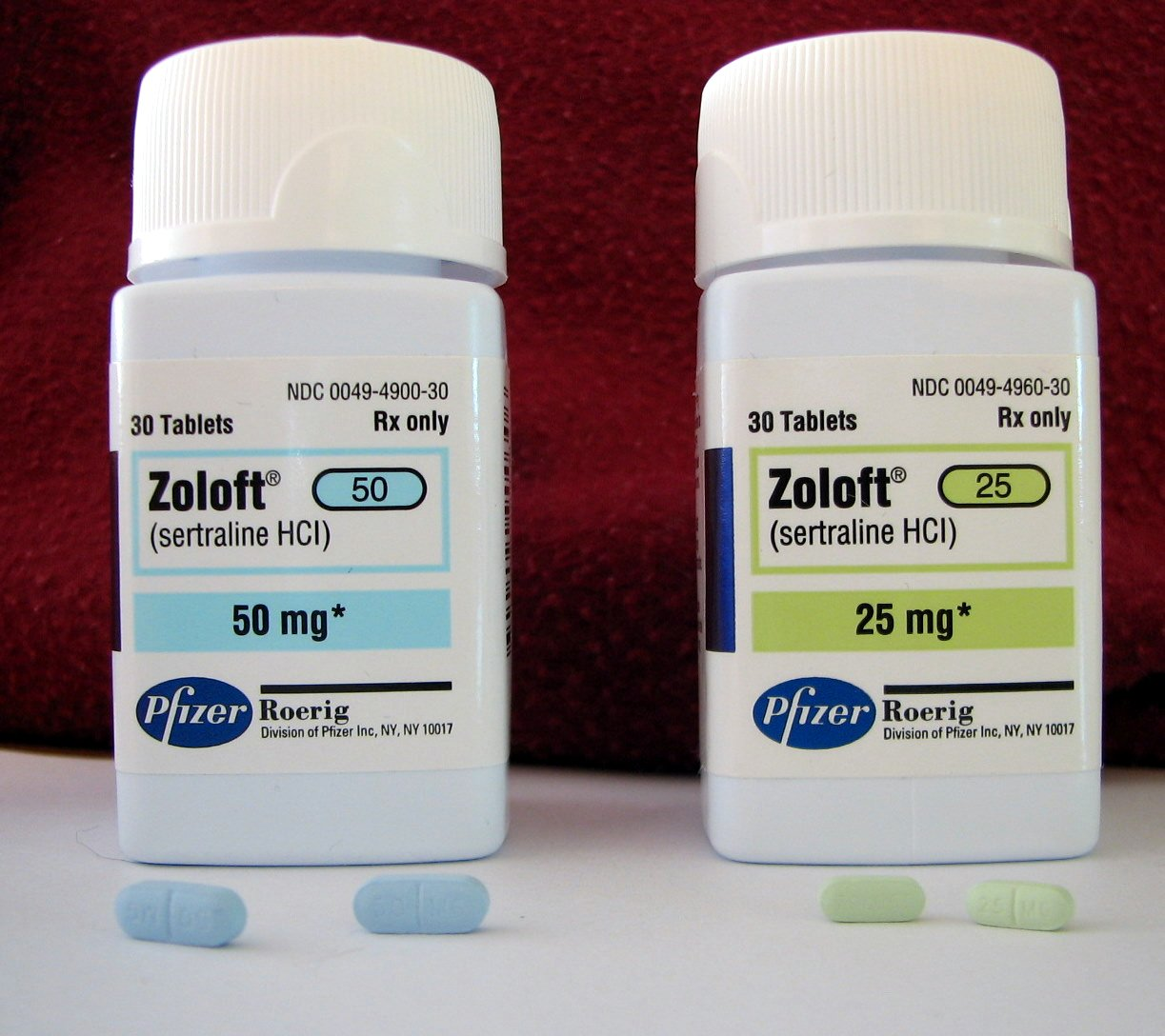
图片题注:Sertraline (Zoloft) is used primarily to treat major depression in adults.
参考译文:舍曲林(Zoloft,商品名“左洛复”)主要用于治疗成人的重度抑郁症。
图片来源:Ragesoss
Conflicting results have arisen from studies that look at the effectiveness of antidepressants in people with acute, mild to moderate depression.[197] A review commissioned by the National Institute for Health and Care Excellence (UK) concluded that there is strong evidence that SSRIs, such as escitalopram, paroxetine, and sertraline, have greater efficacy than placebo on achieving a 50% reduction in depression scores in moderate and severe major depression, and that there is some evidence for a similar effect in mild depression.[198] Similarly, a Cochrane systematic review of clinical trials of amitriptyline, a generic tricyclic antidepressant, concluded that there is strong evidence that its efficacy is superior to placebo.[199] Antidepressants work less well for the elderly than for younger individuals with depression.[191]
【参考译文】关于抗抑郁药在治疗急性、轻度至中度抑郁症患者时的有效性,目前的研究得出了相互矛盾的结论[197]。英国国家健康与临床卓越研究所(NICE)委托进行的一项综述总结指出,有强有力的证据表明,SSRIs类药物(如艾司西酞普兰、帕罗西汀和舍曲林)在治疗中度和重度抑郁症时,其疗效明显优于安慰剂,能够帮助患者在抑郁评分上实现50%的降幅;同时,也有一些证据显示,这类药物对轻度抑郁症同样有效[198]。同样,Cochrane协作网对三环类抗抑郁药(一种常见的仿制药)阿米替林进行的临床试验系统综述也得出结论,有强有力的证据表明其疗效优于安慰剂[199]。不过,抗抑郁药在老年人群体中的效果,不如在年轻抑郁症患者中那么理想[191]。
To find the most effective antidepressant medication with minimal side-effects, the dosages can be adjusted, and if necessary, combinations of different classes of antidepressants can be tried. Response rates to the first antidepressant administered range from 50% to 75%, and it can take at least six to eight weeks from the start of medication to improvement.[160][200] Antidepressant medication treatment is usually continued for six to nine months after remission, to minimize the chance of recurrence, and even up to two years of continuation is recommended.[164]: 305–450
【参考译文】为了找到疗效最好且副作用最小的抗抑郁药物,医生可以调整剂量,如果有必要,还可以尝试联合使用不同种类的抗抑郁药。对第一种抗抑郁药产生有效反应的比例在50%到75%之间,而且从开始服药到症状出现改善,通常需要至少六到八周的时间[160][200]。抗抑郁药物治疗通常需要在病情缓解(即症状基本消失)后继续维持六到九个月,以最大程度降低复发的几率,甚至建议维持治疗长达两年[164]: 305–450。
SSRIs are the primary medications prescribed, owing to their relatively mild side-effects, and safety.[201] People who do not respond to one SSRI can be switched to another antidepressant, and this results in improvement in almost 50% of cases.[202] Another option is to augment the atypical antidepressant bupropion to the SSRI as an adjunctive treatment.[203] Venlafaxine, an antidepressant with a different mechanism of action, may be modestly more effective than SSRIs.[204] However, venlafaxine is not recommended in the UK as a first-line treatment because of evidence suggesting its risks may outweigh benefits,[205] and it is specifically discouraged in children and adolescents as it increases the risk of suicidal thoughts or attempts.[206][207][208][209][210][211][212]
【参考译文】SSRIs(选择性5-羟色胺再摄取抑制剂)是目前主要处方的药物,这主要是因为它们的副作用相对较轻,且安全性较高[201]。如果对某一种SSRI没有反应,可以换成另一种抗抑郁药,这种换药策略在将近50%的病例中都能带来改善[202]。另一种选择是在SSRI的基础上,联合使用非典型抗抑郁药安非他酮(bupropion)作为辅助治疗[203]。文拉法辛(venlafaxine)是一种作用机制不同的抗抑郁药,其疗效可能比SSRIs略胜一筹[204]。不过,在英国,文拉法辛并不被推荐作为一线治疗药物,因为有证据表明它的风险可能超过收益[205];同时,由于它会增加产生自杀念头或自杀企图的风险,因此特别不建议将其用于儿童和青少年群体[206-212]。
Hypericum perforatum (St. John’s wort) has approval in the European Union as an herbal product for the treatment of mild to moderate depressive episodes (according to ICD-10) and for the short-term treatment of symptoms in mild depression.[213] It is more effective than placebo and as effective as standard antidepressants, including SSRIs, for mild to moderate depression, with some evidence suggesting fewer adverse effects and lower discontinuation rates.[214][215][216][217]
【参考译文】贯叶连翘(Hypericum perforatum,即圣约翰草)在欧盟已获批作为一种草本产品,用于治疗轻度至中度的抑郁发作(根据ICD-10标准)以及短期缓解轻度抑郁的症状[213]。在治疗轻度至中度抑郁症方面,它的疗效优于安慰剂,且与包括SSRIs在内的标准抗抑郁药相当;同时,一些证据表明,它的不良反应更少,停药率也更低[214-217]。
Electroconvulsive therapy, ketamine and esketamine, rTMS, and certain adjunctive agents are effective for treatment-resistant depression.[218][219][220]
【参考译文】电休克疗法(ECT)、氯胺酮(ketamine)和艾氯胺酮(esketamine)、重复经颅磁刺激(rTMS),以及某些辅助药物,对于治疗难治性抑郁症都是有效的[218][219][220]。
A nasal spray form of esketamine was approved in the US by the FDA in March 2019 for use in treatment-resistant depression when combined with an oral antidepressant.[221] It was approved as monotherapy for treatment-resistant depression in adults in January 2025.[222] Ketamine and esketamine offer rapid-acting, non-monoaminergic treatment options for adults with treatment-resistant depression, but questions remain about their safety, optimal use, and implementation in clinical practice.[223] Racemic ketamine, especially at higher doses, may have greater and more sustained antidepressant effects than esketamine.[224]
【参考译文】用于抑郁症的致幻剂辅助疗法,其疗效可能并不比公开标签(即医患双方都知道具体用药)的传统抗抑郁药更出色;但与抗抑郁药不同的是,它的最终疗效似乎不会受到“盲法”(即患者不知道自己吃的是药还是安慰剂)的影响[225]。2023年,澳大利亚批准了裸盖菇素(Psilocybin)用于治疗难治性抑郁症[226][227]。裸盖菇素辅助疗法能产生显著的抗抑郁效果,其缓解率高于对比药物,且患者的接受度相当[228]。
Psychedelic-assisted therapy for depression may be no more effective than open-label traditional antidepressants, and unlike antidepressants, its outcomes may be unaffected by blinding.[225] Psilocybin was approved for treatment-resistant depression in Australia in 2023.[226][227] Psilocybin-assisted therapy produces robust antidepressant effects with higher remission rates than comparators and comparable acceptability.[228]
【参考译文】用于抑郁症的致幻剂辅助疗法,其疗效可能并不比公开标签(即医患双方都知道具体用药)的传统抗抑郁药更出色;但与抗抑郁药不同的是,它的最终疗效似乎不会受到“盲法”(即患者不知道自己吃的是药还是安慰剂)的影响[225]。2023年,澳大利亚批准了裸盖菇素(Psilocybin)用于治疗难治性抑郁症[226][227]。裸盖菇素辅助疗法能产生显著的抗抑郁效果,其缓解率高于对比药物,且患者的接受度相当[228]。
For children and adolescents with moderate-to-severe depressive disorder, fluoxetine seems to be the best treatment (either with or without cognitive behavioural therapy) but more research is needed to be certain.[229][207][230][208] Sertraline, escitalopram, duloxetine might also help in reducing symptoms.[231] Some antidepressants have not been shown to be effective.[232][207] Medications are not recommended in children with mild disease.[231]
【参考译文】对于患有中重度抑郁症的儿童和青少年,氟西汀(fluoxetine)似乎是目前最好的治疗选择(无论是单独使用还是配合认知行为疗法),不过仍需更多的研究来进一步确认[229][207][230][208]。舍曲林(sertraline)、艾司西酞普兰(escitalopram)、度洛西汀(duloxetine)也可能有助于减轻症状[231]。但也有一些抗抑郁药被证实并没有效果[232][207]。对于轻度抑郁的儿童,并不建议使用药物治疗[231]。
There is also insufficient evidence to determine effectiveness in those with depression complicated by dementia.[233] Any antidepressant can cause low blood sodium levels;[234] nevertheless, it has been reported more often with SSRIs.[235] It is not uncommon for SSRIs to cause or worsen insomnia; the sedating atypical antidepressant mirtazapine can be used in such cases.[236][235]
【参考译文】目前,对于抑郁症合并痴呆症的患者,也缺乏足够的证据来确定抗抑郁药的有效性[233]。任何抗抑郁药都可能导致血钠水平过低(低钠血症)[234];不过,这种情况在 SSRIs 类药物中报告得更为频繁[235]。SSRIs 引起或加重失眠的情况并不少见;在这种情况下,可以使用具有镇静作用的非典型抗抑郁药米氮平(mirtazapine)[236][235]。
Irreversible monoamine oxidase inhibitors, an older class of antidepressants, have been plagued by potentially life-threatening dietary and drug interactions. They are still used only rarely, although newer and better-tolerated agents of this class have been developed.[237] The safety profile is different with reversible monoamine oxidase inhibitors, such as moclobemide, where the risk of serious dietary interactions is negligible and dietary restrictions are less strict.[238]
【参考译文】不可逆单胺氧化酶抑制剂是一类较早的抗抑郁药,它们一直饱受潜在的致命性饮食和药物相互作用的困扰。尽管这类药物已经开发出了耐受性更好、更新型的药物,但目前仍然很少被使用[237]。而可逆性单胺氧化酶抑制剂(例如吗氯贝胺 moclobemide)的安全性特征则有所不同,其发生严重饮食相互作用的风险微乎其微,饮食限制也没有那么严格[238]。
It is unclear whether antidepressants affect a person’s risk of suicide.[239] For children, adolescents, and probably young adults between 18 and 24 years old, there is a higher risk of both suicidal ideations and suicidal behavior in those treated with SSRIs.[240][241] For adults, it is unclear whether SSRIs affect the risk of suicidality. One review found no connection;[242] another an increased risk;[243] and a third no risk in those 25–65 years old and a decreased risk in those more than 65.[244] A black box warning was introduced in the United States in 2007 on SSRIs and other antidepressant medications due to the increased risk of suicide in people younger than 24 years.[245] Similar precautionary notice revisions were implemented by the Japanese Ministry of Health.[246]
【参考译文】目前尚不清楚抗抑郁药是否会影响一个人的自杀风险[239]。对于儿童、青少年,以及可能在18至24岁之间的年轻成年人来说,接受SSRIs治疗的人群中,出现自杀念头和自杀行为的风险更高[240][241]。对于成年人而言,SSRIs是否会影响自杀风险目前尚无定论。一项综述发现两者之间没有关联[242];另一项则发现了风险增加[243];还有一项发现,在25至65岁的人群中没有风险,而在65岁以上的人群中风险反而降低了[244]。由于24岁以下人群的自杀风险增加,美国在2007年对SSRIs及其他抗抑郁药物引入了“黑框警告”(最高级别的药物安全警示)[245]。日本厚生劳动省也实施了类似的预防性警示修订[246]。
6.3.1 联合用药
在治疗抵抗的情况下医生可能会添加一种不同作用原理的药物来提高抗抑郁药的疗效[191]。对于对单独的抗抑郁药反应不良的患者,锂盐通常被用来加强抗抑郁药的治疗效果[192]。另外,锂盐可以显著地降低抑郁复发时的自杀率[193]。增加一种甲状腺激素——三碘甲状腺氨酸,可能和锂盐一样有效(即使是在甲状腺功能正常的患者中)[194]。当患者对一种抗抑郁药物没有反应时增加非典型抗精神病药可以增加抗抑郁药的疗效,尽管这种疗效会被增加的副作用抵消[195]。
6.3.2 疗效的争议
抗抑郁药的疗效一直受到质疑。它们的疗效会随着抑郁症的严重程度的增加而增加,并且只在包括了最严重患者的研究中达到临床标准。这可能是因为病情严重的患者对安慰剂的反应减弱而不是对药物的反应增强[196]。显示抗抑郁药有效的研究比显示抗抑郁药无效的研究更容易被发表,英国医学杂志的一篇社论引起了医学界对这一偏见的关注。尽管这些未发表的研究可能有方法学或者其他方面的问题,这篇社论引起了医学界对这样一种可能性的注意:赞助商或者期刊可能夸大了或者创造了抗抑郁药相对于安慰剂的明显疗效[197]。由于会增加24岁以下患者的自杀风险,2007年,美国FDA要求在SSRIs和其他抗抑郁药上加上黑框警告[198]。
6.4 其他药物和补充剂 | Other medications and supplements
The combined use of antidepressants plus benzodiazepines demonstrates improved effectiveness when compared to antidepressants alone, but these effects may not endure. The addition of a benzodiazepine is balanced against possible harms and other alternative treatment strategies when antidepressant mono-therapy is considered inadequate.[247]
【参考译文】抗抑郁药联合使用苯二氮䓬类药物(benzodiazepines),其效果优于单用抗抑郁药,但这种优势可能无法长久维持。当单用抗抑郁药被认为效果不足时,医生会在权衡潜在危害以及其他替代治疗策略后,考虑是否加用苯二氮䓬类药物[247]。
For treatment-resistant depression, adding on brexpiprazole for short-term or acute management may be considered.[248] Brexpiprazole may be effective for some people; however, the evidence as of 2023 supporting its use is weak and this medication has potential adverse effects including weight gain and akathisia.[248] Brexpiprazole has not been sufficiently studied in older people or children and the use and effectiveness of this adjunctive therapy for longer term management is not clear.[248]
【参考译文】对于难治性抑郁症,可以考虑短期或急性期加用布雷哌唑(brexpiprazole)[248]。布雷哌唑对部分患者可能有效;然而,截至2023年的证据显示,支持其使用的证据力度较弱,且该药物存在潜在的副作用,包括体重增加和静坐不能(akathisia,即一种内心焦躁、身体无法静坐的不适感)[248]。此外,布雷哌唑在老年人或儿童群体中尚未得到充分研究,且将其作为辅助疗法进行长期管理的用途和有效性目前尚不明确[248]。
Nonsteroidal anti-inflammatory drugs (NSAIDs) and cytokine inhibitors may be effective in treating depression. For instance, celecoxib, an NSAID, is a selective COX-2 inhibitor; COX-2 is an enzyme that helps in the production of pain and inflammation.[249] In recent clinical trials, this NSAID has been shown helpful with treatment-resistant depression as it helps inhibit proinflammatory signaling.[250][251]
【参考译文】非甾体抗炎药(NSAIDs)和细胞因子抑制剂在抑郁症的治疗中可能有效。例如,塞来昔布(celecoxib)是一种非甾体抗炎药,属于选择性COX-2抑制剂;COX-2是一种有助于产生疼痛和炎症的酶[249]。在最近的临床试验中,这种非甾体抗炎药被证明对难治性抑郁症有帮助,因为它能够抑制促炎信号传导[250][251]。
Statins, which are anti-inflammatory medications prescribed to lower cholesterol levels, have also been shown to have antidepressant effects. When prescribed for patients already taking SSRIs, this add-on treatment was shown to improve anti-depressant effects of SSRIs when compared to the placebo group. With this, statins have been shown to be effective in preventing depression in some cases too.[252]
【参考译文】他汀类药物(statins)是一种用于降低胆固醇水平的抗炎药物,也被证实具有抗抑郁作用。当作为附加疗法开给已经在服用SSRIs的患者时,与安慰剂组相比,这种联合治疗被证明能增强SSRIs的抗抑郁效果。此外,他汀类药物在某些情况下也被证明能有效预防抑郁症[252]。
There is insufficient high-quality evidence to suggest omega-3 fatty acids are effective in depression.[253] There is limited evidence that vitamin D supplementation is of value in alleviating the symptoms of depression in individuals who are vitamin D-deficient.[121]
【参考译文】目前,尚无足够的高质量证据表明 Omega-3 脂肪酸对治疗抑郁症有效[253]。有限的证据显示,对于缺乏维生素 D 的个体,补充维生素 D 有助于缓解抑郁症状[121]。
Lithium has long been used to augment antidepressants.[254] Lithium augmentation is much more effective than placebo and has proven efficacy in treating major depressive disorder in multiple randomized controlled trials.[255][256] Lithium dramatically lowers the risk of suicide in people with depression. The risk of suicide is reduced by 87% in people with depression or bipolar disorder who take lithium.[257] In addition to lowering the risk of suicide, lithium also lowers the risk of mortality from all causes in people with depression or bipolar disorder.[258] One disadvantage of lithium therapy is that occasional blood tests are usually prescribed to monitor lithium levels.[259]
【参考译文】长期以来,锂盐一直被用于增强抗抑郁药的疗效[254]。锂盐增效疗法的疗效远超安慰剂,并且在多项随机对照试验中,已被证实对治疗重度抑郁症有效[255][256]。锂盐能显著降低抑郁症患者的自杀风险。数据显示,服用锂盐的抑郁症或双相情感障碍患者,其自杀风险降低了 87%[257]。除了降低自杀风险外,锂盐还能降低抑郁症或双相情感障碍患者的全因死亡风险[258]。锂盐治疗的一个缺点是,通常需要进行不定期的抽血检查,以监测血液中的锂浓度[259]。
Low-dose thyroid hormone may be added to existing antidepressants to treat persistent depression symptoms.[260] Limited evidence suggests stimulants, such as amphetamine and modafinil, may be effective in the short term, or as adjuvant therapy.[261][262] Also, it is suggested that folate supplements may have a role in depression management.[263] There is tentative evidence for benefit from testosterone in males.[264]
【参考译文】在现有的抗抑郁药基础上,可以添加小剂量的甲状腺激素来治疗持续存在的抑郁症状[260]。有限的证据表明,兴奋剂类药物(如苯丙胺和莫达非尼)可能在短期内有效,或者可以作为辅助疗法使用[261][262]。此外,也有观点认为叶酸补充剂可能在抑郁症的管理中发挥作用[263]。目前也有初步证据表明,补充睾酮对男性患者可能有益[264]。
6.5 电休克疗法(ECT)| Electroconvulsive therapy
Electroconvulsive therapy (ECT) is a standard psychiatric treatment in which seizures are electrically induced in a person with depression to provide relief from psychiatric illnesses.[265] ECT is used with informed consent[266] as a last line of intervention for major depressive disorder.[164] A round of ECT is effective for about 50% of people with treatment-resistant major depressive disorder, whether it is unipolar or bipolar.[267] Follow-up treatment is still poorly studied, but about half of people who respond relapse within twelve months.[268] Aside from effects in the brain, the general physical risks of ECT are similar to those of brief general anesthesia.[269]: 259 Immediately following treatment, the most common adverse effects are confusion and memory loss.[270][271] ECT is considered one of the least harmful treatment options available for severely depressed pregnant women.[272]
【参考译文】电休克疗法(ECT)是一种标准的精神科治疗方法,通过电流在抑郁症患者体内诱发癫痫发作,从而缓解精神疾病症状[265]。ECT需要在患者知情同意的情况下进行[266],通常作为重度抑郁症的最后干预手段[164]。对于难治性重度抑郁症(无论是单相抑郁还是双相抑郁),一个疗程的ECT对大约50%的患者有效[267]。关于后续治疗的研究仍然不足,但大约有一半的有效患者在12个月内会复发[268]。除了对大脑的影响外,ECT的全身生理风险与短暂的全身麻醉相似[269]:259。治疗结束后,最常见的不良反应是意识模糊和记忆丧失[270][271]。ECT被认为是目前可供严重抑郁的孕妇使用的、伤害性最小的治疗选择之一[272]。
A usual course of ECT involves multiple administrations, typically given two or three times per week, with a total of six to twelve treatments.[273] ECT is administered under anesthesia with a muscle relaxant.[274] Electroconvulsive therapy can differ in its application in three ways: electrode placement, frequency of treatments, and the electrical waveform of the stimulus. These three forms of application have significant differences in both adverse side effects and symptom remission. After treatment, drug therapy is usually continued, and some people receive maintenance ECT.[270]
【参考译文】一个常规的ECT疗程包括多次治疗,通常每周进行两到三次,总共进行六到十二次治疗[273]。ECT是在麻醉和肌肉松弛剂的作用下进行的[274]。电休克疗法在应用上有三种不同的方式:电极放置位置、治疗频率以及刺激的电波形。这三种应用形式在不良副作用和症状缓解方面存在显著差异。治疗结束后,通常会继续药物治疗,部分患者还会接受维持性ECT[270]。
ECT appears to work in the short term via an anticonvulsant effect mostly in the frontal lobes, and longer term via neurotrophic effects primarily in the medial temporal lobe.[275]
【参考译文】电休克疗法(ECT)似乎在短期内主要通过额叶的抗惊厥效应发挥作用,而长期效果则主要通过内侧颞叶的神经营养效应实现。[275]
早期研究中的复发率可能因为患者使用精神类药物或者接受更多电休克治疗而被低估[204][205],尽管如此恶化率却依然很高[206],而且接受更多电休克治疗不被一些医疗卫生当局推荐[207]。电休克治疗常见的早期副作用包括短期记忆和长期记忆的紊乱、方向障碍和头痛[208]。尽管客观的心理学测试显示大部分接受电休克后的记忆紊乱在一个月后消失,电休克疗法依然是一种有争议的疗法,关于这种疗法对认知的额外影响和它的安全性的争论一直在继续[209][210]。
6.6 其他 | Other
Transcranial magnetic stimulation (TMS) or deep transcranial magnetic stimulation (dTMS) is a noninvasive method used to stimulate small regions of the brain.[276] TMS was approved by the FDA for treatment-resistant major depressive disorder (trMDD) in 2008.[142] While TMS is widely considered safe and effective for treating MDD, its actual efficacy and tolerability vary across populations, with high heterogeneity, small-study effects, and widespread bias in the evidence.[277][278] The American Psychiatric Association,[279] the Canadian Network for Mood and Anxiety Disorders,[280] and the Royal Australia and New Zealand College of Psychiatrists have endorsed TMS for trMDD.[281] Transcranial direct current stimulation (tDCS) is another noninvasive method used to stimulate small regions of the brain with a weak electric current. Several meta-analyses have concluded that active tDCS was useful for treating depression.[282][283]
【参考译文】经颅磁刺激(TMS)或深部经颅磁刺激(dTMS)是一种无创方法,用于刺激大脑的特定小区域[276]。美国食品药品监督管理局(FDA)于2008年批准TMS用于治疗难治性重度抑郁症(trMDD)[142]。虽然TMS被广泛认为是治疗重度抑郁症的安全有效手段,但其实际疗效和耐受性在不同人群中存在差异,相关证据呈现出高度异质性、小样本效应以及普遍的偏差[277][278]。不过,美国精神医学协会[279]、加拿大心境与焦虑障碍网络[280]以及澳大利亚和新西兰皇家精神科医师学院均已认可将TMS用于治疗难治性重度抑郁症[281]。经颅直流电刺激(tDCS)是另一种无创方法,通过微弱电流刺激大脑的特定小区域。多项荟萃分析得出结论,主动式tDCS对治疗抑郁症是有效的[282][283]。
There is a small amount of evidence that sleep deprivation may improve depressive symptoms in some individuals,[284] with the effects usually showing up within a day. This effect is usually temporary. Besides sleepiness, this method can cause a side effect of mania or hypomania.[285] There is insufficient evidence for reiki[286] and dance movement therapy[287] in depression. Cannabis is specifically not recommended as a treatment.[288]
【参考译文】有少量证据表明,剥夺睡眠可能会改善部分个体的抑郁症状[284],这种效果通常在一天内就会显现。但这种效果通常是暂时的。除了引起嗜睡外,这种方法还可能导致躁狂或轻躁狂的副作用[285]。目前,没有足够的证据支持灵气疗法(Reiki)[286]和舞蹈运动疗法[287]对抑郁症有效。大麻则被明确建议不作为治疗手段[288]。
The microbiome of people with major depressive disorder differs from that of healthy people, and probiotic and synbiotic treatment may achieve a modest depressive symptom reduction.[289][290] With this, fecal microbiota transplants (FMT) are being researched as add-on therapy treatments for people who do not respond to typical therapies. It has been shown that the patient’s depressive symptoms improved, with minor gastrointestinal issues, after a FMT, with improvements in symptoms lasting at least 4 weeks after the transplant.[291]
【参考译文】重度抑郁症患者的肠道菌群与健康人群存在差异,益生菌和合生元治疗可能会适度减轻抑郁症状[289][290]。因此,粪菌移植(FMT)正在被研究作为对常规疗法无效患者的附加治疗。研究表明,患者在粪菌移植后抑郁症状有所改善,并伴有轻微的胃肠道问题,且症状的改善在移植后至少可持续4周[291]。
7. 预后 | Prognosis
Studies have shown that 80% of those with a first major depressive episode will have at least one more during their life,[292] with a lifetime average of four episodes.[293] Other general population studies indicate that around half those who have an episode recover (whether treated or not) and remain well, while the other half will have at least one more, and around 15% of those experience chronic recurrence.[294] Studies recruiting from selective inpatient sources suggest lower recovery and higher chronicity, while studies of mostly outpatients show that nearly all recover, with a median episode duration of 11 months. Around 90% of those with severe or psychotic depression, most of whom also meet criteria for other mental disorders, experience recurrence.[295][296] Cases when outcome is poor are associated with inappropriate treatment, severe initial symptoms including psychosis, early age of onset, previous episodes, incomplete recovery after one year of treatment, pre-existing severe mental or medical disorder, and family dysfunction.[297]
【参考译文】研究表明,80%首次经历重度抑郁发作的人,一生中至少会再次经历一次[292],一生的平均发作次数为四次[293]。其他针对普通人群的研究显示,大约一半经历过发作的人(无论是否接受过治疗)能够康复并保持健康状态,而另一半人至少会再次发作,其中约15%的人会经历慢性复发[294]。针对特定住院患者群体的研究显示,其康复率较低,慢性化程度较高;而针对门诊患者的研究则显示,几乎所有患者都能康复,发作的中位持续时间为11个月。大约90%的重度或伴有精神病性症状的抑郁症患者(其中大多数人同时也符合其他精神障碍的诊断标准)会经历复发[295][296]。预后不良的情况通常与以下因素相关:治疗不当、初始症状严重(包括伴有精神病性症状)、发病年龄早、既往有过发作史、治疗一年后未能完全康复、既往患有严重的精神或躯体疾病,以及家庭功能失调[297]。
A high proportion of people who experience full symptomatic remission still have at least one symptom not fully resolved after treatment.[298] Recurrence or chronicity is more likely if symptoms have not fully resolved with treatment.[298] Current guidelines recommend continuing antidepressants for four to six months after remission to prevent relapse. Evidence from many randomized controlled trials indicates continuing antidepressant medications after recovery can reduce the chance of relapse by 70% (41% on placebo vs. 18% on antidepressant). The preventive effect probably lasts for at least the first 36 months of use.[299]
【参考译文】很大一部分实现了症状完全缓解的人,在治疗结束后仍会残留至少一个未完全消除的症状[298]。如果症状在治疗后未能完全消除,病情复发或转为慢性的可能性会更高[298]。目前的指南建议,在症状缓解后继续服用抗抑郁药四到六个月,以防止病情复发。许多随机对照试验的证据表明,在康复后继续服用抗抑郁药可以将复发的几率降低70%(安慰剂组的复发率为41%,而抗抑郁药组为18%)。这种预防作用在至少用药的前36个月内都是有效的[299]。
Major depressive episodes often resolve over time, whether or not they are treated. Outpatients on a waiting list show a 10%–15% reduction in symptoms within a few months, with approximately 20% no longer meeting the full criteria for a depressive disorder.[300] The median duration of an episode has been estimated to be 23 weeks, with the highest rate of recovery in the first three months.[301] According to a 2013 review, 23% of untreated adults with mild to moderate depression will remit within 3 months, 32% within 6 months and 53% within 12 months.[302]
【参考译文】无论是否接受治疗,重度抑郁发作通常会随着时间的推移而缓解。在候诊名单上的门诊患者数据显示,他们在几个月内症状会减轻10%–15%,大约20%的人不再完全符合抑郁症的诊断标准[300]。据估计,单次发作的中位持续时间为23周,康复率最高的阶段是在最初的三个月内[301]。根据2013年的一项综述,3个月内,23%未经治疗的轻度至中度抑郁症成年患者会缓解;6个月内这一比例为32%;12个月内则为53%[302]。
如果治疗没能完全缓解所有症状,那么患者更有可能经历复发。当前的治疗指南建议在症状缓和后继续服用抗抑郁药4到6个月来防止病情反复。许多随机对照试验指出,在康复后继续服用抗抑郁药可以将病情反复的几率降低70%(安慰剂组41%,抗抑郁药组18%的患者病情反复)。这种预防作用至少在用药的头36个月有效[237]。
7.1 工作能力 | Ability to work
Depression may affect people’s ability to work. The combination of usual clinical care and support with return to work (like working less hours or changing tasks) probably reduces sick leave by 15%, and leads to fewer depressive symptoms and improved work capacity, reducing sick leave by an annual average of 25 days per year.[185] Helping depressed people return to work without a connection to clinical care has not been shown to have an effect on sick leave days. Additional psychological interventions (such as online cognitive behavioral therapy) lead to fewer sick days compared to standard management only. Streamlining care or adding specific providers for depression care may help to reduce sick leave.[185]
【参考译文】抑郁症可能会影响人们的工作能力。将常规的临床护理与支持性重返工作岗位(比如减少工时或调整工作任务)结合起来,可能会使病假时间减少15%,并且能减轻抑郁症状,提升工作能力,平均每年可减少25天的病假[185]。但如果只是单纯帮助抑郁症患者重返工作岗位,却不与临床护理相结合,则被证实对减少病假天数没有明显效果。额外的心理干预(例如在线认知行为疗法)与仅接受标准管理相比,能进一步减少病假天数。简化护理流程或为抑郁症护理增设专职人员,可能也有助于减少病假[185]。
7.2 寿命和自杀风险 | Life expectancy and the risk of suicide
Depressed individuals have a shorter life expectancy than those without depression, in part because people who are depressed are at risk of dying of suicide.[303] About 50% of people who die of suicide have a mood disorder such as major depression, and the risk is especially high if a person has a marked sense of hopelessness or has both depression and borderline personality disorder.[304][305] About 2%–8% of adults with major depression die by suicide.[2][306] In the US, the lifetime risk of suicide associated with a diagnosis of major depression is estimated at 7% for men and 1% for women,[307] even though suicide attempts are more frequent in women.[308]
【参考译文】抑郁症患者的预期寿命比非抑郁症患者更短,部分原因是抑郁症患者面临自杀死亡的风险[303]。大约50%死于自杀的人患有某种心境障碍(如重度抑郁症),如果一个人有强烈的绝望感,或者同时患有抑郁症和边缘型人格障碍,这种风险会尤其高[304][305]。大约2%–8%的重度抑郁症成年人死于自杀[2][306]。在美国,据估计,被诊断为重度抑郁症的男性,其终身自杀风险为7%,女性为1%[307],尽管女性尝试自杀的次数更为频繁[308]。
Depressed people also have a higher rate of dying from other causes.[309] There is a 1.5- to 2-fold increased risk of cardiovascular disease, independent of other known risk factors, and is itself linked directly or indirectly to risk factors such as smoking and obesity. People with major depression are less likely to follow medical recommendations for treating and preventing cardiovascular disorders, further increasing their risk of medical complications.[310] Cardiologists may not recognize underlying depression that complicates a cardiovascular problem under their care.[311]
【参考译文】抑郁症患者死于其他原因的比例也更高[309]。他们患心血管疾病的风险增加了1.5到2倍,这与已知的其他风险因素无关,并且与吸烟、肥胖等风险因素直接或间接相关。重度抑郁症患者往往不太愿意遵循关于治疗和预防心血管疾病的医疗建议,这进一步增加了他们出现身体并发症的风险[310]。心脏病专家可能无法识别出潜在的抑郁症,而这恰恰会让其诊治的心血管问题变得更加复杂[311]。
8. 流行病学 | Epidemiology
Main article: Epidemiology of depression【主条目:抑郁症的流行病学】
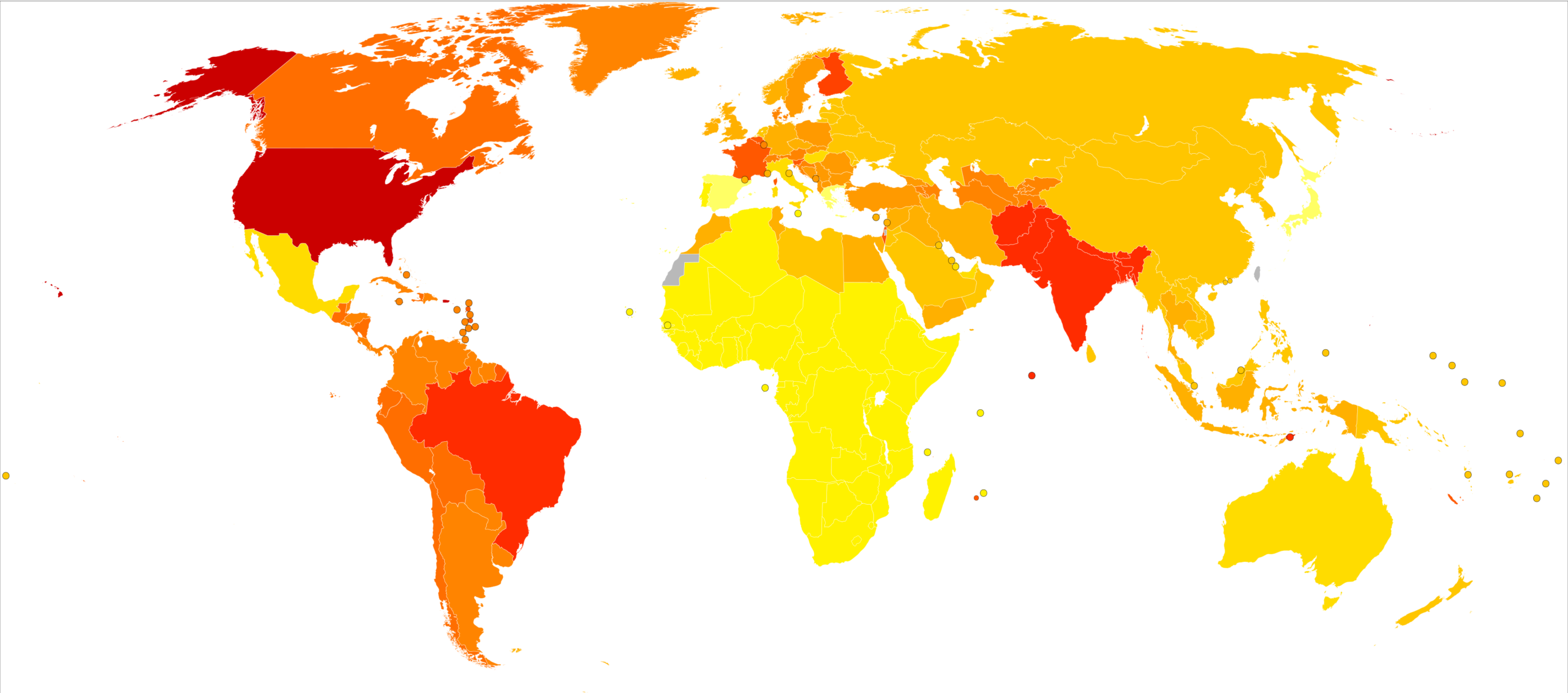
图片来源:Lokal_Profil
Major depressive disorder affected approximately 163 million people in 2017 (2% of the global population).[14] The percentage of people who are affected at one point in their life varies from 7% in Japan to 21% in France. In most countries the number of people who have depression during their lives falls within an 8%–18% range. Lifetime rates are higher in the developed world (15%) compared to the developing world (11%).[4]
【参考译文】2017年,全球约有1.63亿人(占全球总人口的2%)患有重度抑郁症[14]。一生中某个阶段受抑郁症影响的人口比例因国家而异,从日本的7%到法国的21%不等。在大多数国家,一生中患有抑郁症的人口比例在8%到18%之间。发达国家的终身患病率(15%)高于发展中国家(11%)[4]。
In the United States, 8.4% of adults (21 million individuals) have at least one episode within a year-long period; the probability of having a major depressive episode is higher for females than males (10.5% to 6.2%), and highest for those aged 18 to 25 (17%).[313] 15% of adolescents, ages 12 to 17, in America are also affected by depression, which is equal to 3.7 million teenagers.[314] Among individuals reporting two or more races, the US prevalence is highest.[313] Out of all the people suffering from MDD, only about 35% seek help from a professional for their disorder.[314]
【参考译文】在美国,8.4%的成年人(约2100万人)在一年内至少经历一次重度抑郁发作;女性经历重度抑郁发作的概率高于男性(10.5% 对 6.2%),而在18至25岁的人群中这一概率最高(17%)[313]。美国15%的青少年(12至17岁)也受到抑郁症的影响,相当于370万名青少年[314]。在报告为两种或多种族裔的人群中,美国的患病率最高[313]。在所有重度抑郁症患者中,只有约35%的人会就自己的病情向专业人士寻求帮助[314]。
Major depression is about twice as common in women as in men, although it is unclear why this is so, and whether factors unaccounted for are contributing to this.[315] The relative increase in occurrence is related to pubertal development rather than chronological age, reaches adult ratios between the ages of 15 and 18, and appears associated with psychosocial more than hormonal factors.[315] In 2019, major depressive disorder was identified (using either the DSM-IV-TR or ICD-10) in the Global Burden of Disease Study as the fifth most common cause of years lived with disability and the 18th most common for disability-adjusted life years.[316]
【参考译文】女性患重度抑郁症的概率大约是男性的两倍,不过目前尚不清楚具体原因,也不确定是否有其他未被考虑的因素在其中起作用[315]。这种发病率的相对增加与青春期发育(而非单纯的年龄增长)有关,通常在15到18岁之间达到成年人的比例水平,并且似乎更多与心理社会因素相关,而非激素因素[315]。在2019年的《全球疾病负担研究》中,重度抑郁症(使用DSM-IV-TR或ICD-10标准进行诊断)被列为导致伤残损失健康生命年(YLD)的第五大常见原因,以及导致伤残调整生命年(DALY)的第18大常见原因[316]。
People are most likely to develop their first depressive episode between the ages of 30 and 40, and there is a second, smaller peak of incidence between ages 50 and 60.[317] The risk of major depression is increased with neurological conditions such as stroke, Parkinson’s disease, or multiple sclerosis, and during the first year after childbirth (postpartum depression).[318] It is also more common after cardiovascular illnesses, and is related more to those with a poor cardiac disease outcome than to a better one.[319][320] Depressive disorders are more common in urban populations than in rural ones and the prevalence is increased in groups with poorer socioeconomic factors, such as homelessness.[321] Depression is common among those over 65 years of age and increases in frequency beyond this age.[41] The risk of depression increases in relation to the frailty of the individual.[322] Depression is one of the most important factors which negatively impact quality of life in adults, as well as the elderly.[41] Both symptoms and treatment among the elderly differ from those of the rest of the population.[41]
【参考译文】人们最有可能在30至40岁之间经历首次抑郁发作,而在50至60岁之间会出现第二个较小的发病高峰[317]。患有中风、帕金森病或多发性硬化症等神经系统疾病,以及在产后第一年(产后抑郁症),患重度抑郁症的风险会增加[318]。心血管疾病之后也更容易出现抑郁,且与心脏预后较差的人群关系更为密切[319][320]。城市人口的抑郁症患病率高于农村人口,且在社会经济条件较差的群体(如无家可归者)中,患病率会进一步上升[321]。抑郁症在65岁以上的人群中很常见,并且随着年龄增长,发病频率还会继续增加[41]。个体越虚弱,患抑郁症的风险就越高[322]。抑郁症是对成年人以及老年人生活质量产生负面影响的最重要因素之一[41]。老年人在抑郁症状表现和治疗方法上,都与其他年龄段的人群有所不同[41]。
Major depression was the leading cause of disease burden in North America and other high-income countries, and the fourth-leading cause worldwide as of 2006. In the year 2030, it is predicted to be the second-leading cause of disease burden worldwide after HIV/AIDS, according to the WHO.[323] Delay or failure in seeking treatment after relapse and the failure of health professionals to provide treatment are two barriers to reducing disability.[324]
【参考译文】截至2006年,重度抑郁症是北美及其他高收入国家疾病负担的首要原因,也是全球第四大疾病负担原因。根据世界卫生组织(WHO)的预测,到2030年,它将成为全球第二大疾病负担原因,仅次于艾滋病(HIV/AIDS)[323]。复发后延迟就医或拒绝就医,以及医疗专业人员未能提供有效的治疗,是阻碍减少(抑郁症所致)残疾的两大障碍[324]。
8.1 共病 | Comorbidity
Major depression frequently co-occurs with other psychiatric problems. The 1990–92 National Comorbidity Survey (US) reported that half of those with major depression also have lifetime anxiety and its associated disorders, such as generalized anxiety disorder.[325] Anxiety symptoms can have a major impact on the course of a depressive illness, with delayed recovery, increased risk of relapse, greater disability and increased suicidal behavior.[326] Depressed people have increased rates of alcohol and substance use, particularly dependence,[327][328] and around a third of individuals diagnosed with attention deficit hyperactivity disorder (ADHD) develop comorbid depression.[329] Post-traumatic stress disorder and depression often co-occur.[36] Depression may also coexist with ADHD, complicating the diagnosis and treatment of both.[330] Depression is also frequently comorbid with alcohol use disorder and personality disorders.[331] Depression can also be exacerbated during particular months (usually winter) in those with seasonal affective disorder. While overuse of digital media has been associated with depressive symptoms, using digital media may also improve mood in some situations.[332][333]
【参考译文】重度抑郁症经常与其他精神问题同时发生。1990年至1992年的美国全国共病调查报告显示,半数重度抑郁症患者一生中同时患有焦虑症及其相关障碍,例如广泛性焦虑障碍[325]。焦虑症状会对抑郁症的病程产生重大影响,导致康复延迟、复发风险增加、致残率升高以及自杀行为增多[326]。抑郁症患者酗酒和滥用药物(尤其是药物依赖)的比例更高[327][328],大约三分之一的注意力缺陷多动障碍(ADHD)患者会并发抑郁症[329]。创伤后应激障碍(PTSD)和抑郁症也常常同时出现[36]。抑郁症还可能与ADHD共存,这使得两者的诊断和治疗都变得更加复杂[330]。抑郁症也常与酒精使用障碍和人格障碍并发[331]。对于患有季节性情感障碍的人群来说,在特定的月份(通常是冬季)抑郁情绪可能会加重。虽然过度使用数字媒体与抑郁症状有关,但在某些情况下,使用数字媒体也可能改善情绪[332][333]。
Depression and pain often co-occur. One or more pain symptoms are present in 65% of people who have depression, and anywhere from 5% to 85% of people who are experiencing pain will also have depression, depending on the setting—a lower prevalence in general practice, and higher in specialty clinics. Depression is often underrecognized, and therefore undertreated, in patients presenting with pain.[334] Depression often coexists with physical disorders common among the elderly, such as stroke, other cardiovascular diseases,[335] Parkinson’s disease, and chronic obstructive pulmonary disease.[336]
【参考译文】抑郁症和疼痛也常常同时出现。65%的抑郁症患者会出现一种或多种疼痛症状;而在经历疼痛的人群中,根据就诊环境的不同(综合诊所的患病率较低,专科诊所较高),有5%到85%的人也会同时患有抑郁症。在因疼痛就诊的患者中,抑郁症常常被忽视,因此也未能得到充分的治疗[334]。抑郁症还经常与老年人常见的身体疾病共存,例如中风、其他心血管疾病[335]、帕金森病以及慢性阻塞性肺疾病(COPD)[336]。
抑郁症直接造成患者患心血管疾病的风险增加1.5-2倍;除此以外,其他与抑郁症有关的因素例如吸烟和肥胖也会增加患者患心血管疾病的风险。重度抑郁症患者比一般人更不太可能遵从医嘱来治疗心血管疾病,这更进一步增加了他们的风险。况且,心血管病学家可能不能认识到潜在的抑郁症状使心血管症状复杂化[269]。
9. 中医学的解释与治疗
中医学对于抑郁症的看法与西医体系有着根本性的不同。中医对于抑郁症的认识有十分悠久的历史,《素问 六元正纪大论》就有:“郁之甚者治之奈何,木郁达之,火郁发之,土郁夺之,金郁泄之,水郁折之”的说法[270]。中医的所谓郁症,一为以病机而立病名,二为情志之病,重度抑郁症属于后者,除郁症外,虚证也是引起抑郁症的一大原因[271]。根据一项横跨中国大陆8省的针对1,977名抑郁症患者的调查显示,抑郁症的发病机理主要与中医所指的肝、脾、心有关,而最常见的是肝郁气滞、肝郁脾虚、肝郁痰阻、心脾两虚证4类[272]。而情志因素,即:喜、怒、忧、思、悲、恐、惊,七情太过则是抑郁症的诱因[273]。针对以上病因,中医治疗抑郁症的方法往往以疏肝解郁、活血化瘀为原则。尽管有小规模的研究显示中医药物治疗抑郁症的效果甚至不亚于氟西汀等SSRI类药物[274][275],但是这些研究往往存在方法学上的问题。一项2008年的对中、英、日、韩文数据库和学位论文数据库的元分析指出,中医电针治疗的疗效与抗抑郁药氟西汀的疗效无统计学差异,并明显优于空白对照组,且中医电针治疗的不良反应轻微,这显示出中医在治疗抑郁症方面有很大潜力[276]。
10. 历史 | History
Main article: History of depression【主条目:抑郁症的历史】

图片题注:Diagnoses of depression go back at least as far as Hippocrates.
参考译文:抑郁症的诊断至少可追溯至希波克拉底时代。
图片来源:user:shakko
The Ancient Greek physician Hippocrates described a syndrome of melancholia (μελαγχολία, melankholía) as a distinct disease with particular mental and physical symptoms; he characterized all “fears and despondencies, if they last a long time” as being symptomatic of the ailment.[337] It was a similar but far broader concept than today’s depression; prominence was given to a clustering of the symptoms of sadness, dejection, and despondency, and often fear, anger, delusions and obsessions were included.[338]
【参考译文】古希腊医师希波克拉底将“忧郁症”(melancholia)描述为一种具有特定精神和身体症状的独立疾病;他将所有“持续长时间的恐惧和沮丧”都归为该疾病的症状[337]。这是一个与今天的抑郁症相似但内涵更为宽泛的概念;其重点在于一系列症状的集合,包括悲伤、沮丧和消沉,而且通常还涵盖了恐惧、愤怒、妄想和强迫观念[338]。
The term depression itself was derived from the Latin verb deprimere, meaning “to press down”.[339] From the 14th century, “to depress” meant to subjugate or to bring down in spirits. It was used in 1665 in English author Richard Baker’s Chronicle to refer to someone having “a great depression of spirit”, and by English author Samuel Johnson in a similar sense in 1753.[340] The term also came into use in physiology and economics. An early usage referring to a psychiatric symptom was by French psychiatrist Louis Delasiauve in 1856, and by the 1860s it was appearing in medical dictionaries to refer to a physiological and metaphorical lowering of emotional function.[341] Since Aristotle, melancholia had been associated with men of learning and intellectual brilliance, a hazard of contemplation and creativity. However, by the 19th century, this association has largely shifted and melancholia became more commonly linked with women.[338]
【参考译文】“抑郁”(depression)这个词本身源自拉丁语动词 deprimere,意为“向下按压”[339]。从14世纪开始,“to depress”(使沮丧/压抑)一词便有了“征服”或“使情绪低落”的含义。1665年,英国作家理查德·贝克(Richard Baker)在《编年史》(Chronicle)中使用该词,用来形容某人“精神极度消沉”;1753年,英国作家塞缪尔·约翰逊(Samuel Johnson)也以类似的含义使用了这个词[340]。该术语后来也被用于生理学和经济学领域。法国精神病学家路易·德拉西奥夫(Louis Delasiauve)在1856年首次将其用于描述一种精神病学症状;到了19世纪60年代,它开始出现在医学词典中,用来指代情绪功能在生理和隐喻层面上的“降低”[341]。自亚里士多德以来,忧郁症(melancholia)一直与好学之人和才华横溢的智者相关联,被视为沉思和创造力所带来的“风险”。然而到了19世纪,这种关联发生了巨大转变,忧郁症更多地开始与女性联系在一起[338]。
Although melancholia remained the dominant diagnostic term, depression gained increasing currency in medical treatises and was a synonym by the end of the century; German psychiatrist Emil Kraepelin may have been the first to use it as the overarching term, referring to different kinds of melancholia as depressive states.[342] Freud likened the state of melancholia to mourning in his 1917 paper Mourning and Melancholia. He theorized that objective loss, such as the loss of a valued relationship through death or a romantic break-up, results in subjective loss as well; the depressed individual has identified with the object of affection through an unconscious, narcissistic process called the libidinal cathexis of the ego. Such loss results in severe melancholic symptoms more profound than mourning; not only is the outside world viewed negatively but the ego itself is compromised.[343]
【参考译文】尽管“忧郁症”(melancholia)仍然是当时主流的医学术语,但“抑郁”(depression)一词在医学论著中的使用频率越来越高,并在19世纪末成为了它的同义词;德国精神病学家埃米尔·克雷佩林(Emil Kraepelin)可能是第一个将其作为总括性术语来使用的人,他将各种不同类型的忧郁症统称为“抑郁状态”[342]。弗洛伊德在他1917年的论文《哀悼与忧郁》(Mourning and Melancholia)中,将忧郁状态比作哀悼。他提出理论认为,“客观的丧失”(例如因死亡或失恋而失去一段珍贵的关系)同样会导致“主观的丧失”;抑郁的个体通过一种被称为“自我的力比多投注”的无意识、自恋过程,在心理上认同了那个情感依恋的对象。这种丧失会导致比正常哀悼更为深刻的严重忧郁症状;患者不仅会以消极的眼光看待外部世界,连自我的本质也受到了损害[343]。
The person’s decline of self-perception is revealed in his belief of his own blame, inferiority, and unworthiness.[344] He also emphasized early life experiences as a predisposing factor.[338] Adolf Meyer put forward a mixed social and biological framework emphasizing reactions in the context of an individual’s life, and argued that the term depression should be used instead of melancholia.[345] The first version of the DSM (DSM-I, 1952) contained depressive reaction and the DSM-II (1968) depressive neurosis, defined as an excessive reaction to internal conflict or an identifiable event, and also included a depressive type of manic-depressive psychosis within Major affective disorders.[346]
【参考译文】这种自我认知的衰退体现在患者坚信自己应当受到责备、低人一等且毫无价值[344]。弗洛伊德还特别强调,早年的生活经历是导致抑郁的潜在诱因[338]。阿道夫·迈耶(Adolf Meyer)则提出了一种结合社会与生物因素的混合框架,强调个体在其生活背景下产生的“反应”,并主张应使用“抑郁”(depression)一词来取代“忧郁症”(melancholia)[345]。第一版《精神疾病诊断与统计手册》(DSM-I, 1952年)收录了“抑郁反应”,而第二版(DSM-II, 1968年)则收录了“抑郁性神经症”,将其定义为对内心冲突或可识别事件的过度反应;此外,该版还在“主要情感障碍”中包含了躁狂抑郁性精神病(manic-depressive psychosis)的抑郁型[346]。
The term unipolar (along with the related term bipolar) was coined by the neurologist and psychiatrist Karl Kleist, and subsequently used by his disciples Edda Neele and Karl Leonhard.[347]
【参考译文】“单相”(unipolar)一词(以及相关的“双相”一词)是由神经学家兼精神病学家卡尔·克莱斯特(Karl Kleist)创造的,随后由他的学生埃达·尼勒(Edda Neele)和卡尔·莱昂哈德(Karl Leonhard)加以使用[347]。
The term major depressive disorder was introduced by a group of US clinicians in the mid-1970s as part of proposals for diagnostic criteria based on patterns of symptoms (called the “Research Diagnostic Criteria”, building on earlier Feighner Criteria),[16] and was incorporated into the DSM-III in 1980.[348] The American Psychiatric Association added “major depressive disorder” to the Diagnostic and Statistical Manual of Mental Disorders (DSM-III),[349] as a split of the previous depressive neurosis in the DSM-II, which also encompassed the conditions now known as dysthymia and adjustment disorder with depressed mood.[349] To maintain consistency the ICD-10 used the same criteria, with only minor alterations, but using the DSM diagnostic threshold to mark a mild depressive episode, adding higher threshold categories for moderate and severe episodes.[129][348] The ancient idea of melancholia still survives in the notion of a melancholic subtype.
The new definitions of depression were widely accepted, albeit with some conflicting findings and views. There have been some continued empirically based arguments for a return to the diagnosis of melancholia.[350][351] There has been some criticism of the expansion of coverage of the diagnosis, related to the development and promotion of antidepressants and the biological model since the late 1950s.[352]
【参考译文】“重度抑郁症”(major depressive disorder)这一术语是在20世纪70年代中期由一群美国临床医生引入的,作为基于症状模式的诊断标准提案的一部分(被称为“研究用诊断标准”,是在早期费赫纳标准的基础上建立的)[16],并于1980年被纳入DSM-III(《精神疾病诊断与统计手册》第三版)[348]。美国精神医学学会将“重度抑郁症”加入了《精神疾病诊断与统计手册》(DSM-III)[349],这是对DSM-II中原有的“抑郁性神经症”进行拆分的结果,而原来的“抑郁性神经症”还涵盖了现在被称为恶劣心境(dysthymia)和伴有抑郁心境的适应障碍等疾病[349]。为了保持一致性,ICD-10(《国际疾病分类》第十版)采用了相同的标准,仅做了微小的修改,但使用了DSM的诊断阈值来界定轻度抑郁发作,并增加了中等和重度发作的更高阈值类别[129][348]。古代“忧郁症”(melancholia)的理念,至今仍以“忧郁型亚型”的概念形式存续着。
11. 社会和文化 | Society and culture
Further information: Depression and culture【延伸信息:“抑郁症与文化”词条】
图片题注:美国前总统亚伯拉罕·林肯可能至少经历了两次重性抑郁发作[291]。
图片来源:马修·布雷迪
11.1 术语 | Terminology
The term depression is used in a number of different ways. It is often used to mean this syndrome but may refer to other mood disorders or simply to a low mood. People’s conceptualizations of depression vary widely, both within and among cultures. “Because of the lack of scientific certainty,” one commentator has observed, “the debate over depression turns on questions of language. What we call it—’disease,’ ‘disorder,’ ‘state of mind’—affects how we view, diagnose, and treat it.”[354] There are cultural differences in the extent to which serious depression is considered an illness requiring personal professional treatment, or an indicator of something else, such as the need to address social or moral problems, the result of biological imbalances, or a reflection of individual differences in the understanding of distress that may reinforce feelings of powerlessness, and emotional struggle.[355][356]
【参考译文】”抑郁”一词有多种不同用法。它常被用来指代这一综合征,但也可能指其他心境障碍,或仅仅指情绪低落。人们对抑郁的概念化理解差异很大,无论在同一文化内部还是不同文化之间都是如此。”由于缺乏科学确定性,”一位评论者指出,”关于抑郁的争论转向了语言问题。我们称其为’疾病’、’障碍’还是’心理状态’,会影响我们如何看待、诊断和治疗它。”[354] 在多大程度上将严重抑郁视为需要个人专业治疗的疾病,或视为其他问题的指标(如需要解决社会或道德问题、生物失衡的结果、或对痛苦理解的个体差异,这可能强化无力感和情感挣扎),存在文化差异。[355][356]
11.2 文化维度 | Cultural dimension
Cultural differences contribute to different prevalence of symptoms. In their article, “Do the Chinese somatize depression? A cross-cultural study”, Parker and others discuss the cultural differences in prevalent symptoms of depression between individualistic and collectivistic cultures.[357] The authors write that individuals with depression in collectivistic cultures tend to present more somatic symptoms and less affective symptoms compared to those in individualistic cultures. The finding suggests that individualistic cultures’ “warranting” or validating of one’s expression of emotions explains this cultural difference since collectivistic cultures see this as a taboo against the social cooperation it deems one of the most significant values.[357]
【参考译文】文化差异导致症状流行率的不同。帕克等人在其文章《中国人是否躯体化抑郁?一项跨文化研究》中,讨论了个人主义文化与集体主义文化中抑郁常见症状的文化差异。[357] 作者指出,与个人主义文化中的抑郁个体相比,集体主义文化中的抑郁个体往往表现出更多的躯体症状和更少的情感症状。这一发现表明,个人主义文化对个人情绪表达的”认可”或”验证”解释了这种文化差异,因为集体主义文化将此视为禁忌,违背了其视为最重要价值之一的社会合作。[357]
对抑郁症的诊断在一些国家比较少见,例如中国。这可能是因为中国人传统上否认或者躯体化抑郁情绪[295]。与此相反,西方国家则可能曲解或者夸大了部分人类对压力的正常表达,而把它们称为障碍。有一些学者提出西方文化中抑郁症的概念将正常的悲伤或痛苦“医学化”[296][297]。匈牙利裔美籍精神病学家汤玛斯·马斯萨斯和其他人也有类似观点,他们认为抑郁症纯粹是被隐喻成一种疾病,把它当成一种真正的疾病是不恰当的[298]。也有一些人针对DSM和描述精神病学表达了担忧,它们试图具体化抽象的症状,例如抑郁,然而这可能是社会建构的结果[299]。原型心理学家詹姆斯·希尔曼写道:“抑郁给予我们庇护、目标、自知之明和谨慎的无为”[300],因此抑郁症可以升华灵魂。他还认为各种试图消除抑郁症的疗法反应了基督教的主题“复活”,但却不幸使一种高尚的生存状态妖魔化了。
11.3 污名化 | Stigma
Historical figures were often reluctant to discuss or seek treatment for depression due to social stigma about the condition, or due to ignorance of diagnosis or treatments. Nevertheless, analysis or interpretation of letters, journals, artwork, writings, or statements of family and friends of some historical personalities has led to the presumption that they may have had some form of depression. People who may have had depression include English author Mary Shelley,[358] American-British writer Henry James,[359] and American president Abraham Lincoln.[360] Some well-known contemporary people with possible depression include Canadian songwriter Leonard Cohen[361] and American playwright and novelist Tennessee Williams.[362] Some pioneering psychologists, such as Americans William James[363][364] and John B. Watson,[365] dealt with their own depression.
【参考译文】由于社会对抑郁症的污名化,或对诊断和治疗的无知,历史人物往往不愿讨论或寻求抑郁症治疗。然而,对一些历史名人的书信、日记、艺术作品、著作或其家人朋友的陈述进行分析或解读,推测他们可能曾患有某种形式的抑郁症。可能患有抑郁症的人物包括英国作家玛丽·雪莱、[358] 美英作家亨利·詹姆斯、[359] 以及美国总统亚伯拉罕·林肯。[360] 一些可能患有抑郁症的当代知名人士包括加拿大词曲作家莱昂纳德·科恩 [361] 和美国剧作家、小说家田纳西·威廉斯。[362] 一些开创性的心理学家,如美国人威廉·詹姆斯 [363][364] 和约翰·B·华生,[365] 也曾与自身的抑郁症作斗争。
There has been a continuing discussion of whether neurological disorders and mood disorders may be linked to creativity, a discussion that goes back to Aristotelian times.[366][367] British literature gives many examples of reflections on depression.[368] English philosopher John Stuart Mill experienced a several-months-long period of what he called “a dull state of nerves”, when one is “unsusceptible to enjoyment or pleasurable excitement; one of those moods when what is pleasure at other times, becomes insipid or indifferent”. He quoted English poet Samuel Taylor Coleridge‘s “Dejection” as a perfect description of his case: “A grief without a pang, void, dark and drear, / A drowsy, stifled, unimpassioned grief, / Which finds no natural outlet or relief / In word, or sigh, or tear.”[369][370] English writer Samuel Johnson used the term “the black dog” in the 1780s to describe his own depression,[371][372] and it was subsequently popularized by British Prime Minister Sir Winston Churchill, who also had the disorder.[371][372] Johann Wolfgang von Goethe, in his Faust, Part One, published in 1808, has Mephistopheles assume the form of a black dog, specifically a poodle.
【参考译文】神经系统疾病和心境障碍是否与创造力有关,这一讨论由来已久,可追溯至亚里士多德时代。[366][367] 英国文学中有许多关于抑郁的思考。[368] 英国哲学家约翰·斯图尔特·密尔曾经历长达数月的他称之为”神经的迟钝状态”,即”对享受或愉悦刺激无动于衷;一种在其他时候是快乐的东西,变得无味或漠不关心的情绪”。他引用英国诗人塞缪尔·泰勒·柯勒律治的《沮丧》作为对自己状况的完美描述:”一种没有剧痛的悲伤,空虚、黑暗而凄凉,/ 一种昏昏欲睡、窒息、没有激情的悲伤,/ 在言语、叹息或眼泪中找不到自然的出口或宣泄。”[369][370] 英国作家塞缪尔·约翰逊在18世纪80年代用”黑狗”一词来描述自己的抑郁,[371][372] 后来这一说法因同样患有该疾病的英国首相温斯顿·丘吉尔爵士而广为人知。[371][372] 约翰·沃尔夫冈·冯·歌德在1808年出版的《浮士德》第一部中,让梅菲斯特以黑狗的形象出现,具体是一只贵宾犬。

图片题注:In 1998, the Norwegian PM Kjell Magne Bondevik publicly announced he would take a leave of absence in order to recover from a depressive episode.
参考译文:1998年,挪威首相谢尔·马格纳·邦德维克公开宣布将休假,以便从抑郁发作中恢复。
图片来源:Magnus Fröderberg/norden.org
民众对重度抑郁症普遍存有误区,与心理健康服务机构联系只能轻微改善这一问题。公众对疗法的认知与专业人士之间有巨大差异。一些民众认为替代疗法比药物疗法更有效,但事实上这些疗法的疗效大多没有被证实[317]。1992年至1996年,英国皇家精神科医学院和英国全科医生医学院一起在英国领导了一次为期五年的击败抑郁运动,以教育民众认识抑郁症从而减少误区[318]。这次运动结束后调查公司MOPI研究显示公众对抑郁症的态度有了小幅度的积极改变[319]。
While serving his first term as Prime Minister of Norway, Kjell Magne Bondevik attracted international attention in August 1998 when he announced that he was suffering from a depressive episode, becoming the highest-ranking world leader to admit to suffering from a mental illness while in office. Upon this revelation, Anne Enger became acting Prime Minister for three weeks, from 30 August to 23 September, while he recovered from the depressive episode. Bondevik then returned to office. Bondevik received thousands of supportive letters, and said that the experience had been positive overall, both for himself and because it made mental illness more publicly acceptable.[377][378]
【参考译文】挪威首相谢尔·马格纳·邦德维克在第一个任期内,于1998年8月宣布自己正遭受抑郁发作,引起国际关注,成为在任期间承认患有精神疾病的最高级别世界领导人。这一消息公布后,安妮·恩格尔从8月30日至9月23日代理首相职务三周,期间他从抑郁发作中恢复。随后邦德维克重返职位。邦德维克收到了数千封支持信,并表示这段经历总体上是积极的,不仅对他本人如此,也因为这使精神疾病更易被公众接受。[377][378]
A. 参见(维基百科的相关词条)| See also
- Depression and Bipolar Support Alliance【抑郁症与双相情感障碍支持联盟】
- 污染与脑部疾病
B. 参考文献 | References
B1 英文词条引用列表
- · “Depression”. U.S. National Institute of Mental Health (NIMH). May 2016. Archived from the original on 5 August 2016. Retrieved 31 July 2016.
- · Richards CS, O’Hara MW (2014). The Oxford Handbook of Depression and Comorbidity. Oxford University Press. p. 254. ISBN 978-0-19-979704-2.
- · American Psychiatric Association 2013, p. 165.
- · Kessler RC, Bromet EJ (2013). “The epidemiology of depression across cultures”. Annual Review of Public Health. 34: 119–38. doi:10.1146/annurev-publhealth-031912-114409. PMC 4100461. PMID 23514317.
- · American Psychiatric Association 2013, p. 166.
- · American Psychiatric Association 2013, pp. 167–168.
- · Cooney GM, Dwan K, Greig CA, Lawlor DA, Rimer J, Waugh FR, McMurdo M, Mead GE (September 2013). Mead GE (ed.). “Exercise for depression”. The Cochrane Database of Systematic Reviews. 2013 (9): CD004366. doi:10.1002/14651858.CD004366.pub6. PMC 9721454. PMID 24026850.
- · · GBD 2017 Disease and Injury Incidence and Prevalence Collaborators (10 November 2018). “Global, regional, and national incidence, prevalence, and years lived with disability for 354 diseases and injuries for 195 countries and territories, 1990–2017: a systematic analysis for the Global Burden of Disease Study 2017”. Lancet. 392 (10159): 1789–1858. doi:10.1016/S0140-6736(18)32279-7. PMC 6227754. PMID 30496104.
- · Sartorius N, Henderson AS, Strotzka H, et al. “The ICD-10 Classification of Mental and Behavioural Disorders Clinical descriptions and diagnostic guidelines” (PDF). World Health Organization. Archived from the original (PDF) on 5 February 2022. Retrieved 23 June 2021.
- · Spitzer RL, Endicott J, Robins E (1975). “The development of diagnostic criteria in psychiatry” (PDF). Archived (PDF) from the original on 14 December 2005. Retrieved 8 November 2008.
- · Patton LL (2015). The ADA Practical Guide to Patients with Medical Conditions (2nd ed.). John Wiley & Sons. p. 339. ISBN 978-1-118-92928-5.
- · Fournier JC, DeRubeis RJ, Hollon SD, Dimidjian S, Amsterdam JD, Shelton RC, Fawcett J (January 2010). “Antidepressant drug effects and depression severity: a patient-level meta-analysis”. JAMA. 303 (1): 47–53. doi:10.1001/jama.2009.1943. PMC 3712503. PMID 20051569.
- · Kirsch I, Deacon BJ, Huedo-Medina TB, Scoboria A, Moore TJ, Johnson BT (February 2008). “Initial severity and antidepressant benefits: a meta-analysis of data submitted to the Food and Drug Administration”. PLOS Medicine. 5 (2): e45. doi:10.1371/journal.pmed.0050045. PMC 2253608. PMID 18303940.
- · Global Burden of Disease Study 2013 Collaborators (August 2015). “Global, regional, and national incidence, prevalence, and years lived with disability for 301 acute and chronic diseases and injuries in 188 countries, 1990–2013: a systematic analysis for the Global Burden of Disease Study 2013”. Lancet. 386 (9995): 743–800. doi:10.1016/S0140-6736(15)60692-4. PMC 4561509. PMID 26063472.
- · Depression (PDF). National Institute of Mental Health (NIMH). Archived (PDF) from the original on 28 August 2021. Retrieved 13 October 2021.
- · American Psychiatric Association 2013, p. 160.
- · American_Psychiatric_Association 2013, p. 161.
- · Everaert J, Vrijsen JN, Martin-Willett R, van de Kraats L, Joormann J (2022). “A meta-analytic review of the relationship between explicit memory bias and depression: Depression features an explicit memory bias that persists beyond a depressive episode”. Psychological Bulletin. 148 (5–6): 435–463. doi:10.1037/bul0000367. ISSN 1939-1455. S2CID 253306482.
- · · American Psychiatric Association 2013, p. 163.
- · · Murray G (September 2007). “Diurnal mood variation in depression: a signal of disturbed circadian function?”. Journal of Affective Disorders. 102 (1–3): 47–53. doi:10.1016/j.jad.2006.12.001. PMID 17239958.
- · “Insomnia: Assessment and Management in Primary Care”. American Family Physician. 59 (11): 3029–3038. 1999. Archived from the original on 26 July 2011. Retrieved 12 November 2014.
- · American Psychiatric Association 2000a, p. 412
- · Nelson JC, Bickford D, Delucchi K, Fiedorowicz JG, Coryell WH (September 2018). “Risk of Psychosis in Recurrent Episodes of Psychotic and Nonpsychotic Major Depressive Disorder: A Systematic Review and Meta-Analysis”. The American Journal of Psychiatry. 175 (9): 897–904. doi:10.1176/appi.ajp.2018.17101138. PMID 29792050. S2CID 43951278.
- · Fisher JC, Powers WE, Tuerk DB, Edgerton MT (March 1975). “Development of a plastic surgical teaching service in a women’s correctional institution”. American Journal of Surgery. 129 (3): 269–72. doi:10.1136/bmj.322.7284.482. PMC 1119689. PMID 11222428.
- · American Psychiatric Association 2000a, p. 349
- · Delgado PL, Schillerstrom J (2009). “Cognitive Difficulties Associated With Depression: What Are the Implications for Treatment?”. Psychiatric Times. 26 (3). Archived from the original on 22 July 2009.
- · Faculty of Psychiatry of Old Age, NSW Branch, RANZCP, Kitching D, Raphael B (2001). Consensus Guidelines for Assessment and Management of Depression in the Elderly (PDF). North Sydney, New South Wales: NSW Health Department. p. 2. ISBN 978-0-7347-3341-2. Archived (PDF) from the original on 1 April 2015.
- · American Psychiatric Association 2013, p. 164.
- · Swedish Agency for Health Technology Assessment and Assessment of Social Services (SBU) (27 January 2015). “Depression treatment for the elderly”. sbu.se. Archived from the original on 18 June 2016. Retrieved 16 June 2016.
- · Hankin BL, Abela JR (2005). Development of Psychopathology: A Vulnerability-Stress Perspective. SAGE Publications. pp. 32–34. ISBN 9781412904902.
- · Otte C, Gold SM, Penninx BW, Pariante CM, Etkin A, Fava M, et al. (September 2016). “Major depressive disorder” (PDF). Nature Reviews. Disease Primers. Springer Nature (published 15 September 2016). 2 (1): 16065. doi:10.1038/nrdp.2016.65. PMID 27629598. S2CID 4047310. Despite advances in our understanding of the neuro-biology of MDD, no established mechanism can explain all aspects of the disease.
- · Boland RJ, Verduin ML (14 March 2022). Kaplan & Sadock’s concise textbook of clinical psychiatry (5th ed.). Philadelphia: Wolters Kluwer. ISBN 9781975167486. OCLC 1264172789. Although there is no single unifying theory, several theories have emerged over the last century that attempt to account for the various clinical, psychological, and biologic findings in depression.
- · Sontheimer H (20 May 2021). Diseases of the nervous system (2nd ed.). Elsevier. p. 286. ISBN 978-0-12-821396-4. OCLC 1260160457. A number of risk factors for depression are known or suspected, but only in rare cases is the link to disease strong.
- · Mann JJ, McGrath PJ, Roose SP, eds. (June 2013). Clinical handbook for the management of mood disorders. Cambridge: Cambridge University Press. p. 1. doi:10.1017/CBO9781139175869. ISBN 9781107055636. OCLC 843944119. Although genes are an important cause of major depression and bipolar disorder, we have not confirmed the identity of the responsible genes.
- · Department of Health and Human Services (1999). “The fundamentals of mental health and mental illness” (PDF). Mental Health: A Report of the Surgeon General. Archived (PDF) from the original on 17 December 2008. Retrieved 11 November 2008.
- · Caspi A, Sugden K, Moffitt TE, Taylor A, Craig IW, Harrington H, et al. (July 2003). “Influence of life stress on depression: moderation by a polymorphism in the 5-HTT gene”. Science. 301 (5631): 386–389. Bibcode:2003Sci…301..386C. doi:10.1126/science.1083968. PMID 12869766. S2CID 146500484.
- · Haeffel GJ, Getchell M, Koposov RA, Yrigollen CM, Deyoung CG, Klinteberg BA, et al. (January 2008). “Association between polymorphisms in the dopamine transporter gene and depression: evidence for a gene-environment interaction in a sample of juvenile detainees” (PDF). Psychological Science. 19 (1): 62–69. doi:10.1111/j.1467-9280.2008.02047.x. PMID 18181793. S2CID 15520723. Archived (PDF) from the original on 17 December 2008.
- · Slavich GM (2004). “Deconstructing depression: A diathesis-stress perspective (Opinion)”. APS Observer. Archived from the original on 11 May 2011. Retrieved 11 November 2008.
- · Beck AT, Rush AJ, Shaw BF, Emery G (1979). Cognitive therapy of depression. New York: The Guilford Press. pp. 11–12. ISBN 0-89862-000-7. Retrieved 26 February 2022.
- · Nieto I, Robles E, Vazquez C (December 2020). “Self-reported cognitive biases in depression: A meta-analysis”. Clinical Psychology Review. 82: 101934. doi:10.1016/j.cpr.2020.101934. PMID 33137610. S2CID 226243519.
- · Do MC, Weersing VR (3 April 2017). Wenzel A (ed.). The SAGE encyclopedia of abnormal and clinical psychology. Thousand Oaks, California: SAGE Publishing. p. 1014. doi:10.4135/9781483365817. ISBN 978-1-4833-6582-4. OCLC 982958263. Depression is highly heritable, as youths with a parent with a history of depression are approximately 4 times as likely to develop the disorder as youths who do not have a parent with depression.
- · Sullivan PF, Neale MC, Kendler KS (October 2000). “Genetic epidemiology of major depression: review and meta-analysis”. The American Journal of Psychiatry. 157 (10): 1552–1562. doi:10.1176/appi.ajp.157.10.1552. PMID 11007705.
- · Belmaker RH, Agam G (January 2008). “Major depressive disorder”. The New England Journal of Medicine. 358 (1): 55–68. doi:10.1056/NEJMra073096. PMID 18172175. It is clear from studies of families that major depression is not caused by any single gene but is a disease with complex genetic features.
- · Wray NR, Ripke S, Mattheisen M, Trzaskowski M, Byrne EM, Abdellaoui A, et al. (May 2018). “Genome-wide association analyses identify 44 risk variants and refine the genetic architecture of major depression”. Nature Genetics. 50 (5): 668–681. doi:10.1038/s41588-018-0090-3. hdl:11370/3a0e2468-99e7-40c3-80f4-9d25adfae485. PMC 5934326. PMID 29700475.
- · Howard DM, Adams MJ, Clarke TK, Hafferty JD, Gibson J, Shirali M, et al. (March 2019). “Genome-wide meta-analysis of depression identifies 102 independent variants and highlights the importance of the prefrontal brain regions”. Nature Neuroscience. 22 (3): 343–352. doi:10.1038/s41593-018-0326-7. PMC 6522363. PMID 30718901.
- · Sullivan PF, Neale MC, Kendler KS (October 2000). “Genetic epidemiology of major depression: review and meta-analysis”. The American Journal of Psychiatry. 157 (10): 1552–1562. doi:10.1176/appi.ajp.157.10.1552. PMID 11007705. The heritability of major depression is likely to be in the range of 31%–42%. This is probably the lower bound, and the level of heritability is likely to be substantially higher for reliably diagnosed major depression or for subtypes such as recurrent major depression. In comparison, the heritabilities of schizophrenia and bipolar disorder are estimated to be approximately 70%.
- · Jorde LB, Carey JC, Bamshad MJ (27 September 2019). Medical genetics (6th ed.). Philadelphia: Elsevier. p. 247. ISBN 9780323596534. OCLC 1138027525. Thus it appears that bipolar disorder is more strongly influenced by genetic factors than is major depressive disorder.
- · Duncan LE, Keller MC (October 2011). “A critical review of the first 10 years of candidate gene-by-environment interaction research in psychiatry”. The American Journal of Psychiatry. 168 (10): 1041–1049. doi:10.1176/appi.ajp.2011.11020191. PMC 3222234. PMID 21890791.
- · Peyrot WJ, Van der Auwera S, Milaneschi Y, Dolan CV, Madden PA, Sullivan PF, et al. (July 2018). “Does Childhood Trauma Moderate Polygenic Risk for Depression? A Meta-analysis of 5765 Subjects From the Psychiatric Genomics Consortium”. Biological Psychiatry. 84 (2): 138–147. doi:10.1016/j.biopsych.2017.09.009. PMC 5862738. PMID 29129318.
- · Simon GE (November 2001). “Treating depression in patients with chronic disease: recognition and treatment are crucial; depression worsens the course of a chronic illness”. The Western Journal of Medicine. 175 (5): 292–93. doi:10.1136/ewjm.175.5.292. PMC 1071593. PMID 11694462.
- · Clayton PJ, Lewis CE (March 1981). “The significance of secondary depression”. Journal of Affective Disorders. 3 (1): 25–35. doi:10.1016/0165-0327(81)90016-1. PMID 6455456.
- · Kewalramani A, Bollinger ME, Postolache TT (1 January 2008). “Asthma and Mood Disorders”. International Journal of Child Health and Human Development. 1 (2): 115–23. PMC 2631932. PMID 19180246.
- · Rogers D, Pies R (December 2008). “General medical with depression drugs associated”. Psychiatry. 5 (12): 28–41. PMC 2729620. PMID 19724774.
- · Botts S, Ryan M. Drug-Induced Diseases Section IV: Drug-Induced Psychiatric Diseases Chapter 18: Depression. pp. 1–23. Archived from the original on 23 December 2010.
- · Brook DW, Brook JS, Zhang C, Cohen P, Whiteman M (November 2002). “Drug use and the risk of major depressive disorder, alcohol dependence, and substance use disorders”. Archives of General Psychiatry. 59 (11): 1039–44. doi:10.1001/archpsyc.59.11.1039. PMID 12418937.
- · Meltzer-Brody S (9 January 2017). “New insights into perinatal depression: pathogenesis and treatment during pregnancy and postpartum”. Dialogues in Clinical Neuroscience. 13 (1): 89–100. doi:10.31887/DCNS.2011.13.1/smbrody. PMC 3181972. PMID 21485749.
- · Melrose S (1 January 2015). “Seasonal Affective Disorder: An Overview of Assessment and Treatment Approaches”. Depression Research and Treatment. 2015: 178564. doi:10.1155/2015/178564. PMC 4673349. PMID 26688752.
- · Wu Y, Zhang L, Li S, Zhang D (29 April 2021). “Associations of dietary vitamin B1, vitamin B2, vitamin B6, and vitamin B12 with the risk of depression: a systematic review and meta-analysis”. Nutrition Reviews. Oxford University Press (OUP). 80 (3): 351–366. doi:10.1093/nutrit/nuab014. ISSN 0029-6643. PMID 33912967.
- · Saveanu RV, Nemeroff CB (March 2012). “Etiology of depression: genetic and environmental factors”. The Psychiatric Clinics of North America. 35 (1): 51–71. doi:10.1016/j.psc.2011.12.001. PMID 22370490.
- · Goldfarb MR, Trudel G (6 May 2019). “Marital quality and depression: a review”. Marriage & Family Review. Routledge: Taylor & Francis Group. 55 (8): 737–763. doi:10.1080/01494929.2019.1610136. Citing among others: Weissman MM (April 1987). “Advances in psychiatric epidemiology: rates and risks for major depression”. Am J Public Health. 77 (4): 445–51. doi:10.2105/ajph.77.4.445. PMC 1646931. PMID 3826462.
- · Braithwaite I, Zhang S, Kirkbride JB, Osborn DP, Hayes JF (December 2019). “Air Pollution (Particulate Matter) Exposure and Associations with Depression, Anxiety, Bipolar, Psychosis and Suicide Risk: A Systematic Review and Meta-Analysis”. Environmental Health Perspectives. 127 (12): 126002. doi:10.1289/EHP4595. PMC 6957283. PMID 31850801.
- · Ruhé HG, Mason NS, Schene AH (April 2007). “Mood is indirectly related to serotonin, norepinephrine and dopamine levels in humans: a meta-analysis of monoamine depletion studies”. Molecular Psychiatry. 12 (4): 331–59. doi:10.1038/sj.mp.4001949. PMID 17389902.
- · Delgado PL, Moreno FA (2000). “Role of norepinephrine in depression”. The Journal of Clinical Psychiatry. 61 (Suppl 1): 5–12. PMID 10703757.
- · Savitz JB, Drevets WC (April 2013). “Neuroreceptor imaging in depression”. Neurobiology of Disease. 52: 49–65. doi:10.1016/j.nbd.2012.06.001. PMID 22691454.
- · Hasler G (October 2010). “Pathophysiology of depression: do we have any solid evidence of interest to clinicians?”. World Psychiatry. 9 (3): 155–61. doi:10.1002/j.2051-5545.2010.tb00298.x. PMC 2950973. PMID 20975857.
- · Dunlop BW, Nemeroff CB (March 2007). “The role of dopamine in the pathophysiology of depression”. Archives of General Psychiatry. 64 (3): 327–37. doi:10.1001/archpsyc.64.3.327. PMID 17339521. S2CID 26550661.
- · Meyer JH, Ginovart N, Boovariwala A, et al. (November 2006). “Elevated monoamine oxidase a levels in the brain: an explanation for the monoamine imbalance of major depression”. Archives of General Psychiatry. 63 (11): 1209–16. doi:10.1001/archpsyc.63.11.1209. PMID 17088501.
- · Davis KL, Charney D, Coyle JT, Nemeroff C, eds. (2002). Neuropsychopharmacology: the fifth generation of progress: an official publication of the American College of Neuropsychopharmacology (5th ed.). Philadelphia: Lippincott Williams & Wilkins. pp. 1139–63. ISBN 978-0-7817-2837-9.
- · Adell A (April 2015). “Revisiting the role of raphe and serotonin in neuropsychiatric disorders”. The Journal of General Physiology. 145 (4): 257–59. doi:10.1085/jgp.201511389. PMC 4380212. PMID 25825168.
- · Andrews PW, Bharwani A, Lee KR, Fox M, Thomson JA (April 2015). “Is serotonin an upper or a downer? The evolution of the serotonergic system and its role in depression and the antidepressant response”. Neuroscience and Biobehavioral Reviews. 51: 164–88. doi:10.1016/j.neubiorev.2015.01.018. PMID 25625874. S2CID 23980182.
- · Lacasse JR, Leo J (December 2005). “Serotonin and depression: a disconnect between the advertisements and the scientific literature”. PLOS Medicine. 2 (12): e392. doi:10.1371/journal.pmed.0020392. PMC 1277931. PMID 16268734.
- · Moncrieff J, Cooper RE, Stockman T, et al. (July 2022). “The serotonin theory of depression: a systematic umbrella review of the evidence”. Mol Psychiatry. 28 (8): 3243–3256. doi:10.1038/s41380-022-01661-0. PMC 10618090. PMID 35854107. S2CID 250646781. Lay source Medicalxpress
- · Krishnadas R, Cavanagh J (May 2012). “Depression: an inflammatory illness?”. Journal of Neurology, Neurosurgery, and Psychiatry. 83 (5): 495–502. doi:10.1136/jnnp-2011-301779. PMID 22423117.
- · Patel A (September 2013). “Review: the role of inflammation in depression”. Psychiatria Danubina. 25 (Suppl 2): S216–23. PMID 23995180.
- · Dowlati Y, Herrmann N, Swardfager W, Liu H, Sham L, Reim EK, Lanctôt KL (March 2010). “A meta-analysis of cytokines in major depression”. Biological Psychiatry. 67 (5): 446–57. doi:10.1016/j.biopsych.2009.09.033. PMID 20015486. S2CID 230209.
- · Köhler O, Benros ME, Nordentoft M, Farkouh ME, Iyengar RL, Mors O, Krogh J (December 2014). “Effect of anti-inflammatory treatment on depression, depressive symptoms, and adverse effects: a systematic review and meta-analysis of randomized clinical trials” (PDF). JAMA Psychiatry. 71 (12): 1381–91. doi:10.1001/jamapsychiatry.2014.1611. PMID 25322082. Archived (PDF) from the original on 20 July 2018.
- · Raedler TJ (November 2011). “Inflammatory mechanisms in major depressive disorder”. Current Opinion in Psychiatry. 24 (6): 519–25. doi:10.1097/YCO.0b013e32834b9db6. PMID 21897249. S2CID 24215407.
- · Arana GW, Baldessarini RJ, Ornsteen M (December 1985). “The dexamethasone suppression test for diagnosis and prognosis in psychiatry. Commentary and review”. Archives of General Psychiatry. 42 (12): 1193–204. doi:10.1001/archpsyc.1985.01790350067012. PMID 3000317.
- · Varghese FP, Brown ES (August 2001). “The Hypothalamic-Pituitary-Adrenal Axis in Major Depressive Disorder: A Brief Primer for Primary Care Physicians”. Primary Care Companion to the Journal of Clinical Psychiatry. 3 (4): 151–55. doi:10.4088/pcc.v03n0401. PMC 181180. PMID 15014598.
- · Lopez-Duran NL, Kovacs M, George CJ (2009). “Hypothalamic-pituitary-adrenal axis dysregulation in depressed children and adolescents: a meta-analysis”. Psychoneuroendocrinology. 34 (9): 1272–1283. doi:10.1016/j.psyneuen.2009.03.016. PMC 2796553. PMID 19406581.
- · Dedovic K, Ngiam J (2015). “The cortisol awakening response and major depression: examining the evidence”. Neuropsychiatric Disease and Treatment. 11: 1181–1189. doi:10.2147/NDT.S62289. PMC 4437603. PMID 25999722.
- · Mayberg HS (1997). “Limbic-cortical dysregulation: a proposed model of depression”. The Journal of Neuropsychiatry and Clinical Neurosciences. 9 (3): 471–81. doi:10.1176/jnp.9.3.471. PMID 9276848.
- · Graham J, Salimi-Khorshidi G, Hagan C, Walsh N, Goodyer I, Lennox B, Suckling J (2013). “Meta-analytic evidence for neuroimaging models of depression: state or trait?”. Journal of Affective Disorders. 151 (2): 423–431. doi:10.1016/j.jad.2013.07.002. PMID 23890584.
- · Hamilton JP, Etkin A, Furman DJ, Lemus MG, Johnson RF, Gotlib IH (July 2012). “Functional neuroimaging of major depressive disorder: a meta-analysis and new integration of base line activation and neural response data”. The American Journal of Psychiatry. 169 (7): 693–703. doi:10.1176/appi.ajp.2012.11071105. PMID 22535198.
- · Kaufmann IM (1993). “Rural psychiatric services. A collaborative model”. Canadian Family Physician. 39: 1957–1961. PMC 2379905. PMID 8219844.
- · “Call for action over Third World depression”. BBC News (Health). British Broadcasting Corporation (BBC). 1 November 1999. Archived from the original on 13 May 2008. Retrieved 11 October 2008.
- · Sharp LK, Lipsky MS (September 2002). “Screening for depression across the lifespan: a review of measures for use in primary care settings”. American Family Physician. 66 (6): 1001–08. PMID 12358212.
- · Zimmerman M, Chelminski I, Posternak M (September 2004). “A review of studies of the Hamilton depression rating scale in healthy controls: implications for the definition of remission in treatment studies of depression”. The Journal of Nervous and Mental Disease. 192 (9): 595–601. doi:10.1097/01.nmd.0000138226.22761.39. PMID 15348975. S2CID 24291799.
- · McPherson A, Martin CR (February 2010). “A narrative review of the Beck Depression Inventory (BDI) and implications for its use in an alcohol-dependent population”. Journal of Psychiatric and Mental Health Nursing. 17 (1): 19–30. doi:10.1111/j.1365-2850.2009.01469.x. PMID 20100303.
- · Osman A, Bagge CL, Gutierrez PM, Konick LC, Kopper BA, Barrios FX (December 2001). “The Suicidal Behaviors Questionnaire-Revised (SBQ-R): validation with clinical and nonclinical samples”. Assessment. 8 (4): 443–54. doi:10.1177/107319110100800409. PMID 11785588. S2CID 11477277.
- · Cepoiu M, McCusker J, Cole MG, Sewitch M, Belzile E, Ciampi A (January 2008). “Recognition of depression by non-psychiatric physicians—a systematic literature review and meta-analysis”. Journal of General Internal Medicine. 23 (1): 25–36. doi:10.1007/s11606-007-0428-5. PMC 2173927. PMID 17968628.
- · Dale J, Sorour E, Milner G (2008). “Do psychiatrists perform appropriate physical investigations for their patients? A review of current practices in a general psychiatric inpatient and outpatient setting”. Journal of Mental Health. 17 (3): 293–98. doi:10.1080/09638230701498325. S2CID 72755878.
- · Orengo CA, Fullerton G, Tan R (October 2004). “Male depression: a review of gender concerns and testosterone therapy”. Geriatrics. 59 (10): 24–30. PMID 15508552.
- · Parker GB, Brotchie H, Graham RK (January 2017). “Vitamin D and depression”. Journal of Affective Disorders. 208: 56–61. doi:10.1016/j.jad.2016.08.082. PMID 27750060.
- · Reid LM, Maclullich AM (2006). “Subjective memory complaints and cognitive impairment in older people”. Dementia and Geriatric Cognitive Disorders. 22 (5–6): 471–85. doi:10.1159/000096295. PMID 17047326. S2CID 9328852.
- · Katz IR (1998). “Diagnosis and treatment of depression in patients with Alzheimer’s disease and other dementias”. The Journal of Clinical Psychiatry. 59 (Suppl 9): 38–44. PMID 9720486.
- · Wright SL, Persad C (December 2007). “Distinguishing between depression and dementia in older persons: neuropsychological and neuropathological correlates”. Journal of Geriatric Psychiatry and Neurology. 20 (4): 189–98. doi:10.1177/0891988707308801. PMID 18004006. S2CID 33714179.
- · Sadock 2002, p. 108
- · Sadock 2002, p. 260
- · Sadock 2002, p. 288
- · American Psychiatric Association 2013, p. xii.
- · Gruenberg AM, Goldstein RD, Pincus HA (2005). “Classification of Depression: Research and Diagnostic Criteria: DSM-IV and ICD-10” (PDF). In Licinio J, Wong ML (eds.). Biology of Depression: From Novel Insights to Therapeutic Strategies. Wiley-VCH Verlag GmbH. pp. 1–12. doi:10.1002/9783527619672.ch1. ISBN 978-3-527-61967-2. Archived (PDF) from the original on 3 May 2005. Retrieved 30 October 2008.
- · “Diagnostic and Statistical Manual of Mental Disorders (DSM-5-TR)”. American Psychiatric Association. Retrieved 9 July 2022. The Diagnostic and Statistical Manual of Mental Disorders, Fifth Edition, Text Revision (DSM-5-TR) features the most current text updates based on scientific literature with contributions from more than 200 subject matter experts.
- · “International Statistical Classification of Diseases and Related Health Problems (ICD)”. World Health Organization. Retrieved 9 July 2022. … the latest version of the ICD, ICD-11, was adopted by the 72nd World Health Assembly in 2019 and came into effect on 1st January 2022.
- · ICD-11, 6A70 Single episode depressive disorder and 6A71 Recurrent depressive disorder
- · “Diagnostic Criteria for Major Depressive Disorder and Depressive Episodes” (PDF). City of Palo Alto Project Safety Net. Archived from the original (PDF) on 3 August 2020. Retrieved 21 February 2019.
- · Parker GF (1 June 2014). “DSM-5 and Psychotic and Mood Disorders”. Journal of the American Academy of Psychiatry and the Law Online. 42 (2): 182–190. ISSN 1093-6793. PMID 24986345.
- · American Psychiatric Association 2013, p. 162
- · Parker 1996, p. 173
- · Sadock 2002, p. 552
- · American Psychiatric Association 2013, p. 183.
- · Carta MG, Altamura AC, Hardoy MC, Pinna F, Medda S, Dell’Osso L, Carpiniello B, Angst J (June 2003). “Is recurrent brief depression an expression of mood spectrum disorders in young people? Results of a large community sample”. European Archives of Psychiatry and Clinical Neuroscience. 253 (3): 149–53. doi:10.1007/s00406-003-0418-5. hdl:2434/521599. PMID 12904979. S2CID 26860606.
- · Rapaport MH, Judd LL, Schettler PJ, Yonkers KA, Thase ME, Kupfer DJ, Frank E, Plewes JM, Tollefson GD, Rush AJ (April 2002). “A descriptive analysis of minor depression”. The American Journal of Psychiatry. 159 (4): 637–43. doi:10.1176/appi.ajp.159.4.637. PMID 11925303.
- · American Psychiatric Association 2013, p. 168.
- · American Psychiatric Association 2013, p. 185.
- · American Psychiatric Association 2013, pp. 185–186.
- · American Psychiatric Association 2013, pp. 119–120.
- · American Psychiatric Association 2013, pp. 186–187.
- · American Psychiatric Association 2013, p. 187.
- · American_Psychiatric_Association 2013, p. 167.
- · Cuijpers P, van Straten A, Smit F, Mihalopoulos C, Beekman A (October 2008). “Preventing the onset of depressive disorders: a meta-analytic review of psychological interventions”. The American Journal of Psychiatry. 165 (10): 1272–80. doi:10.1176/appi.ajp.2008.07091422. hdl:1871/16952. PMID 18765483.
- · Siu AL, Bibbins-Domingo K, Grossman DC, et al. (January 2016). “Screening for Depression in Adults: US Preventive Services Task Force Recommendation Statement”. JAMA. 315 (4): 380–87. doi:10.1001/jama.2015.18392. PMID 26813211.
- · Siu AL (March 2016). “Screening for Depression in Children and Adolescents: U.S. Preventive Services Task Force Recommendation Statement”. Annals of Internal Medicine. 164 (5): 360–66. doi:10.7326/M15-2957. PMID 26858097.
- · Gilbody S, House AO, Sheldon TA (October 2005). “Screening and case finding instruments for depression”. The Cochrane Database of Systematic Reviews. 2005 (4): CD002792. doi:10.1002/14651858.CD002792.pub2. PMC 6769050. PMID 16235301.
- · Ferenchick EK, Ramanuj P, Pincus HA (2019). “Depression in primary care: part 1—screening and diagnosis”. British Medical Journal. 365: l794. doi:10.1136/bmj.l794. PMID 30962184. S2CID 104296515.
- · Muñoz RF, Beardslee WR, Leykin Y (May–June 2012). “Major depression can be prevented”. The American Psychologist. 67 (4): 285–95. doi:10.1037/a0027666. PMC 4533896. PMID 22583342.
- · Cuijpers P (20 September 2012). Prevention and early treatment of mental ill-health (PDF). Psychology for Health: Contributions to Policy Making, Brussels. Archived from the original (PDF) on 12 May 2013. Retrieved 16 June 2013.
- · Griffiths KM, Farrer L, Christensen H (2010). “The efficacy of internet interventions for depression and anxiety disorders: a review of randomised controlled trials” (PDF). Medical Journal of Australia. 192 (11): 4–11. doi:10.5694/j.1326-5377.2010.tb03685.x. PMID 20528707. S2CID 1948009. Archived (PDF) from the original on 12 November 2014. Retrieved 12 November 2014.
- · Cuijpers P, Muñoz RF, Clarke GN, Lewinsohn PM (July 2009). “Psychoeducational treatment and prevention of depression: the “Coping with Depression” course thirty years later”. Clinical Psychology Review. 29 (5): 449–58. doi:10.1016/j.cpr.2009.04.005. PMID 19450912.
- · Karrouri R, Hammani Z, Benjelloun R, Otheman Y (November 2021). “Major depressive disorder: Validated treatments and future challenges”. World J Clin Cases (Review). 9 (31): 9350–9367. doi:10.12998/wjcc.v9.i31.9350. PMC 8610877. PMID 34877271.
- · “Practice guideline for the treatment of patients with major depressive disorder (revision). American Psychiatric Association”. The American Journal of Psychiatry. 157 (4 Suppl): 1–45. April 2000. PMID 10767867.; Third edition doi:10.1176/appi.books.9780890423363.48690
- · Archer J, Bower P, Gilbody S, et al. (October 2012). “Collaborative care for depression and anxiety problems”. The Cochrane Database of Systematic Reviews. 10: CD006525. doi:10.1002/14651858.CD006525.pub2. hdl:10871/13751. PMID 23076925.
- · “Depression”. National Institute for Health and Care Excellence. December 2004. Archived from the original on 15 November 2008. Retrieved 20 March 2013.
- · Hetrick SE, Cox GR, Witt KG, Bir JJ, Merry SN (August 2016). “Cognitive behavioural therapy (CBT), third-wave CBT and interpersonal therapy (IPT) based interventions for preventing depression in children and adolescents”. The Cochrane Database of Systematic Reviews. 2016 (8): CD003380. doi:10.1002/14651858.CD003380.pub4. PMC 8407360. PMID 27501438.
- · Patel V, Araya R, Bolton P (May 2004). “Treating depression in the developing world”. Tropical Medicine & International Health. 9 (5): 539–41. doi:10.1111/j.1365-3156.2004.01243.x. PMID 15117296. S2CID 73073889.
- · Cox GR, Callahan P, Churchill R, et al. (November 2014). “Psychological therapies versus antidepressant medication, alone and in combination for depression in children and adolescents”. The Cochrane Database of Systematic Reviews. 2014 (11): CD008324. doi:10.1002/14651858.CD008324.pub3. PMC 8556660. PMID 25433518.
- · Josefsson T, Lindwall M, Archer T (April 2014). “Physical exercise intervention in depressive disorders: meta-analysis and systematic review”. Scandinavian Journal of Medicine & Science in Sports. 24 (2): 259–72. doi:10.1111/sms.12050. PMID 23362828. S2CID 29351791.
- · Bridle C, Spanjers K, Patel S, Atherton NM, Lamb SE (September 2012). “Effect of exercise on depression severity in older people: systematic review and meta-analysis of randomised controlled trials”. The British Journal of Psychiatry. 201 (3): 180–85. doi:10.1192/bjp.bp.111.095174. PMID 22945926.
- · Lopresti AL, Hood SD, Drummond PD (May 2013). “A review of lifestyle factors that contribute to important pathways associated with major depression: diet, sleep and exercise” (PDF). Journal of Affective Disorders. 148 (1): 12–27. doi:10.1016/j.jad.2013.01.014. PMID 23415826. S2CID 22218602. Archived (PDF) from the original on 9 January 2017.
- · Taylor G, McNeill A, Girling A, et al. (February 2014). “Change in mental health after smoking cessation: systematic review and meta-analysis”. BMJ. 348 (feb13 1): g1151. doi:10.1136/bmj.g1151. PMC 3923980. PMID 24524926.
- · Khan A, Faucett J, Lichtenberg P, Kirsch I, Brown WA (30 July 2012). “A systematic review of comparative efficacy of treatments and controls for depression”. PLOS ONE. 7 (7): e41778. Bibcode:2012PLoSO…741778K. doi:10.1371/journal.pone.0041778. PMC 3408478. PMID 22860015.
- · Thase ME (1999). “When are psychotherapy and pharmacotherapy combinations the treatment of choice for major depressive disorder?”. The Psychiatric Quarterly. 70 (4): 333–46. doi:10.1023/A:1022042316895. PMID 10587988. S2CID 45091134.
- · Cordes J (2013). “Depression”. Encyclopedia of Sciences and Religions. pp. 610–16. doi:10.1007/978-1-4020-8265-8_301. ISBN 978-1-4020-8264-1.
- · Ijaz S, Davies P, Williams CJ, et al. (May 2018). “Psychological therapies for treatment-resistant depression in adults”. The Cochrane Database of Systematic Reviews. 5 (8): CD010558. doi:10.1002/14651858.CD010558.pub2. PMC 6494651. PMID 29761488.
- · Wilson KC, Mottram PG, Vassilas CA (January 2008). “Psychotherapeutic treatments for older depressed people”. The Cochrane Database of Systematic Reviews. 23 (1): CD004853. doi:10.1002/14651858.CD004853.pub2. PMID 18254062.
- · Cuijpers P, van Straten A, Smit F (December 2006). “Psychological treatment of late-life depression: a meta-analysis of randomized controlled trials”. International Journal of Geriatric Psychiatry. 21 (12): 1139–49. doi:10.1002/gps.1620. hdl:1871/16894. PMID 16955421. S2CID 14778731.
- · Gartlehner G, Wagner G, Matyas N, et al. (June 2017). “Pharmacological and non-pharmacological treatments for major depressive disorder: review of systematic reviews”. BMJ Open. 7 (6): e014912. doi:10.1136/bmjopen-2016-014912. PMC 5623437. PMID 28615268.
- · Childhood Depression. abct.org. Last updated: 30 July 2010
- · NICE guidelines: Depression in children and adolescents. London: NICE. 2005. p. 5. ISBN 978-1-84629-074-9. Archived from the original on 24 September 2008. Retrieved 16 August 2008.
- · Becker SJ (2008). “Cognitive-Behavioral Therapy for Adolescent Depression: Processes of Cognitive Change”. Psychiatric Times. 25 (14).
- · Almeida AM, Lotufo Neto F (October 2003). “[Cognitive-behavioral therapy in prevention of depression relapses and recurrences: a review]”. Revista Brasileira de Psiquiatria. 25 (4): 239–44. doi:10.1590/S1516-44462003000400011. PMID 15328551.
- · Paykel ES (February 2007). “Cognitive therapy in relapse prevention in depression”. The International Journal of Neuropsychopharmacology. 10 (1): 131–36. doi:10.1017/S1461145706006912. PMID 16787553.
- · Nieuwenhuijsen K, Verbeek JH, Neumeyer-Gromen A, et al. (October 2020). “Interventions to improve return to work in depressed people”. Cochrane Database Syst Rev. 10 (12): CD006237. doi:10.1002/14651858.CD006237.pub4. PMC 8094165. PMID 33052607.
- · Beck et al. 1987, p. 10.
- · Coelho HF, Canter PH, Ernst E (December 2007). “Mindfulness-based cognitive therapy: evaluating current evidence and informing future research”. Journal of Consulting and Clinical Psychology. 75 (6): 1000–05. doi:10.1037/0022-006X.75.6.1000. PMID 18085916.
- · Khoury B, Lecomte T, Fortin G, et al. (August 2013). “Mindfulness-based therapy: a comprehensive meta-analysis”. Clinical Psychology Review. 33 (6): 763–71. doi:10.1016/j.cpr.2013.05.005. PMID 23796855.
- · Jain FA, Walsh RN, Eisendrath SJ, Christensen S, Rael Cahn B (2014). “Critical analysis of the efficacy of meditation therapies for acute and subacute phase treatment of depressive disorders: a systematic review”. Psychosomatics. 56 (2): 140–52. doi:10.1016/j.psym.2014.10.007. PMC 4383597. PMID 25591492.
- · Simkin DR, Black NB (July 2014). “Meditation and mindfulness in clinical practice”. Child and Adolescent Psychiatric Clinics of North America. 23 (3): 487–534. doi:10.1016/j.chc.2014.03.002. PMID 24975623.
- · Alexopoulos GS (August 2019). “Mechanisms and treatment of late-life depression”. Transl Psychiatry. 9 (1): 188. doi:10.1038/s41398-019-0514-6. PMC 6683149. PMID 31383842.
- · Dworetzky J (1997). Psychology. Pacific Grove, CA: Brooks/Cole Pub. Co. p. 602. ISBN 978-0-314-20412-7.
- · Doidge N, Simon B, Lancee WJ, et al. (2002). “Psychoanalytic patients in the U.S., Canada, and Australia: II. A DSM-III-R validation study”. Journal of the American Psychoanalytic Association. 50 (2): 615–27. doi:10.1177/00030651020500021101. PMID 12206545. S2CID 25110425.
- · Barlow & Durand 2005, p. 20.
- · de Maat S, Dekker J, Schoevers R, et al. (2007). “Short psychodynamic supportive psychotherapy, antidepressants, and their combination in the treatment of major depression: a mega-analysis based on three randomized clinical trials”. Depression and Anxiety. 25 (7): 565–74. doi:10.1002/da.20305. PMID 17557313. S2CID 20373635.
- · Iglesias-González M, Aznar-Lou I, Gil-Girbau M, et al. (November 2017). “Comparing watchful waiting with antidepressants for the management of subclinical depression symptoms to mild-moderate depression in primary care: a systematic review”. Family Practice. 34 (6): 639–48. doi:10.1093/fampra/cmx054. PMID 28985309.
- · “The treatment and management of depression in adults”. NICE. October 2009. Archived from the original on 12 November 2014. Retrieved 12 November 2014.
- · Leucht C, Huhn M, Leucht S (December 2012). Leucht C (ed.). “Amitriptyline versus placebo for major depressive disorder”. The Cochrane Database of Systematic Reviews. 12: CD009138. doi:10.1002/14651858.CD009138.pub2. PMID 23235671.
- · de Vries YA, Roest AM, Bos EH, et al. (January 2019). “Predicting antidepressant response by monitoring early improvement of individual symptoms of depression: individual patient data meta-analysis”. The British Journal of Psychiatry. 214 (1): 4–10. doi:10.1192/bjp.2018.122. PMC 7557872. PMID 29952277.
- · Thase ME (December 2006). “Preventing relapse and recurrence of depression: a brief review of therapeutic options”. CNS Spectrums. 11 (12 Suppl 15): 12–21. doi:10.1017/S1092852900015212. PMID 17146414. S2CID 2347144.
- · Royal Pharmaceutical Society of Great Britain 2008, p. 204
- · Whooley MA, Simon GE (December 2000). “Managing depression in medical outpatients”. The New England Journal of Medicine. 343 (26): 1942–50. doi:10.1056/NEJM200012283432607. PMID 11136266.
- · Zisook S, Rush AJ, Haight BR, Clines DC, Rockett CB (February 2006). “Use of bupropion in combination with serotonin reuptake inhibitors”. Biological Psychiatry. 59 (3): 203–10. doi:10.1016/j.biopsych.2005.06.027. PMID 16165100. S2CID 20997303.
- · Papakostas GI, Thase ME, Fava M, Nelson JC, Shelton RC (December 2007). “Are antidepressant drugs that combine serotonergic and noradrenergic mechanisms of action more effective than the selective serotonin reuptake inhibitors in treating major depressive disorder? A meta-analysis of studies of newer agents”. Biological Psychiatry. 62 (11): 1217–27. doi:10.1016/j.biopsych.2007.03.027. PMID 17588546. S2CID 45621773.
- · Duff G (31 May 2006). “Updated prescribing advice for venlafaxine (Efexor/Efexor XL)”. Medicines and Healthcare products Regulatory Agency (MHRA). Archived from the original on 13 November 2008.
- · “Antidepressants for children and teenagers: what works for anxiety and depression?”. NIHR Evidence (Plain English summary). National Institute for Health and Care Research. 3 November 2022. doi:10.3310/nihrevidence_53342. S2CID 253347210.
- · Zhou X, Teng T, Zhang Y, Del Giovane C, Furukawa TA, Weisz JR, et al. (July 2020). “Comparative efficacy and acceptability of antidepressants, psychotherapies, and their combination for acute treatment of children and adolescents with depressive disorder: a systematic review and network meta-analysis”. The Lancet. Psychiatry. 7 (7): 581–601. doi:10.1016/S2215-0366(20)30137-1. PMC 7303954. PMID 32563306.
- · Hetrick SE, McKenzie JE, Bailey AP, Sharma V, Moller CI, Badcock PB, et al. (Cochrane Common Mental Disorders Group) (May 2021). “New generation antidepressants for depression in children and adolescents: a network meta-analysis”. The Cochrane Database of Systematic Reviews. 2021 (5): CD013674. doi:10.1002/14651858.CD013674.pub2. PMC 8143444. PMID 34029378.
- · Solmi M, Fornaro M, Ostinelli EG, Zangani C, Croatto G, Monaco F, et al. (June 2020). “Safety of 80 antidepressants, antipsychotics, anti-attention-deficit/hyperactivity medications and mood stabilizers in children and adolescents with psychiatric disorders: a large scale systematic meta-review of 78 adverse effects”. World Psychiatry. 19 (2): 214–232. doi:10.1002/wps.20765. PMC 7215080. PMID 32394557.
- · Boaden K, Tomlinson A, Cortese S, Cipriani A (2 September 2020). “Antidepressants in Children and Adolescents: Meta-Review of Efficacy, Tolerability and Suicidality in Acute Treatment”. Frontiers in Psychiatry. 11: 717. doi:10.3389/fpsyt.2020.00717. PMC 7493620. PMID 32982805.
- · Correll CU, Cortese S, Croatto G, Monaco F, Krinitski D, Arrondo G, et al. (June 2021). “Efficacy and acceptability of pharmacological, psychosocial, and brain stimulation interventions in children and adolescents with mental disorders: an umbrella review”. World Psychiatry. 20 (2): 244–275. doi:10.1002/wps.20881. PMC 8129843. PMID 34002501.
- · “Depression in children and young people: Identification and management in primary, community and secondary care”. NICE Clinical Guidelines. NHS National Institute for Health and Clinical Excellence (28). 2005. Archived from the original on 12 November 2014. Retrieved 12 November 2014.
- · “Prozac may be the best treatment for young people with depression – but more research is needed”. NIHR Evidence (Plain English summary). National Institute for Health and Care Research. 12 October 2020. doi:10.3310/alert_41917. S2CID 242952585.
- · Boaden K, Tomlinson A, Cortese S, Cipriani A (2 September 2020). “Antidepressants in Children and Adolescents: Meta-Review of Efficacy, Tolerability and Suicidality in Acute Treatment”. Frontiers in Psychiatry. 11: 717. doi:10.3389/fpsyt.2020.00717. PMC 7493620. PMID 32982805.
- · Cipriani A, Zhou X, Del Giovane C, Hetrick SE, Qin B, Whittington C, et al. (August 2016). “Comparative efficacy and tolerability of antidepressants for major depressive disorder in children and adolescents: a network meta-analysis”. Lancet. 388 (10047): 881–890. doi:10.1016/S0140-6736(16)30385-3. hdl:11380/1279478. PMID 27289172. S2CID 19728203.
- · Cheung AH, Zuckerbrot RA, Jensen PS, Laraque D, Stein RE (March 2018). “Guidelines for Adolescent Depression in Primary Care (GLAD-PC): Part II. Treatment and Ongoing Management”. Pediatrics. 141 (3): e20174082. doi:10.1542/peds.2017-4082. PMID 29483201.
- · Nelson JC, Devanand DP (April 2011). “A systematic review and meta-analysis of placebo-controlled antidepressant studies in people with depression and dementia”. Journal of the American Geriatrics Society. 59 (4): 577–85. doi:10.1111/j.1532-5415.2011.03355.x. PMID 21453380. S2CID 2592434.
- · Palmer BF, Gates JR, Lader M (November 2003). “Causes and management of hyponatremia”. The Annals of Pharmacotherapy. 37 (11): 1694–702. doi:10.1345/aph.1D105. PMID 14565794. S2CID 37965495.
- · Guaiana G, Barbui C, Hotopf M (July 2007). “Amitriptyline for depression”. The Cochrane Database of Systematic Reviews. 18 (3): CD004186. doi:10.1002/14651858.CD004186.pub2. PMID 17636748.
- · Anderson IM (April 2000). “Selective serotonin reuptake inhibitors versus tricyclic antidepressants: a meta-analysis of efficacy and tolerability”. Journal of Affective Disorders. 58 (1): 19–36. doi:10.1016/S0165-0327(99)00092-0. PMID 10760555.
- · Krishnan KR (2007). “Revisiting monoamine oxidase inhibitors”. The Journal of Clinical Psychiatry. 68 (Suppl 8): 35–41. PMID 17640156.
- · Bonnet U (2003). “Moclobemide: therapeutic use and clinical studies”. CNS Drug Reviews. 9 (1): 97–140. doi:10.1111/j.1527-3458.2003.tb00245.x. PMC 6741704. PMID 12595913.
- · Braun C, Bschor T, Franklin J, Baethge C (2016). “Suicides and Suicide Attempts during Long-Term Treatment with Antidepressants: A Meta-Analysis of 29 Placebo-Controlled Studies Including 6,934 Patients with Major Depressive Disorder”. Psychotherapy and Psychosomatics. 85 (3): 171–79. doi:10.1159/000442293. PMID 27043848. S2CID 40682753.
- · Hammad TA (16 August 2004). “Review and evaluation of clinical data. Relationship between psychiatric drugs and pediatric suicidality” (PDF). FDA. pp. 42, 115. Archived (PDF) from the original on 25 June 2008. Retrieved 29 May 2008.
- · Hetrick SE, McKenzie JE, Cox GR, Simmons MB, Merry SN (November 2012). “Newer generation antidepressants for depressive disorders in children and adolescents”. The Cochrane Database of Systematic Reviews. 11 (9): CD004851. doi:10.1002/14651858.CD004851.pub3. hdl:11343/59246. PMC 8786271. PMID 23152227.
- · Gunnell D, Saperia J, Ashby D (February 2005). “Selective serotonin reuptake inhibitors (SSRIs) and suicide in adults: meta-analysis of drug company data from placebo controlled, randomised controlled trials submitted to the MHRA’s safety review”. BMJ. 330 (7488): 385. doi:10.1136/bmj.330.7488.385. PMC 549105. PMID 15718537.
- · Fergusson D, Doucette S, Glass KC, et al. (February 2005). “Association between suicide attempts and selective serotonin reuptake inhibitors: systematic review of randomised controlled trials”. BMJ. 330 (7488): 396. doi:10.1136/bmj.330.7488.396. PMC 549110. PMID 15718539.
- · Stone M, Laughren T, Jones ML, et al. (August 2009). “Risk of suicidality in clinical trials of antidepressants in adults: analysis of proprietary data submitted to US Food and Drug Administration”. BMJ. 339: b2880. doi:10.1136/bmj.b2880. PMC 2725270. PMID 19671933.
- · “FDA Proposes New Warnings About Suicidal Thinking, Behavior in Young Adults Who Take Antidepressant Medications”. FDA. 2 May 2007. Archived from the original on 23 February 2008. Retrieved 29 May 2008.
- · Medics and Foods Department. Pharmaceuticals and Medical Devices Safety Information (PDF) (Report). 261 (in Japanese). Ministry of Health, Labour and Welfare (Japan). Archived from the original (PDF) on 29 April 2011. Retrieved 19 May 2010.
- · Ogawa Y, Takeshima N, Hayasaka Y, et al. (June 2019). “Antidepressants plus benzodiazepines for adults with major depression”. The Cochrane Database of Systematic Reviews. 6 (6): CD001026. doi:10.1002/14651858.CD001026.pub2. PMC 6546439. PMID 31158298.
- · Ralovska S, Koyvhev I, Marinov P, Furukawa TA, Mulsant B, Cipriani A, et al. (Cochrane Common Mental Disorders Group) (July 2023). “Brexpiprazole versus placebo or other antidepressive agents for treating depression”. Cochrane Database of Systematic Reviews. 2023 (7): CD013866. doi:10.1002/14651858.CD013866.pub2. PMC 10406422.
- · Corriger A, Pickering G (2019). “Ketamine and depression: a narrative review”. Drug Des Devel Ther. 13: 3051–3067. doi:10.2147/DDDT.S221437. PMC 6717708. PMID 31695324.
- · Krystal JH, Abdallah CG, Sanacora G, Charney DS, Duman RS (March 2019). “Ketamine: A Paradigm Shift for Depression Research and Treatment”. Neuron. 101 (5): 774–778. doi:10.1016/j.neuron.2019.02.005. PMC 6560624. PMID 30844397.
- · McIntyre RS, Rosenblat JD, Nemeroff CB, et al. (May 2021). “Synthesizing the Evidence for Ketamine and Esketamine in Treatment-Resistant Depression: An International Expert Opinion on the Available Evidence and Implementation”. Am J Psychiatry. 178 (5): 383–399. doi:10.1176/appi.ajp.2020.20081251. PMC 9635017. PMID 33726522. S2CID 232262694.
- · Bahr R, Lopez A, Rey JA (June 2019). “Intranasal Esketamine (SpravatoTM) for Use in Treatment-Resistant Depression In Conjunction With an Oral Antidepressant”. P T. 44 (6): 340–375. PMC 6534172. PMID 31160868.
- · Appleton KM, Voyias PD, Sallis HM, et al. (November 2021). “Omega-3 fatty acids for depression in adults”. Cochrane Database Syst Rev. 2021 (11): CD004692. doi:10.1002/14651858.CD004692.pub5. PMC 8612309. PMID 34817851.
- · Cipriani A, Hawton K, Stockton S, Geddes JR (June 2013). “Lithium in the prevention of suicide in mood disorders: updated systematic review and meta-analysis”. BMJ. 346 (jun27 4): f3646. doi:10.1136/bmj.f3646. PMID 23814104.
- · Nolen-Hoeksema, Susan. (2014) “Treatment of Mood Disorders”. In (6th ed.) Abnormal Psychology p. 196. New York: McGraw-Hill. ISBN 978-0-07-803538-8.
- · Gelenberg AJ, Freeman MP, Markowitz JC. “Practice Guideline for the Treatment of Patients with Major Depressive Disorder” (PDF) (3rd ed.). American Psychiatric Association (APA). Retrieved 3 November 2014.
- · Corp SA, Gitlin MJ, Altshuler LL (September 2014). “A review of the use of stimulants and stimulant alternatives in treating bipolar depression and major depressive disorder”. The Journal of Clinical Psychiatry. 75 (9): 1010–18. doi:10.4088/JCP.13r08851. PMID 25295426.
- · Malhi GS, Byrow Y, Bassett D, et al. (March 2016). “Stimulants for depression: On the up and up?”. The Australian and New Zealand Journal of Psychiatry. 50 (3): 203–07. doi:10.1177/0004867416634208. PMID 26906078. S2CID 45341424.
- · Taylor MJ, Carney S, Geddes J, Goodwin G (2003). “Folate for depressive disorders”. The Cochrane Database of Systematic Reviews. 2003 (2): CD003390. doi:10.1002/14651858.CD003390. PMC 6991158. PMID 12804463.
- · Walther A, Breidenstein J, Miller R (January 2019). “Association of Testosterone Treatment With Alleviation of Depressive Symptoms in Men: A Systematic Review and Meta-analysis”. JAMA Psychiatry. 76 (1): 31–40. doi:10.1001/jamapsychiatry.2018.2734. PMC 6583468. PMID 30427999.
- · Rudorfer, MV, Henry, ME, Sackeim, HA (2003). “Electroconvulsive therapy”. In A Tasman, J Kay, JA Lieberman (eds) Psychiatry, Second Edition. Chichester: John Wiley & Sons Ltd, 1865–1901.
- · Beloucif S (April 2013). “Informed consent for special procedures: electroconvulsive therapy and psychosurgery”. Current Opinion in Anesthesiology. 26 (2): 182–85. doi:10.1097/ACO.0b013e32835e7380. PMID 23385317. S2CID 36643014.
- · FDA. FDA Executive Summary Archived 24 September 2015 at the Wayback Machine. Prepared for the 27–28 January 2011 meeting of the Neurological Devices Panel Meeting to Discuss the Classification of Electroconvulsive Therapy Devices (ECT). Quote, p38: “Three major practice guidelines have been published on ECT. These guidelines include: APA Task Force on ECT (2001); Third report of the Royal College of Psychiatrists’ Special Committee on ECT (2004); National Institute for Health and Clinical Excellence (NICE 2003; NICE 2009). There is significant agreement between the three sets of recommendations.”
- · Dierckx B, Heijnen WT, van den Broek WW, Birkenhäger TK (March 2012). “Efficacy of electroconvulsive therapy in bipolar versus unipolar major depression: a meta-analysis”. Bipolar Disorders. 14 (2): 146–50. doi:10.1111/j.1399-5618.2012.00997.x. PMID 22420590. S2CID 44280002.
- · Jelovac A, Kolshus E, McLoughlin DM (November 2013). “Relapse following successful electroconvulsive therapy for major depression: a meta-analysis”. Neuropsychopharmacology. 38 (12): 2467–74. doi:10.1038/npp.2013.149. PMC 3799066. PMID 23774532.
- · Surgeon General (1999). Mental Health: A Report of the Surgeon General Archived 12 January 2007 at the Wayback Machine, chapter 4.
- · Committee on Electroconvulsive Therapy (2001). The practice of electroconvulsive therapy: recommendations for treatment, training, and privileging (2nd ed.). Washington, DC: American Psychiatric Publishing. American Psychiatric Association. ISBN 978-0-89042-206-9.
- · Pompili M, Dominici G, Giordano G, et al. (December 2014). “Electroconvulsive treatment during pregnancy: a systematic review”. Expert Review of Neurotherapeutics. 14 (12): 1377–90. doi:10.1586/14737175.2014.972373. PMID 25346216. S2CID 31209001.
- · “5 Outdated Beliefs About ECT”. Psych Central.com. 17 May 2016. Archived from the original on 8 August 2013.
- · Abbott CC, Gallegos P, Rediske N, Lemke NT, Quinn DK (March 2014). “A review of longitudinal electroconvulsive therapy: neuroimaging investigations”. Journal of Geriatric Psychiatry and Neurology. 27 (1): 33–46. doi:10.1177/0891988713516542. PMC 6624835. PMID 24381234.
- · “NiCE. January 2014 Transcranial magnetic stimulation for treating and preventing migraine”. Archived from the original on 4 October 2015.
- · Melkerson MN (16 December 2008). “Special Premarket 510(k) Notification for NeuroStar® TMS Therapy System for Major Depressive Disorder” (PDF). Food and Drug Administration. Archived (PDF) from the original on 31 March 2010. Retrieved 16 July 2010.
- · Lefaucheur JP, André-Obadia N, Antal A, et al. (November 2014). “Evidence-based guidelines on the therapeutic use of repetitive transcranial magnetic stimulation (rTMS)” (PDF). Clinical Neurophysiology. 125 (11): 2150–206. doi:10.1016/j.clinph.2014.05.021. PMID 25034472. S2CID 206798663. Archived (PDF) from the original on 23 July 2022.
- · Gelenberg AJ, Freeman MP, Markowitz JC, Rosenbaum JF, Thase ME, Trivedi MH, Van Rhoads RS, eds. (2010). “Practice Guidelines for the Treatment of Patients with Major Depressive Disorder” (PDF) (3rd ed.). American Psychiatric Association.
- · Kennedy SH, Lam RW, Parikh SV, Patten SB, Ravindran AV (2009). “Canadian Network for Mood and Anxiety Treatments (CANMAT) Clinical guidelines for the management of major depressive disorder in adults” (PDF). Journal of Affective Disorders. Elsevier BV. 117 (Suppl 1): S1–S64. doi:10.1016/j.jad.2009.06.043. ISSN 0165-0327. PMID 19682750. Archived from the original (PDF) on 23 August 2015.
- · Rush AJ, Marangell LB, Sackeim HA, et al. (September 2005). “Vagus nerve stimulation for treatment-resistant depression: a randomized, controlled acute phase trial”. Biological Psychiatry. 58 (5): 347–54. doi:10.1016/j.biopsych.2005.05.025. PMID 16139580. S2CID 22066326.
- · Fregni F, El-Hagrassy MM, Pacheco-Barrios K, et al. (April 2021). “Evidence-Based Guidelines and Secondary Meta-Analysis for the Use of Transcranial Direct Current Stimulation in Neurological and Psychiatric Disorders”. Int J Neuropsychopharmacol. 24 (4): 256–313. doi:10.1093/ijnp/pyaa051. PMC 8059493. PMID 32710772.
- · Moffa AH, Martin D, Alonzo A, et al. (April 2020). “Efficacy and acceptability of transcranial direct current stimulation (tDCS) for major depressive disorder: An individual patient data meta-analysis”. Progress in Neuro-Psychopharmacology & Biological Psychiatry. 99: 109836. doi:10.1016/j.pnpbp.2019.109836. PMID 31837388. S2CID 209373871.
- · Ioannou M, Wartenberg C, Greenbrook JT, et al. (January 2021). “Sleep deprivation as treatment for depression: Systematic review and meta-analysis”. Acta Psychiatr Scand. 143 (1): 22–35. doi:10.1111/acps.13253. PMC 7839702. PMID 33145770.
- · Giedke H, Schwärzler F (October 2002). “Therapeutic use of sleep deprivation in depression”. Sleep Medicine Reviews. 6 (5): 361–77. doi:10.1053/smrv.2002.0235. PMID 12531127.
- · Joyce J, Herbison GP (April 2015). “Reiki for depression and anxiety”. The Cochrane Database of Systematic Reviews (4): CD006833. doi:10.1002/14651858.cd006833.pub2. PMID 25835541.
- · Meekums B, Karkou V, Nelson EA (February 2015). “Dance movement therapy for depression” (PDF). The Cochrane Database of Systematic Reviews. 2016 (2): CD009895. doi:10.1002/14651858.cd009895.pub2. PMC 8928931. PMID 25695871.
- · Black N, Stockings E, Campbell G, et al. (December 2019). “Cannabinoids for the treatment of mental disorders and symptoms of mental disorders: a systematic review and meta-analysis”. The Lancet. Psychiatry. 6 (12): 995–1010. doi:10.1016/S2215-0366(19)30401-8. PMC 6949116. PMID 31672337.
- · Fava GA, Park SK, Sonino N (November 2006). “Treatment of recurrent depression”. Expert Review of Neurotherapeutics. 6 (11): 1735–40. doi:10.1586/14737175.6.11.1735. PMID 17144786. S2CID 22808803.
- · Limosin F, Mekaoui L, Hautecouverture S (November 2007). “[Prophylactic treatment for recurrent major depression]”. Presse Médicale. 36 (11 Pt 2): 1627–33. doi:10.1016/j.lpm.2007.03.032. PMID 17555914.
- · Eaton WW, Shao H, Nestadt G, et al. (May 2008). “Population-based study of first onset and chronicity in major depressive disorder”. Archives of General Psychiatry. 65 (5): 513–20. doi:10.1001/archpsyc.65.5.513. PMC 2761826. PMID 18458203.
- · Holma KM, Holma IA, Melartin TK, Rytsälä HJ, Isometsä ET (February 2008). “Long-term outcome of major depressive disorder in psychiatric patients is variable”. The Journal of Clinical Psychiatry. 69 (2): 196–205. doi:10.4088/JCP.v69n0205. PMID 18251627.
- · Kanai T, Takeuchi H, Furukawa TA, et al. (July 2003). “Time to recurrence after recovery from major depressive episodes and its predictors”. Psychological Medicine. 33 (5): 839–45. doi:10.1017/S0033291703007827. PMID 12877398. S2CID 10490348.
- · “Depression, Major: Prognosis”. MDGuidelines. The Guardian Life Insurance Company of America. Archived from the original on 20 April 2010. Retrieved 16 July 2010.
- · Culpepper L, Muskin PR, Stahl SM (September 2015). “Major Depressive Disorder: Understanding the Significance of Residual Symptoms and Balancing Efficacy with Tolerability”. The American Journal of Medicine. 128 (9 Suppl): S1–S15. doi:10.1016/j.amjmed.2015.07.001. PMID 26337210.
- · Geddes JR, Carney SM, Davies C, et al. (February 2003). “Relapse prevention with antidepressant drug treatment in depressive disorders: a systematic review”. Lancet. 361 (9358): 653–61. doi:10.1016/S0140-6736(03)12599-8. PMID 12606176. S2CID 20198748.
- · Posternak MA, Miller I (October 2001). “Untreated short-term course of major depression: a meta-analysis of outcomes from studies using wait-list control groups”. Journal of Affective Disorders. 66 (2–3): 139–46. doi:10.1016/S0165-0327(00)00304-9. PMID 11578666.
- · Posternak MA, Solomon DA, Leon AC, et al. (May 2006). “The naturalistic course of unipolar major depression in the absence of somatic therapy”. The Journal of Nervous and Mental Disease. 194 (5): 324–29. doi:10.1097/01.nmd.0000217820.33841.53. PMID 16699380. S2CID 22891687.
- · Whiteford HA, Harris MG, McKeon G, et al. (10 August 2012). “Estimating remission from untreated major depression: a systematic review and meta-analysis”. Psychological Medicine. Cambridge University Press (CUP). 43 (8): 1569–1585. doi:10.1017/s0033291712001717. ISSN 0033-2917. PMID 22883473. S2CID 11068930.
- · Cassano P, Fava M (October 2002). “Depression and public health: an overview”. Journal of Psychosomatic Research. 53 (4): 849–57. doi:10.1016/S0022-3999(02)00304-5. PMID 12377293.
- · Barlow & Durand 2005, pp. 248–49.
- · Bachmann S (6 July 2018). “Epidemiology of Suicide and the Psychiatric Perspective”. International Journal of Environmental Research and Public Health. 15 (7): 1425. doi:10.3390/ijerph15071425. PMC 6068947. PMID 29986446. Half of all completed suicides are related to depressive and other mood disorders
- · Strakowski S, Nelson E (2015). Major Depressive Disorder. Oxford University Press. p. PT27. ISBN 978-0-19-026432-1.
- · Blair-West GW, Mellsop GW (June 2001). “Major depression: does a gender-based down-rating of suicide risk challenge its diagnostic validity?”. The Australian and New Zealand Journal of Psychiatry. 35 (3): 322–28. doi:10.1046/j.1440-1614.2001.00895.x. PMID 11437805. S2CID 36975913.
- · Oquendo MA, Bongiovi-Garcia ME, Galfalvy H, et al. (January 2007). “Sex differences in clinical predictors of suicidal acts after major depression: a prospective study”. The American Journal of Psychiatry. 164 (1): 134–41. doi:10.1176/ajp.2007.164.1.134. PMC 3785095. PMID 17202555.
- · Rush AJ (2007). “The varied clinical presentations of major depressive disorder”. The Journal of Clinical Psychiatry. 68 (Supplement 8): 4–10. PMID 17640152.
- · Swardfager W, Herrmann N, Marzolini S, et al. (September 2011). “Major depressive disorder predicts completion, adherence, and outcomes in cardiac rehabilitation: a prospective cohort study of 195 patients with coronary artery disease”. The Journal of Clinical Psychiatry. 72 (9): 1181–88. doi:10.4088/jcp.09m05810blu. PMID 21208573.
- · Schulman J, Shapiro BA (2008). “Depression and Cardiovascular Disease: What Is the Correlation?”. Psychiatric Times. 25 (9). Archived from the original on 6 March 2020. Retrieved 10 June 2009.
- · “WHO Disease and injury country estimates”. World Health Organization. 2009. Archived from the original on 11 November 2009. Retrieved 11 November 2009.
- · “Major depression”. U.S. National Institute of Mental Health (NIMH). January 2022. Archived from the original on 9 August 2022. Retrieved 14 August 2022.
This article incorporates text from this source, which is in the public domain.
- · Kuehner C (September 2003). “Gender differences in unipolar depression: an update of epidemiological findings and possible explanations”. Acta Psychiatrica Scandinavica. 108 (3): 163–74. doi:10.1034/j.1600-0447.2003.00204.x. PMID 12890270. S2CID 19538251.
- · Institute for Health Metrics and Evaluation (2020), Global Burden of Disease 2019 Cause and Risk Summary: Major depressive disorder — Level 4 cause, Seattle, US: University of Washington, Table 3, retrieved 9 July 2022
- · Eaton WW, Anthony JC, Gallo J, et al. (November 1997). “Natural history of Diagnostic Interview Schedule/DSM-IV major depression. The Baltimore Epidemiologic Catchment Area follow-up”. Archives of General Psychiatry. 54 (11): 993–99. doi:10.1001/archpsyc.1997.01830230023003. PMID 9366655.
- · Rickards H (March 2005). “Depression in neurological disorders: Parkinson’s disease, multiple sclerosis, and stroke”. Journal of Neurology, Neurosurgery, and Psychiatry. 76 (Suppl 1): i48–52. doi:10.1136/jnnp.2004.060426. PMC 1765679. PMID 15718222.
- · Alboni P, Favaron E, Paparella N, Sciammarella M, Pedaci M (April 2008). “Is there an association between depression and cardiovascular mortality or sudden death?”. Journal of Cardiovascular Medicine. 9 (4): 356–62. doi:10.2459/JCM.0b013e3282785240. PMID 18334889. S2CID 11051637.
- · Strik JJ, Honig A, Maes M (May 2001). “Depression and myocardial infarction: relationship between heart and mind”. Progress in Neuro-Psychopharmacology & Biological Psychiatry. 25 (4): 879–92. doi:10.1016/S0278-5846(01)00150-6. PMID 11383983. S2CID 45722423.
- · Gelder, M, Mayou, R and Geddes, J (2005). Psychiatry. 3rd ed. New York: Oxford. p. 105.
- · Soysal P, Veronese N, Thompson, et al. (July 2017). “Relationship between depression and frailty in older adults: A systematic review and meta-analysis”. Ageing Res Rev. 36: 78–87. doi:10.1016/j.arr.2017.03.005. PMID 28366616. S2CID 205668529.
- · Mathers CD, Loncar D (November 2006). “Projections of global mortality and burden of disease from 2002 to 2030”. PLOS Medicine. 3 (11): e442. doi:10.1371/journal.pmed.0030442. PMC 1664601. PMID 17132052.
- · Andrews G (July 2008). “Reducing the burden of depression”. Canadian Journal of Psychiatry. 53 (7): 420–27. doi:10.1177/070674370805300703. PMID 18674396.
- · Kessler RC, Nelson CB, McGonagle KA, et al. (June 1996). “Comorbidity of DSM-III-R major depressive disorder in the general population: results from the US National Comorbidity Survey”. The British Journal of Psychiatry. Supplement. 168 (30): 17–30. doi:10.1192/S0007125000298371. PMID 8864145. S2CID 19525295.
- · Hirschfeld RM (December 2001). “The Comorbidity of Major Depression and Anxiety Disorders: Recognition and Management in Primary Care”. Primary Care Companion to the Journal of Clinical Psychiatry. 3 (6): 244–54. doi:10.4088/PCC.v03n0609. PMC 181193. PMID 15014592.
- · Grant BF (1995). “Comorbidity between DSM-IV drug use disorders and major depression: results of a national survey of adults”. Journal of Substance Abuse. 7 (4): 481–97. doi:10.1016/0899-3289(95)90017-9. PMID 8838629.
- · Boden JM, Fergusson DM (May 2011). “Alcohol and depression”. Addiction. 106 (5): 906–14. doi:10.1111/j.1360-0443.2010.03351.x. hdl:10523/10319. PMID 21382111.
- · Hallowell EM, Ratey JJ (2005). Delivered from distraction: Getting the most out of life with Attention Deficit Disorder. New York: Ballantine Books. pp. 253–55. ISBN 978-0-345-44231-4.
- · Brunsvold GL, Oepen G (2008). “Comorbid Depression in ADHD: Children and Adolescents”. Psychiatric Times. 25 (10). Archived from the original on 24 May 2009.
- · Melartin TK, Rytsälä HJ, Leskelä US, Lestelä-Mielonen PS, Sokero TP, Isometsä ET (February 2002). “Current comorbidity of psychiatric disorders among DSM-IV major depressive disorder patients in psychiatric care in the Vantaa Depression Study”. The Journal of Clinical Psychiatry. 63 (2): 126–34. doi:10.4088/jcp.v63n0207. PMID 11874213.
- · Hoge E, Bickham D, Cantor J (November 2017). “Digital Media, Anxiety, and Depression in Children”. Pediatrics. 140 (Suppl 2): S76–S80. doi:10.1542/peds.2016-1758G. PMID 29093037.
- · Elhai JD, Dvorak RD, Levine JC, Hall BJ (January 2017). “Problematic smartphone use: A conceptual overview and systematic review of relations with anxiety and depression psychopathology”. Journal of Affective Disorders. 207: 251–259. doi:10.1016/j.jad.2016.08.030. PMID 27736736. S2CID 205642153.
- · Bair MJ, Robinson RL, Katon W, Kroenke K (November 2003). “Depression and pain comorbidity: a literature review”. Archives of Internal Medicine. 163 (20): 2433–45. doi:10.1001/archinte.163.20.2433. PMID 14609780.
- · Yohannes AM, Baldwin RC (2008). “Medical Comorbidities in Late-Life Depression”. Psychiatric Times. 25 (14). Archived from the original on 14 June 2020. Retrieved 10 June 2009.
- · Hippocrates, Aphorisms, Section 6.23
- · Radden J (2003). “Is this dame melancholy? Equating today’s depression and past melancholia”. Philosophy, Psychiatry, & Psychology. 10 (1): 37–52. doi:10.1353/ppp.2003.0081. S2CID 143684460.
- · “Definition of depress | Dictionary.com”. www.dictionary.com. Retrieved 14 August 2022.
- · Wolpert L (1999). “Malignant Sadness: The Anatomy of Depression”. The New York Times. Archived from the original on 9 April 2009. Retrieved 30 October 2008.
- · Berrios GE (September 1988). “Melancholia and depression during the 19th century: a conceptual history”. The British Journal of Psychiatry. 153 (3): 298–304. doi:10.1192/bjp.153.3.298. PMID 3074848. S2CID 145445990.
- · Davison K (2006). “Historical aspects of mood disorders”. Psychiatry. 5 (4): 115–18. doi:10.1383/psyt.2006.5.4.115.
- · Carhart-Harris RL, Mayberg HS, Malizia AL, Nutt D (July 2008). “Mourning and melancholia revisited: correspondences between principles of Freudian metapsychology and empirical findings in neuropsychiatry”. Annals of General Psychiatry. 7: 9. doi:10.1186/1744-859X-7-9. PMC 2515304. PMID 18652673.
- · Freud S (1984). “Mourning and Melancholia”. In Richards A (ed.). 11. On Metapsychology: The Theory of Psycholoanalysis. Aylesbury, Bucks: Pelican. pp. 245–69. ISBN 978-0-14-021740-7.
- · Lewis AJ (1934). “Melancholia: A historical review”. Journal of Mental Science. 80 (328): 1–42. doi:10.1192/bjp.80.328.1.
- · American Psychiatric Association (1968). “Schizophrenia” (PDF). Diagnostic and statistical manual of mental disorders: DSM-II. Washington, DC: American Psychiatric Publishing, Inc. pp. 36–37, 40. doi:10.1176/appi.books.9780890420355.dsm-ii (inactive 1 August 2023).
- · Angst J. Terminology, history and definition of bipolar spectrum. In: Maj M, Akiskal HS, López-Ibor JJ, Sartorius N (eds.), Bipolar disorders. Chichester: Wiley & Sons, LTD; 2002. pp. 53–55.
- · Philipp M, Maier W, Delmo CD (1991). “The concept of major depression. I. Descriptive comparison of six competing operational definitions including ICD-10 and DSM-III-R“. European Archives of Psychiatry and Clinical Neuroscience. 240 (4–5): 258–65. doi:10.1007/BF02189537. PMID 1829000. S2CID 36768744.
- · Hersen M, Rosqvist J (2008). Handbook of Psychological Assessment, Case Conceptualization, and Treatment, Volume 1: Adults. John Wiley & Sons. p. 32. ISBN 978-0-470-17356-5.
- · Bolwig TG (2007). “Melancholia: Beyond DSM, Beyond Neurotransmitters. Proceedings of a conference, May 2006, Copenhagen, Denmark”. Acta Psychiatrica Scandinavica. Supplementum. 115 (433): 4–183. doi:10.1111/j.1600-0447.2007.00956.x. PMID 17280564. S2CID 221452354.
- · Fink M, Bolwig TG, Parker G, Shorter E (February 2007). “Melancholia: restoration in psychiatric classification recommended”. Acta Psychiatrica Scandinavica. 115 (2): 89–92. doi:10.1111/j.1600-0447.2006.00943.x. PMC 3712974. PMID 17244171.
- · Healy D (1999). The Antidepressant Era. Cambridge, MA: Harvard University Press. p. 42. ISBN 978-0-674-03958-2.
- · Wolf, Joshua “Lincoln’s Great Depression” Archived 9 October 2011 at the Wayback Machine, The Atlantic, October 2005. Retrieved 10 October 2009
- · Maloney F (3 November 2005). “The Depression Wars: Would Honest Abe Have Written the Gettysburg Address on Prozac?”. Slate. Archived from the original on 25 September 2008. Retrieved 3 October 2008.
- · Karasz A (April 2005). “Cultural differences in conceptual models of depression”. Social Science & Medicine. 60 (7): 1625–35. doi:10.1016/j.socscimed.2004.08.011. PMID 15652693.
- · Tilbury F, Rapley M (2004). “‘There are orphans in Africa still looking for my hands’: African women refugees and the sources of emotional distress”. Health Sociology Review. 13 (1): 54–64. doi:10.5172/hesr.13.1.54. S2CID 145545714.
- · Seymour M (2002). Mary Shelley. Grove Press. pp. 560–61. ISBN 978-0-8021-3948-1.
- · “Biography of Henry James”. PBS. Archived from the original on 8 October 2008. Retrieved 19 August 2008.
- · Burlingame M (1997). The Inner World of Abraham Lincoln. Urbana: University of Illinois Press. pp. xvii, 92–113. ISBN 978-0-252-06667-2.
- · Pita E (26 September 2001). “An Intimate Conversation with…Leonard Cohen”. Archived from the original on 11 October 2008. Retrieved 3 October 2008.
- · Jeste ND, Palmer BW, Jeste DV (2004). “Tennessee Williams”. The American Journal of Geriatric Psychiatry. 12 (4): 370–75. doi:10.1097/00019442-200407000-00004. PMID 15249274.
- · James H (1920). Letters of William James (Vols. 1 and 2). Montana: Kessinger Publishing Co. pp. 147–48. ISBN 978-0-7661-7566-2.
- · Hergenhahn 2005, p. 311
- · Cohen D (1979). J. B. Watson: The Founder of Behaviourism. London: Routledge & Kegan Paul. p. 7. ISBN 978-0-7100-0054-5.
- · Andreasen NC (2008). “The relationship between creativity and mood disorders”. Dialogues in Clinical Neuroscience. 10 (2): 251–5. doi:10.31887/DCNS.2008.10.2/ncandreasen. PMC 3181877. PMID 18689294.
- · Simonton DK (2005). “Are genius and madness related? Contemporary answers to an ancient question”. Psychiatric Times. 22 (7). Archived from the original on 14 January 2009.
- · Heffernan CF (1996). The melancholy muse: Chaucer, Shakespeare and early medicine. Pittsburgh: Duquesne University Press. ISBN 978-0-8207-0262-9.
- · Mill JS (2003). “A crisis in my mental history: One stage onward” (txt). Autobiography. Project Gutenberg EBook. pp. 1826–32. ISBN 978-1-4212-4200-2. Archived from the original on 21 September 2008. Retrieved 9 August 2008.
- · Sterba R (1947). “The ‘Mental Crisis’ of John Stuart Mill”. Psychoanalytic Quarterly. 16 (2): 271–72. Archived from the original on 12 January 2009. Retrieved 5 November 2008.
- · “Churchill’s Black Dog?: The History of the ‘Black Dog’ as a Metaphor for Depression” (PDF). Black Dog Institute website. Black Dog Institute. 2005. Archived from the original (PDF) on 10 September 2008. Retrieved 18 August 2008.
- · Jorm AF, Angermeyer M, Katschnig H (2000). “Public knowledge of and attitudes to mental disorders: a limiting factor in the optimal use of treatment services”. In Andrews G, Henderson S (eds.). Unmet Need in Psychiatry:Problems, Resources, Responses. Cambridge University Press. p. 409. ISBN 978-0-521-66229-1.
- · Paykel ES, Tylee A, Wright A, et al. (June 1997). “The Defeat Depression Campaign: psychiatry in the public arena”. The American Journal of Psychiatry. 154 (6 Suppl): 59–65. doi:10.1176/ajp.154.6.59. PMID 9167546.
- · Paykel ES, Hart D, Priest RG (December 1998). “Changes in public attitudes to depression during the Defeat Depression Campaign”. The British Journal of Psychiatry. 173 (6): 519–22. doi:10.1192/bjp.173.6.519. PMID 9926082. S2CID 21172113.
- · Bondevik KM (December 2011). “Fighting stigma with openness. Interview by Ben Jones”. Bulletin of the World Health Organization. 89 (12): 862–863. doi:10.2471/BLT.11.041211. PMC 3260893. PMID 22271941. Archived from the original on 31 October 2013. Retrieved 19 July 2013.
- · BBC Newsnight, 21 January 2008.
B2 中文词条引用列表
- · Depression. NIMH. 2016-05 [2016-07-31]. (原始内容存档于2016-08-05).
- · Strakowski, Stephen; Nelson, Erik. Major Depressive Disorder. Oxford University Press. 2015-07-13: PT27 [2020-03-03]. ISBN 978-0-19-026432-1. (原始内容存档于2019-12-16) (英语).
- · American Psychiatric Association, Diagnostic and Statistical Manual of Mental Disorders 5th, Arlington: American Psychiatric Publishing: 160–68, 2013 [2016-07-22], ISBN 978-0-89042-555-8, (原始内容存档于2016-07-31)
- · Kessler RC, Bromet EJ. The epidemiology of depression across cultures. Annual Review of Public Health. 2013, 34: 119–38. PMC 4100461
. PMID 23514317. doi:10.1146/annurev-publhealth-031912-114409.
- · Cooney, Gary M.; Dwan, Kerry; Greig, Carolyn A.; Lawlor, Debbie A.; Rimer, Jane; Waugh, Fiona R.; McMurdo, Marion; Mead, Gillian E. Exercise for depression. The Cochrane Database of Systematic Reviews. 2013-09-12, (9): CD004366 [2021-02-01]. ISSN 1469-493X. PMID 24026850. doi:10.1002/14651858.CD004366.pub6. (原始内容存档于2020-12-21).
- · Vos, Theo; Allen, Christine; Arora, Megha; Barber, Ryan M; Bhutta, Zulfiqar A; Brown, Alexandria; Carter, Austin; Casey, Daniel C; Charlson, Fiona J. Global, regional, and national incidence, prevalence, and years lived with disability for 310 diseases and injuries, 1990–2015: a systematic analysis for the Global Burden of Disease Study 2015. The Lancet. 2016-10, 388 (10053): 1545–1602 [2021-02-01]. PMC 5055577
. PMID 27733282. doi:10.1016/S0140-6736(16)31678-6. (原始内容存档于2021-01-24) (英语).
- · Bachmann, Silke. Epidemiology of Suicide and the Psychiatric Perspective. International Journal of Environmental Research and Public Health. 2018-07, 15 (7) [2021-02-01]. ISSN 1661-7827. PMC 6068947
. PMID 29986446. doi:10.3390/ijerph15071425. (原始内容存档于2020-12-01).
- · Patton, Lauren L. The ADA Practical Guide to Patients with Medical Conditions. John Wiley & Sons. 2015-08-13: 339 [2020-03-03]. ISBN 978-1-118-92928-5. (原始内容存档于2021-01-16) (英语).
- · Siu, Albert L.; US Preventive Services Task Force (USPSTF); Bibbins-Domingo, Kirsten; Grossman, David C.; Baumann, Linda Ciofu; Davidson, Karina W.; Ebell, Mark; García, Francisco A. R.; Gillman, Matthew. Screening for Depression in Adults: US Preventive Services Task Force Recommendation Statement. JAMA. 2016-01-26, 315 (4): 380–387 [2021-02-01]. ISSN 1538-3598. PMID 26813211. doi:10.1001/jama.2015.18392. (原始内容存档于2021-01-14).
- · Siu, Albert L.; U.S. Preventive Services Task Force. Screening for Depression in Children and Adolescents: U.S. Preventive Services Task Force Recommendation Statement. Annals of Internal Medicine. 2016-03-01, 164 (5): 360–366 [2021-02-01]. ISSN 1539-3704. PMID 26858097. doi:10.7326/M15-2957. (原始内容存档于2021-01-12).
- · Gilbody, S.; House, A. O.; Sheldon, T. A. Screening and case finding instruments for depression. The Cochrane Database of Systematic Reviews. 2005-10-19, (4): CD002792 [2021-02-01]. ISSN 1469-493X. PMC 6769050
. PMID 16235301. doi:10.1002/14651858.CD002792.pub2. (原始内容存档于2020-12-06).
- · Fournier, Jay C.; DeRubeis, Robert J.; Hollon, Steven D.; Dimidjian, Sona; Amsterdam, Jay D.; Shelton, Richard C.; Fawcett, Jan. Antidepressant Drug effects and Depression Severity: A Patient-Level Meta-Analysis. JAMA : the journal of the American Medical Association. 2010-01-06, 303 (1): 47–53 [2021-02-01]. ISSN 0098-7484. PMC 3712503
. PMID 20051569. doi:10.1001/jama.2009.1943. (原始内容存档于2020-11-11).
- · Kirsch, Irving; Deacon, Brett J; Huedo-Medina, Tania B; Scoboria, Alan; Moore, Thomas J; Johnson, Blair T. Initial Severity and Antidepressant Benefits: A Meta-Analysis of Data Submitted to the Food and Drug Administration. PLoS Medicine. 2008-02, 5 (2) [2021-02-01]. ISSN 1549-1277. PMC 2253608
. PMID 18303940. doi:10.1371/journal.pmed.0050045. (原始内容存档于2020-11-12).
- · Braun, Cora; Bschor, Tom; Franklin, Jeremy; Baethge, Christopher. Suicides and Suicide Attempts during Long-Term Treatment with Antidepressants: A Meta-Analysis of 29 Placebo-Controlled Studies Including 6,934 Patients with Major Depressive Disorder. Psychotherapy and Psychosomatics. 2016, 85 (3): 171–179 [2021-02-01]. ISSN 1423-0348. PMID 27043848. doi:10.1159/000442293. (原始内容存档于2020-11-19).
- · Driessen, Ellen; Hollon, Steven D. Cognitive Behavioral Therapy for Mood Disorders: Efficacy, Moderators and Mediators. The Psychiatric clinics of North America. 2010-09, 33 (3): 537–555 [2021-02-01]. ISSN 0193-953X. PMC 2933381
. PMID 20599132. doi:10.1016/j.psc.2010.04.005. (原始内容存档于2019-05-06).
- · Association, American Psychiatric. American Psychiatric Association Practice Guidelines for the Treatment of Psychiatric Disorders: Compendium 2006. American Psychiatric Association. 2006: 780 [2020-03-03]. ISBN 978-0-89042-385-1. (原始内容存档于2021-01-16) (英语).
- · Vos, Theo; Barber, Ryan M; Bell, Brad; Bertozzi-Villa, Amelia; Biryukov, Stan; Bolliger, Ian; Charlson, Fiona; Davis, Adrian; Degenhardt, Louisa. Global, regional, and national incidence, prevalence, and years lived with disability for 301 acute and chronic diseases and injuries in 188 countries, 1990–2013: a systematic analysis for the Global Burden of Disease Study 2013. The Lancet. 2015-08, 386 (9995): 743–800 [2021-02-01]. PMC 4561509
. PMID 26063472. doi:10.1016/S0140-6736(15)60692-4. (原始内容存档于2019-09-18) (英语).
- · Hersen M, Rosqvist J. Handbook of Psychological Assessment, Case Conceptualization, and Treatment, Volume 1: Adults. John Wiley & Sons. 2008: 32 [2020-03-03]. ISBN 978-0-470-17356-5. (原始内容存档于2021-01-16).
- · Strakowski SM, Nelson E. Introduction. Major Depressive Disorder. Oxford University Press. 2015: Chapter 1 [2020-03-03]. ISBN 978-0-19-020618-5. (原始内容存档于2021-01-16).
- · American Psychiatric Association 2000a,第349页
- · Delgado PL and Schillerstrom J. Cognitive Difficulties Associated With Depression: What Are the Implications for Treatment?. Psychiatric Times. 2009, 26 (3) [2009-07-06]. (原始内容存档于2009-07-22).
- · American Psychiatric Association 2000a,第350页
- · Patel, V. Depression in developing countries: lessons from Zimbabwe. BMJ. 2001-02-24, 322 (7284): 482–484. PMC 1119689
. PMID 11222428. doi:10.1136/bmj.322.7284.482.
- · Faculty of Psychiatry of Old Age, NSW Branch, RANZCP; Kitching D Raphael B. Consensus Guidelines for Assessment and Management of Depression in the Elderly (PDF). North Sydney, New South Wales: NSW Health Department. 2001: 2 [2009-09-13]. ISBN 0-7347-33410. (原始内容存档 (PDF)于2016-11-12).
- · Yohannes AM and Baldwin RC. Medical Comorbidities in Late-Life Depression. Psychiatric Times. 2008, 25 (14) [2009-07-06]. (原始内容存档于2020-06-14).
- · American Psychiatric Association 2000a,第412页
- · American Psychiatric Association 2000a,第354页
- · Brunsvold GL, Oepen G; et al. Comorbid Depression in ADHD: Children and Adolescents. Psychiatric Times. 2008, 25 (10) [2009-07-06]. (原始内容存档于2009-05-24).
- · Department of Health and Human Services. The fundamentals of mental health and mental illness (PDF). Mental Health: A Report of the Surgeon General. 1999 [2008-11-11]. (原始内容存档 (PDF)于2012-02-27).
- · Caspi, A. Influence of Life Stress on Depression: Moderation by a Polymorphism in the 5-HTT Gene. Science. 2003-07-18, 301 (5631): 386–389. ISSN 0036-8075. doi:10.1126/science.1083968 (英语).
- · Haeffel GJ; Getchell M; Koposov RA; Yrigollen CM; DeYoung CG; af Klinteberg B; et al. Association between polymorphisms in the dopamine transporter gene and depression: Evidence for a gene-environment interaction in a sample of juvenile detainees (PDF). Psychological Science. 2008 [2008-11-11]. (原始内容存档 (PDF)于2008-12-17).
- · Slavich GM. Deconstructing depression: A diathesis-stress perspective. APS Observer. 2004-09 [2008-11-11]. (原始内容存档于2011-05-11).
- · Kendler, Kenneth S.; Gatz, Margaret; Gardner, Charles O.; Pedersen, Nancy L. A Swedish national twin study of lifetime major depression. The American Journal of Psychiatry. 2006-01, 163 (1): 109–114 [2021-02-01]. ISSN 0002-953X. PMID 16390897. doi:10.1176/appi.ajp.163.1.109. (原始内容存档于2020-11-12).
- · Schuckit, M. A.; Tipp, J. E.; Bergman, M.; Reich, W.; Hesselbrock, V. M.; Smith, T. L. Comparison of induced and independent major depressive disorders in 2,945 alcoholics. The American Journal of Psychiatry. 1997-07, 154 (7): 948–957 [2021-02-01]. ISSN 0002-953X. PMID 9210745. doi:10.1176/ajp.154.7.948. (原始内容存档于2020-11-04).
- · Professor Heather Ashton. Benzodiazepines: How They Work and How to Withdraw. 2002 [2009-07-06]. (原始内容存档于2019-04-04).
- · Barlow 2005,第226页
- · Shah N, Eisner T, Farrell M, Raeder C. An overview of SSRIs for the treatment of depression (PDF). Journal of the Pharmacy Society of Wisconsin. 1999-07-08 [2008-11-10]. (原始内容 (PDF)存档于2008-12-17).
- · Nutt, David J. Relationship of neurotransmitters to the symptoms of major depressive disorder. The Journal of Clinical Psychiatry. 2008,. 69 Suppl E1: 4–7 [2021-02-01]. ISSN 1555-2101. PMID 18494537. (原始内容存档于2021-01-06).
- · Hirschfeld, R. M. History and evolution of the monoamine hypothesis of depression. The Journal of Clinical Psychiatry. 2000,. 61 Suppl 6: 4–6 [2021-02-01]. ISSN 0160-6689. PMID 10775017. (原始内容存档于2021-01-18).
- · Delgado, P. L. Depression: the case for a monoamine deficiency. The Journal of Clinical Psychiatry. 2000,. 61 Suppl 6: 7–11 [2021-02-01]. ISSN 0160-6689. PMID 10775018. (原始内容存档于2020-11-29).
- · Videbech, Poul; Ravnkilde, Barbara. Hippocampal volume and depression: a meta-analysis of MRI studies. The American Journal of Psychiatry. 2004-11, 161 (11): 1957–1966 [2021-02-01]. ISSN 0002-953X. PMID 15514393. doi:10.1176/appi.ajp.161.11.1957. (原始内容存档于2020-09-20).
- · Videbech, P. MRI findings in patients with affective disorder: a meta-analysis. Acta Psychiatrica Scandinavica. 1997-09, 96 (3): 157–168. ISSN 0001-690X. doi:10.1111/j.1600-0447.1997.tb10146.x (英语).
- · Herrmann, L. L.; Le Masurier, M.; Ebmeier, K. P. White matter hyperintensities in late life depression: a systematic review. Journal of Neurology, Neurosurgery, and Psychiatry. 2008-06, 79 (6): 619–624 [2021-02-01]. ISSN 1468-330X. PMID 17717021. doi:10.1136/jnnp.2007.124651. (原始内容存档于2020-09-20).
- · Mayberg H. Brain pathway may underlie depression. Scientific American. 2007-07-06, 17 (4): 26–31 [2008-09-13]. (原始内容存档于2019-06-30).
- · Sheline, Yvette I.; Gado, Mokhtar H.; Kraemer, Helena C. Untreated depression and hippocampal volume loss. The American Journal of Psychiatry. 2003-08, 160 (8): 1516–1518 [2021-02-01]. ISSN 0002-953X. PMID 12900317. doi:10.1176/appi.ajp.160.8.1516. (原始内容存档于2020-11-12).
- · · Duman, R. S.; Heninger, G. R.; Nestler, E. J. A molecular and cellular theory of depression. Archives of General Psychiatry. 1997-07, 54 (7): 597–606 [2021-02-01]. ISSN 0003-990X. PMID 9236543. doi:10.1001/archpsyc.1997.01830190015002. (原始内容存档于2021-01-26).
- · Drevets, Wayne C.; Savitz, Jonathan; Trimble, Michael. The subgenual anterior cingulate cortex in mood disorders. CNS spectrums. 2008-08, 13 (8): 663–681 [2021-02-01]. ISSN 1092-8529. PMC 2729429
. PMID 18704022. doi:10.1017/s1092852900013754. (原始内容存档于2020-10-18).
- · Sen, Srijan; Duman, Ronald; Sanacora, Gerard. Serum brain-derived neurotrophic factor, depression, and antidepressant medications: meta-analyses and implications. Biological Psychiatry. 2008-09-15, 64 (6): 527–532 [2021-02-01]. ISSN 1873-2402. PMC 2597158
. PMID 18571629. doi:10.1016/j.biopsych.2008.05.005. (原始内容存档于2020-09-20).
- · Monteleone, Palmiero. Endocrine disturbances and psychiatric disorders:. Current Opinion in Psychiatry. 2001-11, 14 (6): 605–610. ISSN 0951-7367. doi:10.1097/00001504-200111000-00020 (英语).
- · Adrien, Joëlle. Neurobiological bases for the relation between sleep and depression. Sleep Medicine Reviews. 2002-10, 6 (5): 341–351 [2021-02-01]. ISSN 1087-0792. PMID 12531125. (原始内容存档于2020-09-20).
- · Terman, Michael. Evolving applications of light therapy. Sleep Medicine Reviews. 2007-12, 11 (6): 497–507 [2021-02-01]. ISSN 1087-0792. PMID 17964200. doi:10.1016/j.smrv.2007.06.003. (原始内容存档于2020-09-20).
- · Benedetti, Francesco; Barbini, Barbara; Colombo, Cristina; Smeraldi, Enrico. Chronotherapeutics in a psychiatric ward. Sleep Medicine Reviews. 2007-12, 11 (6): 509–522 [2021-02-01]. ISSN 1087-0792. PMID 17689120. doi:10.1016/j.smrv.2007.06.004. (原始内容存档于2020-09-20).
- · Cutter, W; Norbury, R; Murphy, D. Oestrogen, brain function, and neuropsychiatric disorders. Journal of Neurology, Neurosurgery, and Psychiatry. 2003-07, 74 (7): 837–840 [2021-02-01]. ISSN 0022-3050. PMC 1738534
. PMID 12810759. doi:10.1136/jnnp.74.7.837. (原始内容存档于2021-11-07).
- · Hart, B. L. Biological basis of the behavior of sick animals. Neuroscience and Biobehavioral Reviews. 1988, 12 (2): 123–137 [2021-02-01]. ISSN 0149-7634. PMID 3050629. doi:10.1016/s0149-7634(88)80004-6. (原始内容存档于2021-01-16).
- · Charlton, B. G. The malaise theory of depression: major depressive disorder is sickness behavior and antidepressants are analgesic. Medical Hypotheses. 2000-01, 54 (1): 126–130 [2021-02-01]. ISSN 0306-9877. PMID 10790737. doi:10.1054/mehy.1999.0986. (原始内容存档于2021-11-07).
- · Dantzer, Robert; O’Connor, Jason C.; Freund, Gregory G.; Johnson, Rodney W.; Kelley, Keith W. From inflammation to sickness and depression: when the immune system subjugates the brain. Nature Reviews. Neuroscience. 2008-01, 9 (1): 46–56 [2021-02-01]. ISSN 1471-0048. PMC 2919277
. PMID 18073775. doi:10.1038/nrn2297. (原始内容存档于2020-12-15).
- · Maes, Michael. The cytokine hypothesis of depression: inflammation, oxidative & nitrosative stress (IO&NS) and leaky gut as new targets for adjunctive treatments in depression. Neuro Endocrinology Letters. 2008-06, 29 (3): 287–291 [2021-02-01]. ISSN 0172-780X. PMID 18580840. (原始内容存档于2020-11-12).
- · Coppen, Alec; Bolander-Gouaille, Christina. Treatment of depression: time to consider folic acid and vitamin B12. Journal of Psychopharmacology (Oxford, England). 2005-01, 19 (1): 59–65 [2021-02-01]. ISSN 0269-8811. PMID 15671130. doi:10.1177/0269881105048899. (原始内容存档于2021-01-26).
- · Siwek, Marcin; Wróbel, Andrzej; Dudek, Dominika; Nowak, Gabriel; Zieba, Andrzej. [The role of copper and magnesium in the pathogenesis and treatment of affective disorders]. Psychiatria Polska. 2005-09, 39 (5): 911–920 [2021-02-01]. ISSN 0033-2674. PMID 16358591. (原始内容存档于2020-09-20).
- · Bremner, J. Douglas; McCaffery, Peter. The neurobiology of retinoic acid in affective disorders. Progress in Neuro-Psychopharmacology & Biological Psychiatry. 2008-02-15, 32 (2): 315–331 [2021-02-01]. ISSN 0278-5846. PMC 2704911
. PMID 17707566. doi:10.1016/j.pnpbp.2007.07.001. (原始内容存档于2020-09-20).
- · Jeronimus B.F.; Kotov, R.; Riese, H.; Ormel, J. Neuroticism’s prospective association with mental disorders halves after adjustment for baseline symptoms and psychiatric history, but the adjusted association hardly decays with time: a meta-analysis on 59 longitudinal/prospective studies with 443 313 participants. Psychological Medicine. 2016 [2016-09-16]. PMID 27523506. doi:10.1017/S0033291716001653. (原始内容存档于2019-06-30).
- · Raphael B. Unmet Need for Prevention. Andrews G, Henderson S (eds) (编). Unmet Need in Psychiatry:Problems, Resources, Responses. Cambridge University Press. 2000: 138–39. ISBN 0-521-66229-X.
- · Sadock 2002,第541页
- · Dein, Simon. Religion, spirituality and depression: implications for research and treatment. Primary Care and Community Psychiatry. 2006-10-01, 11 (2): 67–72. doi:10.1185/135525706X121110 (英语).[失效链接]
- · Warman DM, Aaron Temkin Beck. About treatment and supports: Cognitive behavioral therapy. National Alliance on Mental Illness(NAMI)website. 2003-06 [2008-10-17]. (原始内容存档于2008-10-29).
- · Beck 1987,第10–15页
- · Beck 1987,第3页
- · Seligman, M. Depression. Helplessness: On depression, development and death. San Francisco, CA, USA: WH Freeman. 1975: 75–106. ISBN 0716707519.
- · Barlow 2005,第230–32页
- · Pinto, A.; Francis, G. Cognitive correlates of depressive symptoms in hospitalized adolescents. Adolescence. 1993, 28 (111): 661–672 [2021-02-01]. ISSN 0001-8449. PMID 8237551. (原始内容存档于2021-11-07).
- · Kanfer, R.; Zeiss, A. M. Depression, interpersonal standard setting, and judgments of self-efficacy. Journal of Abnormal Psychology. 1983-08, 92 (3): 319–329 [2021-02-01]. ISSN 0021-843X. PMID 6619407. doi:10.1037//0021-843x.92.3.319. (原始内容存档于2020-09-20).
- · Bandura A. Self-Efficacy. Friedman H (编). Encyclopedia of mental health. San Diego: Academic Press. 1998 [2008-08-17]. ISBN 0122266765. (原始内容存档于2012-10-01).
- · Brown GW, Harris TO. Social Origins of Depression: A Study of Psychiatric Disorder in Women. Routledge. 2001 [1978]. ISBN 0-415-20268-X.
- · Hinrichsen, Gregory A.; Emery, Erin E. Interpersonal Factors and Late-Life Depression. Clinical Psychology: Science and Practice. 2006-05-11, 12 (3): 264–275. doi:10.1093/clipsy.bpi027 (英语).
- · Carhart-Harris, Robin L; Mayberg, Helen S; Malizia, Andrea L; Nutt, David. Mourning and melancholia revisited: correspondences between principles of Freudian metapsychology and empirical findings in neuropsychiatry. Annals of General Psychiatry. 2008-07-24, 7: 9 [2021-02-01]. ISSN 1744-859X. PMC 2515304
. PMID 18652673. doi:10.1186/1744-859X-7-9. (原始内容存档于2020-12-20).
- · Freud, S. Mourning and Melancholia. Richards A (ed.) (编). 11.On Metapsychology: The Theory of Psycholoanalysis. Aylesbury, Bucks: Pelican. 1984: 245–69. ISBN 0-14-021740-1.
- · Radden, Jennifer. Is This Dame Melancholy?: Equating Today’s Depression and Past Melancholia. Philosophy, Psychiatry, & Psychology. 2003, 10 (1): 37–52. ISSN 1086-3303. doi:10.1353/ppp.2003.0081 (英语).
- · Frankl VE. Man’s search for ultimate meaning. New York, NY, USA: Basic Books. 2000: 139–40. ISBN 0738203548.
- · Geppert CMA. Damage control. Psychiatric Times. 2006-05 [2008-11-08]. (原始内容存档于2020-06-14).
- · May 1994,第133页
- · Boeree, CG. Abraham Maslow: Personality Theories (PDF). Psychology Department, Shippensburg University. 1998 [2008-10-27]. (原始内容存档 (PDF)于2021-01-13).
- · Maslow A. The Farther Reaches of Human Nature. New York, NY, USA: Viking Books. 1971: 318. ISBN 0670308536.
- · Heim, Christine; Newport, D. Jeffrey; Mletzko, Tanja; Miller, Andrew H.; Nemeroff, Charles B. The link between childhood trauma and depression: insights from HPA axis studies in humans. Psychoneuroendocrinology. 2008-07, 33 (6): 693–710 [2021-02-01]. ISSN 0306-4530. PMID 18602762. doi:10.1016/j.psyneuen.2008.03.008. (原始内容存档于2020-11-15).
- · Kessler, R. C. The effects of stressful life events on depression. Annual Review of Psychology. 1997, 48: 191–214 [2021-02-01]. ISSN 0066-4308. PMID 9046559. doi:10.1146/annurev.psych.48.1.191. (原始内容存档于2021-01-31).
- · Jeronimus, B.F., Ormel, J., Aleman, A., Penninx, B.W.J.H., Riese, H. Negative and positive life events are associated with small but lasting change in neuroticism. Psychological Medicine. 2013, 43 (11): 2403–15 [2016-09-16]. (原始内容存档于2016-03-06).
- · Sadock 2002,第540页
- · Vilhjalmsson, R. Life stress, social support and clinical depression: a reanalysis of the literature. Social Science & Medicine (1982). 1993-08, 37 (3): 331–342 [2021-02-01]. ISSN 0277-9536. PMID 8356482. doi:10.1016/0277-9536(93)90264-5. (原始内容存档于2020-09-20).
- · Kim, Daniel. Blues from the neighborhood? Neighborhood characteristics and depression. Epidemiologic Reviews. 2008, 30: 101–117 [2021-02-01]. ISSN 0193-936X. PMID 18753674. doi:10.1093/epirev/mxn009. (原始内容存档于2020-09-20).
- · Bonde, J. P. E. Psychosocial factors at work and risk of depression: a systematic review of the epidemiological evidence. Occupational and Environmental Medicine. 2008-07, 65 (7): 438–445 [2021-02-01]. ISSN 1470-7926. PMID 18417557. doi:10.1136/oem.2007.038430. (原始内容存档于2020-09-20).
- · Panksepp, Jaak; Moskal, Joseph R.; Panksepp, Jules B.; Kroes, Roger A. Comparative approaches in evolutionary psychology: molecular neuroscience meets the mind. Neuro Endocrinology Letters. 2002-12,. 23 Suppl 4: 105–115 [2021-02-01]. ISSN 0172-780X. PMID 12496741. (原始内容存档于2020-09-20).
- · Sloman, L. Evolved mechanisms in depression: the role and interaction of attachment and social rank in depression. Journal of Affective Disorders. 2003-04, 74 (2): 107–121 [2021-02-01]. doi:10.1016/S0165-0327(02)00116-7. (原始内容存档于2021-01-16) (英语).
- · >Tooby, J, Cosmides, L. Conceptual foundations of evolutionary psychology. In D. M. Buss(Ed.),The Handbook of Evolutionary Psychology (PDF). Hoboken, NJ: Wiley & Sons. 2005: 5–67 [2009-07-10]. (原始内容 (PDF)存档于2018-12-17).
- · Carey, Tony J. Evolution, depression and counselling. Counselling Psychology Quarterly. 2005-09, 18 (3): 215–222 [2021-02-01]. ISSN 0951-5070. doi:10.1080/09515070500304508. (原始内容存档于2019-06-29) (英语).
- · Boer, Frits; Westenberg, P. Michiel; McHale, Susan M.; Updegraff, Kimberly A.; Stocker, Clare M. The Factorial Structure of the Sibling Relationship Inventory (SRI) in American and Dutch Samples. Journal of Social and Personal Relationships. 1997-12, 14 (6): 851–859 [2021-02-01]. ISSN 0265-4075. doi:10.1177/0265407597146009. (原始内容存档于2021-11-10) (英语).
- · Berber, M. J. Pharmacological treatment of depression. Consulting with Dr Oscar.. Canadian Family Physician. 1999-11, 45: 2663–2668 [2020-09-20]. ISSN 0008-350X. PMC 2328680
. PMID 10587774. (原始内容存档于2021-11-10).
- · Fergusson, David M.; Boden, Joseph M.; Horwood, L. John. Tests of causal links between alcohol abuse or dependence and major depression. Archives of General Psychiatry. 2009-03, 66 (3): 260–266 [2021-02-01]. ISSN 1538-3636. PMID 19255375. doi:10.1001/archgenpsychiatry.2008.543. (原始内容存档于2020-11-12).
- · Falk, Daniel E.; Yi, Hsiao-Ye; Hilton, Michael E. Age of onset and temporal sequencing of lifetime DSM-IV alcohol use disorders relative to comorbid mood and anxiety disorders. Drug and Alcohol Dependence. 2008-04-01, 94 (1-3): 234–245 [2021-02-01]. ISSN 0376-8716. PMC 2386955
. PMID 18215474. doi:10.1016/j.drugalcdep.2007.11.022. (原始内容存档于2021-01-08).
- · Schuckit, Marc A.; Smith, Tom L.; Danko, George P.; Pierson, Juliann; Trim, Ryan; Nurnberger, John I.; Kramer, John; Kuperman, Samuel; Bierut, Laura J. A comparison of factors associated with substance-induced versus independent depressions. Journal of Studies on Alcohol and Drugs. 2007-11, 68 (6): 805–812 [2021-02-01]. ISSN 1937-1888. PMID 17960298. doi:10.15288/jsad.2007.68.805. (原始内容存档于2020-09-20).
- · Semple, David; Roger Smyth; Jonathan Burns; Rajan Darjee; Andrew McIntosh. 13. Oxford Handbook of Psychiatry. United Kingdom: Oxford University Press. 2007: 540 [2005]. ISBN 0198527837.
- · Collier, Judith; Longmore, Murray. 4. Scally, Peter (编). Oxford Handbook of Clinical Specialties 6. Oxford University Press. 2003: 366. ISBN 978-0198525189.
- · Ashton, Heather. Protracted Withdrawal From Benzodiazepines: The Post-Withdrawal Syndrome. Psychiatric Annals. 1995-03-01, 25 (3): 174–179 [2022-01-16]. ISSN 0048-5713. doi:10.3928/0048-5713-19950301-11. (原始内容存档于2018-06-03) (英语).
- · Professor Heather Ashton. Protracted Withdrawal Symptoms From Benzodiazepines. Comprehensive Handbook of Drug & Alcohol Addiction. 2004 [2009-07-10]. (原始内容存档于2020-09-28).
- · Depression (PDF). National Institute of Mental Health(NIMH). [2008-09-07]. (原始内容 (PDF)存档于2007-10-25).
- · Kaufmann IM. Rural psychiatric services. A collaborative model. Canadian Family Physician. 1993-09-01, 39: 1957–61. PMC 2379905
. PMID 8219844.
- · Call for action over Third World depression. BBC News(Health). British Broadcasting Corporation (BBC). 1999-11-01 [2008-10-11]. (原始内容存档于2008-05-13).
- · Sharp, Lisa K.; Lipsky, Martin S. Screening for depression across the lifespan: a review of measures for use in primary care settings. American Family Physician. 2002-09-15, 66 (6): 1001–1008 [2021-02-01]. ISSN 0002-838X. PMID 12358212. (原始内容存档于2021-01-21).
- · Gilbody, Simon; House, Allan; Sheldon, Trevor. Cochrane Common Mental Disorders Group , 编. Screening and case finding instruments for depression. Cochrane Database of Systematic Reviews. 2005-10-19. PMC 6769050
. PMID 16235301. doi:10.1002/14651858.CD002792.pub2 (英语).
- · Alex J Mitchell, Amol Vaze, Sanjay Rao. Clinical diagnosis of depression in primary care: a meta-analysis. The Lancet: 609–619. [2018-04-02]. doi:10.1016/s0140-6736(09)60879-5. (原始内容存档于2021-01-16).
- · Dale, Jenny; Sorour, Eman; Milner, Gabrielle. Do psychiatrists perform appropriate physical investigations for their patients? A review of current practices in a general psychiatric inpatient and outpatient setting. Journal of Mental Health. 2008-01, 17 (3): 293–298 [2021-02-01]. ISSN 0963-8237. doi:10.1080/09638230701498325. (原始内容存档于2019-05-26) (英语).
- · Orengo, Claudia A.; Fullerton, Ginny; Tan, Robert. Male depression: a review of gender concerns and testosterone therapy. Geriatrics. 2004-10, 59 (10): 24–30 [2021-02-01]. ISSN 0016-867X. PMID 15508552. (原始内容存档于2020-09-20).
- · Reid, Louise M.; Maclullich, Alasdair M. J. Subjective memory complaints and cognitive impairment in older people. Dementia and Geriatric Cognitive Disorders. 2006, 22 (5-6): 471–485 [2021-02-01]. ISSN 1420-8008. PMID 17047326. doi:10.1159/000096295. (原始内容存档于2020-09-20).
- · Katz, I. R. Diagnosis and treatment of depression in patients with Alzheimer’s disease and other dementias. The Journal of Clinical Psychiatry. 1998,. 59 Suppl 9: 38–44 [2021-02-01]. ISSN 0160-6689. PMID 9720486. (原始内容存档于2020-11-24).
- · Wright, Sara L.; Persad, Carol. Distinguishing between depression and dementia in older persons: neuropsychological and neuropathological correlates. Journal of Geriatric Psychiatry and Neurology. 2007-12, 20 (4): 189–198 [2021-02-01]. ISSN 0891-9887. PMID 18004006. doi:10.1177/0891988707308801. (原始内容存档于2020-09-20).
- · Sadock 2002,第108页
- · Sadock 2002,第260页
- · ICD-10:. www.who.int. [2008-11-08]. (原始内容存档于2009-03-15).
- · Sadock 2002,第288页
- · American Psychiatric Association 2000a,第xxix页
- · American Psychiatric Association 2000a,第345页
- · Mood(affective)disorders. ICD-10, Chapter V, Mental and behavioural disorders. World Health Organization(WHO). 2004 [2008-10-19]. (原始内容存档于2009-03-19).
- · American Psychiatric Association 2000a,第372页
- · Parker 1996,第173页
- · American Psychiatric Association 2000a,第352页
- · Wakefield, Jerome C.; Schmitz, Mark F.; First, Michael B.; Horwitz, Allan V. Extending the bereavement exclusion for major depression to other losses: evidence from the National Comorbidity Survey. Archives of General Psychiatry. 2007-04, 64 (4): 433–440 [2021-02-01]. ISSN 0003-990X. PMID 17404120. doi:10.1001/archpsyc.64.4.433. (原始内容存档于2021-01-26).
- · Kendler, K. S.; Gardner, C. O. Boundaries of major depression: an evaluation of DSM-IV criteria. The American Journal of Psychiatry. 1998-02, 155 (2): 172–177 [2021-02-01]. ISSN 0002-953X. PMID 9464194. doi:10.1176/ajp.155.2.172. (原始内容存档于2020-11-24).
- · Sadock 2002,第552页
- · American Psychiatric Association 2000a,第778页
- · Carta MG; Altamura AC; Hardoy MC; et al. Is recurrent brief depression an expression of mood spectrum disorders in young people?. European Archives of Psychiatry and Clinical Neuroscience. 2003, 253 (3): 149–53. doi:10.1007/s00406-003-0418-5.
- · Rapaport, Mark Hyman; Judd, Lewis L.; Schettler, Pamela J.; Yonkers, Kimberly Ann; Thase, Michael E.; Kupfer, David J.; Frank, Ellen; Plewes, John M.; Tollefson, Gary D. A descriptive analysis of minor depression. The American Journal of Psychiatry. 2002-04, 159 (4): 637–643 [2021-02-01]. ISSN 0002-953X. PMID 11925303. doi:10.1176/appi.ajp.159.4.637. (原始内容存档于2020-09-20).
- · American Psychiatric Association 2000a,第355页
- · American Psychiatric Association 2000a,第419–20页
- · American Psychiatric Association 2000a,第421–22页
- · American Psychiatric Association 2000a,第417–18页
- · ICD-10:. www.who.int. [2008-11-06]. (原始内容存档于2009-03-16).
- · Nonacs, Ruta M. Postpartum depression. eMedicine. 2007-12-04 [2008-10-30]. (原始内容存档于2008-12-08).
- · American Psychiatric Association 2000a,第425页
- · Akiskal, Hagop S.; Benazzi, Franco. The DSM-IV and ICD-10 categories of recurrent [major] depressive and bipolar II disorders: evidence that they lie on a dimensional spectrum. Journal of Affective Disorders. 2006-05, 92 (1): 45–54 [2021-02-01]. ISSN 0165-0327. PMID 16488021. doi:10.1016/j.jad.2005.12.035. (原始内容存档于2020-11-15).
- · Cuijpers, Pim; van Straten, Annemieke; Smit, Filip; Mihalopoulos, Cathrine; Beekman, Aartjan. Preventing the onset of depressive disorders: a meta-analytic review of psychological interventions. The American Journal of Psychiatry. 2008-10, 165 (10): 1272–1280 [2021-02-01]. ISSN 1535-7228. PMID 18765483. doi:10.1176/appi.ajp.2008.07091422. (原始内容存档于2020-11-15).
- · Christensen H; Griffiths KM. The prevention of depression using the Internet (PDF). Medical Journal of Australia. 2002 [2009-04-02]. (原始内容存档 (PDF)于2004-07-25).
- · Jané-Llopis E; Hosman C; Jenkins R; Anderson P. Predictors of efficacy in depression prevention programmes (PDF). British Journal of Psychiatry. 2003 [2009-04-02]. (原始内容 (PDF)存档于2009-03-26).
- · Patel, Vikram; Araya, Ricardo; Bolton, Paul. Editorial: Treating depression in the developing world. Tropical Medicine and International Health. 2004-05, 9 (5): 539–541. ISSN 1360-2276. doi:10.1111/j.1365-3156.2004.01243.x (英语).
- · National Institute for Health and Clinical Excellence(NICE). NICE guidelines: Depression in children and adolescents. London: NICE. 2005: 5. ISBN 1-84629-074-0.
- · Wilson, K. C. M.; Mottram, P. G.; Vassilas, C. A. Psychotherapeutic treatments for older depressed people. The Cochrane Database of Systematic Reviews. 2008-01-23, (1): CD004853 [2021-02-01]. ISSN 1469-493X. PMID 18254062. doi:10.1002/14651858.CD004853.pub2. (原始内容存档于2020-12-19).
- · Cuijpers, Pim; van Straten, Annemieke; Smit, Filip. Psychological treatment of late-life depression: a meta-analysis of randomized controlled trials. International Journal of Geriatric Psychiatry. 2006-12, 21 (12): 1139–1149 [2021-02-01]. ISSN 0885-6230. PMID 16955421. doi:10.1002/gps.1620. (原始内容存档于2020-12-18).
- · Roth, Anthony; Fonagy, Peter. What Works for Whom? Second Edition: A Critical Review of Psychotherapy Research. Guilford Press. 2005: 78 [1996]. ISBN 159385272X.
- · Weersing, V R.; Walker, P. N. Review: Cognitive behavioural therapy for adolescents with depression. Evidence-Based Mental Health. 2008-08-01, 11 (3): 76–76. ISSN 1362-0347. doi:10.1136/ebmh.11.3.76 (英语).
- · Harrington, R.; Whittaker, J.; Shoebridge, P.; Campbell, F. Systematic review of efficacy of cognitive behaviour therapies in childhood and adolescent depressive disorder. BMJ (Clinical research ed.). 1998-05-23, 316 (7144): 1559–1563 [2021-02-01]. ISSN 0959-8138. PMID 9596592. doi:10.1136/bmj.316.7144.1559. (原始内容存档于2021-01-07).
- · Goodyer, Ian; Dubicka, Bernadka; Wilkinson, Paul; Kelvin, Raphael; Roberts, Chris; Byford, Sarah; Breen, Siobhan; Ford, Claire; Barrett, Barbara. Selective serotonin reuptake inhibitors (SSRIs) and routine specialist care with and without cognitive behaviour therapy in adolescents with major depression: randomised controlled trial. BMJ : British Medical Journal. 2007-07-21, 335 (7611): 142 [2021-02-01]. ISSN 0959-8138. PMC 1925185
. PMID 17556431. doi:10.1136/bmj.39224.494340.55. (原始内容存档于2021-11-10).
- · Goodyer, I. M.; Dubicka, B.; Wilkinson, P.; Kelvin, R.; Roberts, C.; Byford, S.; Breen, S.; Ford, C.; Barrett, B. A randomised controlled trial of cognitive behaviour therapy in adolescents with major depression treated by selective serotonin reuptake inhibitors. The ADAPT trial. Health Technology Assessment (Winchester, England). 2008-05, 12 (14): iii–iv, ix–60 [2021-02-01]. ISSN 1366-5278. PMID 18462573. doi:10.3310/hta12140. (原始内容存档于2020-09-20).
- · Domino, Marisa Elena; Burns, Barbara J.; Silva, Susan G.; Kratochvil, Christopher J.; Vitiello, Benedetto; Reinecke, Mark A.; Mario, Jeremy; March, John S. Cost-effectiveness of treatments for adolescent depression: results from TADS. The American Journal of Psychiatry. 2008-05, 165 (5): 588–596 [2021-02-01]. ISSN 1535-7228. PMID 18413703. doi:10.1176/appi.ajp.2008.07101610. (原始内容存档于2020-09-20).
- · Becker, SJ; Sanchez CC; et al. Cognitive-Behavioral Therapy for Adolescent Depression: Processes of Cognitive Change. Psychiatric Times. 2008, 25 (14).
- · Beck 1987,第10页
- · Coelho, Helen F.; Canter, Peter H.; Ernst, Edzard. Mindfulness-based cognitive therapy: evaluating current evidence and informing future research. Journal of Consulting and Clinical Psychology. 2007-12, 75 (6): 1000–1005 [2021-02-01]. ISSN 0022-006X. PMID 18085916. doi:10.1037/0022-006X.75.6.1000. (原始内容存档于2020-11-11).
- · Weissman MM, Markowitz JC, Klerman GL. Comprehensive Guide to Interpersonal Psychotherapy. New York: Basic Books. 2000. ISBN 0-465-09566-6.
- · Dworetzky J. Psychology. Pacific Grove, CA, USA: Brooks/Cole Pub. Co. 1997: 602. ISBN 0-314-20412-1.
- · Doidge, Norman; Simon, Barry; Lancee, William J.; First, Michael; Brunshaw, Jacqueline; Brauer, Lee; Grant, Donald C.; Stevens, Annette; Oldham, John M. Psychoanalytic patients in the U.S., Canada, and Australia: II. A DSM-III-R validation study. Journal of the American Psychoanalytic Association. 2002, 50 (2): 615–627 [2021-02-01]. ISSN 0003-0651. PMID 12206545. doi:10.1177/00030651020500021101. (原始内容存档于2020-09-20).
- · Barlow 2005,第20页
- · de Maat, Saskia; Dekker, Jack; Schoevers, Robert; van Aalst, Gerda; Gijsbers-van Wijk, Cecile; Hendriksen, Marielle; Kool, Simone; Peen, Jaap; Van, Rien. Short psychodynamic supportive psychotherapy, antidepressants, and their combination in the treatment of major depression: a mega-analysis based on three randomized clinical trials. Depression and Anxiety. 2008, 25 (7): 565–574 [2021-02-01]. ISSN 1520-6394. PMID 17557313. doi:10.1002/da.20305. (原始内容存档于2020-09-20).
- · Blair RG. Helping older adolescents search for meaning in depression. Journal of Mental Health Counseling. 2004-10 [2008-11-06]. (原始内容存档于2019-06-30).
- · Cuijpers, Pim; van Straten, Annemieke; van Oppen, Patricia; Andersson, Gerhard. Are psychological and pharmacologic interventions equally effective in the treatment of adult depressive disorders? A meta-analysis of comparative studies. The Journal of Clinical Psychiatry. 2008-11, 69 (11): 1675–1685; quiz 1839–1841 [2021-02-01]. ISSN 1555-2101. PMID 18945396. doi:10.4088/jcp.v69n1102. (原始内容存档于2020-11-06).
- · Karasu TB, Gelenberg A, Merriam A, Wang P. Practice Guideline for the Treatment of Patients With Major Depressive Disorder(Second Edition). American Psychiatric Association: 1–78. 2000-04 [2009-07-16]. doi:10.1176/appi.books.9780890423363.48690. (原始内容存档于2011-10-04).
- · Royal Pharmaceutical Society of Great Britain 2008,第204页
- · Whooley, M. A.; Simon, G. E. Managing depression in medical outpatients. The New England Journal of Medicine. 2000-12-28, 343 (26): 1942–1950 [2021-02-01]. ISSN 0028-4793. PMID 11136266. doi:10.1056/NEJM200012283432607. (原始内容存档于2020-09-20).
- · Zisook, Sidney; Rush, A. John; Haight, Barbara R.; Clines, Dawn C.; Rockett, Carol B. Use of bupropion in combination with serotonin reuptake inhibitors. Biological Psychiatry. 2006-02-01, 59 (3): 203–210 [2021-02-01]. ISSN 0006-3223. PMID 16165100. doi:10.1016/j.biopsych.2005.06.027. (原始内容存档于2020-11-15).
- · Rush, A. John; Trivedi, Madhukar H.; Wisniewski, Stephen R.; Stewart, Jonathan W.; Nierenberg, Andrew A.; Thase, Michael E.; Ritz, Louise; Biggs, Melanie M.; Warden, Diane. Bupropion-SR, sertraline, or venlafaxine-XR after failure of SSRIs for depression. The New England Journal of Medicine. 2006-03-23, 354 (12): 1231–1242 [2021-02-01]. ISSN 1533-4406. PMID 16554525. doi:10.1056/NEJMoa052963. (原始内容存档于2021-01-22).
- · Trivedi, Madhukar H.; Fava, Maurizio; Wisniewski, Stephen R.; Thase, Michael E.; Quitkin, Frederick; Warden, Diane; Ritz, Louise; Nierenberg, Andrew A.; Lebowitz, Barry D. Medication augmentation after the failure of SSRIs for depression. The New England Journal of Medicine. 2006-03-23, 354 (12): 1243–1252 [2021-02-01]. ISSN 1533-4406. PMID 16554526. doi:10.1056/NEJMoa052964. (原始内容存档于2020-09-30).
- · Papakostas, George I.; Thase, Michael E.; Fava, Maurizio; Nelson, J. Craig; Shelton, Richard C. Are antidepressant drugs that combine serotonergic and noradrenergic mechanisms of action more effective than the selective serotonin reuptake inhibitors in treating major depressive disorder? A meta-analysis of studies of newer agents. Biological Psychiatry. 2007-12-01, 62 (11): 1217–1227 [2021-02-01]. ISSN 0006-3223. PMID 17588546. doi:10.1016/j.biopsych.2007.03.027. (原始内容存档于2020-09-20).
- · Prof Gordon Duff. The Medicines and Healthcare products Regulatory Agency(MHRA). 2006-05-31 [2009-07-16]. (原始内容存档于2008-11-13).
- · Depression in children and young people: Identification and management in primary, community and secondary care. NHS National Institute for Health and Clinical Excellence. 2005-09.
- · Mayers, Andrew G.; Baldwin, David S. Antidepressants and their effect on sleep. Human Psychopharmacology. 2005-12, 20 (8): 533–559 [2021-02-01]. ISSN 0885-6222. PMID 16229049. doi:10.1002/hup.726. (原始内容存档于2021-01-24).
- · Lexapro Prescribing Information for the U.S. (PDF). Forest Laboratories. 2009-03 [2009-04-09]. (原始内容存档 (PDF)于2014-10-21).
- · Tsapakis, Evangelia M.; Soldani, Federico; Tondo, Leonardo; Baldessarini, Ross J. Efficacy of antidepressants in juvenile depression: meta-analysis. The British Journal of Psychiatry: The Journal of Mental Science. 2008-07, 193 (1): 10–17 [2021-02-01]. ISSN 0007-1250. PMID 18700212. doi:10.1192/bjp.bp.106.031088. (原始内容存档于2020-11-15).
- · Palmer, Biff F.; Gates, John R.; Lader, Malcolm. Causes and management of hyponatremia. The Annals of Pharmacotherapy. 2003-11, 37 (11): 1694–1702 [2021-02-01]. ISSN 1060-0280. PMID 14565794. doi:10.1345/aph.1D105. (原始内容存档于2020-09-20).
- · Anderson, I. M. SSRIS versus tricyclic antidepressants in depressed inpatients: a meta-analysis of efficacy and tolerability. Depression and Anxiety. 1998,. 7 Suppl 1: 11–17 [2021-02-01]. ISSN 1091-4269. PMID 9597346. (原始内容存档于2020-09-20).
- · Anderson, I. M. Selective serotonin reuptake inhibitors versus tricyclic antidepressants: a meta-analysis of efficacy and tolerability. Journal of Affective Disorders. 2000-04, 58 (1): 19–36 [2021-02-01]. ISSN 0165-0327. PMID 10760555. doi:10.1016/s0165-0327(99)00092-0. (原始内容存档于2021-01-21).
- · Krishnan, K. Ranga. Revisiting monoamine oxidase inhibitors. The Journal of Clinical Psychiatry. 2007,. 68 Suppl 8: 35–41 [2021-02-01]. ISSN 1555-2101. PMID 17640156. (原始内容存档于2021-01-07).
- · Wijeratne, Chanaka; Sachdev, Perminder. Treatment-resistant depression: critique of current approaches. The Australian and New Zealand Journal of Psychiatry. 2008-09, 42 (9): 751–762 [2021-02-01]. ISSN 1440-1614. PMID 18696279. doi:10.1080/00048670802277206. (原始内容存档于2020-09-20).
- · Barbee JG. Treatment-Resistant Depression: Advances in Assessment. Psychiatric Times. 2008, 25 (10).
- · Valenstein, Marcia; McCarthy, John F.; Austin, Karen L.; Greden, John F.; Young, Elizabeth A.; Blow, Frederic C. What happened to lithium? Antidepressant augmentation in clinical settings. The American Journal of Psychiatry. 2006-07, 163 (7): 1219–1225 [2021-02-01]. ISSN 0002-953X. PMID 16816227. doi:10.1176/appi.ajp.163.7.1219. (原始内容存档于2020-10-29).
- · Bschor, Tom; Bauer, Michael. Efficacy and mechanisms of action of lithium augmentation in refractory major depression. Current Pharmaceutical Design. 2006, 12 (23): 2985–2992 [2021-02-01]. ISSN 1381-6128. PMID 16918427. doi:10.2174/138161206777947650. (原始内容存档于2020-09-20).
- · Guzzetta, Francesca; Tondo, Leonardo; Centorrino, Franca; Baldessarini, Ross J. Lithium treatment reduces suicide risk in recurrent major depressive disorder. The Journal of Clinical Psychiatry. 2007-03, 68 (3): 380–383 [2021-02-01]. ISSN 1555-2101. PMID 17388706. doi:10.4088/jcp.v68n0304. (原始内容存档于2020-09-20).
- · Nierenberg, Andrew A.; Fava, Maurizio; Trivedi, Madhukar H.; Wisniewski, Stephen R.; Thase, Michael E.; McGrath, Patrick J.; Alpert, Jonathan E.; Warden, Diane; Luther, James F. A comparison of lithium and T(3) augmentation following two failed medication treatments for depression: a STAR*D report. The American Journal of Psychiatry. 2006-09, 163 (9): 1519–1530; quiz 1665 [2021-02-01]. ISSN 0002-953X. PMID 16946176. doi:10.1176/ajp.2006.163.9.1519. (原始内容存档于2020-09-20).
- · Bender KJ. Evidence Grows for Value of Antipsychotics as Antidepressant Adjuncts – Psychiatric Times. Psychiatric Times. 2008-02-01 [2008-08-06]. (原始内容存档于2020-06-13).
- · Kirsch, Irving; Deacon, Brett J; Huedo-Medina, Tania B; Scoboria, Alan; Moore, Thomas J; Johnson, Blair T. Initial Severity and Antidepressant Benefits: A Meta-Analysis of Data Submitted to the Food and Drug Administration. PLoS Medicine. 2008-02, 5 (2) [2021-02-01]. ISSN 1549-1277. PMC 2253608
. PMID 18303940. doi:10.1371/journal.pmed.0050045. (原始内容存档于2020-11-12).
- · Turner, Erick H.; Matthews, Annette M.; Linardatos, Eftihia; Tell, Robert A.; Rosenthal, Robert. Selective publication of antidepressant trials and its influence on apparent efficacy. The New England Journal of Medicine. 2008-01-17, 358 (3): 252–260 [2021-02-01]. ISSN 1533-4406. PMID 18199864. doi:10.1056/NEJMsa065779. (原始内容存档于2021-01-21).
- · FDA Proposes New Warnings About Suicidal Thinking, Behavior in Young Adults Who Take Antidepressant Medications. U.S. Food and Drug Administration. 2007-05-02 [2008-05-29]. (原始内容存档于2009-05-25).
- · Practice guideline for the treatment of patients with major depressive disorder (revision). American Psychiatric Association. The American Journal of Psychiatry. 2000-04, 157 (4 Suppl): 1–45 [2021-02-01]. ISSN 0002-953X. PMID 10767867. (原始内容存档于2020-12-05).
- · UK ECT Review Group. Efficacy and safety of electroconvulsive therapy in depressive disorders: a systematic review and meta-analysis. Lancet (London, England). 2003-03-08, 361 (9360): 799–808 [2021-02-01]. ISSN 0140-6736. PMID 12642045. doi:10.1016/S0140-6736(03)12705-5. (原始内容存档于2020-11-12).
- · Prudic, Joan; Olfson, Mark; Marcus, Steven C.; Fuller, Rice B.; Sackeim, Harold A. Effectiveness of electroconvulsive therapy in community settings. Biological Psychiatry. 2004-02-01, 55 (3): 301–312 [2021-02-01]. ISSN 0006-3223. PMID 14744473. doi:10.1016/j.biopsych.2003.09.015. (原始内容存档于2020-09-20).
- · Bourgon, L. N.; Kellner, C. H. Relapse of depression after ECT: a review. The journal of ECT. 2000-03, 16 (1): 19–31 [2021-02-01]. ISSN 1095-0680. PMID 10735328. doi:10.1097/00124509-200003000-00003. (原始内容存档于2020-09-20).
- · Sackeim, H. A.; Haskett, R. F.; Mulsant, B. H.; Thase, M. E.; Mann, J. J.; Pettinati, H. M.; Greenberg, R. M.; Crowe, R. R.; Cooper, T. B. Continuation pharmacotherapy in the prevention of relapse following electroconvulsive therapy: a randomized controlled trial. JAMA. 2001-03-14, 285 (10): 1299–1307 [2021-02-01]. ISSN 0098-7484. PMID 11255384. doi:10.1001/jama.285.10.1299. (原始内容存档于2021-01-07).
- · Tew, James D.; Mulsant, Benoit H.; Haskett, Roger F.; Joan, Prudic; Begley, Amy E.; Sackeim, Harold A. Relapse during continuation pharmacotherapy after acute response to ECT: a comparison of usual care versus protocolized treatment. Annals of Clinical Psychiatry: Official Journal of the American Academy of Clinical Psychiatrists. 2007-01, 19 (1): 1–4 [2021-02-01]. ISSN 1040-1237. PMID 17453654. doi:10.1080/10401230601163360. (原始内容存档于2020-09-20).
- · Frederikse, Melissa; Petrides, Georgios; Kellner, Charles. Continuation and maintenance electroconvulsive therapy for the treatment of depressive illness: a response to the National Institute for Clinical Excellence report. The journal of ECT. 2006-03, 22 (1): 13–17 [2021-02-01]. ISSN 1095-0680. PMID 16633200. doi:10.1097/00124509-200603000-00003. (原始内容存档于2021-01-21).
- · Kellner, Charles H.; Knapp, Rebecca G.; Petrides, Georgios; Rummans, Teresa A.; Husain, Mustafa M.; Rasmussen, Keith; Mueller, Martina; Bernstein, Hilary J.; O’Connor, Kevin. Continuation electroconvulsive therapy vs pharmacotherapy for relapse prevention in major depression: a multisite study from the Consortium for Research in Electroconvulsive Therapy (CORE). Archives of General Psychiatry. 2006-12, 63 (12): 1337–1344 [2021-02-01]. ISSN 0003-990X. PMC 3708140
. PMID 17146008. doi:10.1001/archpsyc.63.12.1337. (原始内容存档于2020-11-04).
- · National Institute for Health and Clinical Excellence. Guidance on the use of electroconvulsive therapy (PDF). London: National Institute for Health and Clinical Excellence. 2003 [2009-08-16]. ISBN 1-84257-282-2. (原始内容存档 (PDF)于2008-06-25).
- · Barlow 2005,第239页
- · Ingram, Anna; Saling, Michael M.; Schweitzer, Isaac. Cognitive side effects of brief pulse electroconvulsive therapy: a review. The journal of ECT. 2008-03, 24 (1): 3–9 [2021-02-01]. ISSN 1095-0680. PMID 18379328. doi:10.1097/YCT.0b013e31815ef24a. (原始内容存档于2020-09-20).
- · Reisner AD. The electroconvulsive therapy controversy: evidence and ethics (PDF). Neuropsychology review. 2003-12, 13 (4): 199–219 [2009-08-16]. PMID 15000226. (原始内容存档 (PDF)于2019-06-30).
- · Management of depression in primary and secondary care (PDF). National Clinical Practice Guideline Number 23. National Institute for Health and Clinical Excellence. 2007 [2008-11-04]. (原始内容存档 (PDF)于2014-06-11).
- · Mead, Gillian E.; Morley, Wendy; Campbell, Paul; Greig, Carolyn A.; McMurdo, Marion; Lawlor, Debbie A. Exercise for depression. The Cochrane Database of Systematic Reviews. 2008-10-08, (4): CD004366 [2021-02-01]. ISSN 1469-493X. PMID 18843656. doi:10.1002/14651858.CD004366.pub3. (原始内容存档于2020-11-27).
- · St. John’s Wort and Depression. NCCAM Health Information. [2008-10-13]. (原始内容存档于2007-10-11).
- · Linde, K.; Mulrow, C. D.; Berner, M.; Egger, M. St John’s wort for depression. The Cochrane Database of Systematic Reviews. 2005-04-18, (2): CD000448 [2021-02-01]. ISSN 1469-493X. PMID 15846605. doi:10.1002/14651858.CD000448.pub2. (原始内容存档于2020-09-20).
- · Sarino, Lord V.; Dang, Kristy H.; Dianat, Nahal; Djihanian, Hera; Natanian, Neda; Hudmon, Karen Suchanek; Ambrose, Peter J. Drug interaction between oral contraceptives and St. John’s Wort: appropriateness of advice received from community pharmacists and health food store clerks. Journal of the American Pharmacists Association: JAPhA. 2007-01, 47 (1): 42–47 [2021-02-01]. ISSN 1544-3191. PMID 17338474. doi:10.1331/1544-3191.47.1.42.sarino. (原始内容存档于2020-09-20).
- · Richardson, Alex J. n-3 Fatty acids and mood: the devil is in the detail. The British Journal of Nutrition. 2008-02, 99 (2): 221–223 [2021-02-01]. ISSN 0007-1145. PMID 17919344. doi:10.1017/S0007114507824123. (原始内容存档于2020-09-20).
- · Freeman, Marlene P.; Hibbeln, Joseph R.; Wisner, Katherine L.; Davis, John M.; Mischoulon, David; Peet, Malcolm; Keck, Paul E.; Marangell, Lauren B.; Richardson, Alexandra J. Omega-3 fatty acids: evidence basis for treatment and future research in psychiatry. The Journal of Clinical Psychiatry. 2006-12, 67 (12): 1954–1967 [2021-02-01]. ISSN 1555-2101. PMID 17194275. doi:10.4088/jcp.v67n1217. (原始内容存档于2020-09-20).
- · Ross, Brian M; Seguin, Jennifer; Sieswerda, Lee E. Omega-3 fatty acids as treatments for mental illness: which disorder and which fatty acid?. Lipids in Health and Disease. 2007-09-18, 6: 21 [2021-02-01]. ISSN 1476-511X. PMC 2071911
. PMID 17877810. doi:10.1186/1476-511X-6-21. (原始内容存档于2021-11-10).
- · Appleton, Katherine M.; Hayward, Robert C.; Gunnell, David; Peters, Tim J.; Rogers, Peter J.; Kessler, David; Ness, Andrew R. Effects of n-3 long-chain polyunsaturated fatty acids on depressed mood: systematic review of published trials. The American Journal of Clinical Nutrition. 2006-12, 84 (6): 1308–1316 [2021-02-01]. ISSN 0002-9165. PMID 17158410. doi:10.1093/ajcn/84.6.1308. (原始内容存档于2020-09-20).
- · Rogers, Peter J.; Appleton, Katherine M.; Kessler, David; Peters, Tim J.; Gunnell, David; Hayward, Robert C.; Heatherley, Susan V.; Christian, Leonie M.; McNaughton, Sarah A. No effect of n-3 long-chain polyunsaturated fatty acid (EPA and DHA) supplementation on depressed mood and cognitive function: a randomised controlled trial. The British Journal of Nutrition. 2008-02, 99 (2): 421–431 [2021-02-01]. ISSN 0007-1145. PMID 17956647. doi:10.1017/S0007114507801097. (原始内容存档于2021-02-02).
- · Chiu CC, Liu JP, and Su KP. The Use of Omega-3 Fatty Acids in Treatment of Depression. Psychiatric Times. 2008, 25 (9). (原始内容存档于2009-10-24).
- · Williams, Anna-leila; Girard, Christine; Jui, Danny; Sabina, Alyse; Katz, David L. S-adenosylmethionine (SAMe) as treatment for depression: a systematic review. Clinical and Investigative Medicine. Medecine Clinique Et Experimentale. 2005-06, 28 (3): 132–139 [2021-02-01]. ISSN 0147-958X. PMID 16021987. (原始内容存档于2020-09-20).
- · Shaw, K.; Turner, J.; Del Mar, C. Tryptophan and 5-hydroxytryptophan for depression. The Cochrane Database of Systematic Reviews. 2002, (1): CD003198 [2021-02-01]. ISSN 1469-493X. PMID 11869656. doi:10.1002/14651858.CD003198. (原始内容存档于2020-11-12).
- · Marangell, L. B.; Martinez, M.; Jurdi, R. A.; Zboyan, H. Neurostimulation therapies in depression: a review of new modalities. Acta Psychiatrica Scandinavica. 2007-09, 116 (3): 174–181 [2021-02-01]. ISSN 0001-690X. PMID 17655558. doi:10.1111/j.1600-0447.2007.01033.x. (原始内容存档于2020-11-24).
- · Schutter, D. J. L. G. Antidepressant efficacy of high-frequency transcranial magnetic stimulation over the left dorsolateral prefrontal cortex in double-blind sham-controlled designs: a meta-analysis. Psychological Medicine. 2009-01, 39 (1): 65–75 [2021-02-01]. ISSN 0033-2917. PMID 18447962. doi:10.1017/S0033291708003462. (原始内容存档于2020-09-20).
- · DeNoon, Daniel J. FDA OKs TMS Depression Device: Brain-Stimulating Device Cleared for Depression Treatment After 1 Drug Failure. WebMD. WebMD. 2008-10-08 [2008-11-10]. (原始内容存档于2021-01-16).
- · Eranti, Savitha; Mogg, Andrew; Pluck, Graham; Landau, Sabine; Purvis, Rick; Brown, Richard G.; Howard, Robert; Knapp, Martin; Philpot, Michael. A randomized, controlled trial with 6-month follow-up of repetitive transcranial magnetic stimulation and electroconvulsive therapy for severe depression. The American Journal of Psychiatry. 2007-01, 164 (1): 73–81 [2021-02-01]. ISSN 0002-953X. PMID 17202547. doi:10.1176/ajp.2007.164.1.73. (原始内容存档于2020-09-20).
- · New Device Approval: VNS Therapy System – P970003s050. U.S. Food and Drug Administration. 2005-08-12 [2008-11-11]. (原始内容存档于2009-04-10).
- · Rush, A. John; Marangell, Lauren B.; Sackeim, Harold A.; George, Mark S.; Brannan, Stephen K.; Davis, Sonia M.; Howland, Robert; Kling, Mitchel A.; Rittberg, Barry R. Vagus nerve stimulation for treatment-resistant depression: a randomized, controlled acute phase trial. Biological Psychiatry. 2005-09-01, 58 (5): 347–354 [2021-02-01]. ISSN 0006-3223. PMID 16139580. doi:10.1016/j.biopsych.2005.05.025. (原始内容存档于2020-11-15).
- · Daban, Claire; Martinez-Aran, Anabel; Cruz, Nuria; Vieta, Eduard. Safety and efficacy of Vagus Nerve Stimulation in treatment-resistant depression. A systematic review. Journal of Affective Disorders. 2008-09, 110 (1-2): 1–15 [2021-02-01]. ISSN 0165-0327. PMID 18374988. doi:10.1016/j.jad.2008.02.012. (原始内容存档于2020-09-20).
- · Benton, D.; Donohoe, R. T. The effects of nutrients on mood. Public Health Nutrition. 1999-09, 2 (3A): 403–409 [2021-02-01]. ISSN 1368-9800. PMID 10610080. doi:10.1017/s1368980099000555. (原始内容存档于2020-10-31).
- · Posternak MA, Miller I. Untreated short-term course of major depression: A meta-analysis of outcomes from studies using wait-list control groups. Journal of Affective Disorders. 2001, 66 (2–3): 139–46. PMID 11578666. doi:10.1016/S0165-0327(00)00304-9.
- · Posternak, Michael A.; Solomon, David A.; Leon, Andrew C.; Mueller, Timothy I.; Shea, M. Tracie; Endicott, Jean; Keller, Martin B. The naturalistic course of unipolar major depression in the absence of somatic therapy. The Journal of Nervous and Mental Disease. 2006-05, 194 (5): 324–329 [2021-02-01]. ISSN 0022-3018. PMID 16699380. doi:10.1097/01.nmd.0000217820.33841.53. (原始内容存档于2021-01-12).
- · Eaton, William W.; Shao, Huibo; Nestadt, Gerald; Lee, Hochang Benjamin; Lee, Ben Hochang; Bienvenu, O. Joseph; Zandi, Peter. Population-based study of first onset and chronicity in major depressive disorder. Archives of General Psychiatry. 2008-05, 65 (5): 513–520 [2021-02-01]. ISSN 1538-3636. PMC 2761826
. PMID 18458203. doi:10.1001/archpsyc.65.5.513. (原始内容存档于2020-12-16).
- · Holma, K. Mikael; Holma, Irina A. K.; Melartin, Tarja K.; Rytsälä, Heikki J.; Isometsä, Erkki T. Long-term outcome of major depressive disorder in psychiatric patients is variable. The Journal of Clinical Psychiatry. 2008-02, 69 (2): 196–205 [2021-02-01]. ISSN 1555-2101. PMID 18251627. doi:10.4088/jcp.v69n0205. (原始内容存档于2020-11-27).
- · Kanai, T.; Takeuchi, H.; Furukawa, T. A.; Yoshimura, R.; Imaizumi, T.; Kitamura, T.; Takahashi, K. Time to recurrence after recovery from major depressive episodes and its predictors. Psychological Medicine. 2003-07, 33 (5): 839–845 [2021-02-01]. ISSN 0033-2917. PMID 12877398. doi:10.1017/s0033291703007827. (原始内容存档于2020-12-06).
- · Geddes, John R.; Carney, Stuart M.; Davies, Christina; Furukawa, Toshiaki A.; Kupfer, David J.; Frank, Ellen; Goodwin, Guy M. Relapse prevention with antidepressant drug treatment in depressive disorders: a systematic review. Lancet (London, England). 2003-02-22, 361 (9358): 653–661 [2021-02-01]. ISSN 0140-6736. PMID 12606176. doi:10.1016/S0140-6736(03)12599-8. (原始内容存档于2021-01-13).
- · Cassano, Paolo; Fava, Maurizio. Depression and public health: an overview. Journal of Psychosomatic Research. 2002-10, 53 (4): 849–857 [2021-02-01]. ISSN 0022-3999. PMID 12377293. doi:10.1016/s0022-3999(02)00304-5. (原始内容存档于2020-12-04).
- · Rush, A. John. The varied clinical presentations of major depressive disorder. The Journal of Clinical Psychiatry. 2007,. 68 Suppl 8: 4–10 [2021-02-01]. ISSN 1555-2101. PMID 17640152. (原始内容存档于2020-12-04).
- · Alboni, Paolo; Favaron, Elisa; Paparella, Nelly; Sciammarella, Massimo; Pedaci, Mario. Is there an association between depression and cardiovascular mortality or sudden death?. Journal of Cardiovascular Medicine (Hagerstown, Md.). 2008-04, 9 (4): 356–362 [2021-02-01]. ISSN 1558-2027. PMID 18334889. doi:10.2459/JCM.0b013e3282785240. (原始内容存档于2020-12-06).
- · Barlow 2005,第248–49页
- · Blair-West, G. W.; Mellsop, G. W. Major depression: does a gender-based down-rating of suicide risk challenge its diagnostic validity?. The Australian and New Zealand Journal of Psychiatry. 2001-06, 35 (3): 322–328 [2021-02-01]. ISSN 0004-8674. PMID 11437805. doi:10.1046/j.1440-1614.2001.00895.x. (原始内容存档于2020-11-26).
- · Oquendo, Maria A.; Bongiovi-Garcia, Mary E.; Galfalvy, Hanga; Goldberg, Pablo H.; Grunebaum, Michael F.; Burke, Ainsley K.; Mann, J. John. Sex differences in clinical predictors of suicidal acts after major depression: a prospective study. The American Journal of Psychiatry. 2007-01, 164 (1): 134–141 [2021-02-01]. ISSN 0002-953X. PMC 3785095
. PMID 17202555. doi:10.1176/ajp.2007.164.1.134. (原始内容存档于2020-12-06).
- · Bostwick, J. M.; Pankratz, V. S. Affective disorders and suicide risk: a reexamination. The American Journal of Psychiatry. 2000-12, 157 (12): 1925–1932 [2021-02-01]. ISSN 0002-953X. PMID 11097952. doi:10.1176/appi.ajp.157.12.1925. (原始内容存档于2021-01-13).
- · Mortality and Burden of Disease Estimates for WHO Member States in 2002 (xls). World Health Organization. 2002. (原始内容存档于2013-01-16).
- · The world health report 2001 – Mental Health: New Understanding, New Hope. WHO website. World Health Organization. 2001 [2008-10-19]. (原始内容存档于2006-07-10).
- · Andrade, Laura; Caraveo-Anduaga, Jorge J.; Berglund, Patricia; Bijl, Rob V.; De Graaf, Ron; Vollebergh, Wilma; Dragomirecka, Eva; Kohn, Robert; Keller, Martin. The epidemiology of major depressive episodes: results from the International Consortium of Psychiatric Epidemiology (ICPE) Surveys. International Journal of Methods in Psychiatric Research. 2003, 12 (1): 3–21 [2021-02-01]. ISSN 1049-8931. PMC 6878531
. PMID 12830306. doi:10.1002/mpr.138. (原始内容存档于2020-09-19).
- · Kessler, Ronald C.; Berglund, Patricia; Demler, Olga; Jin, Robert; Koretz, Doreen; Merikangas, Kathleen R.; Rush, A. John; Walters, Ellen E.; Wang, Philip S. The epidemiology of major depressive disorder: results from the National Comorbidity Survey Replication (NCS-R). JAMA. 2003-06-18, 289 (23): 3095–3105 [2021-02-01]. ISSN 1538-3598. PMID 12813115. doi:10.1001/jama.289.23.3095. (原始内容存档于2020-09-20).
- · Kessler, Ronald C.; Berglund, Patricia; Demler, Olga; Jin, Robert; Merikangas, Kathleen R.; Walters, Ellen E. Lifetime prevalence and age-of-onset distributions of DSM-IV disorders in the National Comorbidity Survey Replication. Archives of General Psychiatry. 2005-06, 62 (6): 593–602 [2021-02-01]. ISSN 0003-990X. PMID 15939837. doi:10.1001/archpsyc.62.6.593. (原始内容存档于2021-01-27).
- · Murphy, J. M.; Laird, N. M.; Monson, R. R.; Sobol, A. M.; Leighton, A. H. A 40-year perspective on the prevalence of depression: the Stirling County Study. Archives of General Psychiatry. 2000-03, 57 (3): 209–215 [2021-02-01]. ISSN 0003-990X. PMID 10711905. doi:10.1001/archpsyc.57.3.209. (原始内容存档于2020-12-06).
- · 崔利军,江琴普,武浩然,张武文,黄敬,靳建勋,王学义,徐建国,陶钧,张彦平,张本,张玉夫,侯海山,耿建萍,赵恩义,石光. 河北省精神障碍的现况调查. 中华精神科杂志. 2007, 40 (1) [2009-09-11]. (原始内容存档于2015-05-22).
- · 石其昌,章健民,徐方忠,费立鹏,许毅,傅永利,顾卫,周夏江,王淑敏,张滢,俞敏. 浙江省15岁及以上人群精神疾病流行病学调查. 中华预防医学杂志. 2005, 39 (4) [2009-09-11]. (原始内容存档于2015-06-18).
- · Kuehner, C. Gender differences in unipolar depression: an update of epidemiological findings and possible explanations. Acta Psychiatrica Scandinavica. 2003-09, 108 (3): 163–174 [2021-02-01]. ISSN 0001-690X. PMID 12890270. doi:10.1034/j.1600-0447.2003.00204.x. (原始内容存档于2020-12-18).
- · Eaton, W. W.; Anthony, J. C.; Gallo, J.; Cai, G.; Tien, A.; Romanoski, A.; Lyketsos, C.; Chen, L. S. Natural history of Diagnostic Interview Schedule/DSM-IV major depression. The Baltimore Epidemiologic Catchment Area follow-up. Archives of General Psychiatry. 1997-11, 54 (11): 993–999 [2021-02-01]. ISSN 0003-990X. PMID 9366655. doi:10.1001/archpsyc.1997.01830230023003. (原始内容存档于2020-12-06).
- · Rickards, H. DEPRESSION IN NEUROLOGICAL DISORDERS: PARKINSON’S DISEASE, MULTIPLE SCLEROSIS, AND STROKE. Journal of Neurology, Neurosurgery, and Psychiatry. 2005-03, 76 (Suppl 1): i48–i52 [2021-02-01]. ISSN 0022-3050. PMC 1765679
. PMID 15718222. doi:10.1136/jnnp.2004.060426. (原始内容存档于2021-11-10).
- · Strik, J. J.; Honig, A.; Maes, M. Depression and myocardial infarction: relationship between heart and mind. Progress in Neuro-Psychopharmacology & Biological Psychiatry. 2001-05, 25 (4): 879–892 [2021-02-01]. ISSN 0278-5846. PMID 11383983. doi:10.1016/s0278-5846(01)00150-6. (原始内容存档于2020-12-04).
- · Jorm, A. F. Does old age reduce the risk of anxiety and depression? A review of epidemiological studies across the adult life span. Psychological Medicine. 2000-01, 30 (1): 11–22 [2021-02-01]. ISSN 0033-2917. PMID 10722172. doi:10.1017/s0033291799001452. (原始内容存档于2021-01-07).
- · Weich, S.; Lewis, G. Poverty, unemployment, and common mental disorders: population based cohort study. BMJ (Clinical research ed.). 1998-07-11, 317 (7151): 115–119 [2021-02-01]. ISSN 0959-8138. PMID 9657786. doi:10.1136/bmj.317.7151.115. (原始内容存档于2021-01-11).
- · Mathers, Colin D; Loncar, Dejan. Projections of Global Mortality and Burden of Disease from 2002 to 2030. PLoS Medicine. 2006-11, 3 (11) [2021-02-01]. ISSN 1549-1277. PMC 1664601
. PMID 17132052. doi:10.1371/journal.pmed.0030442. (原始内容存档于2021-01-04).
- · Andrews, Gavin. Reducing the burden of depression. Canadian Journal of Psychiatry. Revue Canadienne De Psychiatrie. 2008-07, 53 (7): 420–427 [2021-02-01]. ISSN 0706-7437. PMID 18674396. doi:10.1177/070674370805300703. (原始内容存档于2020-12-04).
- · World Health Organization(WHO). The global burden of disease: 2004 update, Part 3, Disease incidence, prevalence and disability (PDF). 2004 [2009-01-30]. (原始内容存档 (PDF)于2013-06-23).
- · Kessler, R. C.; Nelson, C. B.; McGonagle, K. A.; Liu, J.; Swartz, M.; Blazer, D. G. Comorbidity of DSM-III-R major depressive disorder in the general population: results from the US National Comorbidity Survey. The British Journal of Psychiatry. Supplement. 1996-06, (30): 17–30 [2021-02-01]. ISSN 0960-5371. PMID 8864145. (原始内容存档于2021-01-25).
- · Hirschfeld, Robert M. A. The Comorbidity of Major Depression and Anxiety Disorders: Recognition and Management in Primary Care. Primary Care Companion to the Journal of Clinical Psychiatry. 2001-12, 3 (6): 244–254 [2021-02-01]. ISSN 1523-5998. PMC 181193
. PMID 15014592. doi:10.4088/pcc.v03n0609. (原始内容存档于2021-01-24).
- · Sapolsky Robert M. Why zebras don’t get ulcers. Henry Holt and Company, LLC. 2004: 291–98. ISBN 0-8050-7369-8.
- · Grant, B. F. Comorbidity between DSM-IV drug use disorders and major depression: results of a national survey of adults. Journal of Substance Abuse. 1995, 7 (4): 481–497 [2021-02-01]. ISSN 0899-3289. PMID 8838629. doi:10.1016/0899-3289(95)90017-9. (原始内容存档于2021-01-25).
- · Hallowell EM, Ratey JJ. Delivered from distraction: Getting the most out of life with Attention Deficit Disorder. New York: Ballantine Books. 2005: 253–55. ISBN 0-345-44231-8.
- · Bair, Matthew J.; Robinson, Rebecca L.; Katon, Wayne; Kroenke, Kurt. Depression and Pain Comorbidity: A Literature Review. Archives of Internal Medicine. 2003-11-10, 163 (20): 2433 [2022-01-16]. ISSN 0003-9926. doi:10.1001/archinte.163.20.2433. (原始内容存档于2020-09-09) (英语).
- · Schulman J and Shapiro BA. Depression and Cardiovascular Disease: What Is the Correlation?. Psychiatric Times. 2008, 25 (9) [2009-08-22]. (原始内容存档于2020-03-06).
- · 邸杰. 中医治疗抑郁症的辩证思路. 中国医药指南. 2009, 7 (7) [2009-09-11]. (原始内容存档于2015-06-18).
- · 曲淼,唐启盛. 抑郁症与中医”郁证”的关系探讨. 北京中医药大学学报. 2004, 27 (1) [2009-09-11]. (原始内容存档于2015-06-28).
- · 胡随瑜,张宏耕,郑林,张海男,陈泽奇,陈昌华,赵志付,王新本,刘发荣,李顺民,黄信初,俸建林,张捷. 1977例抑郁症患者中医不同证候构成比分析. 中国医师杂志. 2003, 5 (10) [2009-09-11]. (原始内容存档于2015-06-03).
- · 彭计红,梅晓云. 抑郁症与脾脏之关系考释. 中医药学刊. 2003, 21 (11) [2009-09-11]. (原始内容存档于2015-06-19).
- · 周仁义,李淑英. 解郁活血法治疗抑郁症45例临床观察. 中医杂志. 2008, 49 (1) [2009-09-11]. (原始内容存档于2014-07-05).
- · 王小云,沈碧琼,张春玲. 中医综合疗法治疗女性抑郁症60例. 广东医学. 2001, 22 (6) [2009-09-11]. (原始内容存档于2015-06-18).
- · 钟宝亮,黄悦勤,李会娟. 针灸治疗抑郁症疗效和安全性的系统评价. 中国心理卫生杂志. 2008, 22 (9) [2009-09-11]. (原始内容存档于2014-07-05).
- · Hippocrates, Aphorisms, Section 6.23
- · depress. (n.d.). Online Etymology Dictionary. Retrieved June 30, 2008, from Dictionary.com (页面存档备份,存于互联网档案馆)
- · Malignant Sadness. archive.nytimes.com. [2021-02-01]. (原始内容存档于2021-01-13).
- · Berrios, G. E. Melancholia and depression during the 19th century: a conceptual history. The British Journal of Psychiatry: The Journal of Mental Science. 1988-09, 153: 298–304 [2021-02-01]. ISSN 0007-1250. PMID 3074848. doi:10.1192/bjp.153.3.298. (原始内容存档于2020-09-20).
- · Lewis, Aubrey J. Melancholia: A Historical Review: Part I. Journal of Mental Science. 1934-01, 80 (328): 1–42. ISSN 0368-315X. doi:10.1192/bjp.80.328.1 (英语).
- · Davison, Kenneth. Historical aspects of mood disorders. Psychiatry. 2006-04, 5 (4): 115–118 [2021-02-01]. doi:10.1383/psyt.2006.5.4.115. (原始内容存档于2021-01-16) (英语).
- · American Psychiatric Association. Schizophrenia. Diagnostic and statistical manual of mental disorders: DSM-II (PDF). Washington, DC: American Psychiatric Publishing, Inc. 1968: 36–37, 40 [2008-08-03]. (原始内容 (PDF)存档于2007-08-20).
- · Schildkraut, J. J. The catecholamine hypothesis of affective disorders: a review of supporting evidence. The American Journal of Psychiatry. 1965-11, 122 (5): 509–522 [2021-02-01]. ISSN 0002-953X. PMID 5319766. doi:10.1176/ajp.122.5.509. (原始内容存档于2020-11-22).
- · Spitzer RL, Endicott J, Robins E. The development of diagnostic criteria in psychiatry (PDF). 1975 [2008-11-08]. (原始内容存档 (PDF)于2005-12-14).
- · Philipp, M.; Maier, W.; Delmo, C. D. The concept of major depression. I. Descriptive comparison of six competing operational definitions including ICD-10 and DSM-III-R. European Archives of Psychiatry and Clinical Neuroscience. 1991, 240 (4-5): 258–265 [2021-02-01]. ISSN 0940-1334. PMID 1829000. doi:10.1007/BF02189537. (原始内容存档于2020-09-20).
- · Gruenberg, Alan M.; Goldstein, Reed D.; Pincus, Harold Alan. Classification of Depression: Research and Diagnostic Criteria: DSM‐IV and ICD‐10. Licinio, Julio (编). Biology of Depression 1. Wiley. 2005-01-26: 1–12 [2021-02-02]. ISBN 978-3-527-30785-2. doi:10.1002/9783527619672.ch1. (原始内容存档于2021-05-08) (英语).
- · Melancholia: Beyond DSM, Beyond Neurotransmitters. Proceedings of a conference, May 2006, Copenhagen, Denmark. Acta Psychiatrica Scandinavica. Supplementum. 2007, (433): 4–183 [2021-02-01]. ISSN 0065-1591. PMID 17280564. doi:10.1111/j.1600-0447.2007.00956.x. (原始内容存档于2020-09-20).
- · Fink, Max; Bolwig, Tom G.; Parker, Gordon; Shorter, Edward. Melancholia: restoration in psychiatric classification recommended. Acta Psychiatrica Scandinavica. 2007-02, 115 (2): 89–92 [2021-02-01]. ISSN 0001-690X. PMC 3712974
. PMID 17244171. doi:10.1111/j.1600-0447.2006.00943.x. (原始内容存档于2020-09-20).
- · Healy, David. The Antidepressant Era. Cambridge, MA: Harvard University Press. 1999: 42. ISBN 0-674-03958-0.
- · Burlingame, Michael. The Inner World of Abraham Lincoln. Urbana: University of Illinois Press. 1997. ISBN 0-252-06667-7.
- · Maloney F. The Depression Wars: Would Honest Abe Have Written the Gettysburg Address on Prozac?. Slate magazine. Washington Post. 2005-11-03 [2008-10-03]. (原始内容存档于2008-09-25).
- · Karasz, Alison. Cultural differences in conceptual models of depression. Social Science & Medicine (1982). 2005-04, 60 (7): 1625–1635 [2021-02-01]. ISSN 0277-9536. PMID 15652693. doi:10.1016/j.socscimed.2004.08.011. (原始内容存档于2021-01-24).
- · Tilbury, Farida; Rapley, Mark. ‘There are orphans in Africa still looking for my hands’: African women refugees and the sources of emotional distress. Health Sociology Review. 2004-09, 13 (1): 54–64. ISSN 1446-1242. doi:10.5172/hesr.13.1.54 (英语).
- · Parker, G.; Gladstone, G.; Chee, K. T. Depression in the planet’s largest ethnic group: the Chinese. The American Journal of Psychiatry. 2001-06, 158 (6): 857–864 [2021-02-01]. ISSN 0002-953X. PMID 11384889. doi:10.1176/appi.ajp.158.6.857. (原始内容存档于2020-11-11).
- · Parker, Gordon. Is depression overdiagnosed? Yes. BMJ (Clinical research ed.). 2007-08-18, 335 (7615): 328 [2021-02-01]. ISSN 1756-1833. PMC 1949440
. PMID 17703040. doi:10.1136/bmj.39268.475799.AD. (原始内容存档于2020-09-19).
- · Pilgrim, David. Editorial Making the best of clinical governance. Journal of Mental Health. 1999-01, 8 (1): 1–2. ISSN 0963-8237. doi:10.1080/09638239917580 (英语).
- · Steibel W(Producer). Is depression a disease?. Debatesdebates. 1998-03 [2008-11-16]. (原始内容存档于2008-12-28).
- · Blazer DG. The age of melancholy: “Major depression” and its social origins. New York, NY, USA: Routledge. 2005. ISBN 978-0415951883.
- · Hillman J(T Moore, Ed.). A blue fire: Selected writings by James Hillman. New York, NY, USA: Harper & Row. 1989: 152–53. ISBN 0060161329.
- · Seymour, Miranda. Mary Shelley. Grove Press. 2002: 560–61. ISBN 0802139485.
- · Biography of Henry James. pbs.org. [2008-08-19]. (原始内容存档于2016-09-26).
- · Burlingame, Michael. The Inner World of Abraham Lincoln. Urbana: University of Illinois Press. 1997. ISBN 0-252-06667-7.
- · Pita E. An Intimate Conversation with…Leonard Cohen. 2001-09-26 [2008-10-03]. (原始内容存档于2016-03-03).
- · Jeste, Neelum D.; Palmer, Barton W.; Jeste, Dilip V. Tennessee Williams. The American Journal of Geriatric Psychiatry: Official Journal of the American Association for Geriatric Psychiatry. 2004-07, 12 (4): 370–375 [2021-02-01]. ISSN 1064-7481. PMID 15249274. doi:10.1176/appi.ajgp.12.4.370. (原始内容存档于2020-09-20).
- · James H. (编). Letters of William James(Vols. 1 and 2). Montana USA: Kessinger Publishing Co. 1920: 147–48. ISBN 978-0766175662.
- · Hergenhahn 2005,第311页
- · Cohen D. J. B. Watson: The Founder of Behaviourism. London, UK: Routledge & Kegan Paul. 1979: 7. ISBN 0710000545.
- · Andreasen, Nancy C. The relationship between creativity and mood disorders. Dialogues in Clinical Neuroscience. 2008, 10 (2): 251–255 [2021-02-01]. ISSN 1294-8322. PMC 3181877
. PMID 18689294. doi:10.31887/DCNS.2008.10.2/ncandreasen. (原始内容存档于2020-12-11).
- · Simonton, DK. Are genius and madness related? Contemporary answers to an ancient question. Psychiatric Times. 2005-06, 22 (7) [2009-10-06]. (原始内容存档于2009-01-14).
- · Heffernan CF. The melancholy muse: Chaucer, Shakespeare and early medicine. Pittsburgh, PA, USA: Duquesne University Press. 1996. ISBN 0820702625.
- · John Stuart Mill. A crisis in my mental history: One stage onward. Autobiography (txt). Project Gutenberg EBook. 2003: 1826–32 [2008-08-09]. ISBN 1421242001. (原始内容存档于2008-09-21).
- · Sterba, R. The ‘Mental Crisis’ of John Stuart Mill: A. W. Levi. Psa. Rev., XXXII, 1945, pp. 86–101.. W. Levi. Psa. Rev. XXXII, 1945, pp. 86–101.. Psychoanal Q.,. 1947, 16: 271–272 [2009-10-06]. (原始内容存档于2009-01-12).
- · Churchill’s Black Dog?: The History of the‘Black Dog’as a Metaphor for Depression (PDF). Black Dog Institute website. Black Dog Institute. 2005-01 [2008-08-18]. (原始内容 (PDF)存档于2008-09-10).
- · Jorm AF, Angermeyer M, Katschnig H. Public knowledge of and attitudes to mental disorders: a limiting factor in the optimal use of treatment services. Andrews G, Henderson S (eds) (编). Unmet Need in Psychiatry:Problems, Resources, Responses. Cambridge University Press. 2000: 409. ISBN 0-521-66229-X.
- · Paykel, E. S.; Tylee, A.; Wright, A.; Priest, R. G.; Rix, S.; Hart, D. The Defeat Depression Campaign: psychiatry in the public arena. The American Journal of Psychiatry. 1997-06, 154 (6 Suppl): 59–65 [2021-02-01]. ISSN 0002-953X. PMID 9167546. doi:10.1176/ajp.154.6.59. (原始内容存档于2021-01-09).
- · Paykel, E. S.; Hart, D.; Priest, R. G. Changes in public attitudes to depression during the Defeat Depression Campaign. The British Journal of Psychiatry: The Journal of Mental Science. 1998-12, 173: 519–522 [2021-02-01]. ISSN 0007-1250. PMID 9926082. doi:10.1192/bjp.173.6.519. (原始内容存档于2020-11-24).
B3 中文和英文词条来源文献列表(Cited works)
- · American Psychiatric Association (2000a). Diagnostic and statistical manual of mental disorders (Fourth Edition, Text Revision: DSM-IV-TR ed.). Washington, DC: American Psychiatric Publishing, Inc. ISBN 978-0-89042-025-6.
- · American Psychiatric Association (2013). Diagnostic and statistical manual of mental disorders (Fifth Edition: DSM-5 ed.). Washington, DC: American Psychiatric Publishing, Inc. ISBN 978-0-89042-555-8.
- · Barlow DH, Durand VM (2005). Abnormal psychology: An integrative approach (5th ed.). Belmont, CA: Thomson Wadsworth. ISBN 978-0-534-63356-1.
- · Beck AT, Rush J, Shaw BF, Emery G (1987) [1979]. Cognitive therapy of depression. New York: Guilford Press. ISBN 978-0-89862-919-4.
- · Hergenhahn BR (2005). An Introduction to the History of Psychology (5th ed.). Belmont, CA: Thomson Wadsworth. ISBN 978-0-534-55401-9.
- · Parker G, Hadzi-Pavlovic D, eds. (1996). Melancholia: a disorder of movement and mood: a phenomenological and neurobiological review. Cambridge: Cambridge University Press. ISBN 978-0-521-47275-3.
- · Royal Pharmaceutical Society of Great Britain (2008). British National Formulary (BNF 56). UK: BMJ Group and RPS Publishing. ISBN 978-0-85369-778-7.
- · Sadock VA, Sadock BJ, Kaplan HI (2003). Kaplan & Sadock’s synopsis of psychiatry: behavioral sciences/clinical psychiatry. Philadelphia: Lippincott Williams & Wilkins. ISBN 978-0-7817-3183-6.
- · “6A70 Single episode depressive disorder”. International Classification of Diseases 11th Revision. World Health Organization. February 2022 [adopted in 2019]. Retrieved 9 July 2022.
- · “6A71 Recurrent depressive disorder”. International Classification of Diseases 11th Revision. World Health Organization. February 2022 [adopted in 2019]. Retrieved 9 July 2022.
C. 外部链接 External Links
- (中文)世界卫生组织网站 健康主题——抑郁症 (页面存档备份,存于互联网档案馆)
- (中文)中国精神疾病分类与诊断标准
- (中文)财团法人董氏基金会 (页面存档备份,存于互联网档案馆)
- (中文)心灵园地 (页面存档备份,存于互联网档案馆)
- (中文)高雄市忘忧草防治协会
- (中文)中华民国生活调适爱心会 (页面存档备份,存于互联网档案馆)
- (中文)台湾抑郁症防治协会 (页面存档备份,存于互联网档案馆)
- (中文)感恩行动网
- (中文)九成患者早期不重视 近半自杀者患有抑郁症 新华网
- (中文)唐代开心散治抑郁胜西药 科大研药方标准化 明报2012/04/11
- (英文)Clinical-Depression(页面存档备份,存于互联网档案馆)
- (英文)DSM-IV-TR的重度抑郁症诊断标准
分享到: