
中文词条原文链接(无法从中国内地访问):请点击这里访问
英文词条原文链接(无法从中国内地访问):请点击这里访问
本文基于英文词条的线索,并补充部分来自中文词条的内容(在二者冲突时,以更晚更新者为准)。 辽观搬运时进行了必要的合规化处理,以使其能够在中国内地上传。部分文字采用汉语拼音方式代替,音节后的数字表示汉语拼音规则中的声调。关于辽观的维基百科搬运计划,及其他已搬运的词条,请点击这里了解更多。维基百科(Wikipedia)是美国维基媒体基金会的互联网百科项目,其内容可能受到立场、信息来源等因素影响,请客观看待。正文内容不代表译者观点。
辽观提供的翻译仅供参考。文中可能包含无法从中国内地访问的链接。
辽观所搬运的词条文本与维基百科一道同样遵循CC BY-SA 4.0协议(辽观搬运的中英文对照版本),在符合协议要求的情况下您可以免费使用其内容(包括商用)。图片和视频可能遵循不同的共享协议。请点击这里访问
正文第一部分(概述、历史、名称与象征:发布于知乎专栏)
正文剩余部分(发布于此处)
3. 派系 | Factions
Main article: Factions in the Republican Party (United States)
【主条目:美国共和党内的派系】
3.1 内战与重建时期 | Civil War and Reconstruction era
Main article: Radical Republicans【主条目:激进共和党人】
The Radical Republicans were a major factor in the party from its inception in 1854 until the end of the Reconstruction Era in 1877. Like the moderate Republicans the radicals strongly opposed the expansion of slavery. Unlike the moderates they were hard-line abolitionists calling for the end of slavery in the South. By 1865 Both factions advocated equal rights for the freedmen. Radicals were heavily influenced by religious ideals and evangelical Christianity.[95]
【参考译文】从1854年建党之初到1877年重建时期结束,激进共和党人在党内一直是一股重要力量。与温和派共和党人一样,激进派强烈反对奴隶制的扩张;但与温和派不同的是,他们是坚定的废奴主义者,呼吁在南方彻底废除奴隶制。到了1865年,这两个派别都主张赋予获得自由的黑人平等的权利。激进派深受宗教理想和福音派基督教的影响。[95]
Radical Republicans pressed for abolition as a major war aim and they opposed the moderate Reconstruction plans of Abraham Lincoln as both too lenient on the Confederates and not going far enough to help former slaves. After the war’s end and Lincoln’s assassination, the Radicals clashed with Andrew Johnson over Reconstruction policy. Radicals led efforts to establish civil rights for former slaves and fully implement emancipation, pushing the Fourteenth Amendment for statutory protections through Congress. They opposed allowing ex-Confederate officers to retake political power in the Southern U.S., and emphasized liberty, equality, and the Fifteenth Amendment which provided voting rights for the freedmen. Many later became Stalwarts, who supported machine politics.
【参考译文】激进共和党人将废除奴隶制作为战争的核心目标之一,他们认为亚伯拉罕·林肯总统的温和重建计划对南方邦联过于宽大,且在帮助前奴隶方面做得远远不够,因此对此表示反对。内战结束及林肯遇刺后,激进派在重建政策上与安德鲁·约翰逊总统发生了激烈冲突。激进派主导了为前奴隶确立公民权利并全面落实解放奴隶的努力,他们通过国会推动了第十四修正案以提供法定保护。他们反对让前南方邦联军官重新掌握美国南部的政治权力,强调自由与平等,并极力推动旨在赋予获释黑人选举权的第十五修正案。其中许多人后来成为了“顽固派”(Stalwarts),支持政党机器政治。
Moderate Republicans were known for their loyal support of President Abraham Lincoln‘s war policies and expressed antipathy towards the more militant stances advocated by the Radical Republicans. In contrast to Radicals, Moderate Republicans were less enthusiastic on the issue of Black suffrage even while embracing civil equality and the expansive federal authority observed throughout the American Civil War. They were also skeptical of the lenient, conciliatory Reconstruction policies of President Andrew Johnson. Members of the Moderate Republicans comprised in part of the previous Radical Republicans who became disenchanted with the alleged corruption of the latter faction. They generally opposed efforts by Radical Republicans to rebuild the Southern U.S. under an economically mobile, free-market system.[96]
【参考译文】温和派共和党人以坚定支持林肯总统的战时政策而闻名,并对激进共和党人倡导的更为激进的立场表示反感。与激进派相比,温和派虽然认同种族平等以及在整个南北战争期间不断扩大的联邦权力,但在黑人选举权问题上热情较低。同时,他们对安德鲁·约翰逊总统宽和、妥协的重建政策也持怀疑态度。部分温和派共和党人是由先前的激进派转变而来的,这些人对激进派的所谓腐败行为感到失望。此外,他们普遍反对激进派试图在美国南部建立一个经济流动性强、自由市场体系下的重建努力。[96]
3.2 20世纪 | 20th century
The 20th century saw the Republican party split into an Old Right and a moderate-liberal faction in the Northeast that eventually became known as Rockefeller Republicans. Opposition to Roosevelt’s New Deal saw the formation of the conservative coalition.[97] The 1950s saw fusionism of traditionalist and social conservatism and right-libertarianism,[35] along with the rise of the First New Right to be followed in 1964 with a more populist Second New Right.[98]
【参考译文】在20世纪,共和党分裂为“老右派”(Old Right)和东北部的温和自由派,后者最终被称为“洛克菲勒共和党人”。出于对罗斯福新政的反对,保守派联盟随之形成。[97] 到了20世纪50年代,传统主义、社会保守主义与右翼自由意志主义出现了融合主义(fusionism),同时第一波“新右派”崛起;随后在1964年,更具民粹主义色彩的第二波“新右派”接踵而至。[98]
The rise of the Reagan coalition in the 1980s began what has been called the Reagan era. Reagan’s rise displaced the liberal-moderate faction of the GOP and established Reagan-style conservatism as the prevailing ideological faction of the Party for the next thirty years, until the rise of the right-wing populist faction.[99][100] Reagan conservatives generally supported policies that favored limited government, individualism, traditionalism, republicanism, and limited federal governmental power in relation to the states.[101]
【参考译文】20世纪80年代“里根联盟”的崛起开启了所谓的“里根时代”。里根的崛起取代了共和党内的温和自由派,确立了“里根式保守主义”作为该党在未来三十年内占主导地位的意识形态派系,直到右翼民粹主义派系的兴起才有所改变。[99][100] 里根派保守主义者普遍支持以下政策主张:限制政府规模、个人主义、传统主义、共和主义,以及相对于各州而言限制联邦政府的权力。[101]
3.3 21世纪 | 21st century
See also: Neoconservatism, Tea Party movement, Right-wing populism, and Trumpism
【另请参阅:新保守主义、茶党运动、右翼民粹主义以及特朗普主义。】
Republicans began the 21st century with the election of George W. Bush in the 2000 United States presidential election and saw the peak of a neoconservative faction that held significant influence over the initial American response to the September 11 attacks through the war on terror.[102] The election of Barack Obama saw the formation of the Tea Party movement in 2009 that coincided with a global rise in right-wing populist movements from the 2010s to 2020s.[103] The global rise in right-wing populism has been attributed to factors including economic insecurity due to financialization,[104] a decline in organized religion, backlash to globalization, and migrant crises.[105][106]
【参考译文】共和党随着乔治·W·布什在2000年美国总统大选中获胜而迈入21世纪。在此期间,新保守主义派别的影响力达到顶峰,他们通过“反恐战争”对美国应对“9·11”恐怖袭击的初期反应产生了重大影响。[102] 2009年巴拉克·奥巴马当选总统后,茶党运动随之兴起;这一时期也与2010年代至2020年代全球右翼民粹主义运动的崛起相吻合。[103] 全球右翼民粹主义的崛起被归因于多种因素,包括金融化带来的经济不安全感、[104] 组织性宗教的衰落、对全球化的强烈反弹以及移民危机等。[105][106]
Right-wing populism became an increasingly dominant ideological faction within the GOP throughout the 2010s and helped lead to the election of Donald Trump in 2016.[52] Starting in the 1970s and accelerating in the 2000s, American right-wing interest groups invested heavily in external mobilization vehicles that led to the organizational weakening of the GOP establishment. The outsized role of conservative media, in particular Fox News, led to it being followed and trusted more by the Republican base over traditional party elites. The depletion of organizational capacity partly led to Trump’s victory in the Republican primaries against the wishes of a very weak party establishment and traditional power brokers.[107]: 27–28 Trump’s election exacerbated internal schisms within the GOP,[107]: 18 and saw the GOP move from a center coalition of moderates and conservatives to a solidly right-wing party hostile to liberal views and any deviations from the party line.[108]
【参考译文】在整个2010年代,右翼民粹主义逐渐成为共和党内日益占据主导地位的意识形态派系,并助力唐纳德·特朗普在2016年赢得大选。[52] 从20世纪70年代开始并在2000年代加速,美国右翼利益集团大量投资于外部动员机制,这导致了共和党传统建制派在组织上的削弱。特别是保守派媒体(如福克斯新闻)的巨大影响力,使得共和党基层选民对其的关注度和信任度超过了传统的党内精英。组织能力的枯竭在一定程度上促成了特朗普的胜利——他在违背极其弱势的党内建制派和传统权力掮客意愿的情况下赢得了共和党初选。[107]: 27–28 特朗普的当选加剧了共和党内部的分裂,[107]: 18 也促使该党从一个由温和派和保守派组成的中间路线联盟,彻底转变为一个坚定的右翼政党,对自由派观点及任何偏离党派路线的行为充满敌意。[108]
The Party has since faced intense factionalism.[109][110] These factions are particularly apparent in the U.S. House of Representatives, where three Republican House leaders (Eric Cantor, John Boehner, and Kevin McCarthy) have been ousted since 2009.[111] All three of the top Republican elected officials during Trump’s first term (Vice President, Speaker of the House, and Senate Republican leader) were ousted or stepped down by Trump’s second term.
【参考译文】此后,该党面临着严重的派系倾轧。[109][110] 这种内斗在美国众议院表现得尤为明显,自2009年以来,已有三位共和党众议院领导人(埃里克·坎托、约翰·博纳和凯文·麦卡锡)被罢免。[111] 到了特朗普第二任期时,其首个任期内排名最高的三位共和党民选官员(副总统、众议院议长和参议院共和党领袖)均已被撤换或辞职。
The party’s establishment conservative faction has lost all of its influence.[112][113][114][115] Many conservatives critical of the Trumpist faction have also lost influence within the party, with no former Republican presidential or vice presidential nominees attending the 2024 Republican National Convention.[116][117]
【参考译文】共和党内的建制派保守派已经失去了所有影响力。[112][113][114][115] 许多批评特朗普派的保守派人士在党内也已失去话语权,没有任何一位前共和党总统或副总统候选人出席了2024年共和党全国代表大会。[116][117]
The victory of Trump in the 2024 presidential election saw the party increasingly shift towards Trumpism,[118][9] and party criticism of Trump was described as being muted to non-existent. The New York Times described it as a “hostile takeover”,[119] and a victory of right-wing populism over the old conservative establishment.[118][115][120] Polling found that 53% of Republican voters saw loyalty to Trump as central to their political identity and what it means to be a Republican.[121] During Trump’s second presidency, Republican members of Congress were described by political commentators and news media as largely submissive to Trump, letting him dictate policies without pushback.[122][123]
【参考译文】随着特朗普在2024年总统大选中获胜,该党正日益向特朗普主义靠拢,[118][9] 党内对特朗普的批评也被形容为微乎其微甚至不复存在。《纽约时报》将其描述为一场“恶意收购”,[119] 标志着右翼民粹主义战胜了老派保守主义建制。[118][115][120] 民调显示,53%的共和党选民认为对特朗普的忠诚是其政治身份认同的核心,也是成为一名共和党人的关键所在。[121] 在特朗普的第二任期内,政治评论员和新闻媒体普遍认为,共和党国会议员在很大程度上对特朗普表现出顺从,任由他制定政策而不加抵制。[122][123]
3.3.1 右翼民粹主义者与特朗普派 | Right-wing populists and Trumpists
Main articles: Right-wing populism and Trumpism
【主条目:右翼民粹主义、特朗普主义】
See also: Radical right (United States), National conservatism, and Freedom Caucus
【另请参阅:激进右翼(美国)、国家保守主义以及自由党团】
Right-wing populism is the dominant political faction of the GOP.[13] Sometimes referred to as the MAGA or “America First” movement,[125][126] Republican populists have been described as consisting of a range of right-wing ideologies including but not limited to right-wing populism,[52][127][128] national conservatism,[129] neo-nationalism,[130][131] mercantilism,[34] and Trumpism.[9][10][11][132] Trump has been described as one of many nationalist leaders, including Vladimir Putin of Russia, X* J**p*ng of China, Recep Tayyip Erdogan of Turkey, Narendra Modi of India, Mohammed bin Salman of Saudi Arabia, Viktor Orbán of Hungary, and Benjamin Netanyahu of Israel.[133][134]
【参考译文】右翼民粹主义是共和党内占据主导地位的政治派系。[13] 该群体有时被称为“MAGA”或“美国优先”运动,[125][126] 被描述为包含多种右翼意识形态,包括但不限于右翼民粹主义、[52][127][128] 国家保守主义、[129] 新民族主义、[130][131] 重商主义、[34] 以及特朗普主义。[9][10][11][132] 特朗普曾被描述为众多民族主义领导人之一,与之并列的还包括俄罗斯的弗拉基米尔·普京、中国的X**、土耳其的雷杰普·塔伊普·埃尔多安、印度的纳伦德拉·莫迪、沙特阿拉伯的穆罕默德·本·萨勒曼、匈牙利的维克托·欧尔班以及以色列的本雅明·内塔尼亚胡。[133][134]
The Republican Party’s right-wing populist movements emerged in concurrence with a global increase in populist movements in the 2010s and 2020s,[103][106] coupled with entrenchment and increased partisanship within the party since 2010.[135] This included the rise of the Tea Party movement, which has also been described as far-right.[136]
【参考译文】共和党内的右翼民粹主义运动的兴起,与2010年代和2020年代全球范围内民粹主义运动的增加相吻合,[103][106] 同时也伴随着自2010年以来该党派内部日益加深的固化与党派对立情绪。[135] 这其中包括茶党运动的崛起,该运动也被描述为极右翼。[136]
Compared to other Republicans, the populist faction is more likely to oppose legal immigration,[137] free trade,[138] neoconservatism,[139] and environmental protection laws.[140] It has been described as featuring anti-intellectualism and overtly racial appeals.[141]
【参考译文】与其他共和党人相比,民粹主义派别更有可能反对合法移民、[137] 自由贸易、[138] 新保守主义[139] 以及环境保护法。[140] 该派别还被指具有反智主义倾向,并公然诉诸种族诉求。[141]
In international relations, populists typically support American aid to Israel but not to Ukraine,[142][143] though since 2025, a growing element is critical of aid to Israel as well.[144] They are generally supportive of improving relations with Russia,[145][146] and favor an isolationist “America First” foreign policy agenda.[147][148][149][150] This faction has been described as closer to that of Vladimir Putin’s Russia and Recep Tayyip Erdogan’s Turkey than Western Europe and the Anglosphere in terms of positions on international cooperation, support for an autocratic leadership style, and trust in institutions.[131] This faction takes nationalist and irredentist views towards other countries in North America, advocating for American territorial expansion to include Canada, Greenland and the Panama Canal, the renaming of the Gulf of Mexico, and potential military action on Mexican soil.[151]
【参考译文】在国际关系方面,民粹主义者通常支持美国向以色列提供援助,但不支持向乌克兰提供援助;[142][143] 不过自2025年以来,也有越来越多的成员对向以色列提供援助持批评态度。[144] 他们普遍支持改善与俄罗斯的关系,[145][146] 并倾向于奉行孤立主义的“美国优先”外交政策议程。[147][148][149][150] 在对待国际合作的态度、对威权领导风格的认同以及对体制的信任度方面,这一派别的立场被描述为更接近于弗拉基米尔·普京治下的俄罗斯和雷杰普·塔伊普·埃尔多安治下的土耳其,而非西欧及盎格鲁-撒克逊语系国家。[131] 该派别对北美其他国家持有民族主义和收复失地主义的观点,主张将美国的领土扩张至包括加拿大、格陵兰岛和巴拿马运河,要求更改墨西哥湾的名称,并考虑在墨西哥领土上采取潜在的军事行动。[151]
The party’s far-right faction includes members of the Freedom Caucus.[152] They generally reject compromise within the party and with the Democrats,[153][154] and are willing to oust fellow Republican office holders they deem to be too moderate.[155][156] According to sociologist Joe Feagin, political polarization by racially extremist Republicans as well as their increased attention from conservative media has perpetuated the near extinction of moderate Republicans and created legislative paralysis at numerous government levels in the last few decades.[157][158]
【参考译文】该党的极右翼派系包括自由党团的成员。[152] 他们普遍拒绝在党内以及与民主党之间进行妥协,[153][154] 并且愿意罢免那些他们认为过于温和的共和党同僚官员。[155][156] 据社会学家乔·费金(Joe Feagin)称,带有种族极端主义色彩的共和党人所造成的政治极化,加上保守派媒体对他们的持续关注,在过去几十年里导致了温和派共和党人的几近消亡,并在多个政府层级造成了立法僵局。[157][158]
3.3.2 保守派 | Conservatives
Main article: Conservatism in the United States
【主条目:美国保守主义】
See also: Cultural conservatism, Fiscal conservatism, Movement conservatism, Neoconservatism, and Social conservatism
【另请参阅:文化保守主义、财政保守主义、运动保守主义、新保守主义以及社会保守主义】
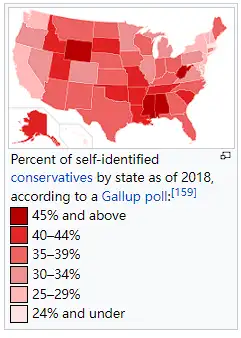
Conventional conservatism has been in decline across the Western world, not just the United States.[120] In the European Union’s multi-party system, right-wing populist parties and European conservative parties both received support from about a quarter of voters in the early 2020s, the highest share for right-wing populist parties since the end of World War II.[165]
【参考译文】传统保守主义不仅在衰退,而且这种衰落遍布整个西方世界,并非仅限于美国。[120] 在欧盟的多党制体系中,到了2020年代初,右翼民粹主义政党和欧洲保守派政党均获得了约四分之一选民的支持,这是自第二次世界大战结束以来右翼民粹主义政党获得的最高的得票份额。[165]
【英文词条原注[d]】Attributed to multiple sources.[113][99][112][100][114][160][161][162]
【参考译文】此观点(或信息)被归因于多个来源。[113][99][112][100][114][160][161][162]
Ronald Reagan’s presidential election in 1980 established Reagan-style American conservatism as the dominant ideological faction of the Republican Party until the election of Donald Trump in 2016.[d] Traditional conservatives combine support for free-market economic policies with social conservatism and a hawkish approach to foreign policy.[163] Other parts of the conservative movement are composed of fiscal conservatives and deficit hawks.[164]
【参考译文】罗纳德·里根在1980年的总统大选确立了“里根式”的美国保守主义作为共和党内占主导地位的意识形态派系,这一局面一直持续到2016年唐纳德·特朗普当选。[d] 传统保守派将支持自由市场经济政策、社会保守主义以及强硬的鹰派外交路线结合在一起。[163] 保守运动的其他组成部分则包括财政保守派和赤字鹰派。[164]
3.3.3 基督教右翼 | Christian right
Main articles: Christian right, Christian nationalism in the United States, and Social conservatism in the United States【主条目:基督教右翼、美国基督教民族主义以及美国社会保守主义】
See also: Bible Belt, United States anti-abortion movement, and 2020s anti-LGBT movement in the United States【另请参阅:圣经地带、美国反堕胎运动以及2020年代美国反LGBT运动】
Since the rise of the Christian right in the 1970s, the Republican Party has drawn significant support from evangelicals,[166] Mormons,[167] and traditionalist Catholics.[168] The Christian right faction is characterized by strong support of socially conservative policies.[169] Holding to right-wing interpretations of Christianity, they have varying beliefs on how it should influence law and public policy.[170] Compared to other Republicans, the Christian right faction is more likely to oppose LGBT rights, marijuana legalization, and support significantly restricting the legality of abortion.[171]
【参考译文】自20世纪70年代基督教右翼崛起以来,共和党获得了来自福音派教徒、[166] 摩门教徒[167] 和传统天主教徒的广泛支持。[168] 基督教右翼派别的特点是强烈支持社会保守政策。[169] 他们坚持对基督教的右翼解读,但在宗教应如何影响法律与公共政策方面存在不同的看法。[170] 与其他共和党人相比,基督教右翼更有可能反对LGBT权利和大麻合法化,并大力支持大幅限制堕胎的合法性。[171]
The Christian right is strongest in the Bible Belt, which covers most of the Southern United States.[172] Mike Pence, Donald Trump’s vice president from 2017 to 2021, was a member of the Christian right.[173] In October 2023, a member of the faction, Louisiana representative Mike Johnson, was elected the 56th Speaker of the United States House of Representatives.[174][175]
【参考译文】基督教右翼在“圣经地带”势力最为强大,该区域涵盖了美国南部的大部分地区。[172] 唐纳德·特朗普在2017年至2021年间的副总统迈克·彭斯(Mike Pence)就是基督教右翼的成员。[173] 2023年10月,该派别成员、路易斯安那州众议员迈克·约翰逊当选为第56任美国众议院议长。[174][175]
3.3.4 自由主义 | Libertarians
Main articles: Libertarian Republican and Right-libertarianism
【主条目:自由意志派共和党人、右翼自由意志主义】
See also: Libertarian conservatism, Libertarianism in the United States, Republican Liberty Caucus, and Tea Party movement【另请参阅:自由意志保守主义、美国的自由意志主义、共和党自由党团以及茶党运动】
The Republican Party has a libertarian faction.[18][150] This faction of the party is most popular in the Midwestern and Western United States.[150] Libertarianism emerged from fusionism in the 1950s and 60s.[176] Barry Goldwater had a substantial impact on the conservative-libertarian movement of the 1960s.[177] Compared to other Republicans, they are more likely to favor the legalization of marijuana, LGBT rights such as same-sex marriage, gun rights, oppose mass surveillance, and support reforms to current laws surrounding civil asset forfeiture. Right-wing libertarians are strongly divided on the subject of abortion.[178] Prominent libertarian conservatives within the Republican Party include Rand Paul,[179][180] Thomas Massie,[181] and Mike Lee.[179][182]
【参考译文】共和党内存在一个自由意志派系。[18][150] 该派别在美国中西部和西部地区最为盛行。[150] 自由意志主义起源于20世纪50年代和60年代的融合主义(fusionism)。[176] 巴里·戈德华特对20世纪60年代的保守-自由意志运动产生了重大影响。[177]与其他共和党人相比,他们更有可能支持大麻合法化、同性婚姻等LGBT权利及枪支权利,反对大规模监控,并支持改革现行的民事资产没收相关法律。不过,右翼自由意志主义者在堕胎问题上存在严重分歧。[178] 共和党内的知名自由意志保守派人士包括兰德·保罗(Rand Paul)、[179][180] 托马斯·马西(Thomas Massie)[181] 以及迈克·李(Mike Lee)。[179][182]
3.3.5 温和派 | Moderates
Main articles: Centrism and Center-right politics【主条目:中间主义、中右翼政治】
See also: Republican Governance Group, Moderate conservatism, and Problem Solvers Caucus
【另请参阅:共和党治理小组、温和保守主义以及问题解决者党团】
Moderates in the Republican Party are an ideologically centrist and center-right group that predominantly come from the Northeastern United States,[183] and are typically located in swing states or blue states. Moderate Republicans are typically highly educated, affluent, fiscally conservative, socially moderate or liberal and often supported the “Never Trump” movement.[150][183]
【参考译文】共和党内的温和派是一个在意识形态上偏向中间和中右翼的群体,他们主要来自美国东北部地区,[183] 通常集中在摇摆州或蓝州。温和派共和党人通常受教育程度较高且经济富裕;他们在财政上持保守立场,但在社会议题上较为温和或偏自由派,并且经常支持“反特朗普”(Never Trump)运动。[150][183]
Moderate Republicans differ in that some are for affirmative action,[184] LGBT rights and same-sex marriage, legal access to abortion, gun control laws, environmental regulation and action on climate change, fewer restrictions on immigration and a path to citizenship for illegal immigrants.[185] In the 21st century, a significant amount of former Republican moderates have switched to the Democratic Party,[186][187][188] and the faction is viewed as in decline.[189]
【参考译文】与其他共和党人不同,部分温和派支持平权行动、[184] LGBT权利及同性婚姻、堕胎合法化、枪支管制法律、环境监管与应对气候变化行动,同时主张放宽移民限制并为非法移民提供获得公民身份的途径。[185] 进入21世纪以来,大量前共和党温和派人士已转投民主党,[186][187][188] 该派别也被认为正处于衰退之中。[189]
Notable Republicans include Senators Lisa Murkowski of Alaska and Susan Collins of Maine,[190] Nevada governor Joe Lombardo, Vermont governor Phil Scott,[191] New Hampshire governor Kelly Ayotte, and former Maryland governor Larry Hogan.[192][193]
【参考译文】知名的温和派共和党人包括阿拉斯加州参议员莉萨·穆尔科斯基(Lisa Murkowski)和缅因州参议员苏珊·柯林斯(Susan Collins),[190] 内华达州州长乔·隆巴多(Joe Lombardo)、佛蒙特州州长菲尔·斯科特(Phil Scott)、[191] 新罕布什尔州州长凯利·阿约特(Kelly Ayotte)以及马里兰州前州长拉里·霍根(Larry Hogan)。[192][193]
4. 政治立场 | Political positions
Main article: Political positions of the Republican Party【主条目:共和党的政治立场】
The Republican Party is a neo-nationalist and right-wing populist party;[g] until 2017, it was generally described as upholding American conservatism, with conservatives now only making up a minority of the party.[h] Comparative politics studies by the V-Dem Institute,[24] Polity Data Series,[198][38] Global Party Survey,[199] Protect Democracy,[200] The Washington Post,[36] and the Manifesto Project Database[201] classify the party as “far-right” in an international context, as well as a majority of political scientists.[i] Freedom House, which is generally respected in the political science field but has also received criticism for dependence on federal government funding, described “the Republicans on the right and the Democrats on the left” in its 2026 report for the United States.[209]
【参考译文】共和党是一个新民族主义和右翼民粹主义政党;[g] 在2017年之前,该党通常被描述为捍卫美国保守主义的政党,但目前保守派在该党内仅占少数。[h] V-Dem研究所、[24] Polity数据系列、[198][38] 全球政党调查、[199] “保护民主”组织、[200] 《华盛顿邮报》[36] 以及《宣言项目数据库》[201] 的比较政治学研究,连同大多数政治学家的观点,在国际背景下将该党归类为“极右翼”。[i] 自由之家(Freedom House)在其2026年的美国报告中描述了“右翼的共和党人和左翼的民主党人”。尽管自由之家在政治科学领域普遍受到尊重,但也因其依赖联邦政府资金而受到过批评。[209]
【英文词条原注[g]】Scholars broadly agree that the modern GOP is a nationalist party.[26] There is an ongoing academic debate on type, and they have variously described the party as civic, cultural, or ethnic nationalist,[e] or taking aspects from them.[f] In 2026, the V-Dem Institute reported a consensus in political science that the party is “far-right” and its nationalism is “anti-pluralist”.[196]
【参考译文】学者们普遍认同,现代共和党(GOP)是一个民族主义政党。[26] 关于其具体的民族主义类型,学术界仍在持续辩论;学者们分别将其描述为公民民族主义、文化民族主义或种族民族主义,[e] 或是认为该党兼具上述几种特征。[f] 2026年,V-DEM研究所的报告指出,政治学界已达成共识,认为该党属于“极右翼”,且其民族主义带有“反多元主义”色彩。[196]
【英文词条原注[e]】One example is Steven Levitsky.[194]
【参考译文】一个典型的例子是史蒂文·列维茨基(Steven Levitsky)。[194]
【英文词条原注[f]】Political scientist Cas Mudde discusses this debate in his 2019 book The Far-Right Today.[195]
【参考译文】政治学家卡斯·穆德(Cas Mudde)在其2019年出版的《今日极右翼》(The Far-Right Today)一书中探讨了这场辩论。[195]
【英文词条原注[h]】olitical scientists had generally seen the party as upholding American conservatism before 2017; it is now considered a minority view in the party.[28][9][10][52][112][113][114][117][35][118][115][120][54][55][12][197]
【参考译文】在2017年之前,政治学家们普遍认为该党坚守美国保守主义;但在如今党内,这已被视为一种少数派观点。[28][9][10][52][112][113][114][117][35][118][115][120][54][55][12][197]
【英文词条原注[i]】In 2026, the V-DEM Institute stated that there was a broad academic consensus that the GOP is located on the far-right of the international political spectrum.[26] Political scientists and historians who hold to this stance, outside of comparative politics studies, include Cas Mudde,[202] Pippa Norris,[203] Lee Drutman,[204] Steven Levitsky,[205] Roger Griffin,[206] Robert Paxton,[207] Brian Klaas,[208] Cristóbal Rovira Kaltwasser,[28] Kenneth Roberts,[28] and Staffan I. Lindberg.[26]
【参考译文】2026年,V-DEM(民主多样性)研究所指出,学术界已达成广泛共识,认为共和党(GOP)在国际政治光谱中处于极右翼位置。[26] 在比较政治学研究之外,持有这一立场的政治学家和历史学家包括卡斯·穆德(Cas Mudde)、[202] 皮帕·诺里斯(Pippa Norris)、[203] 李·德鲁特曼(Lee Drutman)、[204] 史蒂文·列维茨基(Steven Levitsky)、[205] 罗杰·格里芬(Roger Griffin)、[206] 罗伯特·帕克斯顿(Robert Paxton)、[207] 布莱恩·克拉斯(Brian Klaas)、[208] 克里斯托瓦尔·罗维拉·卡尔特瓦塞尔(Cristóbal Rovira Kaltwasser)、[28] 肯尼斯·罗伯茨(Kenneth Roberts)[28] 以及斯塔凡·I·林德伯格(Staffan I. Lindberg)。[26]
By the early 2020s, the Republican Party distanced itself from its traditional international conservative allies and aligned itself with the global far-right,[36][37] supporting Alternative for Germany, Fidesz, and the National Rally.[203]
【参考译文】到了2020年代初,共和党与其传统的国际保守派盟友拉开距离,转而与全球极右翼势力结盟,[36][37] 包括支持德国的选择党(AfD)、匈牙利青年民主主义者联盟(Fidesz)以及法国的国民联盟(National Rally)。[203]
4.2 对特朗普主义与极右翼意识形态的拥抱 | Embrace of Trumpism and far-right ideology
See also: Trumpism and Radical right (United States)【另请参阅:特朗普主义、激进右翼(美国)】
The election of Trump in 2016 saw the Republican Party shift to embrace and bring far-right, fringe, and extreme ideas and organizations into the mainstream.[210] His election shifted traditional Republican beliefs and ideology into a new leadership style and political agenda referred to as Trumpism.[9][10][11]
【参考译文】2016年特朗普的当选,标志着共和党发生转变,开始将极右翼、边缘化以及极端的思想与组织纳入主流。[210] 他的当选改变了共和党的传统信仰和意识形态,使其转向一种被称为“特朗普主义”的新型领导风格和政治议程。[9][10][11]
Trump explicitly and routinely disparages racial, religious, and ethnic minorities,[211] and scholars consistently find that racial animus regarding blacks, immigrants, and Muslims are the best predictors of support for Trump.[212] By 2025, congressional Republicans have increasingly used overtly bigoted language and offensive tropes against the racial and religious identity of their political opponents with little to no pushback from GOP leadership.[213][214] In 2026, elected Republicans have increasingly used blatantly anti-Muslim rhetoric which was described by commentators as mirroring a prior increase in such rhetoric by the GOP following the 9/11 attacks in 2001.[215][216][217]
【参考译文】特朗普经常明确且惯常地贬低少数种族、宗教和族裔群体,[211] 学者们一致认为,针对黑人、移民和穆斯林的种族敌意是预测选民是否支持特朗普的最佳指标。[212] 到2025年,国会中的共和党人越来越多地使用公然带有偏见色彩的语言和冒犯性陈词滥调来攻击政敌的种族与宗教身份,而共和党高层对此几乎或根本没有提出任何反对意见。[213][214] 到了2026年,当选的共和党人越来越多地使用明目张胆的反穆斯林言论,评论人士指出,这与2001年“9·11”袭击事件后该党此类言论增加的情况如出一辙。[215][216][217]
The second presidency of Trump saw him nominate several White House officials[who?] with ties to antisemitic extremists.[218] His administration promoted social media content promoting remigration[41] and containing antisemitic slurs,[219] and was criticized as promoting white nationalism and Nazism.[220][221][222][223] Other social media posts from multiple government agencies have variously alluded to neo-Nazi and white supremacist literature and promoted ethnic cleansing and QAnon conspiracies.[224] The Southern Poverty Law Center found that some “images and language appear to come directly from antisemitic and neo-Nazi publications and a white Christian nationalist website”.[220]
【参考译文】在特朗普的第二任期内,他提名了数名与反犹极端分子有联系的白宫官员。[218] 他的政府不仅通过社交媒体推广鼓吹“重新移民”(remigration)的内容,还发布了包含反犹侮辱性词汇的信息,[219] 并因此被批评涉嫌宣扬白人民族主义和纳粹主义。[220][221][222][223] 此外,多个政府机构发布的其他社交媒体帖子,也曾以不同方式影射新纳粹和白人至上主义的文献,甚至散布过种族清洗言论及QAnon(匿名者Q)阴谋论。[224] 美国南方贫困法律中心(Southern Poverty Law Center)发现,其中一些“图像和语言似乎直接源自反犹和新纳粹出版物,以及一个白人基督教民族主义网站”。[220]
In October 2025, Politico revealed leaked group chats among high-ranking leaders of the “Young Republicans” that included language praising Adolf Hitler and promoting Nazism, encouraging the rape and killing of political opponents, extensive use of antisemitic and racial slurs, and favorable opinions on slavery.[225] The messages drew bipartisan condemnation, and another incident involving the display of an American flag with a swastika in Republican Congressman David Taylor‘s office a day later spurred significant political commentary about the future of the GOP and condemnation about the prominence of Nazi ideology within the Republican Party.[226] The same month, Politico posted more leaked messages from Republican Office of Special Council nominee Paul Ingrassia where he stated he had “a Nazi streak”, that he wanted white men in positions of leadership, used ethnic slurs for Black people and Italians, and proposed making Kwanzaa and all celebrations of Black culture illegal.[227]
【参考译文】2025年10月,《政治报》(Politico)曝光了“青年共和党”高层领导人之间的泄露群聊记录。这些聊天内容包含赞美阿道夫·希特勒和宣扬纳粹主义的言论、煽动对政敌实施强奸与杀害、大量使用反犹及种族歧视性侮辱词汇,以及对奴隶制表示赞同。这些信息引发了两党的一致谴责;一天后,又发生了另一起事件——在共和党众议员戴夫·泰勒(David Taylor)的办公室内发现了一面带有纳粹卐字旗的美国国旗,这进一步引发了针对共和党未来的重大政治评论,以及对纳粹意识形态在共和党内日益凸显的强烈谴责。同月,《政治报》还发布了更多来自共和党特别检察官办公室主任提名人保罗·英格拉西亚(Paul Ingrassia)的泄露信息。他在其中声称自己有“纳粹倾向”,希望由白人男性担任领导职务,使用针对黑人和意大利人的种族歧视称呼,并提议将宽扎节(Kwanzaa)及所有庆祝黑人文化的活动定为非法。
Also starting in October 2025, Axios, Politico, The Economist, The Wall Street Journal, and The New York Times described the party as undergoing a “rift” among a growing cohort of anti-Jewish and antisemitic voices within the party and debate over how expansive the party’s coalition should be.[228][229] In January 2026, Trump publicly came out against those with antisemitic views in the party, which The New York Times and The Economist described as being contrasted with J.D. Vance’s prior refusal to condemn the incidents and statement that the party did not need “purity tests”.[228][230]
【参考译文】同样从2025年10月开始,《Axios》、《政治报》(Politico)、《经济学人》(The Economist)、《华尔街日报》(The Wall Street Journal)和《纽约时报》(The New York Times)均指出,随着党内反犹太主义声音的不断增多,以及关于该党联盟应扩大到何种程度的激烈辩论,共和党正经历一场“裂痕”。[228][229] 到了2026年1月,特朗普公开表态反对党内持反犹观点的人士。《纽约时报》和《经济学人》指出,这与J.D.万斯(J.D. Vance)此前拒绝谴责相关事件,并声称该党不需要进行“纯洁性测试”的立场形成了鲜明对比。[228][230]
Beginning in the early 2020s, several Republican politicians have been promoting the Great Replacement conspiracy theory.[231]
【参考译文】自2020年代初以来,多名共和党政客一直在宣扬“大取代”(Great Replacement)阴谋论。[231]
4.3 经济政策 | Economic policies
Enacting high tariffs on foreign imports is a core component of Donald Trump‘s fiscal agenda. Tariffs are taxes on foreign imports, mainly paid by domestic businesses, given that consumers generally do not import foreign goods directly.[232] By raising tariffs to their highest levels since the Gilded Age, Trump enacted one of the largest tax increases by any Republican president.[233] The Constitution’s Import-Export Clause requires that only the federal government be allowed to collect tariff revenue from imports.[234]
【参考译文】对外国进口商品征收高额关税是唐纳德·特朗普财政议程的核心组成部分。关税是对进口商品征收的税款,主要由国内企业承担,因为消费者通常不会直接进口外国商品。[232] 通过将关税提高至镀金时代(Gilded Age)以来的最高水平,特朗普实施了历任共和党总统中规模最大的增税举措之一。[233] 根据宪法中的进出口条款规定,只有联邦政府才有权从进口商品中收取关税收入。[234]
Traditionally, Republicans believe that free markets and individual achievement are the primary factors behind economic prosperity.[235] Reduction in income taxes for those with higher incomes[236][237] is a core component of Republicans’ fiscal agenda.[238]
【参考译文】传统上,共和党人认为自由市场和个人成就是经济繁荣的主要因素。[235] 降低高收入群体的所得税是共和党财政议程的另一项核心内容。[236][237][238]
As of 2025, Trump and the Republican Party largely abandoned traditional Republican orthodoxy about protecting and promoting the free market,[239] instead favoring state capitalism by taking direct government equity stakes in major US corporations, an approach that has been characterized by critics in favor of free market economics as socialist.[240] The Trump administration has also deviated from the GOP’s conventional free market approach by ordering Nvidia and AMD to pay the federal government a portion of chip sales to China.[241]
【参考译文】截至2025年,特朗普和共和党在很大程度上放弃了关于保护和促进自由市场的传统正统观念,[239] 转而通过直接持有美国大型企业的政府股权来支持国家资本主义;这种被崇尚自由市场经济学的批评人士称为“社会主义”的做法。此外,特朗普政府还下令要求英伟达(Nvidia)和超威半导体(AMD)将其对华芯片销售的部分款项上缴联邦政府,这同样偏离了共和党传统的自由市场路线。[241]
4.3.1 征税和贸易 | Taxes and trade
As of 2025 the Republican Party supports near-universal tariffs, but that has not always been the case. For example, during the last half of the 20th century, Republicans were strong proponents of free trade. However 68% of Republicans and Republican-leaning independents approve of the increasing tariffs while the Democrats overwhelmingly disapprove of it at 89%.[242] The current Republican president, Donald Trump, has been a staunch proponent of enacting tariffs as a means of generating tax revenue and has been described as a mercantilist.[34][243] In 2025, Trump raised American tariff rates to the highest in the world, at the highest level since the Smoot–Hawley Tariff Act of 1930.[244]
【参考译文】截至2025年,共和党支持近乎普遍的关税政策,但这并非一直如此。例如,在20世纪下半叶,共和党曾是自由贸易的坚定拥护者。然而如今,68%的共和党人及倾向共和党的独立人士赞成提高关税,而民主党人中则有高达89%的人对此表示强烈反对。[242]现任共和党总统唐纳德·特朗普是实施关税政策的坚定支持者,他主张以此作为增加税收的手段,并因此被外界称为“重商主义者”。[34][243] 2025年,特朗普将美国的关税税率提升至全球最高水平,这也是自1930年《斯姆特-霍利关税法》(Smoot–Hawley Tariff Act)以来的最高纪录。[244]
Donald Trump opposes globalization, and his economic policies have been described as attempting to unravel the multilateral global economic order, including the power of the World Trade Organization (WTO).[33] Trump has expressed his admiration for Republican president William McKinley‘s tariff policies. McKinley was the author of the Tariff Act of 1890, and both Trump and McKinley nicknamed themselves as a “Tariff Man”.[245][232] According to an April 2025 Economist/YouGov poll, “Republican voters overwhelmingly support Trump’s tariffs, while Democratic voters generally do not.”[246]
【参考译文】唐纳德·特朗普反对全球化,其经济政策被外界形容为试图瓦解多边全球经济秩序,包括削弱世界贸易组织(WTO)的权力。[33] 特朗普曾表达对共和党总统威廉·麦金莱关税政策的赞赏。麦金莱是《1890年关税法》的起草者,而特朗普与麦金莱都曾以“关税人”自居。[245][232] 根据经济学人/YouGov于2025年4月进行的民意调查,“共和党选民压倒性地支持特朗普的关税政策,而民主党选民则普遍持反对态度。”[246]
At its inception, the Republican Party supported protective tariffs. Abraham Lincoln enacted tariffs during the Civil War.[247][248] The great battle over the high Payne–Aldrich Tariff Act in 1910 caused a split in the party.[249] The Reciprocal Tariff Act of 1934 marked a sharp departure from the era of protectionism in the United States. American duties on foreign products declined from an average of 46% in 1934 to 12% by 1962, which included the presidency of Republican president Dwight D. Eisenhower.[250] After World War II, the U.S. promoted the General Agreement on Tariffs and Trade (GATT) established in 1947, to minimize tariffs and other restrictions, and to liberalize trade among all capitalist countries.[251][252]
【参考译文】共和党在成立之初便支持保护性关税。亚伯拉罕·林肯在内战期间就曾实施过关税政策。[247][248] 1910年,围绕高额《佩恩-奥尔德里奇关税法》的激烈斗争导致了该党内部的分裂。[249]1934年的《互惠贸易协定法》标志着美国彻底偏离了过去的保护主义时代。美国对外国产品征收的平均关税从1934年的46%降至1962年的12%,这一时期也包括了共和党总统德怀特·D·艾森豪威尔的任期。[250]第二次世界大战后,美国大力推动于1947年建立的《关税与贸易总协定》(GATT),旨在降低关税及其他贸易壁垒,并促进所有资本主义国家之间的贸易自由化。[251][252]
During the Reagan and George H. W. Bush administrations, Republicans abandoned protectionist policies[253] and came out against quotas and in favor of the GATT and the World Trade Organization policy of minimal economic barriers to global trade. Free trade with Canada came about as a result of the Canada–United States Free Trade Agreement of 1987, which led in 1994 to the North American Free Trade Agreement (NAFTA) based on Reagan’s plan to enlarge the scope of the market for American firms to include Canada and Mexico. President Bill Clinton, with strong Republican support in 1993, pushed NAFTA through Congress over the vehement objection of labor unions.[254][255]
【参考译文】在罗纳德·里根和乔治·H·W·布什(老布什)政府执政期间,共和党放弃了保护主义政策,[253] 转而反对实行进口配额,并支持《关税与贸易总协定》(GATT)以及世界贸易组织(WTO)倡导的减少全球经济贸易壁垒的政策。1987年签署的《美加自由贸易协定》促成了美加两国间的自由贸易;随后在1994年,基于里根总统将美国企业市场范围扩大至加拿大和墨西哥的计划,双方达成了《北美自由贸易协定》(NAFTA)。1993年,时任总统比尔·克林顿在共和党的强力支持下,不顾工会的强烈反对,成功推动国会通过了该协定。[254][255]
The 2016 presidential election marked a return to supporting protectionism, beginning with Donald Trump’s first presidency.[256][257] In 2017, only 36% of Republicans agreed that free trade agreements are good for the United States, compared to 67% of Democrats. When asked if free trade has helped respondents specifically, the approval numbers for Democrats drop to 54%, however approval ratings among Republicans remain relatively unchanged at 34%.[258]
【参考译文】2016年的总统大选标志着保护主义支持的回归,这一转变始于唐纳德·特朗普的首个总统任期。[256][257] 2017年的一项调查显示,仅有36%的共和党人认为自由贸易协定对美国有利,而持相同观点的民主党人比例则高达67%。当被问及自由贸易是否对受访者个人有所帮助时,民主党人的支持率下降至54%,但共和党人的支持率基本保持不变,仍为34%。[258]
Income tax cuts have been at the core of Republican economic policy since 1980.[259] At the national level and state level, Republicans tend to pursue policies of tax cuts and deregulation.[260] Modern Republicans advocate the theory of supply-side economics, which holds that lower tax rates increase economic growth.[261] Many Republicans oppose higher tax rates for higher earners, which they believe are unfairly targeted at those who create jobs and wealth. They believe private spending is more efficient than government spending. Republican lawmakers have also sought to limit funding for tax enforcement and tax collection.[262]
【参考译文】自1980年以来,减税一直是共和党经济政策的核心。[259] 在国家层面和地方州级层面,共和党倾向于推行减税和放松管制的政策。[260] 现代共和党人推崇供给侧经济学理论,该理论认为降低税率能够促进经济增长。[261] 许多共和党人反对向高收入群体征收更高的税率,他们认为这种做法是不公平地针对那些创造就业和财富的人。他们坚信私人支出比政府支出更具效率。此外,共和党的立法者还试图限制用于税务执法和税收征管的资金。[262]
The modern Republican Party’s economic policy positions tend to align with business interests and the affluent.[263][264][265][266][267]
【参考译文】现代共和党的经济政策立场往往与商业利益集团及富裕阶层的诉求相一致。[263][264][265][266][267]
Republicans have traditionally advocated in favor of fiscal conservatism.[268][269][270] By the 2020s, Republicans have largely abandoned fiscal conservatism as an ideological cornerstone.[271]
【参考译文】传统上,共和党一直主张财政保守主义。[268][269][270] 然而到了20世纪20年代(2020s),共和党在很大程度上已经放弃了将财政保守主义作为其意识形态的基石。[271]
4.3.2 工会与最低工资 | Labor unions and the minimum wage
The Republican Party is generally opposed to labor unions.[272][273] Republicans believe corporations should be able to establish their own employment practices, including benefits and wages, with the free market deciding the price of work. Since the 1920s, Republicans have generally been opposed by labor union organizations and members. At the national level, Republicans supported the Taft–Hartley Act of 1947, which gives workers the right not to participate in unions. Modern Republicans at the state level generally support various right-to-work laws.[j] Most Republicans also oppose increases in the minimum wage.[275]
【参考译文】共和党普遍反对工会。[272][273] 共和党人认为,企业应有权自主制定雇佣政策(包括福利和工资),并由自由市场来决定劳动力的价格。自20世纪20年代以来,共和党的立场一直遭到工会组织及其成员的反对。在国家层面,共和党支持1947年的《塔夫脱-哈特莱法案》(Taft–Hartley Act),该法案赋予了工人不参加工会的权利。如今在现代,各州层面的共和党人普遍支持各类“工作权利法”(right-to-work laws)。此外,大多数共和党人也反对提高最低工资标准。[275]
【英文词条原注[j]】Right-to-work laws ban union security agreements, which require all workers in a unionized workplace to pay dues or a fair-share fee regardless of whether they are members of the union or not.[274]
【参考译文】工作权利法”(Right-to-work laws)禁止工会保障协议。这类协议通常要求,在已成立工会的工作场所中,无论工人是否为工会会员,都必须缴纳会费或支付公平份额费用(fair-share fee)。[274]
4.3.3 环境政策 | Environmental policies
Main article: Political positions of the Republican Party § Environmental policies
【主条目:共和党的政治立场 § 环境政策】
Historically, progressive leaders in the Republican Party supported environmental protection. Republican President Theodore Roosevelt was a prominent conservationist whose policies eventually led to the creation of the National Park Service.[278] While Republican President Richard Nixon was not an environmentalist, he signed legislation to create the Environmental Protection Agency in 1970 and had a comprehensive environmental program.[279]
【参考译文】从历史上看,共和党内的进步派领导人曾支持环境保护。共和党总统西奥多·罗斯福是一位著名的自然资源保护主义者,他的政策最终促成了美国国家公园管理局的成立。[278] 尽管共和党总统理查德·尼克松本人并非环保主义者,但他于1970年签署了建立美国国家环境保护局(EPA)的立法,并制定了一项全面的环境计划。[279]
However, this position has changed since the 1980s and the administration of President Ronald Reagan, who labeled environmental regulations a burden on the economy.[280] Since then, Republicans have increasingly taken positions against environmental regulation,[281][282][283] with many Republicans rejecting the scientific consensus on climate change.[280][284][285][286] Republican voters are divided over the human causes of climate change and global warming.[287]
【参考译文】然而,自20世纪80年代罗纳德·里根总统执政以来,这一立场发生了改变。里根将环境法规视为经济发展的负担。[280] 从那以后,共和党人越来越多地采取反对环境监管的立场,[281][282][283] 许多共和党人甚至拒绝接受关于气候变化的科学共识。[280][284][285][286] 在气候变化和全球变暖是否由人类引起的问题上,共和党的选民群体内部也存在分歧。[287]
Since 2008,[288] many members of the Republican Party have been criticized for being anti-environmentalist[289][290][291] and promoting climate change denial[280][292][293] in opposition to the general scientific consensus, making them unique even among other worldwide conservative parties.[293]
【参考译文】自2008年以来,[288] 许多共和党成员因被指责“反环保”以及违背主流科学共识、宣扬“气候变化否认论”而受到批评。[289][290][291][280][292][293] 这使他们即便在全球其他保守派政党中也显得十分独特。[293]
In 2006, then-California Governor Arnold Schwarzenegger broke from Republican orthodoxy to sign several bills imposing caps on carbon emissions in California. Then-President George W. Bush opposed mandatory caps at a national level. Bush’s decision not to regulate carbon dioxide as a pollutant was challenged in the Supreme Court by 12 states,[294] with the court ruling against the Bush administration in 2007.[295] Bush also publicly opposed ratification of the Kyoto Protocols[280][296] which sought to limit greenhouse gas emissions and thereby combat climate change; his position was heavily criticized by climate scientists.[297]
【参考译文】2006年,时任加利福尼亚州州长阿诺德·施瓦辛格打破了共和党的传统正统观念,签署了几项旨在限制加州碳排放的法案。而时任总统乔治·W·布什则反对在国家层面实行强制性排放上限。布什决定不将二氧化碳作为污染物进行监管,这一决定随后遭到12个州的起诉并诉至最高法院;[294] 最终,法院于2007年裁定布什政府败诉。[295]此外,布什还公开反对批准《京都议定书》。该议定书旨在通过限制温室气体排放来应对气候变化;[280][296] 他的这一立场遭到了气候科学家们的强烈批评。[297]
The Republican Party rejects cap-and-trade policy to limit carbon emissions.[298] In the 2000s, Senator John McCain proposed bills (such as the McCain-Lieberman Climate Stewardship Act) that would have regulated carbon emissions, but his position on climate change was unusual among high-ranking party members.[280] Some Republican candidates have supported the development of alternative fuels to achieve energy independence for the United States. Some Republicans support increased oil drilling in protected areas such as the Arctic National Wildlife Refuge, a position that has drawn criticism from activists.[299]
【参考译文】共和党拒绝接受旨在限制碳排放的“总量管制与交易”(cap-and-trade)政策。[298] 在21世纪初,参议员约翰·麦凯恩曾提出过一些旨在监管碳排放的法案(例如《麦凯恩-利伯曼气候管理法》),但在党内高层中,他对气候变化的立场属于异类。[280] 部分共和党候选人支持发展替代燃料,以实现美国的能源独立。与此同时,也有共和党人支持在北极国家野生动物保护区等受保护地区增加石油钻探,这一立场遭到了环保活动人士的批评。[299]
Many Republicans during the presidency of Barack Obama opposed his administration’s new environmental regulations, such as those on carbon emissions from coal. In particular, many Republicans supported building the Keystone Pipeline; this position was supported by businesses, but opposed by indigenous peoples’ groups and environmental activists.[300][301][302]
【参考译文】在贝拉克·奥巴马总统执政期间,许多共和党人反对他政府出台的新环境法规,例如针对煤炭碳排放的监管规定。特别是,许多共和党人支持建设“基石输油管道”(Keystone Pipeline);这一立场得到了企业界的支持,但遭到了原住民团体和环保活动人士的强烈反对。[300][301][302]
According to the Center for American Progress, a non-profit liberal advocacy group, more than 55% of congressional Republicans were climate change deniers in 2014.[303][304] PolitiFact in May 2014 found “relatively few Republican members of Congress … accept the prevailing scientific conclusion that global warming is both real and man-made.” The group found eight members who acknowledged it, although the group acknowledged there could be more and that not all members of Congress have taken a stance on the issue.[305][306]
【参考译文】据非营利自由派倡导组织“美国进步中心”(Center for American Progress)称,2014年有超过55%的国会共和党人是“气候变化否认者”。[303][304] 政治事实核查网站 PolitiFact 在2014年5月发现,“只有相对较少的国会共和党议员……接受主流科学界的结论,即全球变暖是真实存在的且由人类活动引起的。”该机构仅发现有八名议员承认这一结论,不过该机构也指出,实际人数可能更多,而且并非所有国会议员都对该问题表明过立场。[305][306]
From 2008 to 2017, the Republican Party went from “debating how to combat human-caused climate change to arguing that it does not exist”, according to The New York Times.[288] In January 2015, the Republican-led U.S. Senate voted 98–1 to pass a resolution acknowledging that “climate change is real and is not a hoax”; however, an amendment stating that “human activity significantly contributes to climate change” was supported by only five Republican senators.[307]
【参考译文】【参考译文】据《纽约时报》报道,从2008年到2017年,共和党经历了“从辩论如何对抗人类引起的气候变化,到争论气候变化根本不存在”的转变。[288]2015年1月,由共和党主导的美国参议院以98比1的投票结果通过了一项决议,承认“气候变化是真实的,并非骗局”;然而,一项指出“人类活动对气候变化有重大贡献”的修正案仅获得了五名共和党参议员的支持。[307]
By 2025, the GOP during the second Trump administration moved to abandon all efforts to regulate greenhouse gases by reversing the endangerment finding, and Trump criticized global warming as a “hoax” and a “con job”.[308] The Energy Department also released a report promoting climate change denial and refuting the scientific consensus on climate change after several climate skeptics were given government jobs.[309]
【参考译文】到了2025年,在特朗普第二任期内,共和党政府着手废除“危害认定”(endangerment finding),试图放弃所有监管温室气体的努力;同时,特朗普将全球变暖斥为“骗局”和“欺诈行为”。[308] 此外,在多名气候变化怀疑论者被任命为政府官员后,美国能源部还发布了一份报告,宣扬气候变化否认论并反驳关于气候变化的科学共识。[309]
4.3.4 医疗保健 | Health care
The party opposes a single-payer health care system,[310][311] describing it as socialized medicine. It also opposes the Affordable Care Act[312] and expansions of Medicaid.[313] Historically, there have been diverse and overlapping views within both the Republican Party and the Democratic Party on the role of government in health care, but the two parties became highly polarized on the topic during 2008–2009 and onwards.[314]
【参考译文】共和党反对单一支付者医疗体系(single-payer health care system),[310][311] 并将其称为“社会化医疗”。该党同样反对《平价医疗法案》(Affordable Care Act)[312] 以及扩大医疗补助计划(Medicaid)。[313] 历史上,共和党和民主党在政府在医疗保健中的角色问题上一直存在多样且相互交织的观点;但在2008年至2009年及以后,两党在这一议题上变得高度极化。[314]
Both Republicans and Democrats made various proposals to establish federally funded aged health insurance prior to the bipartisan effort to establish Medicare and Medicaid in 1965.[315][316][317] No Republican member of Congress voted for the Affordable Care Act in 2009, and after it passed, the party made frequent attempts to repeal it.[314][318] At the state level, the party has tended to adopt a position against Medicaid expansion.[260][317]
【参考译文】在1965年两党共同努力建立联邦医疗保险(Medicare)和医疗补助计划(Medicaid)之前,共和党和民主党都曾提出过各种建立由联邦资助的老年人医疗保险的方案。[315][316][317] 2009年,没有一名共和党国会议员投票支持《平价医疗法案》,而在该法案通过后,共和党又频繁试图将其废除。[314][318] 在州一级,该党往往采取反对扩大医疗补助计划的立场。[260][317]
Republicans typically believe individuals should take responsibility for their own circumstances and that the private sector is more effective in helping the poor through charity than the government is through welfare programs, and argue that social assistance programs cause government dependency.[319] As of November 2022, all 11 states that had not expanded Medicaid had Republican-controlled state legislatures.[320]
【参考译文】共和党人通常认为个人应为自己的处境负责,并且私营部门通过慈善来帮助穷人比政府通过福利项目更有效;他们主张社会援助计划会导致人们对政府产生依赖。[319] 截至2022年11月,所有未扩大医疗补助计划的11个州均由共和党控制州议会。[320]
By 2020, Republican officials had increasingly adopted anti-vaccine activism and policy.[321]
【参考译文】到了2020年,共和党官员日益采纳反疫苗活动的主张及相关政策。[321]
4.4 对外政策 | Foreign policy
See also: History of foreign policy and national defense in the Republican Party
【另请参阅:共和党外交政策与国防史】
The Republican Party has a persistent history of skepticism or opposition to multilateralism in American foreign policy.[322] Its members have frequently advocated for restricting foreign aid to assert the interests of the United States.[323][324][325]
【参考译文】在美国外交政策方面,共和党一贯持有多边主义的怀疑态度或反对立场。[322] 该党成员经常主张限制对外援助,以维护美国的利益。[323][324][325]
4.4.1 以色列 | Israel
During the 1940s, many Republicans, particularly Senator Robert A. Taft, advocated for recognition of Israel,[326] leading to support for Israel being integrated into the 1948 Republican Party platform.[327] Nevertheless, some Republicans at the time opposed the cause of an independent Jewish state due to the influence of conservatives of the Old Right.[328]
【参考译文】20世纪40年代,许多共和党人(特别是参议员罗伯特·A·塔夫脱)主张承认以色列,[326] 这一立场最终促使支持以色列被纳入1948年共和党的竞选纲领。[327] 尽管如此,受当时“老右翼”(Old Right)保守派的影响,部分共和党人仍反对建立独立的犹太国家。[328]
The rise of neoconservatism saw the Republican Party become further pro-Israel by the 1990s and 2000s,[329] although notable anti-Israel sentiment persisted through paleoconservative figures such as Pat Buchanan.[330] As president, Donald Trump generally supported Israel during most of his term, but became increasingly critical of Israeli Prime Minister Benjamin Netanyahu towards the end of it.[331] According to i24NEWS, the 2020s have seen declining support for Israel among nationalist Republicans, led by individuals such as Tucker Carlson.[328][332]
【参考译文】随着新保守主义的兴起,共和党在20世纪90年代和21世纪初变得更加亲以色列;[329] 不过,以帕特·布坎南(Pat Buchanan)为代表的古保守派人物中,依然存在明显的反以色列情绪。[330] 在担任总统期间,唐纳德·特朗普在其任期的大部分时间里总体上支持以色列,但在任期末尾对以色列总理本雅明·内塔尼亚胡的批评日益增多。[331] 据 i24NEWS 报道,进入21世纪20年代后,以塔克·卡尔森(Tucker Carlson)等人为代表的民族主义共和党人对以色列的支持度有所下降。[328][332]
Nevertheless, the 2024 Republican Party platform reaffirmed the party would “stand with Israel” and called for the deportation of “pro-Hamas radicals”, while expressing a desire for peace in the Middle East.[333] Although the Republican Party has often positioned itself as an opponent of antisemitism and denounced Democrats as insufficiently supportive of Israel,[334] many members of the Christian right support Israel primarily due to theological beliefs about the centrality of Israel to the Second Coming of Jesus Christ and the conversion or damnation of Jews and other non-Christians.[335][336]
【参考译文】然而,2024年共和党竞选纲领重申该党将“与以色列站在一起”,呼吁驱逐“亲哈马斯激进分子”,同时表达了实现中东和平的愿望。[333] 尽管共和党经常将自己定位为反犹主义的反对者,并指责民主党对以色列的支持不够坚定,[334] 但基督教右翼中的许多成员支持以色列,主要是出于神学信仰——他们认为以色列对于耶稣基督的第二次降临以及犹太人和其他非基督徒的皈依或受谴责具有核心意义。[335][336]
4.4.2 中国台湾地区 | Taiwan
In the party’s 2016 platform,[337] its stance on Taiwan is: “We oppose any unilateral steps by either side to alter the status quo in the Taiwan Straits on the principle that all issues regarding the island’s future must be resolved peacefully, through dialogue, and be agreeable to the people of Taiwan.” In addition, if “China were to violate those principles, the United States, in accord with the Taiwan Relations Act, will help Taiwan defend itself”.
【参考译文】在该党2016年的政纲中,[337] 对台湾的立场是:“我们反对任何一方单方面采取行动改变台湾海峡现状,原则上岛屿未来的所有事务都必须通过和平方式、通过对话解决,并且必须得到台湾人民的同意。”此外,如果“中国违反这些原则,美国将依据《台湾关系法》协助台湾自卫。”
Mention of Taiwan was omitted from the party’s 2024 platform.[338]
【参考译文】在该党2024年的政纲中,[338] 对台湾的提及已被省略。
4.4.3 反恐战争 | War on terror
Main article: War on terror【主条目:反恐战争】
Further information: September 11 attacks【更多信息:九一一袭击事件】
Since the terrorist attacks on September 11, 2001, neoconservatives in the party have supported the war on terror, including the War in Afghanistan and the Iraq War. The George W. Bush administration took the position that the Geneva Conventions do not apply to unlawful combatants, while other prominent Republicans, such as Ted Cruz, strongly oppose the use of enhanced interrogation techniques, which they view as torture.[339] In the 2020s, Trumpist Republicans such as Matt Gaetz supported reducing American military presence abroad and ending intervention in countries such as Somalia.[340]
【参考译文】自2001年9月11日恐怖袭击发生以来,党内的新保守主义者一直支持“反恐战争”,其中包括阿富汗战争和伊拉克战争。乔治·W·布什政府曾主张《日内瓦公约》不适用于非法战斗人员;而其他知名共和党人(如特德·克鲁兹)则强烈反对使用强化审讯技术,他们认为这属于酷刑行为。[339] 进入21世纪20年代后,以马特·盖茨(Matt Gaetz)为代表的特朗普派共和党人支持减少美国在海外的军事存在,并结束在索马里等国的干预行动。[340]
4.4.4 欧洲、俄罗斯与乌克兰 | Europe, Russia and Ukraine
See also: United States and the Russian invasion of Ukraine
【另请参阅:美国与俄罗斯入侵乌克兰】
The 2016 Republican platform eliminated references to giving weapons to Ukraine in its fight with Russia and rebel forces; the removal of this language reportedly resulted from intervention from staffers to presumptive Republican presidential nominee Donald Trump.[341] However, the Trump administration approved a new sale of anti-tank weapons to Ukraine in 2017.[342] Republicans generally question European NATO members’ alleged insufficient investment in defense funding, and some are dissatisfied with American aid to Ukraine.[343][344] Some Republican members of the U.S. Congress support foreign aid to Israel but not to Ukraine,[142][143] and have been described by U.S. media as pro-Russian.[145][147][148][149][150]
【参考译文】2016年共和党竞选纲领删除了在乌克兰抗击俄罗斯和叛军的斗争中向其提供武器的相关表述;据报道,这一措辞的删减是受时任共和党假定总统候选人唐纳德·特朗普的幕僚干预所致。[341] 然而,特朗普政府在2017年批准向乌克兰出售新一批反坦克武器。[342] 共和党人普遍质疑欧洲北约成员国国防资金投入不足的说法,且部分人对美国援助乌克兰表示不满。[343][344] 一些美国国会共和党议员支持对外援助以色列但不支持援助乌克兰,[142][143] 并被美国媒体形容为“亲俄”。[145][147][148][149][150]
Amid the Russian invasion of Ukraine, several prominent Republicans criticized some colleagues and conservative media outlets for echoing Russian propaganda. Liz Cheney, formerly the third-ranking House Republican, said “a Putin wing of the Republican Party” had emerged. Former vice president Mike Pence said, “There is no room in the Republican Party for apologists for Putin.” House Foreign Affairs Committee chairman Michael McCaul asserted that Russian propaganda had “infected a good chunk of my party’s base.” House Intelligence Committee chairman Mike Turner confirmed McCaul’s assessment, asserting that some propaganda coming directly from Russia could be heard on the House floor. Republican senator Thom Tillis characterized the influential conservative commentator Tucker Carlson, who frequently expresses pro-Russia sentiments, as Russia’s “useful idiot“.[345][346][347][348]
【参考译文】在俄罗斯入侵乌克兰期间,多名知名共和党人批评部分同僚及保守派媒体迎合俄罗斯的虚假宣传。曾任众议院共和党第三号人物的莉兹·切尼(Liz Cheney)表示,共和党内已经出现了一个“普京派系”;前副总统迈克·彭斯称,“共和党内容不下普京的辩护者”;众议院外交事务委员会主席迈克尔·麦考尔断言,俄罗斯的政治宣传已经“感染了我党相当大一部分基本盘”;众议院情报委员会主席迈克·特纳证实了麦考尔的评估,指出一些直接来自俄罗斯的宣传言论甚至能在众议院的会议厅内听到。共和党参议员汤姆·蒂利斯(Thom Tillis)则将经常表达亲俄情绪的知名保守派评论员塔克·卡尔森称为俄罗斯的“有用的白痴”。[345][346][347][348]
In April 2024, a majority of Republican members of the U.S. House of Representatives voted against a military aid package to Ukraine.[349] Both Trump and Senator JD Vance, the 2024 Republican presidential nominee and vice presidential nominee respectively, have been vocal critics of military aid to Ukraine and advocates of a peace deal between Russia and Ukraine.[350][351][352][353] The 2024 Republican Party platform did not mention Russia or Ukraine, but stated the party’s objectives to “prevent World War III” and “restore peace to Europe”.[354]
【参考译文】2024年4月,美国众议院多数共和党议员投票反对一项对乌军事援助计划。[349] 作为2024年共和党正副总统候选人的特朗普和J.D.万斯(JD Vance)参议员,均公开批评对乌军事援助,并主张俄乌之间达成和平协议。[350][351][352][353] 2024年共和党竞选纲领未提及俄罗斯或乌克兰,但表明该党的目标是“防止第三次世界大战”并“恢复欧洲的和平”。[354]
In February 2025, during the Trump–Zelenskyy meeting, Trump and Vance hostilely berated Ukrainian president Volodymyr Zelenskyy.[355]
【参考译文】2025年2月,在特朗普与泽连斯基会晤期间,特朗普和万斯对乌克兰总统弗拉基米尔·泽连斯基进行了充满敌意的严厉斥责。[355]
4.5 社会议题 | Social issues
The Republican Party is generally associated with social conservative policies, although it does have dissenting centrist and libertarian factions. The social conservatives support laws that uphold their traditional values, such as opposition to same-sex marriage, abortion, and marijuana.[356] The Republican Party’s positions on social and cultural issues are in part a reflection of the influential role that the Christian right has had in the party since the 1970s.[357][358][166] Most conservative Republicans also oppose gun control, affirmative action, and illegal immigration.[356][359]
【参考译文】共和党通常与社会保守主义政策联系在一起,尽管党内也存在持不同意见的中间派和自由意志主义派系。社会保守派支持维护其传统价值观的法律,例如反对同性婚姻、堕胎和大麻合法化。[356] 共和党在社会和文化议题上的立场,在一定程度上反映了自20世纪70年代以来基督教右翼在该党中所发挥的重要影响力。[357][358][166] 大多数保守派共和党人还反对枪支管制、平权行动(affirmative action)以及非法移民。[356][359]
4.5.1 堕胎与胚胎干细胞研究 | Abortion and embryonic stem cell research
The Republican position on abortion has changed significantly over time.[168][360] During the 1960s and early 1970s, opposition to abortion was concentrated among members of the political left and the Democratic Party; most liberal Catholics—which tended to vote for the Democratic Party—opposed expanding abortion access while most conservative evangelical Protestants supported it.[360]
【参考译文】共和党在堕胎问题上的立场随着时间推移发生了显著变化。[168][360] 在20世纪60年代和70年代初,反对堕胎的声音主要集中在政治左翼和民主党内部:当时倾向于投票给民主党的自由派天主教徒大多反对扩大堕胎途径,而大多数保守派福音派新教徒则对此表示支持。[360]
During this period, Republicans generally favored legalized abortion more than Democrats,[361][362] although significant heterogeneity could be found within both parties.[363] Leading Republican political figures, including Richard Nixon, Gerald Ford, Ronald Reagan, and George H. W. Bush, took pro-choice positions until the early 1980s.[361] However, starting at this point, both George H.W. Bush and Ronald Reagan described themselves as pro-life during their presidencies.
【参考译文】在这一时期,共和党人总体上比民主党人更倾向于支持堕胎合法化,[361][362] 尽管两党内部都存在明显的观点分歧。[363] 包括理查德·尼克松、杰拉尔德·福特、罗纳德·里根和乔治·H·W·布什在内的共和党核心政治人物,在20世纪80年代初之前一直持支持选择权(pro-choice)的立场。[361] 然而从那时起,老布什和里根在担任总统期间均将自己标榜为反对堕胎(pro-life)的立场。
In the 21st century, both George W. Bush[364] and Donald Trump described themselves as “pro-life” during their terms. However, Trump stated that he supported the legality and ethics of abortion before his candidacy in 2015.[365]
【参考译文】进入21世纪后,乔治·W·布什和唐纳德·特朗普在任期间均将自己标榜为“反堕胎”(pro-life)的立场。[364] 然而,特朗普在2015年宣布参选总统之前,曾明确表示他支持堕胎的合法性与道德合理性。[365]
Summarizing the rapid shift in the Republican and Democratic positions on abortion, Sue Halpern writes:[168]
【参考译文】在总结共和党和民主党在堕胎问题上的立场转变时,苏·哈尔彭(Sue Halpern)写道:[168]
…in the late 1960s and early 1970s, many Republicans were behind efforts to liberalize and even decriminalize abortion; theirs was the party of reproductive choice, while Democrats, with their large Catholic constituency, were the opposition. Republican governor Ronald Reagan signed the California Therapeutic Abortion Act, one of the most liberal abortion laws in the country, in 1967, legalizing abortion for women whose mental or physical health would be impaired by pregnancy, or whose pregnancies were the result of rape or incest. The same year, the Republican strongholds of North Carolina and Colorado made it easier for women to obtain abortions. New York, under Governor Nelson Rockefeller, a Republican, eliminated all restrictions on women seeking to terminate pregnancies up to twenty-four weeks gestation…. Richard Nixon, Barry Goldwater, Gerald Ford, and George H.W. Bush were all pro-choice, and they were not party outliers. In 1972, a Gallup poll found that 68 percent of Republicans believed abortion to be a private matter between a woman and her doctor. The government, they said, should not be involved…
“……在20世纪60年代末和70年代初,许多共和党人支持放宽甚至将堕胎非罪化的努力;当时的共和党是主张生育选择权的政党,而民主党由于拥有庞大的天主教选民群体,反而成了反对的一方。
1967年,共和党籍州长罗纳德·里根签署了《加州治疗性堕胎法案》(California Therapeutic Abortion Act),这是当时全美最宽松的堕胎法之一。该法案规定,如果怀孕会损害女性的身心精神健康,或者怀孕是由强奸或乱伦导致的,允许其合法堕胎。同年,共和党的传统票仓北卡罗来纳州和科罗拉多州也降低了女性获取堕胎服务的门槛。此外,在共和党籍州长纳尔逊·洛克菲勒(Nelson Rockefeller)执政期间,纽约州取消了所有针对妊娠24周内终止妊娠的限制……
理查德·尼克松、巴里·戈德华特、杰拉尔德·福特和乔治·H·W·布什都持支持堕胎权(pro-choice)的立场,而且他们在党内绝非异类。1972年的一项盖洛普民意调查发现,68%的共和党人认为堕胎完全是女性与其医生之间的私事。他们表示,政府不应介入其中……”
Since the 1980s, opposition to abortion has become strongest in the party among traditionalist Catholics and conservative Protestant evangelicals.[168][363][366] Initially, evangelicals were relatively indifferent to the cause of abortion and overwhelmingly viewed it as a concern that was sectarian and Catholic.[366] Historian Randall Balmer notes that Billy Graham‘s Christianity Today published in 1968 a statement by theologian Bruce Waltke that:[367] “God does not regard the fetus as a soul, no matter how far gestation has progressed.”
【参考译文】自20世纪80年代以来,传统派天主教徒和保守派福音派新教徒成为了党内反对堕胎的最坚定力量。[168][363][366] 最初,福音派对反堕胎运动相对漠不关心,绝大多数人认为这仅仅是一个教派内部的问题,且带有浓厚的天主教色彩。[366] 历史学家兰德尔·巴尔默(Randall Balmer)指出,比利·格雷厄姆(Billy Graham)创办的《今日基督教》(Christianity Today)杂志曾在1968年发表过神学家布鲁斯·沃尔特克(Bruce Waltke)的一段声明:“无论妊娠进展到何种程度,上帝都不会将胎儿视为灵魂。”[367]
Typical of the time, Christianity Today “refused to characterize abortion as sinful” and cited “individual health, family welfare, and social responsibility” as “justifications for ending a pregnancy.”[368] Similar beliefs were held among conservative figures in the Southern Baptist Convention, including W. A. Criswell, who is partially credited with starting the “conservative resurgence” within the organization, who stated: “I have always felt that it was only after a child was born and had a life separate from its mother that it became an individual person and it has always, therefore, seemed to me that what is best for the mother and for the future should be allowed.”
【参考译文】这反映了当时的普遍态度:《今日基督教》杂志“拒绝将堕胎定性为罪恶”,并将“个人健康、家庭福祉和社会责任”列为“终止妊娠的正当理由”。[368] 南方浸信会中的保守派人士也持有类似的观点。其中包括W.A.克里斯韦尔(W. A. Criswell),他在该组织发起“保守派复兴运动”的过程中发挥了部分关键作用。他曾表示:“我一直认为,只有当孩子出生并在生理上脱离母亲独立生存后,他才成为一个独立的个体。因此在我看来,只要是对母亲和未来最好的选择,就应该被允许。”
Balmer argues that evangelical American Christianity being inherently tied to opposition to abortion is a relatively new occurrence.[368][369] After the late 1970s, he writes, opinion against abortion among evangelicals rapidly shifted in favor of its prohibition.[366]
【参考译文】巴尔默(Balmer)认为,美国福音派基督教与反对堕胎立场之间形成内在的紧密联系,其实是一个相对较新的现象。[368][369] 他写道,在20世纪70年代末之后,福音派对堕胎的态度迅速转变,开始强烈支持禁止堕胎。[366]
Today, opinion polls show that Republican voters are heavily divided on the legality of abortion,[370] although the vast majority of the party’s national and state candidates are anti-abortion and oppose elective abortion on religious or moral grounds. While many advocate exceptions in the case of incest, rape, or the mother’s life being at risk, in 2012 the party approved a platform advocating banning abortions without exception.[371]
【参考译文】如今,民调显示共和党选民在堕胎合法性问题上存在严重分歧。[370] 尽管如此,该党绝大多数全国及州级候选人仍持反堕胎立场,并基于宗教或道德理由反对自愿堕胎(elective abortion)。虽然许多人支持在乱伦、强奸或孕妇生命受到威胁的情况下设立例外条款,但在2012年,共和党通过的竞选纲领却主张全面禁止堕胎,不设任何例外。[371]
There were not highly polarized differences between the Democratic Party and the Republican Party before the Roe v. Wade 1973 Supreme Court ruling (which made prohibitions on abortion rights unconstitutional), but after the Supreme Court ruling, opposition to abortion became an increasingly key national platform for the Republican Party.[372][373][374] As a result, Evangelicals gravitated towards the Republican Party.[372][373] Most Republicans oppose government funding for abortion providers, notably Planned Parenthood.[375] This includes support for the Hyde Amendment.
【参考译文】在1973年最高法院就“罗诉韦德案”(Roe v. Wade)作出裁决(该裁决认定禁止堕胎权利违宪)之前,民主党与共和党之间并没有出现高度极化的分歧。但在此裁决之后,反对堕胎逐渐成为共和党日益重要的全国性竞选纲领。[372][373][374] 结果,福音派选民开始向共和党靠拢。[372][373]大多数共和党人反对政府为堕胎服务机构提供资金,特别是计划生育联合会(Planned Parenthood)。[375] 这也包括他们对《海德修正案》(Hyde Amendment)的支持。
Until its dissolution in 2018, Republican Majority for Choice, an abortion rights PAC, advocated for amending the GOP platform to include pro-abortion rights members.[376]
【参考译文】在2018年解散之前,“共和党支持选择权多数派”(Republican Majority for Choice)作为一个主张堕胎权的政治行动委员会(PAC),一直呼吁修改共和党的竞选纲领,以接纳并包容支持堕胎权的党员。[376]
The Republican Party has pursued policies at the national and state levels to restrict embryonic stem cell research beyond the original lines because it involves the destruction of human embryos.[377][378]
【参考译文】共和党在国家层面和各州层面推行了一系列政策,限制在最初批准的细胞系之外进行胚胎干细胞研究,因为这涉及破坏人类胚胎。[377][378]
After the overturning of Roe v. Wade in 2022, a majority of Republican-controlled states passed near-total bans on abortion, rendering it largely illegal throughout much of the United States.[379][380]
【参考译文】2022年“罗诉韦德案”(Roe v. Wade)被推翻后,多数由共和党控制的州通过了近乎全面禁止堕胎的法案,致使堕胎在美国大部分地区基本处于非法状态。[379][380]
4.5.2 平权行动 | Affirmative action
See also: Affirmative action in the United States【另请参阅:美国的平权行动】
Republicans generally oppose affirmative action, often describing it as a “quota system” and believing that it is not meritocratic and is counter-productive socially, with critics arguing that it promotes reverse discrimination. According to a 2023 ABC poll, a majority of Americans (52%) and 75% of Republicans supported the Supreme Court’s decision in Students for Fair Admissions v. Harvard prohibiting race as a factor in college admissions, compared to only 26% of Democrats.[381]
【参考译文】共和党人普遍反对“平权行动”,他们经常将其描述为一种“配额制度”,认为该政策不符合优绩制原则,且在社会层面适得其反。批评人士指出,这种政策实际上助长了“逆向歧视”。根据美国广播公司(ABC)2023年的一项民调,多数美国人(52%)以及75%的共和党人支持最高法院在“公平录取学生组织诉哈佛大学案”(Students for Fair Admissions v. Harvard)中的裁决,该裁决禁止在大学招生中将种族作为考量因素;相比之下,仅有26%的民主党人表示支持。[381]
The 2012 Republican national platform stated, “We support efforts to help low-income individuals get a fair chance based on their potential and individual merit; but we reject preferences, quotas, and set-asides, as the best or sole methods through which fairness can be achieved, whether in government, education, or corporate boardrooms…Merit, ability, aptitude, and results should be the factors that determine advancement in our society.”[382][383][384][385]
【参考译文】2012年共和党全国竞选纲领指出:“我们支持为低收入群体提供帮助,使他们能够凭借自身潜力和个人才干获得公平的机会;但我们拒绝将偏好、配额和预留名额作为实现公平的最好或唯一手段,无论是在政府、教育领域还是企业董事会中皆是如此……在我们的社会中,决定个人晋升的因素应当是才干、能力、天资和实际成绩。”[382][383][384][385]
4.5.3 持枪政策 | Gun policy
Both major parties in the United States support policies on gun ownership, in comparsion to a large majority of the world, which give broad legality to the possession of private firearms.[386] The modern Republican Party is now often seen as more favorable to laissez-faire gun laws.[387] The National Rifle Association of America, a special interest group in support of gun ownership, has consistently aligned itself with the Republican Party.[388] Following gun control measures under the Clinton administration, such as the Violent Crime Control and Law Enforcement Act of 1994, the Republicans allied with the NRA during the Republican Revolution in 1994.[389] Since then, the NRA has consistently backed Republican candidates and contributed financial support.[387]
【参考译文】与美国以外的世界上绝大多数国家不同,美国两大主要政党都支持允许广泛合法持有私人枪支的政策。[386] 如今,现代共和党通常被认为更倾向于对枪支采取自由放任(laissez-faire)的法律政策。[387] 作为支持持枪权的利益集团,美国全国步枪协会(NRA)始终与共和党保持一致立场。[388] 在克林顿政府时期出台了包括《1994年暴力犯罪控制与执法法》在内的枪支管控措施后,共和党在1994年的“共和党革命”中与全国步枪协会结成了同盟。[389] 此后,全国步枪协会一直坚定支持共和党候选人,并为其提供资金援助。[387]
Scholars note that Republicans and conservatives have historically supported forms of gun control when leftist groups, including Black Power and feminist movements, embrace “guns as tools for resistance and self‐defense against systemic oppression”.[390]
【参考译文】学者们指出,当左翼团体(包括“黑人权力”运动和女权运动)将枪支视为“抵抗系统性压迫和进行自卫的工具”时,共和党人和保守派在历史上曾支持过各种形式的枪支管控。[390]
4.5.4 刑事司法 | Criminal justice
See also: Illegal drug trade in the United States, Legality of cannabis by U.S. jurisdiction, Capital punishment in the United States, and Incarceration in the United States
【另请参阅:美国的非法毒品交易、美国各司法管辖区的大麻合法性、美国的死刑以及美国的监禁制度】
The Republican Party has generally promoted strict anti-crime policies, such as mandatory minimum sentences and the death penalty.[391][392][393] In the 2010s, however, prominent Republicans demonstrated some interest in criminal justice reform designed to combat mass incarceration, with President Trump signing the First Step Act, which expanded good behavior credits for perpetrators of most nonviolent crimes and required the U.S. Attorney General to develop a system to assess the recidivism risk of all federal prisoners.[394]
【参考译文】共和党通常主张推行严格的打击犯罪政策,例如强制性最低量刑和死刑。[391][392][393] 然而,在2010年代,一些知名的共和党人开始对旨在解决大规模监禁问题的“刑事司法改革”表现出一定的兴趣。特朗普总统签署了《第一步法案》(First Step Act),该法案扩大了大多数非暴力罪犯的减刑积分(良好行为积分),并要求美国司法部长建立一套系统,以评估所有联邦囚犯的重新犯罪风险。[394]
By 2024, however, the Republican Party and its leaders had largely left behind its prior support for reform of the justice system.[391] Republican elected officials have historically supported the war on drugs. They generally oppose legalization or decriminalization of drugs such as marijuana.[395][396][397]
【参考译文】不过到了2024年,共和党及其领导人已基本放弃了此前对司法体系改革的支持。[391] 从历史上看,共和党当选官员一直支持“禁毒战争”,他们普遍反对将大麻等毒品合法化或非罪化。[395][396][397]
Opposition to the legalization of marijuana has softened significantly over time among Republican voters and politicians.[398][399][400] A 2021 Quinnipiac poll found that 62% of Republicans supported the legalization of recreational marijuana use and that net support for the position was +30 points.[395] Some Republican-controlled states have legalized medical and recreational marijuana in recent years.[401] In September 2024, then-candidate Donald Trump endorsed the legalization of recreational marijuana.[402]
【参考译文】随着时间的推移,共和党选民和政客对大麻合法化的反对态度已显著软化。[398][399][400] 2021年昆尼皮亚克大学(Quinnipiac)的一项民调发现,62%的共和党人支持娱乐性大麻合法化,且该立场的净支持率达到+30个百分点。[395] 近年来,一些由共和党控制的州已经将医疗用大麻和娱乐用大麻合法化。[401] 2024年9月,当时的总统候选人唐纳德·特朗普也公开表态支持娱乐性大麻合法化。[402]
4.5.5 移民问题 | Immigration
See also: Remigration, Immigration to the United States, and Illegal immigration to the United States
【另请参阅:重新安置/遣返(Remigration)、美国移民史以及美国的非法移民】
The Republican Party has taken widely varying views on immigration throughout its history, but has generally and traditionally taken an anti-immigration and nativist stance compared to the opposition.[99] In the period between 1850 and 1870, the Republican Party was more opposed to immigration than the Democrats. The GOP’s opposition was, in part, caused by its reliance on the support of anti-Catholic and anti-immigrant parties such as the Know-Nothings.
【参考译文】纵观其历史,共和党对移民问题的看法存在巨大分歧,但与民主党(反对党)相比,它总体上和传统上一直采取反移民和本土主义立场。[99] 在1850年至1870年期间,共和党比民主党更反对移民。共和党的这种反对态度,部分原因在于其依赖于“一无所知党”(Know-Nothings)等反天主教及反移民政党的支持。
In the decades following the Civil War, especially in the 1880s, the Republican Party lessened its stance on immigration, as it represented the manufacturers in the northeast (who wanted additional labor); although during this period, the Democratic Party still came to be seen as the party of both American and foreign labor, and many religious Republicans used anti-Irish and pro-Christian sentiments. Starting in the early 1930s, the parties focused on Mexican emigration, as the Democrats proposed a softer stance on Mexican immigration during the Great Depression and New Deal, rather than Republicans under Herbert Hoover.[404][405]
【参考译文】在内战结束后的几十年里,尤其是在19世纪80年代,共和党缓和了其在移民问题上的强硬立场,因为该党代表着东北部的制造商群体(他们需要更多的劳动力);不过在此期间,民主党仍被视为代表美国本土工人和外籍劳工的政党,且许多有宗教信仰的共和党人利用反爱尔兰人和亲基督教的情绪来推动主张。从20世纪30年代初开始,两党开始将焦点转向墨西哥人的移出(移民)。在大萧条和罗斯福新政时期,民主党对墨西哥移民提出了相对温和的立场,而赫伯特·胡佛领导下的共和党则没有这样做。[404][405]
The modern GOP opposes the large majority of immigration from non-Western countries, including the Middle East, Africa, and South America.[208] In 2016, Donald Trump proposed to build a wall along the southern border of the United States. Trump immigration policies during his administration included a travel ban from multiple Muslim-majority countries, a Remain in Mexico policy for asylum-seekers, a controversial family separation policy, and attempting to end DACA.[137][406] The party largely opposes immigration reform.[407] The party’s proposed 2024 platform was opposed to immigration, and called for the mass deportation of all illegal immigrants in the United States,[408] which during Trump’s second presidency was extended to uimmigrants without permanent legal status.[409]
【参考译文】现代共和党(GOP)反对来自非西方国家(包括中东、非洲和南美洲)的绝大多数移民。[208] 2016年,唐纳德·特朗普提议在美墨南部边境修建隔离墙。在其执政期间,他推行的移民政策包括:针对多个穆斯林占多数国家的旅行禁令、要求寻求庇护者“留在墨西哥”的政策、备受争议的家庭分离政策,以及试图废除“童年抵美者暂缓遣返计划”(DACA)。[137][406] 该党总体上反对进行移民改革。[407] 在共和党提出的2024年竞选纲领中,明确表达了反移民立场,并呼吁对美国境内的所有非法移民进行大规模驱逐出境。[408] 而在特朗普的第二任总统任期内,这一驱逐范围进一步扩大到了没有永久合法身份的移民。[409]
Since the 2024 presidential election, the party’s leading figures have shifted towards supporting remigration.[398] In September, Donald Trump called for “remigration” of illegal immigrants to their home countries and suspending refugee resettlement, also pledging to “do large deportations in Springfield, Ohio“, referring to the town’s community of legal Haitian immigrants.[410][411] The usage mainstreamed the term in the country.[398] In May 2025 the Department of State released a “reorganisation chart” that included the creation of an “Office of Remigration“.[412][413][414]
【参考译文】自2024年总统大选以来,该党的重要人物逐渐转向支持“重新安置/大规模遣返”(remigration)。[398] 同年9月,唐纳德·特朗普呼吁将非法移民“重新安置”回其母国并暂停难民安置项目,他还承诺“在俄亥俄州斯普林菲尔德市进行大规模驱逐”,该市拥有庞大的海地合法移民社区。[410][411] 这一言论使该术语在美国国内被广泛使用。[398] 2025年5月,美国国务院公布了一份“重组图表”,其中包括设立一个“重新安置办公室”(Office of Remigration)。[412][413][414]
As President, Trump once again endorsed “remigration” in June 2025 as “reversing the invasion” of illegal immigrants into the United States.[415] In July 2025 Trump claimed that the One Big Beautiful Bill Act would allow for remigration to be implemented.[416] White House Deputy Chief of Staff Stephen Miller has been described as an advocate for remigration within the Trump administration.[417] In October 2025, the U.S. Department of Homeland Security gained attention after tweeting “remigrate” from its official X account.[418]
【参考译文】作为总统,特朗普于2025年6月再次公开支持“重新安置/大规模遣返”(remigration),将其称为“扭转非法移民入侵美国”的举措。[415] 同年7月,特朗普声称《一项宏大美好法案》(One Big Beautiful Bill Act)将为实施“重新安置”提供合法依据。[416] 白宫副幕僚长斯蒂芬·米勒(Stephen Miller)被描述为特朗普政府内部“重新安置”政策的积极倡导者。[417] 2025年10月,美国国土安全部在其官方X(原推特)账号上发布了“remigrate”(重新安置/遣返)一词,从而引发了广泛关注。[418]
The Trump administration has brought Afrikaner South Africans to the United States and other European-ethnic refugees through its refugee program.[419] In May 2025, Ramaphosa made a state visit to meet with President Donald Trump. During the press conference, Trump confronted him with claims of Afrikaner genocide in South Africa, which was denied by Ramaphosa.[420]
【参考译文】特朗普政府通过其难民项目,将南非的阿非利卡人(白人)及其他欧洲裔难民引入了美国。[419] 2025年5月,南非总统拉马福萨对美国进行国事访问并与美国总统唐纳德·特朗普举行会晤。在随后的新闻发布会上,特朗普当面提出关于“南非正在发生针对阿非利卡人的种族灭绝”的指控,但遭到拉马福萨的坚决否认。[420]
4.5.6 性少数群体议题 | LGBT issues
Main articles: 2020s anti-LGBT movement in the United States and Transgender genocide
【主要条目:《2020年代美国反LGBT运动》与《跨性别种族灭绝》】
The Republican Party is broadly opposed to LGBT rights, including same-sex marriage, expression, and transgender rights.[30] The large majority of its state and county/equivalent chapter platforms oppose same-sex marriage.[30]
【参考译文】共和党总体上反对LGBT权利,包括同性婚姻、相关表达自由以及跨性别者权利。[30] 该党绝大多数州级及县级(或同等级别)分支机构在其竞选纲领中均明确反对同性婚姻。[30]
From the early 2000s to the mid-2010s, Republicans opposed same-sex marriage, while being divided on the issue of civil unions and domestic partnerships for same-sex couples.[421] During the 2004 election, George W. Bush campaigned prominently on a constitutional amendment to prohibit same-sex marriage; many believe it helped Bush win re-election.[422][423] In both 2004[424] and 2006,[425] President Bush, Senate Majority Leader Bill Frist, and House Majority Leader John Boehner promoted the Federal Marriage Amendment, a proposed failed constitutional amendment which would legally restrict the definition of marriage to heterosexual couples.[426][427][428]
【参考译文】从21世纪初到2010年代中期,共和党一直反对同性婚姻,但在同性伴侣的“民事结合”和“家庭伴侣关系”问题上存在内部分歧。[421] 在2004年总统大选中,乔治·W·布什将推动一项旨在禁止同性婚姻的宪法修正案作为其核心竞选主张;许多人认为这帮助他赢得了连任。[422][423]在2004年[424]和2006年[425],时任总统布什、参议院多数党领袖比尔·弗里斯特(Bill Frist)以及众议院多数党领袖约翰·博纳(John Boehner)共同推动了《联邦婚姻修正案》(Federal Marriage Amendment)。这是一项最终未能通过的宪法修正案提案,旨在法律上将婚姻的定义严格限制为异性伴侣之间。[426][427][428]
As more states legalized same-sex marriage in the 2010s, Republicans increasingly supported allowing each state to decide its own marriage policy.[429] As of 2014, most state GOP platforms expressed opposition to same-sex marriage.[430] The 2016 GOP Platform defined marriage as “natural marriage, the union of one man and one woman,” and condemned the Supreme Court’s ruling legalizing same-sex marriages.[431][432] The 2020 platform, which reused the 2016 platform, retained the statements against same-sex marriage.[433][434][435]
【参考译文】随着2010年代越来越多的州将同性婚姻合法化,共和党人越来越倾向于支持由各州自行决定其婚姻政策。[429] 截至2014年,大多数州级共和党的竞选纲领仍明确表达对同性婚姻的反对。[430] 在《2016年共和党党纲》中,婚姻被定义为“自然婚姻,即一男一女的结合”,并对最高法院关于同性婚姻合法化的裁决予以谴责。[431][432] 《2020年共和党党纲》沿用了2016年的版本,继续保留了这些反对同性婚姻的表述。[433][434][435]
Following his election as president in 2016, Donald Trump stated that he had no objection to same-sex marriage or to the Supreme Court decision in Obergefell v. Hodges, but had previously promised to consider appointing a Supreme Court justice to roll back the constitutional right.[422][436] The Trump administration banned transgender individuals from service in the United States military and rolled back other protections for transgender people which had been enacted during the previous Democratic presidency.[437]
【参考译文】2016年当选总统后,唐纳德·特朗普表示他对同性婚姻或最高法院在“奥贝格费尔诉霍奇斯案”(Obergefell v. Hodges)中的裁决没有异议;但他此前曾承诺,会考虑任命能够推翻该项宪法权利的最高法院大法官。[422][436] 在其执政期间,特朗普政府禁止跨性别者在美国军队服役,并撤销了前任民主党政府在任期间为跨性别群体制定的其他保护措施。[437]
The Republican Party platform previously opposed the inclusion of gay people in the military and opposed adding sexual orientation to the list of protected classes since 1992.[438][439][440] The Republican Party opposed the inclusion of sexual preference in anti-discrimination statutes from 1992 to 2004.[441] The 2008 and 2012 Republican Party platform supported anti-discrimination statutes based on sex, race, age, religion, creed, disability, or national origin, but both platforms were silent on sexual orientation and gender identity.[442][443]
【参考译文】共和党党纲曾明确反对允许同性恋者在军队服役,并且自1992年起一直反对将性取向纳入受保护阶层名单。[438][439][440] 从1992年到2004年期间,共和党反对在反歧视法规中加入“性偏好”(sexual preference)这一项。[441] 在《2008年共和党党纲》和《2012年共和党党纲》中,该党支持基于性别、种族、年龄、宗教、信仰、残疾或国籍的反歧视法规,但这两份纲领均未提及“性取向”与“性别认同”。[442][443]
The 2016 platform was opposed to sex discrimination statutes that included the phrase “sexual orientation”.[444][445] The same 2016 platform rejected Obergefell v. Hodges, and was also used for the party’s 2020 platform.[446] In the early 2020s, numerous Republican-led states proposed or passed laws that have been described as anti-trans by critics,[447][448] as well as laws limiting or banning public performances of drag shows, and teaching schoolchildren about LGBT topics.[447]
【参考译文】《2016年共和党党纲》反对包含“性取向”一词的反性别歧视法规。[444][445] 该份2016年纲领同样拒绝了最高法院在“奥贝格费尔诉霍奇斯案”(Obergefell v. Hodges)中的裁决,并且被直接沿用于该党的《2020年党纲》。[446] 进入2020年代后,众多由共和党主导的州提出或通过了多项法律。批评人士将这些法律称为“反跨性别者”法案;此外,这些法律还限制甚至禁止公开举办变装秀表演,并禁止在学校向学童教授与LGBT相关的话题。[447][448]
4.5.7 投票权 | Voting rights
See also: Voter identification laws in the United States【另请参阅:《美国的选民身份识别法》】
Virtually all restrictions on voting have in recent years been implemented by Republicans. Republicans, mainly at the state level, argue that the restrictions (such as the purging of voter rolls, limiting voting locations, and limiting early and mail-in voting) are vital to prevent voter fraud, saying that voter fraud is an underestimated issue in elections. Polling has found majority support for early voting, automatic voter registration, and voter ID laws among the general population.[449][450][451]
【参考译文】近年来,几乎所有针对投票的限制措施都是由共和党实施的。共和党人(主要在州一级)辩称,这些限制措施(例如清理选民名册、限制投票地点以及限制提前投票和邮寄投票)对于防止选民欺诈至关重要,并表示选民欺诈在选举中是一个被低估的问题。然而,民意调查发现,大多数公众支持提前投票、自动选民登记以及选民身份证法。[449][450][451]
In defending their restrictions to voting rights, Republicans have made false and exaggerated claims about the extent of voter fraud in the United States; all existing research indicates that it is extremely rare,[452][453][454] and civil and voting rights organizations often accuse Republicans of enacting restrictions to influence elections in the party’s favor. Many laws or regulations restricting voting enacted by Republicans have been successfully challenged in court, with court rulings striking down such regulations and accusing Republicans of establishing them with a partisan purpose.[453][454]
【参考译文】在为其限制投票权的行为辩护时,共和党对美国选民欺诈的严重程度作出了虚假且夸大的宣称;而现有的所有研究均表明,选民欺诈现象极为罕见。[452][453][454] 民权和选举权利组织经常指责共和党实施这些限制措施是为了让选举结果偏向本党。许多由共和党制定的限制投票的法律或法规已在法庭上被成功挑战,法院不仅裁定撤销了这些规定,还指责共和党设立它们带有党派目的。[453][454]
After the Supreme Court decision in Shelby County v. Holder rolled back aspects of the Voting Rights Act of 1965, Republicans introduced cuts to early voting, purges of voter rolls, and imposition of strict voter ID laws.[453] The 2016 Republican platform advocated proof of citizenship as a prerequisite for registering to vote and photo ID as a prerequisite when voting.[455]
【参考译文】在最高法院对“谢尔比县诉霍尔德案”(Shelby County v. Holder)作出裁决,从而削弱了《1965年选举权法》的部分条款之后,共和党人推出了削减提前投票时间、清理选民名册以及实施严格选民身份识别法等措施。[453]《2016年共和党党纲》主张将提供公民身份证明作为选民登记的前提条件,并将出示带照片的身份证件作为投票时的前提条件。[455]
After Donald Trump and his Republican allies made false claims of fraud during the 2020 presidential election, Republicans launched a nationwide effort to impose tighter election laws at the state level.[456][457][458] Such bills are centered around limiting mail-in voting, strengthening voter ID laws, shortening early voting, eliminating automatic and same-day voter registration, curbing the use of ballot drop boxes, and allowing for increased purging of voter rolls.[459][460] Republicans in at least eight states have also introduced bills that would give lawmakers greater power over election administration, after they were unsuccessful in their attempts to overturn election results in swing states won by Biden.[458][461]
【参考译文】在唐纳德·特朗普及其共和党盟友对2020年总统大选作出虚假的欺诈指控后,共和党人在全美范围内发起了在州一级推行更严格选举法的行动。[456][457][458] 这些法案的核心内容包括:限制邮寄投票、强化选民身份识别法(voter ID laws)、缩短提前投票时间、取消自动和当日选民登记、限制选票投递箱的使用,以及允许更大规模地清理选民名册。[459][460] 此外,由于试图推翻拜登赢得的摇摆州的选举结果未能成功,至少有八个州的共和党人还提出了相关法案,旨在赋予立法者对选举行政事务更大的控制权。[458][461]
Supporters of the bills argue they would improve election security and reverse temporary changes enacted during the COVID-19 pandemic; they point to false claims of significant election fraud, as well as the substantial public distrust of the integrity of the 2020 election those claims have fostered,[k] as justification.[464][465][466] Political analysts say that the efforts amount to voter suppression, are intended to advantage Republicans by reducing the number of people who vote, and would disproportionately affect minority voters.[467]
【参考译文】这些法案的支持者辩称,此举将提升选举安全性,并撤销新冠疫情期间实施的临时性规定;他们将虚假的“大规模选举欺诈”指控,以及这些指控所引发的公众对2020年大选公正性的严重不信任,作为其合理依据。[464][465][466] 而政治分析人士指出,这些努力实质上等同于压制选民投票权(voter suppression),其目的是通过减少实际投票人数来为共和党谋取优势,并且会对少数族裔选民造成不成比例的负面影响。[467]
【英文词条原注[k]】According to an NPR/PBS NewsHour/Marist poll, while more than 60% of Americans believe the 2020 election was secure, a large majority of Republican voters say they do not trust the results of the 2020 election.[462] According to a poll by Quinnipiac, 77% of Republicans believe there was widespread voter fraud.[463]
【参考译文】根据美国国家公共广播电台(NPR)、《PBS新闻一小时》与马里斯特学院联合开展的民调显示,尽管有超过60%的美国人认为2020年大选是安全可靠的,但绝大多数共和党选民表示他们不信任2020年的选举结果。[462] 此外,昆尼皮亚克大学(Quinnipiac)的一项民调指出,77%的共和党人认为当时存在大规模的选民欺诈行为。[463]
5. 历任共和党籍总统 | Republican presidents
Further information: List of presidents of the United States
【更多信息:《美国总统列表》】
See also: Democratic Party (United States) § Democratic presidents
【另请参阅:民主党 (美国) § 民主党总统】
As of 2025, there have been 19 Republican presidents, which is 3 more than the Democratic Party.
【参考译文】截至2025年,美国共产生了19位共和党籍总统,比民主党多出3位。
【英文词条原注[l]】Died in office
【参考译文】在任期间离世
【英文词条原注[m]】Resigned from office
【参考译文】辞去职务
6. 选举结果 | Election results
6.1 在国会选举中:1950年至今 | In congressional elections: 1950–present
See also: Party divisions of United States Congresses【另请参阅:美国历届国会政党席位分布】
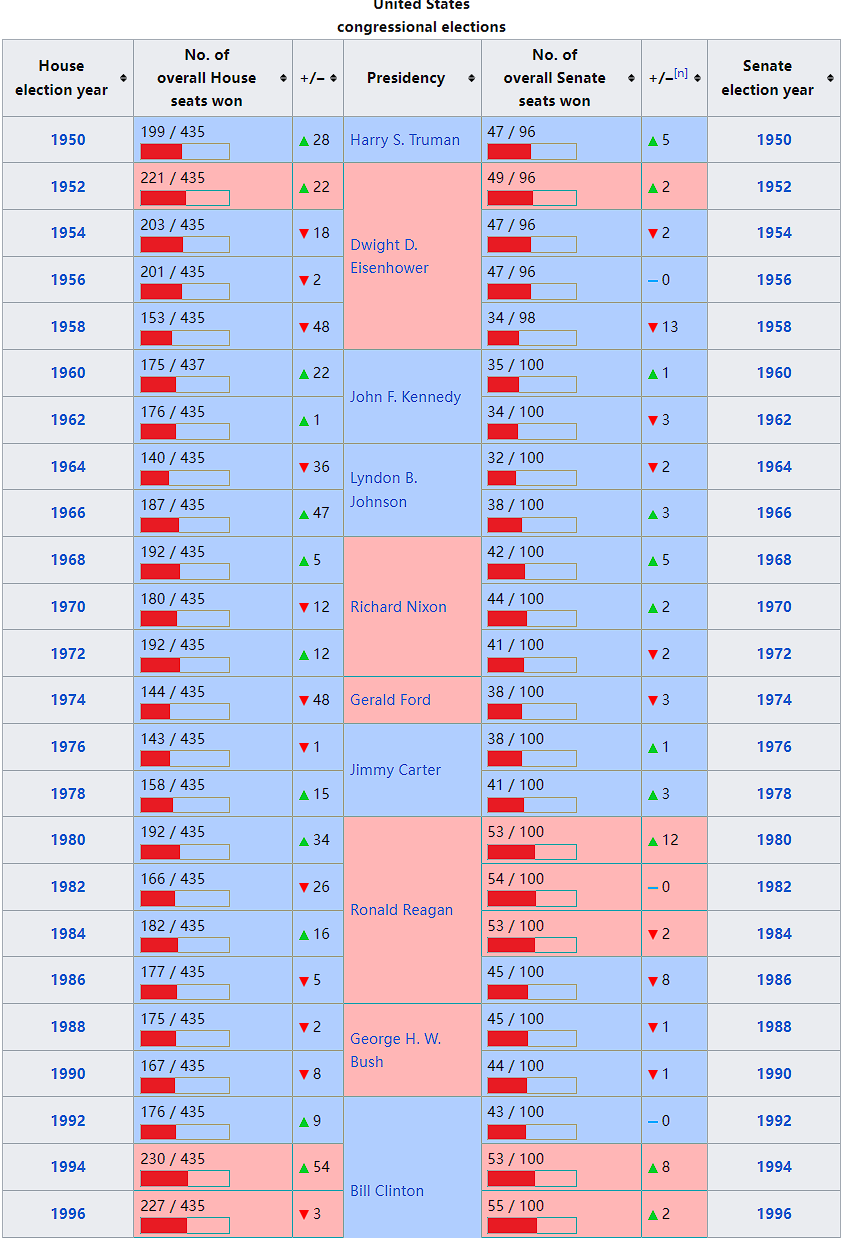
【英文词条原注[n]】Comparing seats held immediately preceding and following the general election
【参考译文】比较普选前后所持有的席位(数量)

【英文词条原注[o]】Republican Vice President Dick Cheney provided a tie-breaking vote, initially giving Republicans a majority from Inauguration Day until Jim Jeffords left the Republican Party to caucus with the Democrats on June 6, 2001.
【参考译文】共和党籍副总统迪克·切尼(Dick Cheney)投下了打破僵局的关键一票,使共和党从就职典礼当天起就获得了多数党地位;这一局面一直持续到2001年6月6日吉姆·杰福兹(Jim Jeffords)退出共和党、转而加入民主党阵营为止。
【英文词条原注[p]】Democratic Vice President Kamala Harris provided a tie-breaking vote, giving Democrats a majority from Inauguration Day until the end of the 117th Congress.
【参考译文】民主党籍副总统卡玛拉·哈里斯(Kamala Harris)投下了打破僵局的关键一票,使民主党从就职典礼当天起直至第117届国会结束,一直维持多数党地位。
6.2 国会选举情况:1950年至今 | In presidential elections: 1856–present
See also: List of United States Republican Party presidential tickets
【另请参阅:美国历届国会政党席位分布】
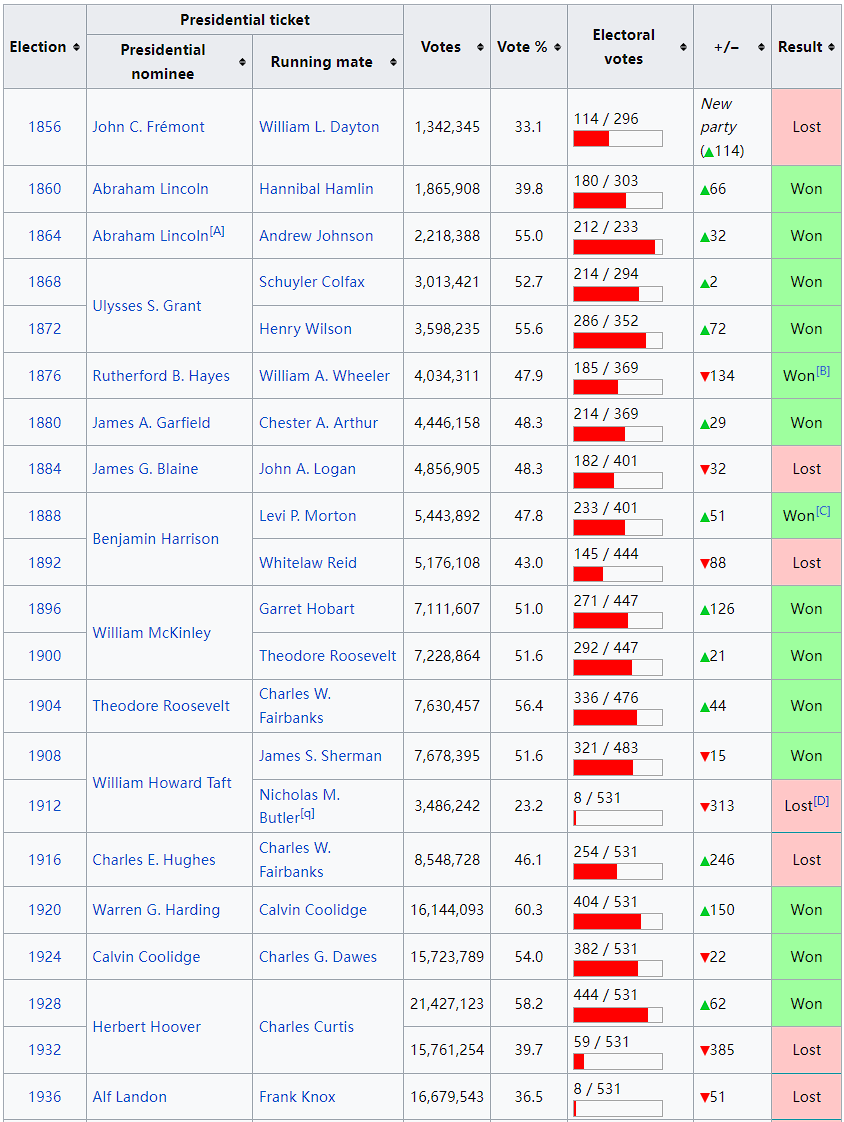
【英文词条原注[A]】Lincoln and Johnson were nominated by the National Union Party, a wartime coalition of Republicans, War Democrats, and Unconditional Unionists.
【参考译文】林肯和约翰逊是由“全国联合党”(National Union Party)提名的,该党是战时由共和党人、主战派民主党人以及无条件联邦主义者组成的政治联盟。
【英文词条原注[B]】Although Hayes won a majority of votes in the Electoral College, Democrat Samuel J. Tilden won a majority of the popular vote.
【参考译文】尽管海斯赢得了选举人团(Electoral College)的多数票,但民主党人塞缪尔·J·蒂尔登(Samuel J. Tilden)却获得了全国普选票(popular vote)的多数。
【英文词条原注[C]】Although Harrison won a majority of votes in the Electoral College, Democrat Grover Cleveland won a plurality of the popular vote.
【参考译文】尽管哈里森赢得了选举人团(Electoral College)的多数票,但民主党人格罗弗·克利夫兰(Grover Cleveland)却获得了全国普选票(popular vote)的最高票数(相对多数)。
【英文词条原注[q]】Incumbent vice-president James S. Sherman was re-nominated as Taft’s running-mate, but died six days before the election. Butler was chosen to receive the Republican vice-presidential votes after the election.
【参考译文】时任副总统詹姆斯·S·谢尔曼(James S. Sherman)被再次提名为塔夫脱的竞选搭档,但他在选举日前六天不幸去世。随后,巴特勒(Butler)被选定在选举后接收共和党的副总统选票。
【英文词条原注[D]】Taft finished in third place in both the electoral and popular vote, behind Progressive Theodore Roosevelt.
【参考译文】在选举人票和全国普选票中,塔夫脱均名列第三,排在进步党的西奥多·罗斯福(Theodore Roosevelt)之后。
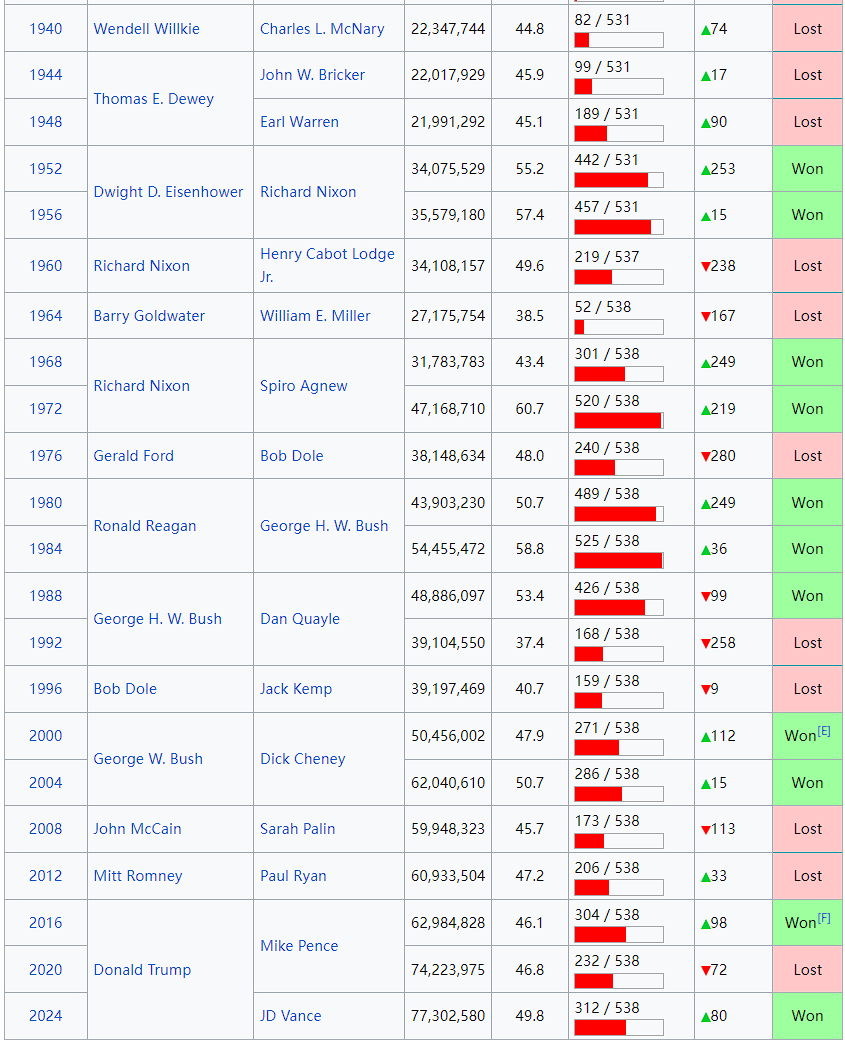
【英文词条原注[E]】Although Bush won a majority of votes in the Electoral College, Democrat Al Gore won a plurality of the popular vote.
【参考译文】尽管布什赢得了选举人团(Electoral College)的多数票,但民主党人阿尔·戈尔(Al Gore)却获得了全国普选票(popular vote)的最高票数(相对多数)。
【英文词条原注[F]】Although Trump won a majority of votes in the Electoral College, Democrat Hillary Clinton won a plurality of the popular vote.
【参考译文】尽管特朗普赢得了选举人团(Electoral College)的多数票,但民主党人希拉里·克林顿(Hillary Clinton)却获得了全国普选票(popular vote)的最高票数(相对多数)。
A. 参见(维基百科的相关词条)| See also
 美国主题 / United States portal
 政党主题
政党主题- Politics portal【政治主题】
- Conservatism portal【保守主义主题】
————————————————————
- 美国共和党的政治立场
- 美国政治
- 美国政党
- 美国民主党
- List of African-American Republicans
- List of Hispanic and Latino Republicans
- List of Republican Party (United States) organizations
- List of state parties of the Republican Party (United States)
- Political party strength in U.S. states
B. 英文词条参考文献 | References
- ^ The Origin of the Republican Party Archived March 22, 2012, at the Wayback Machine by Prof. A. F. Gilman, Ripon College, WI, 1914.
- ^ Widmer, Ted (March 19, 2011). “A Very Mad-Man”. Opinionator. The New York Times. Retrieved March 12, 2017.
- ^ “Political Parties”. Northern Illinois University Digital Library. Archived from the original on May 17, 2024. Retrieved May 27, 2024.
- ^ Howe, Daniel Walker (Winter 1995). “Why Abraham Lincoln Was a Whig”. Journal of the Abraham Lincoln Association. 16 (1): 27–38. doi:10.5406/19457987.16.1.05. hdl:2027/spo.2629860.0016.105. ISSN 1945-7987.
- ^ “Historical Context: The Breakdown of the Party System | Gilder Lehrman Institute of American History”. Archived from the original on May 18, 2024. Retrieved May 27, 2024.
- ^ “Major American Political Parties of the 19th Century”. Norwich University Resource Library. Archived from the original on May 17, 2024. Retrieved May 28, 2024.
- ^ McPherson, James (2003) [1988]. The Illustrated Battle Cry of Freedom: The Civil War Era. Oxford University Press. p. 129. ISBN 978-0-19-974390-2.
- ^ James M. McPherson, Ordeal by Fire: Volume I. The Coming of War, second edition (ISBN 0-07045837-5) p. 94.
- ^ Jump up to:a b c d e f Ball, Molly (January 23, 2024). “The GOP Wants Pure, Uncut Trumpism”. The Wall Street Journal. Archived from the original on January 24, 2024. Retrieved February 22, 2024.
- ^ Jump up to:a b c d e f Martin, Jonathan (March 1, 2021). “Trumpism Grips a Post-Policy G.O.P. as Traditional Conservatism Fades”. The New York Times. Archived from the original on May 23, 2024. Retrieved February 3, 2025.
- ^ Jump up to:a b c d Peoples, Steve (February 14, 2021). “Trump remains dominant force in GOP following acquittal”. AP News. Archived from the original on June 12, 2024. Retrieved February 3, 2025.
- ^ Jump up to:a b c d e f g h i j Boot, Max (September 8, 2024). “How the GOP Went From Reagan to Trump”. The Atlantic. Retrieved May 4, 2026.
The Trump-dominated, populist-nationalist GOP is certainly very different from the conservative party that Reagan led in the 1980s […]
- ^ Jump up to:ab
- Winberg, Oscar (2017). “Insult Politics: Donald Trump, Right-Wing Populism, and Incendiary Language”. European Journal of American Studies. 12 (2): 1–16. doi:10.4000/ejas.12132. ISSN 1991-9336. Archived from the original on December 31, 2024. Retrieved February 2, 2025. pp. 5–6:
With the presidency of George W. Bush, coinciding with the ascendance of the conservative media establishment and ending with the mass protests of the Tea Party, the long tradition of right-wing populism was a firmly institutionalized part of the conservative movement and, by extension, the Republican Party. Trump’s rise should be understood as part of the long tradition of right-wing populism and the ultimate triumph of the Tea Party movement; a right-wing populist eruption within the Republican Party fueled by both a conservative media establishment and anti-intellectual and, at times, overtly racial appeals.
- Fiorino, Daniel J. (2022). “Climate change and right-wing populism in the United States”. Environmental Politics. 31 (5): 801–819. Bibcode:2022EnvPo..31..801F. doi:10.1080/09644016.2021.2018854. ISSN 0964-4016.
In recent years, the Republican Party in the United States has taken on the characteristics of right-wing populism, especially under President Donald Trump. Like most right-wing populist parties, the party under Trump is hostile to climate mitigation. This is reflected in skepticism or rejection of climate science, opposition to multilateral institutions and agreements, aggressive domestic exploitation of fossil fuels, and depiction of climate advocates and experts as ‘elites’ set on undermining the will of ‘the people’.
- Arhin, Kofi; Stockemer, Daniel; Normandin, Marie-Soleil (May 29, 2023). “The Republican Trump Voter: A Populist Radical Right Voter Like Any Other?”. World Affairs. 186 (3). doi:10.1177/00438200231176818. ISSN 1940-1582.
In this article, we first illustrate that the Republican Party, or at least the dominant wing, which supports or tolerates Donald Trump and his Make America Great Again (MAGA) agenda have become a proto-typical populist radical right-wing party (PRRP).
- Cohn, Nate (November 25, 2024). “How Democrats Lost Their Base and their Message”. The New York Times. Archived from the original on November 25, 2024. Retrieved November 25, 2024.
Donald Trump’s populist pitch bumped Democrats off their traditional place in American politics.
- Burn-Murdoch, John (March 6, 2025). “Why the Maga mindset is different”. Financial Times. Retrieved March 18, 2025.
US decisions can no longer be analyzed using assumptions shared across the democratic west
- Arhin, Kofi; Stockemer, Daniel; Normandin, Marie-Soleil (May 29, 2023). “THE REPUBLICAN TRUMP VOTER: A Populist Radical Right Voter Like Any Other?”. World Affairs. 186 (3). doi:10.1177/00438200231176818. ISSN 1940-1582.
In this article, we first illustrate that the Republican Party, or at least the dominant wing, which supports or tolerates Donald Trump and his Make America Great Again (MAGA) agenda have become a proto-typical populist radical right-wing party (PRRP).
- Beauchamp, Zack (July 19, 2024). “It’s Trump’s party now. Mostly”. Vox. Archived from the original on January 18, 2025. Retrieved January 28, 2025.
- Page, Susan. “Trump’s takeover: In a redefined GOP, populism and a new coalition. Goodbye, old guard”. USA TODAY. Archived from the original on September 2, 2024. Retrieved January 28, 2025.
- Aratani, Lauren (February 26, 2021). “Republicans unveil two minimum wage bills in response to Democrats’ push”. The Guardian. Archived from the original on August 14, 2021. Retrieved September 7, 2021.
In keeping with the party’s deep division between its dominant Trumpist faction and its more traditionalist party elites, the twin responses seem aimed at appealing on one hand to its corporate-friendly allies and on the other hand to its populist rightwing base. Both have an anti-immigrant element.
- Winberg, Oscar (2017). “Insult Politics: Donald Trump, Right-Wing Populism, and Incendiary Language”. European Journal of American Studies. 12 (2): 1–16. doi:10.4000/ejas.12132. ISSN 1991-9336. Archived from the original on December 31, 2024. Retrieved February 2, 2025. pp. 5–6:
- ^ Jump up to:a b “DEMOCRACY REPORT 2026: Unraveling The Democratic Era?” (PDF). V-Dem Institute. March 17, 2026. Retrieved March 22, 2026.
One notable shift is the transformation of the Republican Party to endorsing a far-right, nationalist, and anti-pluralist agenda. Nationalist, anti-liberal, far-right parties and leaders have largely driven the “third wave of autocratization.” Yet the USA stands out as the only case where such movement seized control over one party in a rigid two-party system.
- ^ Burns, Jennifer (September 9, 2024). “Did Ronald Reagan Pave the Way for Donald Trump?”. The New York Times. ISSN 0362-4331. Retrieved May 12, 2026.
- ^ Meaney, Thomas. “Trumpism After Trump: Will the movement outlive the man?”. Harper’s Magazine. Vol. February 2020. ISSN 0017-789X. Retrieved July 8, 2023.
- ^
- Baker, Paula; Critchlow, Donald T., eds. (2020). “Chapter 15: Religion and American Politics”. The Oxford Handbook of American Political History. New York City: Oxford University Press. pp. 278–294. ISBN 9780199341788.
- Lewis, Andrew R. (August 28, 2019). “The Inclusion-Moderation Thesis: The U.S. Republican Party and the Christian Right”. Oxford Research Encyclopedia of Politics. Oxford University Press. doi:10.1093/acrefore/9780190228637.013.665. ISBN 978-0-19-022863-7.
Considering all the evidence, the most apt description is that conservative Christianity has transformed the Republican Party, and the Republican Party has transformed conservative Christianity … With its inclusion in the Republican Party, the Christian right has moderated on some aspects … At the same time, the Christian right has altered Republican politics.
- Perry, Samuel L. (2022). “American Religion in the Era of Increasing Polarization”. Annual Review of Sociology. 48 (1). San Mateo, California: Annual Reviews: 87–107. doi:10.1146/annurev-soc-031021-114239. ISSN 0360-0572. p. 91:
Unaffiliated Americans were not abandoning orthodox beliefs, but rather, the increase in “no religion” was confined to political moderates and liberals who were likely reacting to the growing alignment of Christian identity with the religious Right and Republicans.
- Berlet, Chip; Hardisty, Berlet, eds. (2019). “Drifting Right and going wrong: An overview of the US political Right”. Trumping Democracy: From Reagan to the Alt-right (1 ed.). London: Routledge. p. 91. doi:10.4324/9781315438412-9. ISBN 9781315438412.
Within the Republican Party, the Christian Right competes with more secular, upstart free market libertarianism and button-down business conservatism for dominance.
- Gannon, Thomas M. (July–September 1981). “The New Christian Right in America as a Social and Political Force”. Archives de sciences sociales des religions. 26 (52–1). Paris: Éditions de l’EHESS: 69–83. doi:10.3406/assr.1981.2226. ISSN 0335-5985. JSTOR 30125411.
- Ben Barka, Mokhtar (December 2012). “The New Christian Right’s relations with Israel and with the American Jews: the mid-1970s onward”. E-Rea. 10 (1). Aix-en-Provence and Marseille: Centre pour l’Édition Électronique Ouverte on behalf of Aix-Marseille University. doi:10.4000/erea.2753. ISSN 1638-1718. S2CID 191364375.
- Palmer, Randall; Winner, Lauren F. (2005) [2002]. “Protestants and Homosexuality”. Protestantism in America. Columbia Contemporary American Religion Series. New York City: Columbia University Press. pp. 149–178. ISBN 9780231111317. LCCN 2002023859.
- “Content Pages of the Encyclopedia of Religion and Social Science”. Archived from the original on March 3, 2016.
- Trollinger, William (October 8, 2019). “Fundamentalism turns 100, a landmark for the Christian Right”. The Conversation. ISSN 2201-5639. Archived from the original on May 7, 2022. Retrieved July 3, 2022.
The emergent Christian Right attached itself to the Republican Party, which was more aligned with its members’ central commitments than the Democrats … By the time Falwell died, in 2007, the Christian Right had become the most important constituency in the Republican Party. It played a crucial role in electing Donald Trump in 2016.
- Thomson-DeVeaux, Amelia (October 27, 2022). “How Much Power Do Christians Really Have?”. FiveThirtyEight. Archived from the original on April 10, 2024. Retrieved June 16, 2024.
In the 1980s and 1990s, as white Christian conservatives forged an alliance with the Republican Party, Christianity itself started to become a partisan symbol. Identifying as a Christian was no longer just about theology, community or family history — to many Americans, the label became uncomfortably tangled with the Christian Right’s political agenda, which was itself becoming increasingly hard to separate from the GOP’s political agenda.
- ^ Jump up to:a b c Wilbur, Miller (2012). “Libertarianism”. The Social History of Crime and Punishment in America. Vol. 3. Thousand Oaks, California: SAGE Publications. pp. 1006–1007. ISBN 978-1-4129-8876-6.
While right-libertarianism has been equated with libertarianism in general in the United States, left-libertarianism has become a more predominant aspect of politics in western European democracies over the past three decades. … Since the 1950s, libertarianism in the United States has been associated almost exclusively with right-libertarianism … As such, right-libertarianism in the United States remains a fruitful discourse with which to articulate conservative claims, even as it lacks political efficacy as a separate ideology. However, even without its own movement, libertarian sensibility informs numerous social movements in the United States, including the U.S. patriot movement, the gun-rights movement, and the incipient Tea Party movement.
- ^
- “DEMOCRACY REPORT 2026: Unraveling The Democratic Era?” (PDF). V-Dem Institute. March 17, 2026. Retrieved March 22, 2026.
One notable shift is the transformation of the Republican Party to endorsing a far-right, nationalist, and anti-pluralist agenda. Nationalist, anti-liberal, far-right parties and leaders have largely driven the “third wave of autocratization.” Yet the USA stands out as the only case where such movement seized control over one party in a rigid two-party system.
- McKay, David (2020), Crewe, Ivor; Sanders, David (eds.), “Facilitating Donald Trump: Populism, the Republican Party and Media Manipulation”, Authoritarian Populism and Liberal Democracy, Cham: Springer International Publishing, pp. 107–121, doi:10.1007/978-3-030-17997-7_7, ISBN 978-3-030-17997-7, retrieved June 13, 2024,
The first was the transformation of the Republican Party from a centre-right party used to brokering policy solutions with the Democrats to a far-right insurgent outlier intent on imposing its will through manipulation and confrontation.
- Arhin, Kofi; Stockemer, Daniel; Normandin, Marie-Soleil (May 29, 2023). “THE REPUBLICAN TRUMP VOTER: A Populist Radical Right Voter Like Any Other?”. World Affairs. 186 (3). doi:10.1177/00438200231176818. ISSN 1940-1582.
In this article, we first illustrate that the Republican Party, or at least the dominant wing, which supports or tolerates Donald Trump and his Make America Great Again (MAGA) agenda have become a proto-typical populist radical right-wing party (PRRP).
- Greenberg, David (January 27, 2021). “An Intellectual History of Trumpism”. Politico Magazine. Archived from the original on April 11, 2024. Retrieved June 13, 2024.
The larger ideology that the president-elect represents is a post-Iraq War, post-crash, post-Barack Obama update of what used to be called paleoconservatism: On race and immigration, where the alt-right affinities are most pronounced, its populist ideas are carrying an already right-wing party even further right.
- “DEMOCRACY REPORT 2026: Unraveling The Democratic Era?” (PDF). V-Dem Institute. March 17, 2026. Retrieved March 22, 2026.
- ^ “Members”. IDU. Archived from the original on July 16, 2015.
- ^ “Regional Unions”. International Democracy Union. Archived from the original on June 17, 2010. Retrieved August 19, 2024.
- ^ “About – ECR Party”. European Conservatives and Reformists Party. August 4, 2022. Archived from the original on July 1, 2023. Retrieved August 19, 2024.
- ^ Jump up to:ab
- Hacker, Jacob S.; Pierson, Paul (July 7, 2020). “The origins of the Republican Party’s plutocratic populism”. The Washington Post. Archived from the original on January 30, 2021. Retrieved January 28, 2025.
- Bolton, Alexander (July 17, 2023). “GOP senators rattled by radical conservative populism”. The Hill. Archived from the original on December 14, 2024. Retrieved January 28, 2025.
- Lange, Jason; Oliphant, James (March 21, 2024). “Republicans have taken sharp populist turn in the Trump era: Reuters/Ipsos”. Reuters. Archived from the original on June 28, 2024. Retrieved January 28, 2025.
- Cliffe, Jeremy (February 15, 2023). “The strange death of the centre right”. The New Statesman. Archived from the original on February 11, 2025. Retrieved February 5, 2025.
In Western democracies conventional conservatism is foundering. How did this once-dominant political force become so diminished?
- ^ Jump up to:a b c Lührmann, Anna; Medzihorsky, Juraj; Hindle, Garry; Lindberg, Staffan I. (October 2020). “New Global Data on Political Parties: V-Party” (PDF). Briefing Paper No. 9. V-Dem Institute. Archived (PDF) from the original on November 14, 2024. Retrieved November 13, 2024.
- ^ Contreras, Russell (February 18, 2026). “Where Christian nationalism is most dominant in the U.S.” Axios. Retrieved February 18, 2026.
56% of all Republicans are Christian nationalism “adherents” or “sympathizers,” the survey said
- ^ Jump up to:a b c d e Tyler Godines Camarillo, C.; Clark Wilson, Walter; Perroud, Jace; VanGoethem, Margaret (January 3, 2026). “The New Republican Revolution: The Implications of Illiberalism and Populism for GOP Politics and Policy”. The Roads to Congress 2024: Navigating Elections in an Era of Upheaval. Palgrave Macmillan Cham. pp. 127–151. ISBN 978-3-032-07119-4. Cite error: The named reference “:2” was defined multiple times with different content (see the help page).
- ^ Jump up to:ab
- “The Republican Party has lurched towards populism and illiberalism”. The Economist. October 31, 2020. ISSN 0013-0613. Archived from the original on June 2, 2024. Retrieved November 9, 2024.
In the late 20th century the Republican Party already looked a bit less liberal and more populist than most mainstream European parties. But according to the V-Dem Institute’s analysis, it only really started to deviate to “illiberalism” when it embraced religious values under Mr Bush after his election in 2000. The party then veered into populism in 2010 with the rise of the Tea Party movement, which vowed to curb what it saw as the unjustifiable expansion of the federal government under Barack Obama. However, the greatest shift, especially towards illiberalism, came with the election of Mr Trump.
- Encarnación, Omar G. (June 12, 2023). “Democratic Backsliding: Comparative Reflections on the American Experience”. Political Science Quarterly. 138 (3): 407–424. doi:10.1093/psquar/qqad036. pp. 410–423:
Despite the appearance of being consolidated, the American political system is institutionally vulnerable to backsliding—from an electoral system fraught with so many deficiencies that election experts deem it archaic and undemocratic; to an imperial presidency that sits at the center of federal power and towers over the legislature and the judiciary; to the recent transformation of the Republican Party into an illiberal force more interested in acquiring power than in governing. … The Republican Party’s pivotal role in enabling backsliding in the Trump era mirrors the post-Communist experience. In recent years, the Republican party has fashioned itself after the Fidesz Party in Hungary (Europe’s most sobering example of backsliding), from embracing the ideology of Christian Nationalism to using the state to fight culture wars to cynically rejecting the idea of democracy. In connection to the last point, a popular argument among Republican election deniers is that the United States is not a democracy but a republic. As noted by the New York Times, “There is more at stake than the health of the Republican Party when its core activists, as well as a growing number of officials and those campaigning for governmental positions, openly espouse hostility not just to democratic principles, but, increasingly, to the word ‘democracy’ itself.” Indeed, this illiberal behavior puts American democracy in peril.
- Main, Thomas J. (January 4, 2022). The Rise of Illiberalism. Washington, D.C.: Brookings Institution Press. p. 188. ISBN 9780815738503. Archived from the original on January 28, 2025. Retrieved November 12, 2024.
A sharp repudiation at the polls would have checked the vogue for illiberal and identitarian ideologies and driven the Republican party back within the bounds of the liberal democratic political spectrum.
- Laruelle, Marlene (March 1, 2022). “Illiberalism: a conceptual introduction”. East European Politics. 38 (2): 303–327. doi:10.1080/21599165.2022.2037079. ISSN 2159-9165. pp. 315–316:
Classical conservatives—such as the Christian Democrats in Europe or the Republican Party in the US before Donald Trump—are/were fervent supporters of political rights and constitutionalism, while illiberalism challenges them … The struggle of the European People’s Party to win concessions from Orbán’s Fidesz or the Polish PiS, as well as the subjugation of the Republican Party by Donald Trump, have revealed how attractive illiberal leaders may be to the more mainstream right. As Marc Plattner has stated, the future of liberal democracy will largely depend on how successful or unsuccessful the classical conservative right is at resisting illiberalism.
- Cooley, Alexander; Nexon, Daniel H. (January–February 2022). “The Real Crisis of Global Order: Illiberalism on the Rise”. Foreign Affairs. Vol. 101, no. 1. New York City: Council on Foreign Relations. ISSN 0015-7120. Retrieved November 12, 2024.
The election of Donald Trump in 2016 sparked a major debate over the nature and fate of the liberal international order, suddenly caught, it seemed, between the Charybdis of illiberal great-power challengers and the Scylla of a hostile U.S. president. Trump may have lost the presidency in 2020, but the liberal order remains under threat. … In the United States, one of the two major political parties remains beholden to an authoritarian demagogue. Motivated by the “Big Lie” (the objectively false claim that Democrats stole the election from Trump through systematic voter fraud), the Republican Party is purging officials who stood in the way of efforts to overturn the 2020 presidential election. Republican voter-suppression efforts are accelerating.
- Dunwoody, Phillip T.; Gershtenson, Joseph; Plane, Dennis L.; Upchurch-Poole, Territa (August 9, 2022). “The fascist authoritarian model of illiberal democracy”. Frontiers in Political Science. 4 907681. doi:10.3389/fpos.2022.907681. ISSN 2673-3145. p. 12:
All the components of the fascist authoritarian model of illiberal democracy were evidenced in the recent 2020 U.S. presidential election. … In classic authoritarian fashion, Trump sought to remain in power by asserting his preferred fiction over more objective realities promoted by those in traditional, truth-based professions. Trump engaged in threat othering to work up his base so that they would support the use of force to “save” their country. The result of these combined mechanisms was the support of blatantly illiberal antidemocratic behavior at the U.S. Capitol on January 6, 2021.
- Hopkin, Jonathan; Blyth, Mark (2020). “Global Trumpism: Understanding Anti-System Politics in Western Democracies”. In Vormann, Boris; Weinman, Michael D. (eds.). The Emergence of Illiberalism. Routledge. ISBN 978-0367366247. Archived from the original on February 15, 2021. Retrieved October 11, 2020.
- Norris, Pippa (2017). “Online Exchange on “Democratic Deconsolidation” (PDF). Journal of Democracy. 12. Retrieved November 9, 2024. pp. 14–15–18:
The rise of populist authoritarianism in the United States, especially by the risks that President Trump poses to core democratic values, practices and institutions, pose major threats to liberal democracy. … When the populist style of governance is coupled with authoritarian values, however, this potent combination presents most dangerous risk to the principles and practices at the heart of liberal democracy. Trump falls into this category. … populist-authoritarian forces threatening to dismantle core values in liberal democracy pose the gravest risk, especially in America, given the vast powers of the U.S. presidency and its hegemonic role in the world. The mainstream news media, the courts, and a reenergized civil society are actively pushing back to resist the threats to democracy arising from the Trump administration. In Congress and State Houses, however, the Democrats are decimated, and the Republican party and conservative activists seem willing to be seduced by dreams of power.
- Drutman, Lee (June 8, 2021). “The Republican party is now an explicitly illiberal party”. The Guardian. ISSN 0261-3077. Retrieved May 4, 2026.
Though these anti-democratic sentiments have been building within the ranks of the party for years, the events of 2021 mark the transformation of the Republican party into a genuinely illiberal party, and a grave threat to the continuation of American democracy as we’ve known it.
- “The Republican Party has lurched towards populism and illiberalism”. The Economist. October 31, 2020. ISSN 0013-0613. Archived from the original on June 2, 2024. Retrieved November 9, 2024.
- ^ Jump up to:a b c d e “How President Trump has challenged a constitutional foundation”. NPR. January 23, 2026. Retrieved May 9, 2026.
In his first year back in the White House, President Trump has presided over a sweeping expansion of executive power while eroding democratic norms. Many scholars of democracy say that these moves are unprecedented in U.S. history and that Trump has pushed the United States toward authoritarianism.
Cite error: The named reference “:10” was defined multiple times with different content (see the help page). - ^ Barber, Michael; Canes-Wrone, Brandice; Clinton, Joshua; Huber, Greg (2025). “Which Republican Constituencies Support Restrictive Abortion Laws? Comparisons Among Donors, Wealthy, and Mass Publics”. Public Opinion Quarterly. 89 (2): 289–309. doi:10.1093/poq/nfaf012. ISSN 0033-362X.
- ^ Jump up to:a b c Wyatt-Nichol, Heather (November 21, 2025), “Political Attacks on the Lgbtqia+ Community”, LGBTQIA+ Communities, Pandemics, and Policy Responses, New York: Routledge, pp. 23–41, doi:10.4324/9781003566687-4, ISBN 978-1-003-56668-7, retrieved May 9, 2026,
This chapter explores the sociopolitical contestation of power in the fight for LGBTQIA+ rights by examining the rightward shift in the Republican Party and its use of anti-LGBTQIA+ tropes during pandemics, and as a political wedge strategy that contributes to the polarization of Americans.
- ^ Beirich, Heidi (December 8, 2025). “White Supremacist Movements Worldwide”. pp. 122–128. doi:10.1002/9781394300365.ch17. ISBN 978-1-394-30033-4.
The Republican Party has become openly anti-immigrant and is proposing mass deportations…
{{cite book}}:|journal=ignored (help); Missing or empty|title=(help) - ^ Russell, George Fabe. “What is the Republican Party’s stance on guns? Here’s what GOP politicians are saying”. USA Today. Retrieved May 23, 2026.
- ^ Jump up to:a b Fleming, Sam; Strauss, Delphine (April 4, 2025). “Trump’s aggressive push to roll back globalisation”. Financial Times. Retrieved April 4, 2025.
The US president wants to unwind decades of economic integration. The risk of a 1930s-style global trade war is causing markets to panic.
- ^ Jump up to:a b c Helleiner, Eric (January 5, 2021). “The Return of National Self-Sufficiency. Excavating Autarkic Thought in a De-Globalizing Era”. International Studies Review. 23 (3): 933–957. doi:10.1093/isr/viaa092. ISSN 1521-9488. PMC 7928914.
The election of Donald Trump as American president in 2016 encouraged further interest in ideas of national self-sufficiency. … Trump’s worldview was much closer to a neomercantilist one than an autarkist one, but some of his supporters on the far right are more clearly in the latter camp.14 For example, in a 2020 publication from the Claremont Institute, Curtis Yarvin called for the promotion of an “isolationist” policy of “neo-Sakoku”. Like some other past autarkists, he argued that a world of autarkic states would be more peaceful because the reasons for conflict would diminish (Yarvin 2020). The Trump administration also indirectly encouraged new interest in greater national self-sufficiency in other countries because of its protectionism and its broader “weaponization” of America’s international economic relations (Farrell and Newman 2019).
- ^ Jump up to:a b c Ashbee, Edward; Waddan, Alex (December 13, 2023). “US Republicans and the New Fusionism”. The Political Quarterly. 95: 148–156. doi:10.1111/1467-923X.13341. ISSN 1467-923X. S2CID 266282896.
- ^ Jump up to:a b c Tharoor, Ishaan (October 12, 2021). “The GOP alliance with Europe’s far-right deepens”. The Washington Post. ISSN 0190-8286. Retrieved April 26, 2026.
The Republican Party of the United States is, in global terms, a far-right party.
- ^ Jump up to:a b Sunshine, Spencer (January 6, 2026). “The Far Right Is Quietly Building Power Under Trump”. The New Republic. ISSN 0028-6583. Retrieved May 9, 2026.
The administration has also made efforts to help the European far right, which it is increasingly allied with. Trump is close to Hungary’s Prime Minister Viktor Orbán and Britain’s head of the nativist Reform Party, Nigel Farage, while JD Vance met with the leader of the extremist Alternative for Germany party and called on European parties to remove their “firewalls” against cooperating with the far right.
- ^ Jump up to:a b “Polity V Regime Narrative: United States (2025)” (PDF). Polity Data Series. January 20, 2025. pp. 12–15. Retrieved April 3, 2026.
- ^ *[38]
- Massey, Douglas S. (2021). “The Bipartisan Origins of White Nationalism”. Daedalus. 150 (2): Abstract. doi:10.1162/daed_a_01843. ISSN 0011-5266. Archived from the original on January 29, 2026.
Until 2016, this cultivation relied on a dog whistle politics of racially coded symbolic language, but with the election of Donald Trump as president, White nationalist sentiments became explicit and White nationalism emerged as an ideological pillar of the Republican Party.
- Ehrenberg, John (May 18, 2022). White Nationalism and the Republican Party: Toward Minority Rule in America (1 ed.). New York: Routledge. doi:10.4324/9781003182962. ISBN 978-1-003-18296-2.
- Bartels, Larry M. (September 15, 2020). “Ethnic antagonism erodes Republicans’ commitment to democracy”. Proceedings of the National Academy of Sciences. 117 (37): 22752–22759. doi:10.1073/pnas.2007747117. PMC 7502764. PMID 32868419.
- Olzak, Susan (2023). “Ethno-nationalism and Right-Wing Extremist Violence in the United States, 2000 through 2018”. Sociological Science. 10: 197–226. doi:10.15195/v10.a6.
The Republican party has increasingly aligned itself with extremist right-wing views that can be classified as ethno-nationalist (Bonikowski 2017; Thompson 2021).
- Woods, Eric Taylor; Fortier-Chouinard, Alexandre; Closen, Marcus; Ouellet, Catherine; Schertzer, Robert (December 7, 2023). “The Battle for the Soul of the Nation: Nationalist Polarization in the 2020 American Presidential Election and the Threat to Democracy”. Political Communication. 41 (2): 173–198. doi:10.1080/10584609.2023.2291150. ISSN 1058-4609.
- Massey, Douglas S. (2021). “The Bipartisan Origins of White Nationalism”. Daedalus. 150 (2): Abstract. doi:10.1162/daed_a_01843. ISSN 0011-5266. Archived from the original on January 29, 2026.
- ^ Shamim, Sarah. “What is remigration, the far-right fringe idea going mainstream?”. Al Jazeera. Retrieved May 6, 2026.
Remigration — once a fringe far-right notion advocating the deportation of ethnic minorities — is now gaining traction in United States Republican circles as President Donald Trump’s second term enters the final weeks of its first year.
- ^ Jump up to:a b Yousef, Odette (December 9, 2025). “‘Remigration,’ once a fringe idea, becomes a mantra for the Trump administration”. NPR. Retrieved May 9, 2026.
So President Trump on Thanksgiving Day posted to social media about how immigration policies have hurt, quote, “gains and living conditions for many.” And he said only reverse migration can fully cure this situation. But also, the State Department’s proposed reorganization plan included a new office of remigration, and the Department of Homeland Security has called for remigration on social media posts. One of them, for example, Ailsa, with simply the word remigrate.
- ^ Tharoor, Ishaan (November 30, 2025). “Trump’s embrace of ‘remigration’ echoes Europe’s far right”. The Washington Post. ISSN 0190-8286. Retrieved May 9, 2026.
- ^ Lewis L. Gould: The Republicans a history of the Grand Old Party (Oxford University Press/ 2014), pp. 3–23.
- ^ Gould, pp. 34–115.
- ^ Gould, pp. 116–245.
- ^ Zingher, Joshua N. (2018). “Polarization, Demographic Change, and White Flight from the Democratic Party”. The Journal of Politics. 80 (3): 860–872. doi:10.1086/696994. ISSN 0022-3816. S2CID 158351108.
- ^ Layman, Geoffrey (2001). The Great Divide: Religious and Cultural Conflict in American Party Politics. Columbia University Press. pp. 115, 119–120. ISBN 978-0231120586.
- ^ “Republicans Now Dominate State Government”. Daily Kos. November 14, 2016.
- ^ “Presidential Election Results: Donald J. Trump Wins”. The New York Times. August 9, 2017.
- ^ “12 days that stunned a nation: How Hillary Clinton lost”. NBC News. August 23, 2017. Archived from the original on January 28, 2021. Retrieved December 8, 2019.
- ^ Jump up to:a b “How Trump won and proved everyone wrong with his populist message”. NBC News Specials. December 14, 2016. Archived from the original on November 8, 2020. Retrieved December 8, 2019.
- ^ Jump up to:a b c d Campani, Giovanna; Fabelo Concepción, Sunamis; Rodriguez Soler, Angel; Sánchez Savín, Claudia (December 2022). “The Rise of Donald Trump Right-Wing Populism in the United States: Middle American Radicalism and Anti-Immigration Discourse”. Societies. 12 (6): 154. doi:10.3390/soc12060154. ISSN 2075-4698.
- ^ Cohn, Nate (November 9, 2016). “Why Trump Won: Working-Class Whites”. The New York Times. Archived from the original on November 9, 2016. Retrieved February 15, 2021.
- ^ Jump up to:a b Starr, Paul (March 27, 2026). “How the Republican Party Forgot It Was Conservative”. The American Prospect. Retrieved May 4, 2026.
But the truly consequential change is that Republicans have broken with their own past. Under Donald Trump, the party hasn’t just reversed its positions on specific policies. It has routinely betrayed basic tenets of the conservative philosophy that Republicans have long claimed was the bedrock of their party.
- ^ Jump up to:a b Graham, David A. (July 8, 2023). “The Democrats Are Now America’s Conservative Party”. The Atlantic. Retrieved May 4, 2026.
Third, and relatedly, the Trump-era Republican Party has abandoned much of the party’s old orthodoxy in favor of radicalism on domestic and foreign affairs.
- ^ Bosman, Julie; Davey, Monica (November 11, 2016). “Republicans Expand Control in a Deeply Divided Nation”. The New York Times. Archived from the original on November 19, 2016. Retrieved February 18, 2017.
- ^ “2017–2018 Governors’ Races: Where Power Is Most and Least Likely to Flip”. Governing. January 3, 2017. Archived from the original on January 28, 2024. Retrieved January 28, 2024.
- ^ “Republicans Governorships Rise to Highest Mark Since 1922”. U.S. News & World Report. Archived from the original on September 15, 2017. Retrieved September 10, 2017.
- ^ Lieb, David A. (November 6, 2016). “Republican governorships rise to highest mark since 1922”. U.S. News & World Report. Associated Press.
- ^ Phillips, Amber (November 12, 2016). “These 3 maps show just how dominant Republicans are in America after Tuesday”. The Washington Post. Archived from the original on November 13, 2016. Retrieved November 14, 2016.
- ^ Lieb, David A. (December 29, 2016). “GOP-Controlled States Aim to Reshape Laws”. Associated Press. Archived from the original on December 31, 2016. Retrieved December 30, 2016.
- ^ Greenblatt, Alan (November 9, 2016). “Republicans Add to Their Dominance of State Legislatures”. Governing. Archived from the original on November 16, 2016. Retrieved November 17, 2016.
- ^ Graham, David A. (November 7, 2018). “The Democrats Are Back, and Ready to Take On Trump”. The Atlantic. Archived from the original on December 9, 2019. Retrieved November 17, 2020.
- ^ Kumar, Anita (September 26, 2020). “Trump’s legacy is now the Supreme Court”. Politico. Archived from the original on February 16, 2021. Retrieved November 17, 2020.
- ^ Chappell, Bill (January 13, 2021). “House Impeaches Trump A 2nd Time, Citing Insurrection At U.S. Capitol”. NPR. Archived from the original on February 20, 2021. Retrieved February 14, 2021.
- ^ Fandos, Nicholas (January 13, 2021). “Trump Impeached for Inciting Insurrection”. The New York Times. Archived from the original on December 28, 2021. Retrieved February 14, 2021.
- ^ Gregorian, Dareh (February 13, 2021). “Trump acquitted in impeachment trial; 7 GOP Senators vote with Democrats to convict”. NBC News. Archived from the original on February 13, 2021. Retrieved February 14, 2021.
- ^ Riccardi, Nicholas; Mascaro, Lisa (May 21, 2024). “Election deniers moving closer to GOP mainstream, report shows, as Trump allies fill Congress”. AP. Archived from the original on May 21, 2024. Retrieved August 15, 2024.
- ^ Blanco, Adrián; Wolfe, Daniel; Gardner, Amy (November 7, 2022). “Tracking which 2020 election deniers are winning, losing in the midterms”. Washington Post. Archived from the original on January 11, 2024. Retrieved August 15, 2024.
- ^ Izaguirre, Anthony; Coronado, Acacia (January 31, 2021). “GOP lawmakers seek tougher voting rules after record turnout”. Associated Press. Archived from the original on January 31, 2021. Retrieved January 17, 2023.
- ^ McCaskill, Nolan D. (March 15, 2021). “After Trump’s loss and false fraud claims, GOP eyes voter restrictions across nation”. Politico. Archived from the original on March 15, 2021. Retrieved January 17, 2023.
- ^
- “The Republican Party has lurched towards populism and illiberalism”. The Economist. October 31, 2020. ISSN 0013-0613. Archived from the original on June 2, 2024. Retrieved November 9, 2024.
In the late 20th century the Republican Party already looked a bit less liberal and more populist than most mainstream European parties. But according to the V-Dem Institute’s analysis, it only really started to deviate to “illiberalism” when it embraced religious values under Mr Bush after his election in 2000. The party then veered into populism in 2010 with the rise of the Tea Party movement, which vowed to curb what it saw as the unjustifiable expansion of the federal government under Barack Obama. However, the greatest shift, especially towards illiberalism, came with the election of Mr Trump.
- Lührmann, Anna; Medzihorsky, Juraj; Hindle, Garry; Lindberg, Staffan I. (October 2020). “New Global Data on Political Parties: V-Party” (PDF). Briefing Paper No. 9. V-Dem Institute. Archived (PDF) from the original on November 14, 2024. Retrieved November 13, 2024.
- Drutman, Lee (March 18, 2021). “American Democracy Can’t Survive Unless the Far Right Is Marginalized. Here’s How to Do It”. Time. Retrieved May 9, 2026.
By international standards, the current Republican Party is an illiberal anti-democratic nativist global outlier, with positions more extreme than France’s National Rally, and in line with the Germany’s AfD, Hungary’s Fidesz, Turkey’s AKP and Poland’s PiS, according to the widely respected V-Dem (Varieties of Democracy) Institute.
- Kottasová, Ivana (October 26, 2020). “Republicans are starting to look like authoritarian parties in Hungary and Turkey, study finds”. CNN. Retrieved May 9, 2026.
Experts from the V-Dem Institute at the University of Gothenburg in Sweden said the US Republican Party had become more illiberal and populist in recent decades and that its recent retreat from democratic norms has left it resembling authoritarian ruling parties like Hungary’s Fidesz and Turkey’s AKP.
- “Trump’s GOP resembles authoritarian parties in India and Turkey, and Poland, study stays”. The Independent. October 26, 2020. Retrieved May 9, 2026.
Donald Trump’s Republican party has become more illiberal and retreated from upholding democratic norms in recent years, a study has found, with its rhetoric shifting closer that of authoritarian parties ruling in Turkey, Hungary, Poland and India.
- Borger, Julian (October 26, 2020). “Republicans closely resemble autocratic parties in Hungary and Turkey – study”. The Guardian. ISSN 0261-3077. Retrieved May 9, 2026.
In a significant shift since 2000, the GOP has taken to demonising and encouraging violence against its opponents, adopting attitudes and tactics comparable to ruling nationalist parties in Hungary, India, Poland and Turkey.
- “The Republican Party has lurched towards populism and illiberalism”. The Economist. October 31, 2020. ISSN 0013-0613. Archived from the original on June 2, 2024. Retrieved November 9, 2024.
- ^
- “DEMOCRACY REPORT 2026: Unraveling The Democratic Era?” (PDF). V-Dem Institute. March 17, 2026. Retrieved March 22, 2026.
One notable shift is the transformation of the Republican Party to endorsing a far-right, nationalist, and anti-pluralist agenda. Nationalist, anti-liberal, far-right parties and leaders have largely driven the “third wave of autocratization.” Yet the USA stands out as the only case where such movement seized control over one party in a rigid two-party system.
- Klaas, Brian (September 9, 2025). “Is The United States Still A Democracy?”. The London School of Economics and Political Science. Retrieved April 9, 2026.
Political scientists continue to debate this topic, but few would classify the United States as a robust democracy. It is either a democracy in crisis that is barely clinging onto the label, or one that has tipped over the edge into competitive authoritarianism – and I believe it’s the latter.
- Grumbach, Jacob M. (December 1, 2021). “Laboratories of Democratic Backsliding”. American Political Science Review. 117 (3). Published by Cambridge University Press on behalf of the American Political Science Association: 967–984. doi:10.1017/S0003055422000934. ISSN 0003-0554.
Prominent cross-national measures of democracy from the Varieties of Democracy Project (V-Dem), Bright Line Watch, and Freedom House, which had once ranked the country as a global leader, show a U.S. democracy slipping toward “mixed regime” or “illiberal democracy” status.
- Morris, G. Elliott (October 1, 2025). “Experts now rate the U.S. as a “mixed” or “illiberal” democracy”. www.gelliottmorris.com. Retrieved May 9, 2026.
- Langfitt, Frank (April 22, 2025). “Hundreds of scholars say U.S. is swiftly heading toward authoritarianism”. NPR. Retrieved May 9, 2026.
A survey of more than 500 political scientists finds that the vast majority think the United States is moving swiftly from liberal democracy toward some form of authoritarianism.
- Gambino, Lauren (January 21, 2026). “American democracy on the brink a year after Trump’s inauguration, experts say”. The Guardian. ISSN 0261-3077. Retrieved May 9, 2026.
- Schenkkan, Nate (January 15, 2026). “Century’s New Democracy Meter Shows America Took an Authoritarian Turn in 2025”. The Century Foundation. Retrieved May 9, 2026.
The Century Foundation’s 2025 evaluation finds that American democracy is already collapsing—the Democracy Meter rates the United States at 57/100, a 28 percent drop in just one year. In the first year of Trump 2.0, the United States went from being a passing if imperfect democracy to behaving like an authoritarian state: breaking the law, ignoring court rulings, engaging in grand corruption, targeting critics for persecution, and conducting a campaign against immigrants, in particular, that flagrantly violates civil rights.
- “index”. Polity data series. Retrieved May 9, 2026.
The USA is no longer considered a democracy and lies at the cusp of autocracy; it has experienced a Presidental Coup and an Adverse Regime Change event (8-point drop in its POLITY score).
- [28]
- “DEMOCRACY REPORT 2026: Unraveling The Democratic Era?” (PDF). V-Dem Institute. March 17, 2026. Retrieved March 22, 2026.
- ^ Pfannenstiel, Brianne (July 15, 2024). “”Make America great again!”: Iowa Republican chair gives fiery Trump nominating speech at RNC”. The Des Moines Register. Archived from the original on July 22, 2024. Retrieved July 18, 2024.
- ^ Lange, Jason; Erickson, Bo; Heath, Brad (November 7, 2024). “Trump’s return to power fueled by Hispanic, working-class voter support”. Reuters. Archived from the original on December 21, 2024. Retrieved November 13, 2024.
- ^ “Presidents of the United States of America”. OhioSoS.gov. Ohio Secretary of State. Retrieved August 24, 2025.
- ^ “Trump clinches 2024 Republican nomination”. PBS NewsHour. Associated Press. March 12, 2024. Archived from the original on April 29, 2024. Retrieved June 11, 2024.
- ^ Sinclair, Anthony (March 17, 2026). “The GOP’s Shifting Policy Stance in President Trump’s Second Term”. CONGRESS.NET. Retrieved March 18, 2026.
- ^ “Contrasting views of Russia show deepening Republican split over foreign policy”. Reuters. Archived from the original on December 19, 2025. Retrieved March 18, 2026.
- ^ Rutland, RA (1996). The Republicans: From Lincoln to Bush. University of Missouri Press. p. 2. ISBN 0826210902.
- ^ “The Origins of the Republican Party”. UShistory.org. July 4, 1995. Archived from the original on September 30, 2012. Retrieved October 25, 2012.
- ^ Gould, pp. 14–15
- ^ “Republican Party | political party, United States [1854–present]”. Encyclopædia Britannica. Archived from the original on May 5, 2017. Retrieved May 9, 2017.
- ^ Joyner, James. “The Changing Definition of ‘Conservative'”. The Atlantic. Archived from the original on May 25, 2017. Retrieved May 9, 2017.
- ^ “Grand Old Party”, Oxford English Dictionary.
- ^ Jump up to:a b “The Third-Term Panic”. Cartoon of the Day. November 7, 2003. Archived from the original on September 21, 2011. Retrieved September 5, 2011.
- ^ “Ballots of United States: Indiana”. University of North Carolina. Archived from the original on May 25, 2017. Retrieved February 6, 2017.
- ^ Lopez, Tomas (October 23, 2014). “Poor Ballot Design Hurts New York’s Minor Parties … Again”. Brennan Center for Justice. Archived from the original on February 7, 2017. Retrieved February 6, 2017.
- ^ “See Sample Ballots for Today’s Primary Elections”. West Kentucky Star. May 19, 2015. Archived from the original on February 7, 2017. Retrieved February 6, 2017.
- ^ Bump, Philip (November 8, 2016). “Red vs. Blue: A history of how we use political colors”. The Washington Post. Archived from the original on November 7, 2017. Retrieved October 30, 2017.
- ^ Drum, Kevin (November 13, 2004). “Red State, Blue State”. Washington Monthly. Archived from the original on November 7, 2017. Retrieved October 30, 2017.
- ^ Drum, Kevin (November 14, 2004). “Red States and Blue States … Explained!”. Washington Monthly. Archived from the original on November 7, 2017. Retrieved October 30, 2017.
- ^ Bump, Philip. “Red vs. Blue: A history of how we use political colors”. The Washington Post. Archived from the original on February 22, 2021. Retrieved November 8, 2018.
- ^ Holland, Oscar (September 20, 2024). “Republicans are red and Democrats blue. But it wasn’t always that way”. CNN. Retrieved May 30, 2026.
- ^ Howard, Victor B. (2015). Religion and the Radical Republican Movement, 1860–1870. University Press of Kentucky. ISBN 978-0-8131-6144-0. Archived from the original on December 15, 2023. Retrieved March 24, 2023.
- ^ Foner, Eric (1988). Reconstruction: America’s Unfinished Revolution, 1863–1877 (1st ed.). pp. 236–37.
- ^ “The Roots of Modern Conservatism | Michael Bowen”. University of North Carolina Press. Archived from the original on May 22, 2017. Retrieved May 20, 2019.
- ^ Gottfried, Paul; Fleming, Thomas (1988). The Conservative Movement. Boston: Twayne Publishers. pp. 77–95. ISBN 0805797238.
- ^ Jump up to:a b c Smith, Robert C. (2021). “Ronald Reagan, Donald Trump, and the Future of the Republican Party and Conservatism in America”. American Political Thought. 10 (2): 283–289. doi:10.1086/713662.
- ^ Jump up to:a b Ward, Ian (August 26, 2022). “Trump Didn’t Kill Reaganism. These Guys Did”. Politico. Retrieved February 8, 2024.
- ^ Adams, Ian (2001). Political Ideology Today (reprinted, revised ed.). Manchester: Manchester University Press. pp. 32–33. ISBN 978-0719060205. Archived from the original on January 20, 2023. Retrieved February 2, 2023.
Ideologically, all US parties are liberal and always have been. Essentially they espouse classical liberalism, that is a form of democratised Whig constitutionalism plus the free market. The point of difference comes with the influence of social liberalism” and the proper role of government… …the American right has nothing to do with maintaining the traditional social order, as in Europe. What it believes in is… individualism… The American right has tended towards… classical liberalism…
- ^ Rathburn, Brian C. (Summer 2008). “Does One Right Make a Realist? Conservatism, Neoconservatism, and Isolationism in the Foreign Policy Ideology of American Elites”. Political Science Quarterly. 123 (2): 271–299. doi:10.1002/j.1538-165X.2008.tb00625.x. ISSN 1538-165X.
- ^ Jump up to:a b Isaac, Jeffrey (November 2017). “Making America Great Again?”. Perspectives on Politics. 15 (3). Cambridge University Press: 625–631. doi:10.1017/S1537592717000871.
- ^ Scheiring, Gábor; Serrano-Alarcón, Manuel; Moise, Alexandru; McNamara, Courtney; Stuckler, David (July 2024). “The Populist Backlash Against Globalization: A Meta-Analysis of the Causal Evidence”. British Journal of Political Science. 54 (3): 892–916. doi:10.1017/S0007123424000024. ISSN 0007-1234.
- ^ Badger, Emily; Gebeloff, Robert; Bhatia, Aatish (October 26, 2024). “They Used to Be Ahead in the American Economy. Now They’ve Fallen Behind”. The New York Times. Archived from the original on October 27, 2024. Retrieved October 26, 2024.
- ^ Jump up to:a b Maxwell, Rahsaan (March 5, 2019). “Analysis | Why are urban and rural areas so politically divided?”. The Washington Post. ISSN 0190-8286. Archived from the original on October 30, 2020. Retrieved May 6, 2024.
In general, the core supporters of right-wing populist political parties across Europe are in more rural areas, where they feel left behind by the globalized economy and alienated from the multiculturalism of European capitals.
- ^ Jump up to:a b Gidron, Noam; Ziblatt, Daniel (2019). “Center-Right Political Parties in Advanced Democracies”. Annual Review of Political Science. 12. Annual Reviews: 17–35. doi:10.1146/annurev-polisci-090717-092750. ISSN 1094-2939.
- ^ McKay, David (2020), Crewe, Ivor; Sanders, David (eds.), “Facilitating Donald Trump: Populism, the Republican Party and Media Manipulation”, Authoritarian Populism and Liberal Democracy, Cham: Springer International Publishing, pp. 107–121, doi:10.1007/978-3-030-17997-7_7, ISBN 978-3-030-17997-7,
the Republicans changed from being a right of centre coalition of moderates and conservatives to an unambiguously right-wing party that was hostile not only to liberal views but also to any perspective that clashed with the core views of an ideologically cohesive conservative cadre of party faithfuls
- ^ Broadwater, Luke (October 23, 2023). “‘5 Families’ and Factions Within Factions: Why the House G.O.P. Can’t Unite”. The New York Times. ISSN 0362-4331. Archived from the original on October 27, 2023. Retrieved October 27, 2023.
- ^ “The 8 Types Of Democrats And Republicans In The House”. FiveThirtyEight. May 4, 2024. Archived from the original on May 3, 2024. Retrieved May 4, 2024.
- ^
- Kane, Paul (October 5, 2023). “McCarthy thought he could harness forces of disruption. Instead they devoured him”. The Washington Post. Archived from the original on August 11, 2024. Retrieved August 4, 2024.
As far back as 2009, the future House speaker tried to channel the anti-politician, tea party wave building into a political force, but the movement crushed him.
- Martin, Jonathan (June 10, 2014). “Eric Cantor Defeated by David Brat, Tea Party Challenger, in G.O.P. Primary Upset”. The New York Times. Archived from the original on June 11, 2014. Retrieved August 4, 2024.
- Lizza, Ryan (December 14, 2015). “A House Divided: How a radical group of Republicans pushed Congress to the right”. The New Yorker. Archived from the original on February 7, 2021. Retrieved January 8, 2016.
- Steinhauer, Jennifer (September 25, 2015). “John Boehner Will Resign From Congress”. The New York Times. Archived from the original on March 27, 2021. Retrieved October 8, 2015.
- “McCarthy elected House speaker in rowdy post-midnight vote”. AP News. January 7, 2023. Archived from the original on January 7, 2023. Retrieved April 22, 2024.
- “Speaker McCarthy ousted in historic House vote, as scramble begins for a Republican leader”. AP News. October 3, 2023. Archived from the original on October 3, 2023. Retrieved April 22, 2024.
- Kane, Paul (October 5, 2023). “McCarthy thought he could harness forces of disruption. Instead they devoured him”. The Washington Post. Archived from the original on August 11, 2024. Retrieved August 4, 2024.
- ^ Jump up to:a b c Biebricher, Thomas (October 25, 2023). “The Crisis of American Conservatism in Historical–Comparative Perspective”. Politische Vierteljahresschrift. 65 (2): 233–259. doi:10.1007/s11615-023-00501-2. hdl:10419/312444. ISSN 2075-4698.
- ^ Jump up to:a b c Arhin, Kofi; Stockemer, Daniel; Normandin, Marie-Soleil (May 29, 2023). “THE REPUBLICAN TRUMP VOTER: A Populist Radical Right Voter Like Any Other?”. World Affairs. 186 (3). doi:10.1177/00438200231176818. ISSN 1940-1582.
In this article, we first illustrate that the Republican Party, or at least the dominant wing, which supports or tolerates Donald Trump and his Make America Great Again (MAGA) agenda have become a proto-typical populist radical right-wing party (PRRP).
- ^ Jump up to:a b c Desiderio, Andrew; Sherman, Jake; Bresnahan, John (February 7, 2024). “The end of the Old GOP”. Punchbowl News. Archived from the original on February 7, 2024. Retrieved February 8, 2024.
The structures and standards that have come to define the GOP have been breaking down since the Tea Party movement began in 2009. They were further eroded when Trump won the White House in 2016. But in recent months, the last holdout of the old Republican Party — the Senate GOP Conference — has all but abandoned many of its generational positions on foreign policy and governance. … McConnell, perhaps the embodiment of the Republican Party for the last 40 years, is increasingly looking like an anachronism — and not just on policy.
- ^ Jump up to:a b c Tackett, Michael (2024). The Price of Power: How Mitch McConnell Mastered the Senate, Changed America, and Lost His Party. New York: Simon and Schuster. ISBN 978-1-6680-0584-2.
The Trump years brought with them the rise of an almost unrecognizable Republican party, suffused with a reactive populism that even McConnell himself would struggle to control.
- ^ Nagourney, Adam (July 16, 2024). “Guess Who’s Not Coming to Milwaukee? Bush, Quayle, Pence, Cheney or Romney”. The New York Times. Archived from the original on September 16, 2024. Retrieved September 17, 2024.
- ^ Jump up to:a b Dawsey, Josh; Arnsdorf, Isaac; Vozzella, Laura (July 19, 2024). “Trump’s overhaul of GOP shows his sway but leaves some on sidelines”. The Washington Post. Archived from the original on July 21, 2024. Retrieved August 4, 2024.
- ^ Jump up to:a b c Cohn, Nate (December 25, 2024). “Trump’s Re-election Defines a New Era of American Politics”. The New York Times. Archived from the original on December 25, 2024. Retrieved December 25, 2024.
Instead, it’s the three Trump elections — in 2016, 2020 and 2024 — that look as if they have the makings of a new era of politics, one defined by Donald J. Trump’s brand of conservative populism. … Much of the Republican Party’s old establishment — like the Cheneys, the Romneys, Paul Ryan — is now without a home.
- ^ Swan, Jonathan; Haberman, Maggie (December 12, 2024). “The Stock Market and TV: Trump’s Most Durable Guardrails”. The New York Times. ISSN 0362-4331. Archived from the original on January 28, 2025. Retrieved January 20, 2025.
Mr. Trump is likely to receive only the meekest resistance from his own party, which will control both the House and Senate and whose members fear Trump-backed primary challengers. He has completed his hostile takeover of the Republican Party and the dissenters have been driven into retirement, defeated in primaries or cowed into silence.
- ^ Jump up to:a b c Cliffe, Jeremy (February 15, 2023). “The strange death of the centre right”. The New Statesman. Archived from the original on February 11, 2025. Retrieved February 5, 2025.
In Western democracies conventional conservatism is foundering. How did this once-dominant political force become so diminished? … The picture today is drastically different. In every one of those countries the moderate conservative tendency represented by those leaders has been sidelined in one way or another. It has either been displaced by more hard-line elements within the same party, or by another party farther to the right; or it has started cooperating with the hard-line right; or has been partly or wholly marginalised within the political system. In one notable case (Orbán) it has self-radicalised. In several countries more than one of these things has occurred. … The traditional centre right of the postwar decades could do so by “bundling” moderate social conservatism (moderate by the standards of its day, at least) with the pro-business economic conservatism favoured by higher earners. But today those two elements are coming apart: richer folk are more likely to have gone to university and be socially liberal, while social conservatism is more associated with poorer groups. That puts centre-right politics in zugzwang: forced to move, but with no good options. It can emphasize its social conservatism and lose pro-business graduates to the centre, or play it down, shore up its support among those voters and lose social conservatives to the radical right.
- ^ Edwards-Levy, Ariel (January 19, 2025). “CNN Poll: Most Democrats think their party needs major change, while the GOP coalesces around Trump”. CNN. Retrieved January 20, 2025.
- ^ Linkins, Jason (February 23, 2025). “The Incredible Disappearing Republican Lawmaker”. The New Republic. Retrieved February 23, 2025.
The GOP’s total withdrawal from governing is nearly complete, and they’re increasingly determined to push the entire legislative branch into functional irrelevance.
- ^ Green, Erica L.; Kanno-Youngs, Zolan; Haberman, Maggie (March 20, 2025). “How Trump Is Trying to Consolidate Power Over Courts, Congress and More”. The New York Times. Retrieved March 20, 2025.
President Trump’s expansive interpretation of presidential power has become the defining characteristic of his second term.
- ^ Orr, James (July 16, 2024). “JD Vance’s nomination proves Trumpism is here to stay”. The Daily Telegraph. ISSN 0307-1235. Archived from the original on July 18, 2024. Retrieved July 17, 2024.
- ^ “Panel Study of the MAGA Movement”. University of Washington. January 6, 2021. Archived from the original on March 24, 2024. Retrieved March 24, 2024.
- ^ Gabbatt, Adam; Smith, David (August 19, 2023). “‘America First 2.0′: Vivek Ramaswamy pitches to be Republicans’ next Trump”. the Guardian. Retrieved March 24, 2024.
- ^ Norris, Pippa (November 2020). “Measuring populism worldwide”. Party Politics. 26 (6): 697–717. doi:10.1177/1354068820927686. ISSN 1354-0688. S2CID 216298689.
- ^ Cassidy, John (February 29, 2016). “Donald Trump is Transforming the G.O.P. Into a Populist, Nativist Party”. The New Yorker. Archived from the original on March 4, 2016. Retrieved July 22, 2016.
- ^ “”National conservatives” are forging a global front against liberalism”. The Economist. London. February 15, 2024. Archived from the original on February 20, 2024.
- ^ Zhou, Shaoqing (December 8, 2022). “The origins, characteristics and trends of neo-nationalism in the 21st century”. International Journal of Anthropology and Ethnology. 6 (1) 18. doi:10.1186/s41257-022-00079-4. PMC 9735003. PMID 36532330.
On a practical level, the United Kingdom’s withdrawal from the European Union and Trump’s election as the United States president are regarded as typical events of neo-nationalism.
- ^ Jump up to:a b Burn-Murdoch, John (March 6, 2025). “Why the Maga mindset is different”. Financial Times. Retrieved March 18, 2025.
US decisions can no longer be analyzed using assumptions shared across the democratic west … But the series of shock decisions … are less brain-bendingly inexplicable once you realise this: their version of America is operating on an entirely different set of values from the rest of the western world. … A government seemingly driven by zero-sum ideology and a commitment to reducing international co-operation is one whose threats of a trade war you should probably take seriously despite possible economic self-harm. Likewise, a leadership team that believes geopolitics is a game of cards played by strong men and great powers is one whose support and cooperation other countries should quickly build independence from.
- ^ *Katzenstein, Peter J. (March 20, 2019). “Trumpism is US”. WZB | Berlin Social Science Center. Archived from the original on February 15, 2021. Retrieved September 11, 2021.
- The Christian Science Monitor (November 5, 2020). “Why Trumpism is here to stay”. The Christian Science Monitor. Archived from the original on June 12, 2024. Retrieved February 3, 2025.
- Klein, Rick; Parks, Mary Alice (June 13, 2018). “The Note: Trumpism again dominates Republican Party”. ABC News. Archived from the original on June 12, 2024. Retrieved February 3, 2025.
- ^ Kimmage, Michael (February 25, 2025). “The World Trump Wants: American Power in the New Age of Nationalism”. Foreign Affairs. Vol. 104, no. 2. Retrieved March 18, 2025.
In the two decades that followed the Cold War’s end, globalism gained ground over nationalism. Simultaneously, the rise of increasingly complex systems and networks—institutional, financial, and technological—overshadowed the role of the individual in politics. But in the early 2010s, a profound shift began. By learning to harness the tools of this century, a cadre of charismatic figures revived the archetypes of the previous one: the strong leader, the great nation, the proud civilization. … They are self-styled strongmen who place little stock in rules-based systems, alliances, or multinational forums. They embrace the once and future glory of the countries they govern, asserting an almost mystical mandate for their rule. Although their programs can involve radical change, their political strategies rely on strains of conservatism, appealing over the heads of liberal, urban, cosmopolitan elites to constituencies animated by a hunger for tradition and a desire for belonging.
- ^
- Mazzetti, Mark; Kingsley, Patrick (March 21, 2025). “For Trump and Netanyahu, Similar Strategies With Similar Goals”. The New York Times. Retrieved March 22, 2025.
The American and Israeli leaders have been mirroring each other as they go to war with their own governments
- “With Trump’s Victory, Europe’s Populist Right Sees Return of a Fellow Believer”. New York Times. November 8, 2024.
- “Saudi Arabia Has Its Own ‘Deal of the Century’ for Trump”. Newsweek. November 24, 2024.
The president-elect’s “America First” platform resounds heavily with the transformative, increasingly nationalist path on which Riyadh’s monarch-in-waiting has embarked.
- Mazzetti, Mark; Kingsley, Patrick (March 21, 2025). “For Trump and Netanyahu, Similar Strategies With Similar Goals”. The New York Times. Retrieved March 22, 2025.
- ^ Lowndes, Joseph (November 8, 2021). “Far-right extremism dominates the GOP. It didn’t start — and won’t end — with Trump”. Washington Post. Archived from the original on November 23, 2021. Retrieved December 31, 2023.
- ^ Blum, Rachel M.; Cowburn, Mike (2024). “How Local Factions Pressure Parties: Activist Groups and Primary Contests in the Tea Party Era”. British Journal of Political Science. 54 (1). Cambridge University Press: 88–109. doi:10.1017/S0007123423000224. Archived from the original on September 11, 2024. Retrieved December 31, 2023.
- ^ Jump up to:a b Baker, Paula; Critchlow, Donald T. (2020). The Oxford Handbook of American Political History. Oxford University Press. p. 387. ISBN 978-0190628697. Archived from the original on December 15, 2023. Retrieved April 23, 2021 – via Google Books.
Contemporary debate is fueled on one side by immigration restrictionists, led by President Donald Trump and other elected republicans, whose rhetorical and policy assaults on undocumented Latin American immigrants, Muslim refugees, and family-based immigration energized their conservative base.
- ^ Jones, Kent (2021). “Populism, Trade, and Trump’s Path to Victory”. Populism and Trade: The Challenge to the Global Trading System. Oxford University Press. ISBN 978-0190086350.
- ^ Smith, Jordan Michael; Logis, Rich; Logis, Rich; Shephard, Alex; Shephard, Alex; Kipnis, Laura; Kipnis, Laura; Haas, Lidija; Haas, Lidija (October 17, 2022). “The Neocons Are Losing. Why Aren’t We Happy?”. The New Republic. ISSN 0028-6583. Archived from the original on May 5, 2023. Retrieved May 5, 2023.
- ^ Arias-Maldonado, Manuel (January 2020). “Sustainability in the Anthropocene: Between Extinction and Populism”. Sustainability. 12 (6): 2538. Bibcode:2020Sust…12.2538A. doi:10.3390/su12062538. ISSN 2071-1050.
- ^ Winberg, Oscar (2017). “Insult Politics: Donald Trump, Right-Wing Populism, and Incendiary Language”. European Journal of American Studies. 12 (2): 1–16. doi:10.4000/ejas.12132. ISSN 1991-9336. Archived from the original on December 31, 2024. Retrieved February 2, 2025. pp. 5–6:
With the presidency of George W. Bush, coinciding with the ascendance of the conservative media establishment and ending with the mass protests of the Tea Party, the long tradition of right-wing populism was a firmly institutionalized part of the conservative movement and, by extension, the Republican Party. Trump’s rise should be understood as part of the long tradition of right-wing populism and the ultimate triumph of the Tea Party movement; a right-wing populist eruption within the Republican Party fueled by both a conservative media establishment and anti-intellectual and, at times, overtly racial appeals.
- ^ Jump up to:a b Falk, Thomas O (November 8, 2023). “Why are US Republicans pushing for aid to Israel but not Ukraine?”. Al Jazeera. Archived from the original on December 31, 2023. Retrieved December 31, 2023.
- ^ Jump up to:a b Riccardi, Nicholas (February 19, 2024). “Stalled US aid for Ukraine underscores GOP’s shift away from confronting Russia”. Associated Press. Archived from the original on February 28, 2024. Retrieved February 28, 2024.
- ^ “What I Learned Discussing Israel with Tucker Carlson, Steve Bannon and Marjorie Taylor Greene”. Politico. August 12, 2025.
- ^ Jump up to:ab
- Lillis, Mike (February 28, 2024). “GOP strained by Trump-influenced shift from Reagan on Russia”. The Hill. Archived from the original on February 28, 2024. Retrieved February 28, 2024.
Experts say a variety of factors have led to the GOP’s more lenient approach to Moscow, some of which preceded Trump’s arrival on the political scene … Trump’s popularity has only encouraged other Republicans to adopt a soft-gloves approach to Russia.
- Ball, Molly (February 23, 2024). “How Trump Turned Conservatives Against Helping Ukraine”. The Wall Street Journal. Retrieved February 28, 2024.
- Jonathan, Chait (February 23, 2024). “Russian Dolls Trump has finally remade Republicans into Putin’s playthings”. Intelligencer. Archived from the original on February 29, 2024. Retrieved February 28, 2024.
But during his time in office and after, Trump managed to create, from the grassroots up, a Republican constituency for Russia-friendly policy … Conservatives vying to be the Trumpiest of them all have realized that supporting Russia translates in the Republican mind as a proxy for supporting Trump. Hence the politicians most willing to defend his offenses against democratic norms — Marjorie Taylor Greene, Jim Jordan, Tommy Tuberville, Mike Lee, J. D. Vance — hold the most anti-Ukraine or pro-Russia views. Conversely, the least-Trumpy Republicans, such as Mitch McConnell and Mitt Romney, have the most hawkish views on Russia. The rapid growth of Trump’s once-unique pro-Russia stance is a gravitational function of his personality cult.
- Lillis, Mike (February 28, 2024). “GOP strained by Trump-influenced shift from Reagan on Russia”. The Hill. Archived from the original on February 28, 2024. Retrieved February 28, 2024.
- ^ Jimison, Robert (February 19, 2025). “As Trump Turns Toward Russia and Against Ukraine, Republicans Are Mum”. The New York Times.
Congressional Republicans have mostly tempered their criticism or deferred to the president as he topples what were once their party’s core foreign policy principles.
- ^ Jump up to:a b Lange, Jason (January 17, 2024). “Trump’s rise sparks isolationist worries abroad, but voters unfazed”. Reuters. Retrieved January 17, 2024.
- ^ Jump up to:a b Swan, Jonathan; Savage, Charlie; Haberman, Maggie (December 9, 2023). “Fears of a NATO Withdrawal Rise as Trump Seeks a Return to Power”. New York Times. Retrieved December 10, 2023.
- ^ Jump up to:a b Baker, Peter (February 11, 2024). “Favoring Foes Over Friends, Trump Threatens to Upend International Order”. The New York Times. ISSN 1553-8095. Retrieved February 21, 2024.
- ^ Jump up to:a b c d e Cohn, Nate (August 17, 2023). “The 6 Kinds of Republican Voters”. The New York Times. ISSN 0362-4331. Archived from the original on October 12, 2023. Retrieved October 9, 2023.
- ^
- “Trump is teasing US expansion into Panama, Greenland and Canada”. CNN. December 23, 2024.
His pitch to seize the Panama Canal – which he described as a “vital national asset” though it’s been decades since America controlled it – reflected a similarly nationalist agenda that Trump often describes as “America First.”
- “Lawmaker lauds Trump’s expansion plan: Panama, Greenland, Canada ‘should be honored'”. The Hill. January 8, 2025.
- “Trump refuses to rule out use of military force to take control of Greenland and the Panama Canal”. AP. January 8, 2025.
- “AS REPUBLICANS THIRST FOR WAR WITH MEXICO, DEMOCRATS PUSH TO MAKE THEM VOTE ON IT”. The Intercept. August 31, 2023.
The response to the war powers resolution from the office of Rep. Matt Gaetz, R-Fla. — who has led recent efforts to reduce the U.S. military’s foreign entanglements — highlights populist Republicans’ growing pains in their emerging anti-war coalition with progressive Democrats.
- “Trump is teasing US expansion into Panama, Greenland and Canada”. CNN. December 23, 2024.
- ^
- Chatelain, Ryan (March 10, 2023). “Freedom Caucus issues demands for raising debt limit”. Spectrum News NY1. Retrieved December 31, 2023.
- “Far-right Republicans drafted a short-term funding bill with GOP centrists. It’s now at risk of collapse”. NBC4 Washington. September 19, 2023. Retrieved December 31, 2023.
- Hulse, Carl (October 25, 2023). “In Mike Johnson, Far-Right Republicans Find a Speaker They Can Embrace”. The New York Times. Retrieved December 31, 2023.
- Mascaro, Lisa; Freking, Kevin; Amiri, Farnoush (October 13, 2023). “Republicans pick Jim Jordan as nominee for House speaker, putting job within the Trump ally’s reach”. AP News. Retrieved December 31, 2023.
- ^ Collinson, Stephen (October 4, 2023). “McCarthy became the latest victim of Trump’s extreme GOP revolution”. CNN. Archived from the original on December 31, 2023. Retrieved December 31, 2023.
- ^ Rocha, Alander (September 7, 2023). “Mike Rogers says of ‘far-right wing’ of GOP: ‘You can’t get rid of them'”. AL. Retrieved December 31, 2023.
- ^ Macpherson, James (July 24, 2021). “Far right tugs at North Dakota Republican Party”. AP News. Retrieved December 31, 2023.
- ^ “Fringe activists threaten Georgia GOP’s political future”. The Times Herald. May 15, 2023. Retrieved December 31, 2023.
- ^ Feagin, Joe R. (April 25, 2023). White Minority Nation: Past, Present and Future. Taylor & Francis. ISBN 978-1-000-86223-2.
- ^ Homans, Charles (March 17, 2022). “Where Does American Democracy Go From Here? – The New York Times”. The New York Times. Archived from the original on March 17, 2022. Retrieved November 27, 2024.
- ^ Jones, Jeffrey M. (February 22, 2019). “Conservatives Greatly Outnumber Liberals in 19 U.S. States”. Gallup. Archived from the original on February 22, 2019. Retrieved December 27, 2021.
- ^ Kight, Stef W. (February 13, 2023). “GOP’s old guard on verge of extinction as Trump allies circle Senate”. Axios. Archived from the original on February 15, 2024. Retrieved February 14, 2024.
- ^ Ball, Molly (July 19, 2024). “Trump Hasn’t Changed, but the GOP Has”. The Wall Street Journal. Archived from the original on August 11, 2024. Retrieved July 20, 2024.
- ^ Gerstle, Gary (2022). The Rise and Fall of the Neoliberal Order: America and the World in the Free Market Era. Oxford University Press. ISBN 978-0197519646. Archived from the original on June 26, 2022. Retrieved August 1, 2024.
The most sweeping account of how neoliberalism came to dominate American politics for nearly a half century before crashing against the forces of Trumpism on the right and a new progressivism on the left.
- ^ Devine, Donald (April 4, 2014). “Reagan’s Philosophical Fusionism”. The American Conservative. Archived from the original on April 4, 2023. Retrieved January 18, 2023.
- ^ Coates, David (2012). The Oxford Companion to American Politics. Vol. 2. Oxford University Press. p. 393. ISBN 978-0-19-976431-0.
- ^ “Hard-right parties are now Europe’s most popular”. The Economist. February 28, 2025. Retrieved March 21, 2025.
But over the past 15 years hard-right parties have made substantial gains across the region. Drawing on the work of political scientists, our analysis shows that they now make up Europe’s most popular family of political parties by vote share, beating out the conservative and social-democratic blocs for the first time in modern European history.
- ^ Jump up to:a b Lewis, Andrew R. (2019). “The Inclusion-Moderation Thesis: The U.S. Republican Party and the Christian Right”. Oxford Research Encyclopedia of Politics. doi:10.1093/acrefore/9780190228637.013.665. ISBN 978-0190228637.
- ^ “Five things you should know about Mormon politics”. Religion News Service. April 27, 2015. Archived from the original on July 16, 2020. Retrieved July 16, 2020.
- ^ Jump up to:a b c d Williams, Daniel K. (May 9, 2022). “This Really Is a Different Pro-Life Movement”. The Atlantic. Archived from the original on May 10, 2022. Retrieved February 2, 2023.
This was not merely a geographic shift, trading one region for another, but a more fundamental transformation of the anti-abortion movement’s political ideology. In 1973 many of the most vocal opponents of abortion were northern Democrats who believed in an expanded social-welfare state and who wanted to reduce abortion rates through prenatal insurance and federally funded day care. In 2022, most anti-abortion politicians are conservative Republicans who are skeptical of such measures. What happened was a seismic religious and political shift in opposition to abortion that has not occurred in any other Western country.
- ^ * McDaniel, Eric L.; Nooruddin, Irfan; Shortle, Allyson F. (2022). “Preface”. The Everyday Crusade. pp. xiii–xvi. doi:10.1017/9781009029445.001. ISBN978-1-009-02944-5. p. xiii:
White Christian Nationalists are today the base of the Republican Party and those who attacked the U.S. Capitol are drawn from their ranks.
- “First of Its Kind Survey Maps Support for Christian Nationalism Across All 50 States”. Public Religion Research Institute. February 7, 2024. Archived from the original on June 16, 2024. Retrieved June 15, 2024.
At the national level, Christian nationalism is strongly linked to Republican Party affiliation, white evangelical Protestant affiliation, and higher church attendance.
- Whitehead, Andrew L.; Perry, Samuel L. (2020). Taking America Back for God. doi:10.1093/oso/9780190057886.001.0001. ISBN 978-0-19-005788-6.[page needed]
- “A Christian Nation? Understanding the Threat of Christian Nationalism to American Democracy and Culture”. Public Religion Research Institute. February 8, 2023. Archived from the original on June 15, 2024. Retrieved June 16, 2024.
Partisanship is closely linked to Christian nationalist views. Most Republicans qualify as either Christian nationalism sympathizers (33%) or adherents (21%), while at least three-quarters of both independents (46% skeptics and 29% rejecters) and Democrats (36% skeptics and 47% rejecters) lean toward rejecting Christian nationalism. Republicans (21%) are about four times as likely as Democrats (5%) or independents (6%) to be adherents of Christian nationalism.
- Baker, Joseph O.; Perry, Samuel L.; Whitehead, Andrew L. (August 6, 2020). “Crusading for Moral Authority: Christian Nationalism and Opposition to Science”. Sociological Forum. 35 (3): 587–607. doi:10.1111/socf.12619. hdl:1805/26816.
Christian nationalism has become a powerful predictor of supporting conservative policies and political candidates. This is in large part due to the Republican Party platform becoming synonymous with “restoring” the sacred values, moral superiority, unity, pride, and prosperity of America’s mythic past.
- Whitehead, Andrew L.; Perry, Samuel L.; Baker, Joseph O. (January 25, 2018). “Make America Christian Again: Christian Nationalism and Voting for Donald Trump in the 2016 Presidential Election”. Sociology of Religion. 79 (2): 147–171. doi:10.1093/socrel/srx070. JSTOR 48556986.
The current study establishes that, independent of these influences, voting for Trump was, at least for many Americans, a symbolic defense of the United States’ perceived Christian heritage. Data from a national probability sample of Americans surveyed soon after the 2016 election shows that greater adherence to Christian nationalist ideology was a robust predictor of voting for Trump…
- Lauter, David (February 17, 2024). “Will Republicans become a Christian nationalist party? Can they win if they do?”. Los Angeles Times. Los Angeles, California. Archived from the original on April 5, 2024. Retrieved June 16, 2024.
The strength of Christian nationalist sentiment can be clearly seen in a wide range of issues that Republican elected officials have stressed, including efforts to curtail the rights and visibility of transgender people, but also some less obvious topics, such as immigration.
- Whitehead, Andrew L.; Perry, Samuel L. (February 17, 2024). “Is Christian nationalism growing or declining? Both”. The Washington Post. ProQuest 2728318819. Archived from the original on June 16, 2024. Retrieved June 16, 2024.
According to political scientists Stella Rouse and Shibley Telhami, most Republicans support declaring the United States a Christian nation. And Christian nationalists are running for office at all levels of government, from local school boards to presumptive presidential candidates. Though the numbers of those who claim Christian nationalist beliefs may decline, Christian nationalism’s influence in public life only continues to grow.
- Perry, Samuel (August 5, 2022). “After Trump, Christian nationalist ideas are going mainstream – despite a history of violence”. The Conversation. Archived from the original on June 1, 2024. Retrieved June 16, 2024.
The presence of Christian nationalist ideas in recent political campaigns is concerning, given its ties to violence and white supremacy. Trump and his advisers helped to mainstream such rhetoric with events like his photo op with a Bible in Lafayette Square in Washington following the violent dispersal of protesters, and making a show of pastors laying hands on him. But that legacy continues beyond his administration.
- Cummings, Mike (March 15, 2022). “Yale sociologist Phil Gorski on the threat of white Christian nationalism”. Yale News. Archived from the original on June 12, 2024. Retrieved June 16, 2024.
White Christian nationalism is a dangerous threat because it’s incredibly well-organized and powerful. There’s absolutely nothing like it on the left.
- Smith, Peter (February 17, 2024). “Many believe the founders wanted a Christian America. Some want the government to declare one now”. The Associated Press. New York. Archived from the original on February 19, 2024. Retrieved February 22, 2024.
- Rouse, Stella; Telhami, Shibley (September 21, 2022). “Most Republicans Support Declaring the United States a Christian Nation”. Politico. Archived from the original on September 27, 2022. Retrieved February 22, 2024.
Christian nationalism, a belief that the United States was founded as a white, Christian nation and that there is no separation between church and state, is gaining steam on the right. Prominent Republican politicians have made the themes critical to their message to voters in the run up to the 2022 midterm elections.
- Contreras, Russell (February 18, 2026). “Where Christian nationalism is most dominant in the U.S.” Axios. Retrieved February 18, 2026.
56% of all Republicans are Christian nationalism “adherents” or “sympathizers,” the survey said. … The report found that many of those who support Christian nationalism also support far-right conservative views around immigration, pluralism, and gender roles
- “First of Its Kind Survey Maps Support for Christian Nationalism Across All 50 States”. Public Religion Research Institute. February 7, 2024. Archived from the original on June 16, 2024. Retrieved June 15, 2024.
- ^ Andersen, Margaret L.; Taylor, Howard Francis (2006). Sociology: Understanding a Diverse Society. Thomson/Wadsworth. ISBN 978-0-534-61716-5.[page needed]
- ^ Smith, Robert B. (2014). “Social Conservatism, Distractors, and Authoritarianism: Axiological Versus Instrumental Rationality”. Mediations of Social Life in the 21st Century. pp. 95–133. doi:10.1108/S0278-120420140000032005. ISBN 978-1-78441-223-4.
- ^ Brunn, Stanley D.; Webster, Gerald R.; Archer, J. Clark (2011). “The Bible Belt in a Changing South: Shrinking, Relocating, and Multiple Buckles”. Southeastern Geographer. 51 (4): 513–549. doi:10.1353/sgo.2011.0040. JSTOR 26228980. Gale A280558258 Project MUSE 464683 ProQuest 1010367954.
- ^ Mahler, Jonathan; Johnson, Dirk (July 20, 2016). “Mike Pence’s Journey: Catholic Democrat to Evangelical Republican”. The New York Times. ProQuest 1805520866. Archived from the original on November 14, 2016. Retrieved March 22, 2017.
- ^ Karni, Annie; Graham, Ruth; Eder, Steve (October 28, 2023). “For Mike Johnson, Religion Is at the Forefront of Politics and Policy”. The New York Times. ProQuest 2882597068.
- ^ “Christian conservatives cheer one of their own as Mike Johnson assumes Congress’ most powerful seat”. AP News. October 27, 2023. Archived from the original on February 24, 2024. Retrieved February 8, 2024.
- ^ Dionne Jr., E.J. (1991). Why Americans Hate Politics. New York: Simon & Schuster. p. 161.
- ^ Poole, Robert (August–September 1998), “In memoriam: Barry Goldwater”, Reason (Obituary), archived from the original on June 28, 2009
- ^ Gordon, Doris. “Abortion and Rights: Applying Libertarian Principles Correctly”. Libertarians for Life. Archived from the original on May 26, 2016. Retrieved March 8, 2023. Also see: McElroy, Wendy (2002). Liberty for Women. Chicago: Ivan R. Dee. p. 156. ISBN 978-1566634359. OCLC 260069067.
Libertarians for Life declare that abortion is not a right but a ‘wrong under justice.’
- ^ Jump up to:a b “Who are Mike Lee and Rand Paul, the senators slamming the White House’s Iran briefing?”. The Courier-Journal. Archived from the original on December 15, 2023. Retrieved May 26, 2023.
- ^ “Sen. Rand Paul talks CPAC straw poll victory, looks ahead to 2016”. Hannity with Sean Hannity (Fox News Network). March 18, 2013. Archived from the original on April 1, 2013.
- ^ Miller, Joshua (December 22, 2012). “Scientist, Farmer Brings Tea Party Sensibility to House”. Roll Call. Archived from the original on September 1, 2020. Retrieved September 1, 2020.
- ^ Glueck, Katie (July 31, 2013). “Paul, Cruz and Lee in rare form”. Politico. Archived from the original on May 26, 2023. Retrieved May 26, 2023.
- ^ Jump up to:a b Kashinsky, Lisa (July 19, 2023). “Sununu’s exit spells the end of a whole breed of Republican governor”. POLITICO. Archived from the original on November 8, 2023. Retrieved November 8, 2023.
- ^ “Losing Its Preference: Affirmative Action Fades as Issue”. The Washington Post. 1996. Archived from the original on February 23, 2017.
- ^ Silverleib, Alan (May 6, 2009). “Analysis: An autopsy of liberal Republicans”. cnn.com. Archived from the original on June 25, 2018. Retrieved October 14, 2018.
- ^ Tatum, Sophie (December 20, 2018). “3 Kansas legislators switch from Republican to Democrat”. CNN. Archived from the original on October 30, 2020. Retrieved January 8, 2021.
- ^ Weiner, Rachel. “Charlie Crist defends party switch”. The Washington Post. Archived from the original on February 25, 2021. Retrieved January 8, 2021.
- ^ Davis, Susan (August 23, 2019). “Meltdown On Main Street: Inside The Breakdown Of The GOP’s Moderate Wing”. NPR. Archived from the original on June 17, 2022. Retrieved June 17, 2022.
- ^
- “The Decline of GOP Moderates”. Washington Post. December 7, 2006. Retrieved February 3, 2025.
- Harris, Paul (October 25, 2008). “Republicans fear long exile in the wilderness”. The Guardian. Retrieved February 3, 2025.
- Horowitz, Jason (January 18, 2012). “Mitt Romney and the fall of Republican moderates”. Washington Post. Retrieved February 3, 2025.
- Drutman, Lee (August 24, 2020). “Why There Are So Few Moderate Republicans Left”. FiveThirtyEight. Archived from the original on August 24, 2020. Retrieved February 3, 2025.
- Berman, Russell (January 27, 2023). “‘We Used to Be Called Moderate. We Are Not Moderate.'”. The Atlantic. Retrieved February 3, 2025.
- Skolnik, Jon (December 3, 2021). “Moderate Republicans are quitting as the GOP’s big tent narrows”. Salon. Retrieved February 3, 2025.
- ^
- Plott, Elaina (October 6, 2018). “Two Moderate Senators, Two Very Different Paths”. The Atlantic. Retrieved February 23, 2019.
- Faludi, Susan (July 5, 2018). “Opinion – Senators Collins and Murkowski, It’s Time to Leave the G.O.P.” The New York Times. Archived from the original on February 21, 2019. Retrieved February 23, 2019 – via NYTimes.com.
- Petre, Linda (September 25, 2018). “Kavanaugh’s fate rests with Sen. Collins”. TheHill. Archived from the original on February 21, 2019. Retrieved February 23, 2019.
- Connolly, Griffin (October 9, 2018). “Sen. Lisa Murkowski Could Face Reprisal from Alaska GOP”. rollcall.com. Archived from the original on October 11, 2018. Retrieved February 23, 2019.
- ^ Richards, Parker (November 3, 2018). “The Last Liberal Republicans Hang On”. The Atlantic. Archived from the original on November 9, 2018. Retrieved February 23, 2019.
- ^ Reich, Greta (September 29, 2024). “Larry Hogan confirms he won’t vote for Trump, despite the former president’s endorsement”. Politico. Retrieved September 29, 2024.
- ^ “Gov. Larry Hogan positions himself as moderate on the national stage at second inauguration”. WUSA. January 16, 2019. Archived from the original on February 21, 2019. Retrieved February 23, 2019.
- ^ Levitsky, Steven (2021). “Republicans Would Rather End Democracy Than Turn Away From Trump, Says Harvard Professor”. Salon.
I think ideologically it (the GOP) has evolved into something fairly similar to European far-right parties. It’s primarily an ethno-nationalist nativist party. It’s essentially preserving the identity of white Christian America, and that is fairly similar to what we describe as far-right parties in Europe.
- ^ Mudde, Cas (2019). The Far-Right Today. Cambridge: Polity Press. ISBN 978-1-5095-3683-2.
- ^ “DEMOCRACY REPORT 2026: Unraveling The Democratic Era?” (PDF). V-Dem Institute. March 17, 2026. Retrieved March 22, 2026.
One notable shift is the transformation of the Republican Party to endorsing a far-right, nationalist, and anti-pluralist agenda. Nationalist, anti-liberal, far-right parties and leaders have largely driven the “third wave of autocratization.” Yet the USA stands out as the only case where such movement seized control over one party in a rigid two-party system.
- ^ Amira, Karyn (October 3, 2023). “Reagan wouldn’t recognize Trump-style ‘conservatism’ – a look at how the GOP has changed”. The Conversation. Retrieved May 10, 2026.
- ^ “index”. Polity data series. October 2025. Retrieved November 7, 2025.
NOTE: The USA dropped below the “democracy threshold” (+6) on the POLITY scale in 2020 and was considered an anocracy (+5) at the end of the year 2020; the USA score for 2021 returned to democracy (+8). Beginning on 1 July 2024, due to the US Supreme Court ruling granting the US Presidency broad, legal immunity, the USA is noted by the Polity Project as experiencing a regime transition through, at least, 20 January 2025. As of the latter date, the USA is coded EXREC=8, “Competitive Elections”; EXCONST=1 “Unlimited Executive Authority”; and POLCOMP=6 “Factional/Restricted Competition.” Polity scores: DEMOC=4; AUTOC=4; POLITY=0. The USA is no longer considered a democracy and lies at the cusp of autocracy; it has experienced a Presidential Coup and an Adverse Regime Change event (8-point drop in its POLITY score).
- ^ Guillem, Colom (February 26, 2024). “An International Far-Right Alliance? A Comparative Analysis of the Linkages Between the Republican Party and European Far-Right Parties”. SSRN 4739346. Retrieved April 26, 2026.
Norris’s findings conveyed that the Republican Party is as far-right ideologically as many prominent European far-right parties. The Republican Party was measured to be more conservative in comparison to various mainstream European parties. More specifically, the Republican Party was valued to be as economically conservative as the Swiss People’s Party and as socially conservative as the German Alternative for Germany (AfD).
- ^ “The Authoritarian Playbook” (PDF). Protect Democracy. 2024. Retrieved April 26, 2026.
As globalization and looser borders force many nations to grapple with questions about national identity; immigrants and refugees have been the targets of far-right populist parties across many backsliding democracy – including the United States
- ^ Chinoy, Sahil (June 26, 2019). “What Happened to America’s Political Center of Gravity?”. The New York Times. ISSN 0362-4331. Retrieved April 26, 2026.
The Republican Party leans much further right than most traditional conservative parties in Western Europe and Canada, according to an analysis of their election manifestos. It is more extreme than Britain’s Independence Party and France’s National Rally (formerly the National Front), which some consider far-right populist parties. The Democratic Party, in contrast, is positioned closer to mainstream liberal parties.
- ^ Mudde, Cas (2022). “The Far-Right Threat in the United States: A European Perspective”. The Annals of the American Academy of Political and Social Science. 699: 101–115. doi:10.1177/00027162211070060.
- ^ Jump up to:a b Colom, Guillem (2024). “An International Far-Right Alliance? A Comparative Analysis of the Linkages Between the Republican Party and European Far-Right Parties”. SSRN Electronic Journal. doi:10.2139/ssrn.4739346. ISSN 1556-5068.
- ^ Drutman, Lee (2021). “Reform American Democracy”. Time Magazine. Retrieved April 27, 2026.
- ^ Levitsky, Steven (October 13, 2021). “GOP Would Rather End Democracy Than Turn Away From Trump, Says Harvard Professor”. Salon. Retrieved April 27, 2026.
- ^ Griffin, Roger (2025). “Is Donald Trump A Fascist?”. Oxford Union. Retrieved April 27, 2026.
- ^ Zerofsky, Elisabeth (October 23, 2024). “Is It Fascism? A Leading Historian Changes His Mind”. The New York Times. ISSN 0362-4331. Retrieved April 27, 2026.
- ^ Jump up to:a b Klaas, Brian (September 9, 2025). “Is The United States Still A Democracy?”. The London School of Economics and Political Science. Retrieved April 9, 2026.
Political scientists continue to debate this topic, but few would classify the United States as a robust democracy. It is either a democracy in crisis that is barely clinging onto the label, or one that has tipped over the edge into competitive authoritarianism – and I believe it’s the latter.
- ^ “United States: Freedom in the World 2026 Country Report”. Freedom House. Retrieved April 26, 2026.
The intensely competitive US political environment is dominated by two major parties: the Republicans on the right and the Democrats on the left.
- ^ *Baker, Peter (December 1, 2022). “Trump Embraces Extremism as He Seeks to Reclaim Office”. The New York Times. Retrieved January 20, 2025.
Analysts and strategists see Mr. Trump’s pivot toward the far right as a tactic to re-create political momentum […] Mr. Trump has long flirted with the fringes of American society as no other modern president has, openly appealing to prejudice based on race, religion, national origin and sexual orientation, among others […] Mr. Trump’s expanding embrace of extremism has left Republicans once again struggling to figure out how to distance themselves from him.
- Oreskes, Benjamin (May 23, 2024). “Trump and GOP repeatedly echo Nazi and far-right ideology as they aim to retake White House”. Los Angeles Times. Retrieved July 27, 2025.
- Bierman, Noah (August 22, 2016). “Donald Trump helps bring far-right media’s edgier elements into the mainstream”. Los Angeles Times. Retrieved October 7, 2021.
- Swenson, Ali; Kunzelman, Michael (November 18, 2023). “Fears of political violence are growing as the 2024 campaign heats up and conspiracy theories evolve”. AP News. Retrieved January 20, 2025.
Trump has amplified social media accounts that promote QAnon, which grew from the far-right fringes of the internet to become a fixture of mainstream Republican politics […] In his 2024 campaign, Trump has ramped up his combative rhetoric with talk of retribution against his enemies. He recently joked about the hammer attack on Paul Pelosi and suggested that retired Gen. Mark Milley, a former Joint Chiefs of Staff chairman, should be executed for treason.
- Heer, Jeet (July 31, 2023). “The GOP’s Nazi Problem Has Deep Roots”. The Nation. ISSN 0027-8378. Retrieved May 9, 2026.
His [Trump’s] extensive record […] includes his numerous sly uses of alt-right memes, his promotion of extremists like Steve Bannon and Sebastian Gorka, and his infamous “very fine people” response to the 2017 white nationalist rally in Charlottesville, Va.
- Lowndes, Joseph (November 8, 2021). “Far-right extremism dominates the GOP. It didn’t start — and won’t end — with Trump”. The Washington Post. ISSN 0190-8286. Retrieved May 9, 2026.
But far-right extremism did not work its way to the heart of the Republican Party until the nomination and 2016 election of Trump. Neither single election cycles nor individual presidencies determine the trajectories of political parties. But through racial demonization, the treatment of political opponents as enemies and an embrace of executive authoritarianism, Trump achieved two critical things at once: He moved far-right radicals toward the Republican Party and the Republican voter base toward greater radicalization.
- Brownstein, Ronald (February 14, 2021). “Analysis: Is the GOP’s extremist wing now too big to fail?”. CNN. Retrieved June 5, 2026.
Robert P. Jones, founder and CEO of the Public Religion Research Institute, agrees. All these findings about Republican voters’ tolerance for violence and conspiracy theories, he says, present “a chilling portrait of how far down the extremist tracks rank-and-file Republicans have gone with Trump.”
- ^ Stephens-Dougan, LaFluer (May 2021). “The Persistence of Racial Cues and Appeals in American Elections”. Annual Review of Political Science. 24: 301–320. doi:10.1146/annurev-polisci-082619-015522. ISSN 1094-2939. p. 302:
Trump, however, managed to achieve electoral success in 2016 despite routinely using racial appeals that openly and categorically disparaged racial, religious, and ethnic minorities, or what the racial priming literature refers to as explicit racial appeals. … Throughout his campaign and subsequent presidency, Trump continued to traffic in similar explicit racial appeals
- ^ Berman, Sheri (May 2021). “The Causes of Populism in the West”. Annual Review of Political Science. 24: 71–88. doi:10.1146/annurev-polisci-041719-102503. ISSN 1094-2939. p. 76:
In the United States, scholars consistently find that “racial animus,” or attitudes regarding “blacks, immigrants, Muslims” are the best predictors of support for President Trump
- ^ Karni, Annie (June 26, 2025). “Right-Wing Republicans in Congress Attack Mamdani With Islamophobic Comments”. The New York Times. Retrieved September 7, 2025.
The responses to Mr. Mamdani’s electoral triumph were the latest examples of how far-right Republicans in Congress have become overt in their use of bigoted language and ethnically offensive tropes, in both casual comments and official statements. (..) But the kind of language that Mr. Ogles used on social media and the questions he raised in his letter these days have become commonplace among some Republicans. And they almost always go without any real condemnation from G.O.P. leaders.
- ^ Capelletti, Joey (March 14, 2026). “Anti-Muslim rhetoric rises among Republicans with little pushback from GOP leadership”. AP News.
- ^ Lillis, Mike (March 17, 2026). “Rise in anti-Muslim rhetoric by GOP sparks uproar on Capitol Hill”. The Hill.
The difference now is that the GOP lawmakers have doubled down, and their leaders have refused to condemn the anti-Muslim remarks from within their ranks.
- ^ Solender, Andrew (March 13, 2026). “Tensions erupt in Congress over anti-Muslim posts”. Axios.
- ^ Knowles, Hannah (March 19, 2026). “Republicans are ramping up attacks on Muslims — and getting rewarded”. The Washington Post.
- ^ Dreisbach, Tom (May 14, 2025). “Multiple Trump White House officials have ties to antisemitic extremists”. NPR News. Retrieved October 20, 2025.
- ^ Novak, Matt (October 15, 2025). “Border Patrol Posts Instagram Propaganda Video Featuring Antisemitic Slurs”. Gizmodo. Retrieved October 16, 2025.
- ^ Jump up to:a b Kieffer, Caleb; Cravens, R.G. (August 28, 2025). “Homeland Security deploys white nationalist, anti-immigrant graphics to recruit”. Southern Poverty Law Center. Retrieved September 6, 2025.
- ^ Williams, Michael (August 13, 2025). “On social media, the Department of Homeland Security appeals to nostalgia — with motifs of White identity”. CNN. Retrieved September 6, 2025.
- ^ Nichols, Tom (February 23, 2026). “The Republican Party Has a Nazi Problem”. The Atlantic. Retrieved May 9, 2026.
- ^ Avlon, John (March 13, 2026). “The Republican Party’s Nazi Problem Is Getting Worse. It Should Care”. Rolling Stone. Retrieved May 9, 2026.
- ^ Evan, Gorelick (January 27, 2026). “Administration Social Media Posts Echo White Supremacist Messaging”. The New York Times. Retrieved April 11, 2026.
- ^ “‘I love Hitler’: Leaked messages expose Young Republicans’ racist chat”. POLITICO. October 14, 2025. Retrieved October 15, 2025.
- ^
- Kim, Catherine; McHugh, Calder (October 16, 2025). “The Young Republicans’ Leaked Chat Is a Sign of Where We Could Be Headed”. Politico. Retrieved October 16, 2025.
- Dunbar, Marina (October 15, 2025). “US Capitol police investigating flag with swastika in Republican representative’s office – report”. The Guardian. ISSN 0261-3077. Retrieved October 16, 2025.
- Stieb, Matt (October 15, 2025). “Republicans Have a Real Nazi Thing Going On”. Intelligencer. Retrieved October 16, 2025.
- Heer, Jeet (October 17, 2025). “JD Vance Thinks That Tomorrow Belongs to Hitler-Loving Young Republicans”. The Nation. Retrieved October 18, 2025.
- Chait, Jonathan (October 16, 2025). “Vance’s Telling Defense of a Racist Group Chat”. The Atlantic. Archived from the original on October 17, 2025. Retrieved October 18, 2025.
- ^ Lippman, Daniel (October 20, 2025). “Trump nominee says he has a ‘Nazi streak,’ bashes MLK Jr. Day, according to texts”. Politico. Retrieved October 20, 2025.
- ^ Jump up to:a b “MAGA is eating itself”. The Economist. December 23, 2025. Retrieved January 26, 2026.
But they also reveal a broader fight within the Republican Party. As the right begins to look past Mr Trump and debate the party’s future, they are brawling over how big the conservative movement’s tent should be. … The vice-president seemed to suggest that the conservative movement could include the likes of Ms Owens and Mr Fuentes. He declined to criticise racism and antisemitism among the movement’s rising stars.
- ^
- Beeferman, Jason (December 3, 2025). “Young Republicans chapter plans to host far-right German leader after ‘I love Hitler’ chat”. Politico. Retrieved January 26, 2026.
The event is taking place amid a broader rift among Republicans over whether anti-Jewish voices have a place in their party and as an anti-Israel fervor among Democrats has sparked a wave of primary challenges in New York.
- Benson, Samuel (November 2, 2025). “GOP leaders denounce antisemitism in their ranks but shift blame to Democrats”. Politico. Retrieved January 26, 2026.
Republican Jews acknowledged antisemitism is cropping up in their movement during a conference this weekend, but were quick to blame left-leaning Democrats for fanning the flames.
- Zitner, Aaron; Collins, Eliza (December 22, 2025). “After Charlie Kirk’s Death, MAGA Battles Over Free Speech”. The Wall Street Journal. Retrieved January 26, 2026.
Now, three months after Kirk was shot and killed at one of those events, his commitment to open debate is at the center of a bitter fight within the MAGA movement over the rise of antisemitic ideas and conspiracy theories.
- Axelrod, Tal (November 2, 2025). “MAGA’s war within: Right-wing purity tests”. Axios. Retrieved January 26, 2026.
President Trump’s MAGA movement is increasingly at war with itself. The central issue: a purity test over MAGA inclusion. Why it matters: The MAGA fight, ignited by ideological differences over Israel, pulls on a lot of -isms — nativism, antisemitism, racism, sexism and Trumpism.
- Beeferman, Jason (December 3, 2025). “Young Republicans chapter plans to host far-right German leader after ‘I love Hitler’ chat”. Politico. Retrieved January 26, 2026.
- ^ Karni, Annie (January 11, 2026). “‘I Think We Don’t Like Them’: Trump Says MAGA Has No Room for Antisemites”. The New York Times. Retrieved January 26, 2026.
After years in which Mr. Trump has variously embraced and tolerated far-right figures and groups, the Republican Party is mired in a debate about how expansive its coalition should be and whether it should include figures like Nick Fuentes, a Holocaust denier and avowed antisemite. Mr. Trump’s comments stand in contrast to Vice President JD Vance, who said last month that the party did not need “purity tests.”
- ^
- Blake, Aaron (September 27, 2021). “How Republicans learned to stop worrying and embrace ‘replacement theory’ — by name”. The Washington Post. ISSN 0190-8286. Retrieved May 9, 2026.
- Legum, Judd (May 17, 2022). “Republicans have invoked the ‘great replacement’ theory over and over”. The Guardian. ISSN 0261-3077. Retrieved May 9, 2026.
- Joffe-Block, Jude (September 13, 2024). “How Trump is relying on a racist conspiracy theory to question election results”. NPR. Retrieved May 9, 2026.
He was also echoing the latest iteration of a once-fringe racist conspiracy theory that has now become mainstream in the Republican Party. The conspiracy — known as the “great replacement” — claims there is a plan to bring nonwhite immigrants into the United States and other Western countries to replace white voters to achieve a political agenda.
- Beauchamp, Zack (December 2, 2025). “The dark reality behind Trump’s new anti-immigrant policies”. Vox. Retrieved May 9, 2026.
And the concept of a “great replacement” of Americans by migrants, once the province of tiki-torch marchers at Charlottesville, is now widely proclaimed by the Republican Party’s leading figures – from Trump on down.
- Confessore, Nicholas; Yourish, Karen (May 16, 2022). “A Fringe Conspiracy Theory, Fostered Online, Is Refashioned by the G.O.P.” The New York Times. ISSN 0362-4331. Retrieved May 9, 2026.
- Serwer, Adam (May 18, 2022). “Conservatives Are Defending a Sanitized Version of ‘The Great Replacement'”. The Atlantic. Retrieved May 9, 2026.
Their reaction to the Buffalo shooting shows that the racist theory has now entered the Republican mainstream.
- “Our View: ‘Great replacement’ lie runs deep in Republican politics”. The Portland Press Herald. May 17, 2022. Retrieved May 9, 2026.
Once again, the political agenda was “the great replacement” conspiracy theory, an idea born in the fringes of white supremacist movements that is becoming mainstream in Republican politics.
- Goldmacher, Shane; Broadwater, Luke (May 17, 2022). “Republicans Play on Fears of ‘Great Replacement’ in Bid for Base Voters”. The New York Times. ISSN 0362-4331. Retrieved May 9, 2026.
- ^ Jump up to:a b Swan, Jonathan; Haberman, Maggie; Swanson, Ana (March 17, 2025). “Trump’s Unwelcome News to Auto Chiefs: Buckle Up for What’s to Come”. The New York Times.
President Trump’s approach to tariffs has unsettled many corporate leaders who believed he would use the levies as a negotiating tool. As it turns out, he sees them as an end in themselves.
- ^ Duehren, Andrew (April 5, 2025). “Republicans Like to Cut Taxes. With Tariffs, Trump Is Raising Them”. The New York Times. Retrieved April 5, 2025.
President Trump’s tariffs are scrambling the Republican plan for the economy, long centered on tax cuts and growth.
- ^ Sanger, David E. (February 1, 2025). “To Trump, Tariffs Are Not a Means but an End”. The New York Times. Archived from the original on February 2, 2025. Retrieved February 1, 2025.
Many presidents use tariffs to force negotiations. But for President Trump, they are the point, a source of revenue as he pursues a Gilded Age vision.
- ^ Mair, Patrick; Rusch, Thomas; Hornik, Kurt (November 27, 2014). “The grand old party – a party of values?”. SpringerPlus. 3 697. doi:10.1186/2193-1801-3-697. PMC 4256162. PMID 25512889.
- ^ “Trump tax cuts, if made permanent, stand to benefit highest income earners, Treasury analysis shows”. Associated Press News. January 10, 2025.
- ^ “A Distributional Analysis of Donald Trump’s Tax Plan”. Institute on Taxation and Economic Policy. October 7, 2024.
- ^ “How Tax Cuts Became Central to the Republican Party”. www.russellsage.org.
- ^
- Aspan, Maria (August 14, 2025). “Trump is tightening the screws on corporate America — and CEOs are staying mum”. NPR. Retrieved August 24, 2025.
By demanding a cut of a private company’s sales, in exchange for the right to do business, Trump is defying the traditionally Republican gospel of free-market capitalism.
- Morrow, Allison; Mattingly, Phil (August 20, 2025). “Corporate America is silent as Trump abandons free-market principles”. CNN. Retrieved August 24, 2025.
- Wile, Rob (August 22, 2025). “U.S. takes 10% stake in Intel as Trump flexes more power over big business”. NBC News. Retrieved August 24, 2025.
Trump continues to bulldoze through long-held norms regarding government and business, departing from the free-market ethos that has long prevailed in both major U.S. political parties.
- Sutton, Sam; Guida, Victoria (August 22, 2025). “Trump is turning the government into an investment firm”. Politico. Retrieved August 24, 2025.
From tariff carveouts to pro bono legal work from white-shoe law firms, Trump is exerting power over U.S. businesses in ways that go beyond even Sen. Bernie Sanders’s (I-Vt.) aspirations. His ability to inject his agenda into private enterprises and dealmaking has shaken the guardrails that protect businesses from sudden political shifts and defied the free-market orthodoxy that was a hallmark of Republican economic policymaking.
- Aspan, Maria (August 14, 2025). “Trump is tightening the screws on corporate America — and CEOs are staying mum”. NPR. Retrieved August 24, 2025.
- ^
- Graham, David A. (August 25, 2025). “Trump’s Right-Wing Socialism”. The Atlantic. Retrieved September 6, 2025.
- Bennett, John T. (September 5, 2025). “‘This is socialism’: Trump’s private sector intervention causes heartburn on right”. Roll Call. Retrieved September 7, 2025.
- Johnson, Keith; Lu, Chritina (July 16, 2025). “Trump Embraces State Capitalism”. Foreign Policy. Retrieved August 24, 2025.
- “Trump wants to command bosses like Xi does. He is failing”. The Economist. August 13, 2025. Retrieved August 24, 2025.
Thankfully, Mr Trump only dabbles in state capitalism. Even so, his approach is damaging.
- Morrow, Allison (August 13, 2025). “Trump is tightening his grip on the economy, taking a page from China”. CNN. Retrieved August 24, 2025.
Trump’s realignment of American business also bears similarities to China’s model of “state capitalism” — a mix between socialism and classic free-market capitalism in which the state is involved in, but doesn’t directly own, private businesses.
- Ip, Greg (August 11, 2025). “The U.S. Marches Toward State Capitalism With American Characteristics”. The Wall Street Journal. Retrieved August 24, 2025.
- ^ “Nvidia and AMD to pay 15% of China chip sales to US government”. www.bbc.com. August 11, 2025. Retrieved March 19, 2026.
- ^ Kiley, Jocelyn; Borelli, Gabriel; Copeland, Joseph; Gracia, Shanay (August 14, 2025). “How Americans view the Trump administration’s tariff policies and the GOP’s budget and tax bill”. Pew Research Center. Retrieved September 30, 2025.
- ^ Lynch, David J.; Sheridan, Mary Beth; Coletta, Amanda (January 31, 2025). “Trump sketches unprecedented plan for sweeping tariffs”. The Washington Post. Retrieved February 1, 2025.
- ^ “Donald Trump escalates global trade war with sweeping tariff blitz”. Financial Times. April 2, 2025. Retrieved April 2, 2025.
- ^ Jeong, Andrew (January 27, 2025). “Why Trump admires President McKinley, the original ‘tariff man'”. The Washington Post. Retrieved February 1, 2025.
- ^ Lotz, Avery (March 6, 2025). “Republicans favor Trump tariffs despite anticipated price hikes: poll”. Axios. Retrieved March 10, 2025.
- ^ Cross II, Coy F. (2012). Justin Smith Morrill: Father of the Land-Grant Colleges. MSU Press. p. 45. ISBN 9780870139055.
- ^ Republican Party National Platform, 1860 Archived August 13, 2023, at the Wayback Machine Reported from the Platform Committee by Judge Jessup of Pennsylvania and adopted unanimously by the Republican National Convention held at Chicago on May 17, 1860. Broadside printing by The Chicago Press & Tribune, May 1860
- ^ Stanley D. Solvick, “William Howard Taft and the Payne-Aldrich Tariff.” Mississippi Valley Historical Review 50.3 (1963): 424–442 online Archived March 7, 2021, at the Wayback Machine
- ^ Bailey, Michael A.; Goldstein, Weingast (April 1997). “The Institutional Roots of American Trade Policy”. World Politics. 49 (3): 309–38. doi:10.1353/wp.1997.0007. S2CID 154711958.
- ^ John H. Barton, Judith L. Goldstein, Timothy E. Josling, and Richard H. Steinberg, The Evolution of the Trade Regime: Politics, Law, and Economics of the GATT and the WTO (2008)
- ^ McClenahan, William (1991). “The Growth of Voluntary Export Restraints and American Foreign Economic Policy, 1956–1969”. Business and Economic History. 20: 180–190. JSTOR 23702815.
- ^ Karagiannis, Nikolaos; Madjd-Sadjadi, Zagros; Sen, Swapan, eds. (2013). The US Economy and Neoliberalism: Alternative Strategies and Policies. Routledge. p. 58. ISBN 978-1138904910. Archived from the original on August 13, 2021. Retrieved August 14, 2023.
- ^ Warren, Kenneth F. (2008). Encyclopedia of U.S. Campaigns, Elections, and Electoral Behavior. Sage Publications. p. 358. ISBN 978-1412954891. Archived from the original on December 15, 2023. Retrieved August 14, 2023.
- ^ Chaison, Gary (2005). Unions in America. Sage. p. 151. ISBN 978-1452239477. Archived from the original on December 15, 2023. Retrieved August 14, 2023.
- ^ Swedberg, Richard (2018). “Folk economics and its role in Trump’s presidential campaign: an exploratory study”. Theory and Society. 47: 1–36. doi:10.1007/s11186-018-9308-8. S2CID 149378537.
- ^ Swanson, Ana (July 5, 2018). “Trump’s Trade War With China Is Officially Underway”. The New York Times. Retrieved May 26, 2019.
- ^ “Support for free trade agreements rebounds modestly, but wide partisan differences remain”. Pew Research. April 25, 2017. Archived from the original on April 11, 2023. Retrieved August 14, 2023.
- ^ Fox, Justin (January 18, 2019). “Why Republicans Fell in Love With Tax Cuts”. www.bloomberg.com.
- ^ Jump up to:a b Grumbach, Jacob M.; Hacker, Jacob S.; Pierson, Paul (2021), Hertel-Fernandez, Alexander; Hacker, Jacob S.; Thelen, Kathleen; Pierson, Paul (eds.), “The Political Economies of Red States”, The American Political Economy: Politics, Markets, and Power, Cambridge University Press, pp. 209–244, ISBN 978-1316516362, archived from the original on November 23, 2021, retrieved November 10, 2021
- ^ “Diving into the rich pool”. The Economist. September 24, 2011. Archived from the original on January 12, 2012. Retrieved January 13, 2012.
- ^ Paul Kiel, Jesse Eisinger (December 11, 2018). “How the IRS Was Gutted”. ProPublica. Archived from the original on December 11, 2018. Retrieved December 11, 2018.
- ^ Grossmann, Matt; Mahmood, Zuhaib; Isaac, William (2021). “Political Parties, Interest Groups, and Unequal Class Influence in American Policy”. The Journal of Politics. 83 (4): 1706–1720. doi:10.1086/711900.
- ^ Bartels, Larry M. (2016). Unequal Democracy: The Political Economy of the New Gilded Age (2nd ed.). Princeton University Press. ISBN 978-1400883363. Archived from the original on November 5, 2021. Retrieved January 13, 2022.
- ^ Rhodes, Jesse H.; Schaffner, Brian F. (2017). “Testing Models of Unequal Representation: Democratic Populists and Republican Oligarchs?”. Quarterly Journal of Political Science. 12 (2): 185–204. doi:10.1561/100.00016077.
- ^ Lax, Jeffrey R.; Phillips, Justin H.; Zelizer, Adam (2019). “The Party or the Purse? Unequal Representation in the US Senate”. American Political Science Review. 113 (4): 917–940. doi:10.1017/S0003055419000315.
- ^ Hacker, Jacob S.; Pierson, Paul (2020). Let them Eat Tweets: How the Right Rules in an Age of Extreme Inequality. Liveright Publishing. ISBN 978-1631496851.
- ^ Milkis, Sidney M.; King, Desmond; Jacobs, Nicholas F. (2019). “Building a Conservative State: Partisan Polarization and the Redeployment of Administrative Power”. Perspectives on Politics. 17 (2): 453–469. doi:10.1017/S1537592718003511. ISSN 1537-5927.
- ^ “The Rise in Per Capita Federal Spending”. Mercatus Center. November 12, 2014. Archived from the original on December 14, 2021. Retrieved August 30, 2020.
- ^ Atske, Sara (April 11, 2019). “Little Public Support for Reductions in Federal Spending”. Pew Research Center. Retrieved December 25, 2024.
- ^ Rappeport, Alan (June 19, 2025). “Record Debt Limit Increase Would Break Republican Precedent”. The New York Times. Retrieved June 20, 2025.
This year, the party of fiscal conservatism is poised to discard that philosophy as Republicans prepare to press ahead with domestic policy legislation that combines nearly $4 trillion in tax cuts with a $5 trillion increase to the debt limit. An increase of that magnitude would be a record and underscore the ideological flexibility that many Republicans are willing to embrace when they are in power.
- ^ “What the GOP candidates have said about strikes and unions”. The Independent. January 9, 2024.
- ^ Greenhouse, Steven (October 25, 2022). “Republicans want working-class voters — without actually supporting workers”. The Guardian.
- ^ “Employer/Union Rights and Obligations”. National Labor Relations Board. Archived from the original on July 11, 2017. Retrieved July 7, 2017.
- ^ Kapur, Sahil (June 10, 2025). “GOP Sen. Josh Hawley introduces bill to raise federal minimum wage to $15 per hour”. NBC NEWS. NBCUniversal Media, LLC. Retrieved December 4, 2025.
- ^ ● “54% of Americans view climate change as a major threat, but the partisan divide has grown”. Pew Research Center. April 18, 2023. Archived from the original on April 22, 2023. ● Broader discussion by Tyson, Alec; Funk, Cary; Kennedy, Brian (April 18, 2023). “What the data says about Americans’ views of climate change”. Pew Research Center. Archived from the original on May 12, 2023.
- ^ Jump up to:a b Tyson, Alec; Funk, Cary; Kennedy, Brian (March 1, 2022). “Americans Largely Favor U.S. Taking Steps To Become Carbon Neutral by 2050 / Appendix (Detailed charts and tables)”. Pew Research. Archived from the original on April 18, 2022.
- ^ Filler, Daniel. “Theodore Roosevelt: Conservation as the Guardian of Democracy”. Archived from the original on August 2, 2003. Retrieved November 9, 2007.
- ^ Ewert, Sara Dant (July 3, 2003). “Environmental Politics in the Nixon Era”. Journal of Policy History. 15 (3): 345–348. doi:10.1353/jph.2003.0019. ISSN 1528-4190. S2CID 153711962. Archived from the original on August 9, 2017. Retrieved June 3, 2017.
- ^ Jump up to:a b c d e Dunlap, Riley E.; McCright, Araon M. (2008). “A Widening Gap: Republican and Democratic Views on Climate Change”. Environment: Science and Policy for Sustainable Development. 50 (5): 26–35. Bibcode:2008ESPSD..50e..26D. doi:10.3200/ENVT.50.5.26-35.
- ^ Bergquist, Parrish; Warshaw, Christopher (2020). “Elections and parties in environmental politics”. Handbook of U.S. Environmental Policy. doi:10.4337/9781788972840.00017. ISBN 978-1-78897-284-0.
- ^ Fredrickson, Leif; Sellers, Christopher; Dillon, Lindsey; Ohayon, Jennifer Liss; Shapiro, Nicholas; Sullivan, Marianne; Bocking, Stephen; Brown, Phil; de la Rosa, Vanessa; Harrison, Jill; Johns, Sara; Kulik, Katherine; Lave, Rebecca; Murphy, Michelle; Piper, Liza; Richter, Lauren; Wylie, Sara (2018). “History of US Presidential Assaults on Modern Environmental Health Protection”. American Journal of Public Health. 108 (S2): S95–S103. doi:10.2105/AJPH.2018.304396. PMC 5922215. PMID 29698097.
- ^ Coley, Jonathan S.; Hess, David J. (2012). “Green energy laws and Republican legislators in the United States”. Energy Policy. 48: 576–583. Bibcode:2012EnPol..48..576C. doi:10.1016/j.enpol.2012.05.062.
- ^ Turner, James Morton; Isenberg, Andrew C. (2018). The Republican Reversal: Conservatives and the Environment from Nixon to Trump. Harvard University Press. ISBN 978-0674979970. Archived from the original on January 8, 2019.[page needed]
- ^ Ringquist, Evan J.; Neshkova, Milena I.; Aamidor, Joseph (2013). “Campaign Promises, Democratic Governance, and Environmental Policy in the U.S. Congress”. Policy Studies Journal. 41 (2): 365–387. doi:10.1111/psj.12021.
- ^ Shipan, Charles R.; Lowry, William R. (2001). “Environmental Policy and Party Divergence in Congress”. Political Research Quarterly. 54 (2): 245–263. Bibcode:2001PolRQ..54..245S. doi:10.1177/106591290105400201.
- ^ “GOP Deeply Divided Over Climate Change”. Pew Research Center. November 1, 2013. Retrieved December 11, 2014.
- ^ Jump up to:a b Davenport, Coral; Lipton, Eric (June 3, 2017). “How G.O.P. Leaders Came to View Climate Change as Fake Science”. The New York Times. ISSN 0362-4331. Archived from the original on September 14, 2017. Retrieved September 22, 2017.
The Republican Party’s fast journey from debating how to combat human-caused climate change to arguing that it does not exist is a story of big political money, Democratic hubris in the Obama years and a partisan chasm that grew over nine years like a crack in the Antarctic shelf, favoring extreme positions and uncompromising rhetoric over cooperation and conciliation.
- ^ Shabecoff, Philip (2000). Earth Rising: American Environmentalism in the 21st Century. Island Press. p. 125. ISBN 978-1-59726-335-1. Retrieved November 9, 2017.
republican party anti-environmental.
- ^ Hayes, Samuel P. (2000). A History of Environmental Politics Since 1945. University of Pittsburgh Press. p. 119. ISBN 978-0-8229-7224-2. Retrieved November 9, 2017.
- ^ Sellers, Christopher (June 7, 2017). “How Republicans came to embrace anti-environmentalism”. Vox. Retrieved November 9, 2017.
- ^ Båtstrand, Sondre (2015). “More than Markets: A Comparative Study of Nine Conservative Parties on Climate Change”. Politics & Policy. 43 (4): 538–561. doi:10.1111/polp.12122.
The U.S. Republican Party is an anomaly in denying anthropogenic climate change.
- ^ Jump up to:a b Chait, Jonathan (September 27, 2015). “Why Are Republicans the Only Climate-Science-Denying Party in the World?”. New York. Retrieved September 20, 2017.
Of all the major conservative parties in the democratic world, the Republican Party stands alone in its denial of the legitimacy of climate science. Indeed, the Republican Party stands alone in its conviction that no national or international response to climate change is needed. To the extent that the party is divided on the issue, the gap separates candidates who openly dismiss climate science as a hoax, and those who, shying away from the political risks of blatant ignorance, instead couch their stance in the alleged impossibility of international action.
- ^ “Schwarzenegger takes center stage on warming”. NBC News. MSNBC News. September 27, 2006. Archived from the original on July 14, 2014. Retrieved July 3, 2014.
- ^ Text of Opinion
- ^ Bush, George W. (March 13, 2001). “Text of a Letter from the President”. Archived from the original on July 22, 2009. Retrieved November 9, 2007.
- ^ Schrope, Mark (2001). “Criticism mounts as Bush backs out of Kyoto accord”. Nature. 410 (6829): 616. Bibcode:2001Natur.410..616S. doi:10.1038/35070738. PMID 11287908.
- ^ “Our GOP: The Party of Opportunity”. Archived from the original on August 21, 2014. Retrieved December 11, 2014.
- ^ John Collins Rudolf (December 6, 2010). “On Our Radar: Republicans Urge Opening of Arctic Refuge to Drilling”. The New York Times. Archived from the original on July 14, 2014. Retrieved December 11, 2014.
- ^ Davenport, Coral (November 10, 2014). “Republicans Vow to Fight E.P.A. and Approve Keystone Pipeline”. The New York Times. Archived from the original on January 13, 2016. Retrieved January 25, 2016.
- ^ Levy, Gabrielle (February 24, 2015). “Obama Vetoes Keystone XL, Republicans Vow to Continue Fight”. U.S. News & World Report. Archived from the original on February 1, 2016. Retrieved January 25, 2016.
- ^ “Keystone XL pipeline: Why is it so disputed?”. BBC News. November 6, 2015. Archived from the original on February 9, 2016. Retrieved January 25, 2016.
- ^ Matthews, Chris (May 12, 2014). “Hardball With Chris Matthews for May 12, 2014”. Hardball With Chris Matthews. MSNBC. NBC news.
According to a survey by the Center for American Progress’ Action Fund, more than 55 percent of congressional Republicans are climate change deniers. And it gets worse from there. They found that 77 percent of Republicans on the House Science Committee say they don’t believe it in either. And that number balloons to an astounding 90 percent for all the party’s leadership in Congress.
- ^ “Earth Talk: Still in denial about climate change”. The Charleston Gazette. Charleston, West Virginia. December 22, 2014. p. 10.
… a recent survey by the non-profit Center for American Progress found that some 58 percent of Republicans in the U.S. Congress still “refuse to accept climate change. Meanwhile, still others acknowledge the existence of global warming but cling to the scientifically debunked notion that the cause is natural forces, not greenhouse gas pollution by humans.
- ^ Kliegman, Julie (May 18, 2014). “Jerry Brown says ‘virtually no Republican’ in Washington accepts climate change science”. Tampa Bay Times. PolitiFact. Archived from the original on August 13, 2017. Retrieved September 18, 2017.
- ^ McCarthy, Tom (November 17, 2014). “Meet the Republicans in Congress who don’t believe climate change is real”. The Guardian. Archived from the original on September 19, 2017. Retrieved September 18, 2017.
- ^ Weaver, Dustin (January 21, 2015). “Senate votes that climate change is real”. The Hill. Archived from the original on March 27, 2019. Retrieved March 26, 2019.
- ^ Friedman, Lisa; Joselow, Maxine (February 9, 2026). “Trump Allies Near ‘Total Victory’ in Wiping Out U.S. Climate Regulation”. The New York Times. Retrieved February 10, 2026.
- ^ Joselow, Maxine; Plumer, Brad (July 31, 2025). “Energy Dept. Attacks Climate Science in Contentious Report”. The New York Times.
- ^ “Beyond Obamacare: Democrats have plans, GOP is out to destroy them”. NBC News. September 11, 2018.
- ^ Klein, Ezra (June 30, 2012). “The Republican Turn Against Universal Health Insurance”. Washington Post.
- ^ Oberlander, Jonathan (March 1, 2020). “The Ten Years’ War: Politics, Partisanship, And The ACA”. Health Affairs. 39 (3): 471–478. doi:10.1377/hlthaff.2019.01444. PMID 32119603.
- ^ Hertel-Fernandez, Alexander; Skocpol, Theda; Lynch, Daniel (April 2016). “Business Associations, Conservative Networks, and the Ongoing Republican War over Medicaid Expansion”. Journal of Health Politics, Policy and Law. 41 (2): 239–286. doi:10.1215/03616878-3476141. PMID 26732316.
- ^ Jump up to:a b Hacker, Jacob S. (2010). “The Road to Somewhere: Why Health Reform Happened: Or Why Political Scientists Who Write about Public Policy Shouldn’t Assume They Know How to Shape It”. Perspectives on Politics. 8 (3): 861–876. doi:10.1017/S1537592710002021.
- ^ Chapin, Christy Ford, ed. (2015), “The Politics of Medicare, 1957–1965”, Ensuring America’s Health: The Public Creation of the Corporate Health Care System, Cambridge University Press, pp. 194–232, doi:10.1017/CBO9781107045347.008, ISBN 978-1107044883
- ^ Jacobson, Louis; Kennedy, Patrick (April 15, 2011). “Peter DeFazio says “Medicare passed with virtually no Republican support””. Politifact. Archived from the original on April 19, 2022. Retrieved November 10, 2021.
- ^ Jump up to:a b Zeitz, Joshua (June 27, 2017). “How the GOP Turned Against Medicaid”. Politico. Archived from the original on February 13, 2021. Retrieved November 10, 2021.
- ^ Cohn, Jonathan (2021). The Ten Year War: Obamacare and the Unfinished Crusade for Universal Coverage. St. Martin’s Publishing Group. ISBN 978-1250270948.
- ^ Konczal, Mike (March 24, 2014). “The Conservative Myth of a Social Safety Net Built on Charity”. The Atlantic. Archived from the original on May 3, 2022. Retrieved December 30, 2021.
- ^ “Status of State Medicaid Expansion Decisions: Interactive Map”. Kaiser Family Foundation. November 9, 2022. Archived from the original on June 24, 2022. Retrieved February 26, 2023. Scroll down for state by state info.
- ^ Tahir, Darius (September 30, 2024). “Trump leads, and his party follows, on vaccine skepticism”. CNN. Archived from the original on December 1, 2024. Retrieved December 19, 2024.
- ^ Fordham, Benjamin O.; Flynn, Michael (2022). “Everything Old Is New Again: The Persistence of Republican Opposition to Multilateralism in American Foreign Policy”. Studies in American Political Development. 37: 56–73. doi:10.1017/S0898588X22000165.
- ^ Wasson, Erik (July 18, 2013). “House GOP unveils spending bill with $5.8B cut to foreign aid”. The Hill. Archived from the original on December 15, 2014. Retrieved December 11, 2014.
- ^ Rogers, David (February 1, 2011). “GOP seeks to slash foreign aid”. Politico. Archived from the original on February 22, 2015. Retrieved December 11, 2014.
- ^ Trujillo, Mario (July 1, 2014). “Republicans propose halting foreign aid until border surge stops”. The Hill. Archived from the original on December 15, 2014. Retrieved December 11, 2014.
- ^ “TAFT SEEKS ACTION ON JEWISH STATE; Senator Stresses Vital Need for the Immediate Political Recognition of Palestine”. New York Times. March 22, 1945.
The vital need for immediate political recognition of a Jewish national home and a Jewish State in Palestine by the great powers was stressed by Senator Robert A. Taft of Ohio
- ^ “Republicans Adopt Strong Israel Platform; Taft Supporters Upset Vandenberg Policy”. Jewish Telegraphic Agency. June 23, 1948.
- ^ Jump up to:a b Cavari, Amnon; Freedman, Guy (2020). American Public Opinion Toward Israel: From Consensus to Divide. Taylor & Francis. p. 145.
- ^ Beauchamp, Zack (November 11, 2015). “How Republicans fell in love with Israel”. Vox. Archived from the original on November 9, 2023. Retrieved November 9, 2023.
- ^ Ponnuru, Ramesh (May 15, 2018). “The GOP and the Israeli Exception”. National Review. Archived from the original on November 9, 2023. Retrieved November 9, 2023.
- ^ Collinson, Stephen (October 13, 2023). “Trump’s turn against Israel”. CNN. Retrieved November 9, 2023.
- ^ Naftali, India (February 6, 2024). “Hey Israel, don’t be so sure about your support among Republicans”. I24news. Retrieved February 9, 2024.
- ^ “GOP platform pledges to stand with Israel, deport ‘pro-Hamas radicals’ from US”. Times of Israel. July 9, 2024.
- ^ Barbara, Sprunt (May 29, 2024). “GOP lawmakers plan to keep focus on antisemitism to divide Democrats”. NPR. Retrieved February 24, 2025.
- ^ Alnaqib, Saafya (September 30, 2024). “American Evangelicals’ Unique Support for Israel”. Chicago Council on Global Affairs. Retrieved February 24, 2025.
- ^ Posner, Sarah (October 22, 2023). “The dispiriting truth about why many evangelical Christians support Israel”. CNN. Retrieved February 24, 2025.
- ^ “Republican Platform 2016” (PDF). Archived (PDF) from the original on July 19, 2016. Retrieved July 20, 2016.
- ^ “Republican Party Platform Omits Taiwan Mention”. TNL. July 10, 2024.
- ^ “Cruz: ‘America Does Not Need Torture to Protect Ourselves'”. December 3, 2015. Archived from the original on January 1, 2016. Retrieved December 27, 2015.
- ^ Nick, Turse (April 27, 2023). “REP. MATT GAETZ, PROGRESSIVES JOINTLY CALL FOR U.S. MILITARY TO LEAVE SOMALIA”. The Intercept. Retrieved April 27, 2023.
- ^ Wilkinson, Tracy (July 21, 2016). “In a shift, Republican platform doesn’t call for arming Ukraine against Russia, spurring outrage”. Los Angeles Times. Retrieved July 25, 2016.
- ^ “Trump admin approves new sale of anti-tank weapons to Ukraine”. ABC News. Retrieved October 1, 2019.
The Trump administration first approved the sale of Javelins to Ukraine in December 2017 – a step that former President Barack Obama never took and that Trump allies have pointed to as a sign of Trump’s toughness on Russia.
- ^ Erik, Piccoli. “Republicans are no friends of Europe”. ISPI. Retrieved January 31, 2024.
- ^ “Trump’s threat to NATO allies draws little condemnation from GOP, reflecting his grip on the party”. AP. February 12, 2024. Retrieved February 12, 2024.
- ^ Lotz, Avery (April 7, 2024). “House Intelligence Committee chair says Russian propaganda has spread through parts of GOP”. CNN. Archived from the original on April 11, 2024.
- ^ Blake, Aaron (February 16, 2024). “Republicans begin to target Putin ‘apologists’ in their midst”. The Washington Post.
- ^ Miranda, Shauneen (April 7, 2024). “Turner: Russian propaganda “being uttered on the House floor””. Axios.
- ^ Blake, Aaron (April 8, 2024). “Top GOPers’ extraordinary comments on their party and Russian propaganda”. The Washington Post.
- ^ “US House approves $61bn in military aid for Ukraine after months of stalling”. The Guardian. April 20, 2024.
210 Democrats and 101 Republicans joined to support Ukraine, with 112 Republicans – a majority of the GOP members – voting against
- ^ Stanton, Andrew (July 15, 2024). “JD Vance eyes shift in Republican Party”. Newsweek. Archived from the original on July 16, 2024. Retrieved July 16, 2024.
- ^ “Trump threatens to cut US aid to Ukraine quickly if reelected”. Politico. June 16, 2024.
- ^ “Trump’s choice of Vance ‘terrible news’ for Ukraine, Europe experts warn”. The Guardian. July 17, 2024.
- ^ “Exclusive: Trump handed plan to halt US military aid to Kyiv unless it talks peace with Moscow”. Reuters. June 25, 2024.
- ^ “Republican Party committee approves 2024 platform, makes no mention of Ukraine, Russia”. Kyiv Independent. July 9, 2024.
- ^ Smith, David (February 28, 2025). “Diplomacy dies on live TV as Trump and Vance gang up to bully Ukraine leader”. The Guardian. ISSN 0261-3077. Retrieved February 28, 2025.
- ^ Jump up to:a b Zelizer, Julian E. (2004). The American Congress: The Building of Democracy. Houghton Mifflin Harcourt. pp. 704–705. ISBN 978-0547345505. Retrieved June 17, 2015.
- ^ Williams, Daniel K. (2012). God’s Own Party: The Making of the Christian Right. Oxford University Press. ISBN 978-0199929061. Archived from the original on December 15, 2023. Retrieved November 13, 2021.
- ^ Schnabel, Landon Paul (2013). “When Fringe Goes Mainstream: A Sociohistorical Content Analysis of the Christian Coalition’s Contract With The American Family and the Republican Party Platform”. Politics, Religion & Ideology. 14 (1): 94–113. doi:10.1080/21567689.2012.752361.
- ^ Chapman, Roger (2010). Culture Wars: An Encyclopedia of Issues, Viewpoints, and Voices. M.E. Sharpe. p. passim. ISBN 978-0765622501. Archived from the original on April 7, 2015. Retrieved June 17, 2015.
- ^ Jump up to:a b Williams, Daniel K. (June 2015). “The Partisan Trajectory of the American Pro-Life Movement: How a Liberal Catholic Campaign Became a Conservative Evangelical Cause”. Religions. 6 (2): 451–475. doi:10.3390/rel6020451. ISSN 2077-1444.
- ^ Jump up to:a b Halpern, Sue (November 8, 2018). “How Republicans Became Anti-Choice”. The New York Review of Books. ISSN 0028-7504. Archived from the original on February 4, 2023. Retrieved February 4, 2023.
- ^ Williams, Daniel K. (2011). “The GOP’s Abortion Strategy: Why Pro-Choice Republicans Became Pro-Life in the 1970s”. Journal of Policy History. 23 (4): 513–539. doi:10.1017/S0898030611000285.
- ^ Jump up to:a b Taylor, Justin (May 9, 2018). “How the Christian Right Became Prolife on Abortion and Transformed the Culture Wars”. The Gospel Coalition. Archived from the original on February 4, 2023. Retrieved February 4, 2023.
- ^ Bruni, Frank (January 23, 2000). “Bush Says He Supports the Party’s Strong Anti-Abortion Stand”. The New York Times. Archived from the original on February 4, 2023. Retrieved February 4, 2023.
- ^ Smith, David (May 5, 2022). “Trump the hero for anti-abortion movement after bending supreme court his way”. The Guardian. ISSN 0261-3077. Archived from the original on February 4, 2023. Retrieved February 4, 2023.
- ^ Jump up to:a b c Abdelfatah, Rund (June 22, 2022). “Evangelicals didn’t always play such a big role in the fight to limit abortion access”. National Public Radio. Archived from the original on February 24, 2023. Retrieved February 24, 2023.
- ^ Waltke, Bruce K. (November 8, 1968). “The Old Testament and Birth Control”. Christianity Today. Archived from the original on February 24, 2023. Retrieved February 24, 2023.
- ^ Jump up to:a b Balmer, Randall (May 10, 2022). “The Religious Right and the Abortion Myth”. Politico. Archived from the original on February 24, 2023. Retrieved February 24, 2023.
- ^ Allen, Bob (November 6, 2012). “Evangelicals and abortion: chicken or egg?”. Baptist News Global. Archived from the original on February 24, 2023. Retrieved February 24, 2023.
- ^ Doherty, Carroll (January 19, 2023). “How Republicans view their party and key issues facing the country as the 118th Congress begins”. Pew Research Center. Archived from the original on January 21, 2023. Retrieved January 21, 2023.
There are fissures in the GOP coalition. The same typology study found fissures in the GOP coalition, including over economic fairness, tax policy, and in views of abortion and same-sex marriage.
- ^ Fram, Alan; Elliot, Philip (August 29, 2012). “GOP OKs platform barring abortions, gay marriage”. Finance.yahoo.com. Archived from the original on February 26, 2017. Retrieved December 27, 2016.
- ^ Jump up to:a b Layman, Geoffrey (2001). The Great Divide: Religious and Cultural Conflict in American Party Politics. Columbia University Press. pp. 115, 119–120. ISBN 978-0231120586. Archived from the original on June 25, 2015. Retrieved July 15, 2018.
- ^ Jump up to:a b “How race and religion have polarized American voters”. The Washington Post. Archived from the original on July 16, 2018. Retrieved July 15, 2018.
- ^ Gould, Eric D.; Klor, Esteban F. (2019). “Party hacks and true believers: The effect of party affiliation on political preferences”. Journal of Comparative Economics. 47 (3): 504–524. doi:10.1016/j.jce.2019.03.004. S2CID 241140587.
- ^ “Bobby Jindal on the Issues”. Ontheissues.org. Archived from the original on June 13, 2012. Retrieved May 16, 2010.
- ^ Kilgore, Ed. “The Near-Extinction of Pro-Choice Republicans in Congress”. New York Intelligencer. Archived from the original on September 20, 2018. Retrieved October 10, 2018.
- ^ Levine, A. D.; Lacy, T. A.; Hearn, J. C. (February 18, 2013). “The origins of human embryonic stem cell research policies in the US states”. Science and Public Policy. 40 (4): 544–558. doi:10.1093/scipol/sct005.
- ^ Blendon, Robert J.; Kim, Minah Kang; Benson, John M. (November 17, 2011). “The Public, Political Parties, and Stem-Cell Research”. New England Journal of Medicine. 365 (20): 1853–1856. doi:10.1056/NEJMp1110340. PMID 22087677.
- ^ Leonhardt, David (April 6, 2023). “The Power and Limits of Abortion Politics”. The New York Times. ISSN 0362-4331. Archived from the original on April 6, 2023. Retrieved April 7, 2023.
After the Supreme Court overturned Roe last June and allowed states to ban abortion, more than a dozen quickly imposed tight restrictions. Today, abortion is largely illegal in most of red America, even though polls suggest many voters in these states support at least some access.
- ^ Siders, David (April 6, 2023). “No Wisconsin wake-up call: Republicans go full steam ahead on abortion restrictions”. Politico. Archived from the original on April 6, 2023. Retrieved April 7, 2023.
- ^ “Most Americans approve of Supreme Court decision restricting use of race in college admissions”. ABC News. Retrieved March 15, 2024.
- ^ See Republican 2012 Platform
- ^ “Bush criticizes university ‘quota system'”. CNN. January 15, 2003. Archived from the original on June 4, 2010. Retrieved May 22, 2010.
- ^ Eilperin, Juliet (May 12, 1998). “Watts Walks a Tightrope on Affirmative Action”. The Washington Post. Archived from the original on May 24, 2010. Retrieved January 22, 2007.
- ^ Republican National Committee (July 30, 2015). “Republican Views On Affirmative Action”. Archived from the original on April 19, 2022.
- ^ “The differences between Canada and the U.S. remain significant”. Policy Options. 2022. Retrieved May 12, 2026.
- ^ Jump up to:a b Astor, Maggie (September 22, 2022). “For First Time in at Least 25 Years, No Democrat Has Top Grade From N.R.A.” The New York Times. Archived from the original on September 22, 2022. Retrieved September 11, 2023.
The Democratic break from the National Rifle Association is complete: For the first time in at least 25 years, not a single Democrat running for Congress anywhere in the country received an A in the group’s candidate ratings, which were once a powerful influence in U.S. elections.
- ^ Nass, Daniel (September 9, 2020). “A Democrat with an ‘A’ Grade from the NRA? There’s One Left”. The Trace. Archived from the original on September 9, 2020. Retrieved September 11, 2023.
- ^ Siegel, Reva B. “Dead or Alive: Originalism as Popular Constitutionalism in Heller.” The Second Amendment on Trial: Critical Essays on District of Columbia v. Heller, edited by Saul Cornell and Nathan Kozuskanich, University of Massachusetts Press, 2013, p. 104.
- ^ Carlson, Jennifer (December 8, 2025). “Guns in Politics”. pp. 165–170. doi:10.1002/9781394300365.ch23. ISBN 978-1-394-30033-4.
{{cite book}}:|journal=ignored (help); Missing or empty|title=(help) - ^ Jump up to:a b “Republican Party on Crime”. On The Issues. Retrieved February 24, 2025.
- ^ Lancaster, Joe (July 17, 2024). “Republicans Have Completely Abandoned Criminal Justice Reform”. Reason. Retrieved February 24, 2025.
- ^ “Political Party Platforms and the Death Penalty”. Death Penalty Information Center. Retrieved February 25, 2025.
- ^ “Overview of the First Step Act”. Federal Bureau of Prisons. Retrieved February 24, 2025.
- ^ Jump up to:a b Tesler, Michael (April 20, 2022). “Why Do GOP Lawmakers Still Oppose Legalizing Weed?”. FiveThirtyEight. Archived from the original on August 24, 2022. Retrieved August 13, 2022.
- ^ “Republican Views on Drugs | Republican Views”. www.republicanviews.org. Archived from the original on May 2, 2017. Retrieved May 1, 2017.
- ^ “House votes to decriminalize marijuana as GOP resists national shift”. The Washington Post. 2020. Archived from the original on December 21, 2020. Retrieved December 18, 2020.
- ^ Jump up to:a b c Kneeland, Timothy W. (2016). Today’s Social Issues: Democrats and Republicans: Democrats and Republicans. ABC-CLIO. p. 206. ISBN 978-1610698368. Archived from the original on December 15, 2023. Retrieved December 16, 2020.
- ^ Newburn, Greg (July 18, 2014). “Top GOP Presidential Contenders Support Mandatory Minimum Reform”. Families Against Mandatory Minimums. Archived from the original on November 29, 2014. Retrieved December 11, 2014.
- ^ Florko, Nicholas (September 30, 2024). “The GOP’s Tipping Point on Weed”. The Atlantic. Retrieved February 26, 2025.
- ^ “State Medical Cannabis Laws”. National Conference of State Legislatures. June 22, 2023. Archived from the original on February 6, 2021. Retrieved April 26, 2024.
- ^ Sullivan, Kate (September 9, 2024). “Trump says he will vote to legalize adult recreational marijuana use in Florida”. CNN. Retrieved February 26, 2025.
- ^ Homeland Security [@DHSgov] (November 28, 2025). “The stakes have never been higher, and the goal has never been more clear:
Remigration now” (Tweet) – via X (formerly Twitter). - ^ “United States presidential election of 1884”. Britannica.
- ^ “The Deportation Campaigns of the Great Depression”. Becky Little. July 12, 2019.
- ^ Hajnal, Zoltan (January 4, 2021). “Immigration & the Origins of White Backlash”. Daedalus. 150 (2): 23–39. doi:10.1162/daed_a_01844. ISSN 0011-5266.
- ^ Hackman, Michelle; Zitner, Aaron (February 2, 2024). “Why Both Parties Have Shifted Right on Immigration—and Still Can’t Agree”. The Wall Street Journal.
- ^ Haberman, Maggie; Goldmacher, Shane; Swan, Jonathan (July 8, 2024). “Trump Presses G.O.P. for New Platform That Softens Stance on Abortion”. The New York Times. Archived from the original on July 18, 2024. Retrieved July 9, 2024.
The platform is even more nationalistic, more protectionist and less socially conservative than the 2016 Republican platform that was duplicated in the 2020 election.
- ^ McCann, Allison; Sun, Albert; Sullivan, Eileen (January 24, 2025). “Who Are the Millions of Immigrants Trump Wants to Deport?”. The New York Times. New York Times. Retrieved February 26, 2025.
- ^ “Donald Trump Vows To ‘Immediately End Migrant Invasion Of America’ On Taking Office, Remigrate Illegal Aliens”. News18. September 16, 2024.
- ^ Mathias, Christopher (September 20, 2024). “Trump’s Alarming Use Of A Word With A Deep Fascist History”. HuffPost. Archived from the original on September 20, 2024. Retrieved September 20, 2024.
- ^ Kabas, Marisa. “State Department set to launch ‘Office of Remigration'”. The Handbasket. Retrieved May 29, 2025.
- ^ Gilbert, David (May 29, 2025). “The Trump Administration Wants to Create an ‘Office of Remigration’ to Kick Immigrants Out of the Country”. Wired. Retrieved May 30, 2025.
- ^ “State Department Restructuring Memo. Congressional Note 25-032”. archive.org. 2025.
- ^ “‘America was invaded’: Donald Trump pushes for ‘remigration’; slams Biden, Newsom”. Times of India. June 18, 2025.
- ^ “‘It’s Called REMIGRATION!’ Trump Celebrates ‘Largest Mass Deportation’ in History for ‘July 4th Weekend’ ICE Post”. Mediaite. July 5, 2025.
- ^ “Stephen Miller meeting with ICE officials was the spark for LA protests and National Guard call-up: report”. The Independent. June 10, 2025.
- ^ “Nationwide Outrage: DHS Under Fire for “Remigrate” Tweet as Anti-Authoritarian Protests Grow”. Country Herald. October 14, 2025.
- ^ Savage, Rachel; Smith, David (May 12, 2025). “First group of white South Africans arrive in US after Trump grants refugee status”. The Guardian. Retrieved May 12, 2025.
- ^ “Watch moment Trump ambushes Ramaphosa with video”. BBC News. May 21, 2025. Retrieved May 21, 2025.
- ^ Li, Anne (March 9, 2016). “‘Religious Liberty’ Has Replaced ‘Gay Marriage’ In GOP Talking Points”. FiveThirtyEight. Archived from the original on August 14, 2022. Retrieved August 13, 2022.
- ^ Jump up to:a b Lerer, Lisa; Russonello, Giovanni; Paz, Isabella Grullón (June 17, 2020). “On L.G.B.T.Q. Rights, a Gulf Between Trump and Many Republican Voters”. The New York Times. ISSN 0362-4331. Archived from the original on June 17, 2020. Retrieved June 8, 2021.
- ^ Dao, James (November 4, 2004). “Same-Sex Marriage Issue Key to Some G.O.P. Races”. The New York Times. ISSN 0362-4331. Archived from the original on August 12, 2019. Retrieved August 25, 2019.
- ^ “Bush calls for ban on same-sex marriages”. CNN. February 25, 2004. Archived from the original on May 15, 2009. Retrieved February 3, 2016.
- ^ “Bush urges federal marriage amendment”. NBC News. June 6, 2006. Archived from the original on April 8, 2016. Retrieved February 3, 2016.
- ^ Stout, David (February 24, 2004). “Bush Backs Ban in Constitution on Gay Marriage”. The New York Times. ISSN 0362-4331. Archived from the original on December 17, 2018. Retrieved December 17, 2018.
- ^ Murray, Shailagh (June 8, 2006). “Gay Marriage Amendment Fails in Senate”. The Washington Post and Times-Herald. ISSN 0190-8286. Archived from the original on March 8, 2019. Retrieved December 17, 2018.
- ^ “Constitutional Amendment on Marriage Fails”. Fox News. March 25, 2015. Archived from the original on December 17, 2018. Retrieved December 17, 2018.
- ^ Jones, Robert P.; Cox, Daniel; Navarro-Rivera, Juhem (February 26, 2014). “A Shifting Landscape” (PDF). Public Religion Research Institute. Archived from the original (PDF) on April 17, 2016. Retrieved December 27, 2016.
- ^ Terkel, Amanda (May 5, 2014). “Anti-Gay Stance Still Enshrined In Majority Of State GOP Platforms”. HuffPost. Archived from the original on August 24, 2019. Retrieved August 24, 2019.
- ^ Drabold, Will (July 18, 2016). “Read the Republican Platform on Same-Sex Marriage, Guns and Wall Street”. Time. Archived from the original on August 4, 2019. Retrieved August 24, 2019.
- ^ “The 2016 Republican Party Platform”. GOP. July 18, 2016. Archived from the original on February 11, 2021. Retrieved February 1, 2020.
- ^ Orr, Gabby (June 11, 2020). “Republicans across the spectrum slam RNC’s decision to keep 2016 platform”. Politico. Archived from the original on August 2, 2020. Retrieved June 12, 2020.
- ^ Kilgore, Ed (June 11, 2020). “Republicans Will Just Recycle Their 2016 Party Platform”. New York Intelligencer. Archived from the original on July 30, 2020. Retrieved June 12, 2020.
- ^ Epstein, Reid J.; Karni, Annie (June 11, 2020). “G.O.P. Platform, Rolled Over From 2016, Condemns the ‘Current President'”. The New York Times. ISSN 0362-4331. Archived from the original on June 11, 2020. Retrieved June 12, 2020.
- ^ de Vogue, Ariane (November 14, 2016). “Trump: Same-sex marriage is ‘settled,’ but Roe v Wade can be changed”. CNN. Archived from the original on May 11, 2019. Retrieved May 11, 2019.
- ^ Fadulu, Lola; Flanagan, Annie (December 6, 2019). “Trump’s Rollback of Transgender Rights Extends Through Entire Government”. The New York Times. Archived from the original on December 6, 2019. Retrieved June 9, 2020.
- ^ Schmalz, Jeffrey (August 20, 1992). “A Delicate Balance: The Gay Vote; Gay Rights and AIDS Emerging As Divisive Issues in Campaign”. The New York Times. ISSN 0362-4331. Archived from the original on August 24, 2019. Retrieved August 24, 2019.
- ^ Fisher, Marc (August 28, 2012). “GOP platform through the years shows party’s shift from moderate to conservative”. The Washington Post. Archived from the original on August 24, 2019.
- ^ Mellnik, Ted; Alcantara, Chris; Uhrmacher, Kevin (July 15, 2016). “What Republicans and Democrats have disagreed on, from 1856 to today”. The Washington Post. Archived from the original on November 14, 2017.
- ^ “Republican Party Platforms: Republican Party Platform of 1992”. Presidency.ucsb.edu. August 17, 1992. Archived from the original on February 4, 2017. Retrieved December 27, 2016.
- ^ “Layout 1” (PDF). Gop.com. Archived (PDF) from the original on July 30, 2014. Retrieved December 27, 2016.
- ^ “Republican Party Platforms: 2008 Republican Party Platform”. Presidency.ucsb.edu. Archived from the original on January 28, 2017. Retrieved December 27, 2016.
- ^ “Republican Party Platform”. GOP. Archived from the original on November 23, 2019. Retrieved December 29, 2019.
- ^ “Republican Platform 2016” (PDF). GOP.com. 2016. Archived (PDF) from the original on May 3, 2017. Retrieved December 29, 2019.
- ^ Zezima, Katie; Weigel, David (July 13, 2016). “While Trump stays out of it, GOP platform tacks to the right on gay rights”. Washington Post. Retrieved January 23, 2024.
- ^ Jump up to:a b Astor, Maggie (January 25, 2023). “G.O.P. State Lawmakers Push a Growing Wave of Anti-Transgender Bills”. The New York Times. Archived from the original on June 15, 2023. Retrieved June 12, 2023.
- ^
- Gabriel, Trip (July 22, 2022). “After Roe, Republicans Sharpen Attacks on Gay and Transgender Rights”. The New York Times. Retrieved September 30, 2024.
- Funakoshi, Minami (August 19, 2023). “The rise of anti-trans bills in the US”. Reuters. Retrieved September 30, 2024.
- Clare Foran, Shawna Mizelle (April 20, 2023). “CNN”. CNN. Retrieved September 30, 2024.
- “1A Remaking America: Why The GOP Has Rallied Behind Anti-Trans Legislation : 1A”. NPR. June 2, 2022. Retrieved September 30, 2024.
- “From drag bans to sports restrictions, 75 anti-LGBTQ bills have become law in 2023”. NBC News. December 17, 2023. Retrieved September 30, 2024.
- Schoenbaum, Hannah (January 7, 2023). “Republican states aim to restrict transgender health care in first bills of 2023”. PBS News. Retrieved September 30, 2024.
- ^ “Four in Five Americans Support Voter ID Laws, Early Voting”. Gallup.com. August 22, 2016. Archived from the original on April 6, 2021. Retrieved April 7, 2021.
- ^ Rakich, Nathaniel (April 2, 2021). “Americans Oppose Many Voting Restrictions — But Not Voter ID Laws”. FiveThirtyEight. Archived from the original on April 6, 2021. Retrieved April 7, 2021.
- ^ Vasilogambros, Matt (February 5, 2021). “Republicans Target Ballot Access After Record Turnout”. Stateline. Pew Trusts. Archived from the original on April 25, 2021. Retrieved April 25, 2021.
- ^
- Bump, Philip (October 13, 2014). “The disconnect between voter ID laws and voter fraud”. The Fix. The Washington Post. Retrieved July 26, 2016.
- Levitt, Justin (August 6, 2014). “A comprehensive investigation of voter impersonation finds 31 credible incidents out of one billion ballots cast”. The Washington Post. Archived from the original on October 28, 2019.
- ^ Jump up to:a b c Hakim, Danny; Wines, Michael (November 3, 2018). “‘They Don’t Really Want Us to Vote’: How Republicans Made it Harder”. The New York Times. Archived from the original on November 4, 2018. Retrieved November 4, 2018.
- ^ Jump up to:a b “The big conservative lie on ‘voter fraud'”. The Week. October 23, 2018. Archived from the original on December 28, 2018. Retrieved December 27, 2018.
- ^ Mali, Meghashyam (July 19, 2016). “GOP platform calls for tough voter ID laws”. The Hill. Archived from the original on April 18, 2021. Retrieved April 7, 2021.
- ^ Wines, Michael (February 27, 2021). “In Statehouses, Stolen-Election Myth Fuels a G.O.P. Drive to Rewrite Rules”. The New York Times. Archived from the original on December 28, 2021.
- ^ Mena, Kelly (February 2, 2021). “More than 100 bills that would restrict voting are moving through state legislatures”. CNN. Archived from the original on February 3, 2021. Retrieved February 3, 2021.
- ^ Jump up to:a b Gardner, Amy (March 26, 2021). “After Trump tried to intervene in the 2020 vote, state Republicans are moving to take more control of elections”. The Washington Post. Archived from the original on June 14, 2022. Retrieved April 7, 2021.
- ^ “State Voting Bills Tracker 2021”. Brennan Center for Justice. February 24, 2021. Archived from the original on June 11, 2022.
- ^ Corisaniti, Nick; Epstein, Reid J. (March 23, 2021). “G.O.P. and Allies Draft ‘Best Practices’ for Restricting Voting”. The New York Times. Archived from the original on June 11, 2022.
- ^
- Corasaniti, Nick (March 24, 2021). “Republicans Aim to Seize More Power Over How Elections Are Run”. The New York Times. Archived from the original on June 11, 2022.
- Kalmbacher, Colin (May 26, 2021). “Arizona GOP Bill Would Allow GOP-Controlled State Legislature to Strip Key Election Powers from Democratic Secretary of State”. Law & Crime. Archived from the original on May 31, 2021. Retrieved October 20, 2022.
- Gardner, Amy (May 29, 2021). “Texas Republicans finalize bill that would enact stiff new voting restrictions and make it easier to overturn election results”. The Washington Post. Archived from the original on July 14, 2021. Retrieved October 20, 2022.
- ^ Montanaro, Domenico (December 9, 2020). “Poll: Just A Quarter Of Republicans Accept Election Outcome”. NPR. Archived from the original on June 11, 2022. Retrieved June 14, 2022.
- ^ “December 10, 2020 – 60% View Joe Biden’s 2020 Presidential Victory As Legitimate, Quinnipiac University National Poll Finds; 77% Of Republicans Believe There Was Widespread Voter Fraud”. Quinnipiac University. December 10, 2020. Archived from the original on March 21, 2021. Retrieved October 20, 2022.
- ^ Inskeep, Steve (February 28, 2021). “Why Republicans Are Moving To Fix Elections That Weren’t Broken”. NPR. Archived from the original on March 28, 2021. Retrieved October 20, 2022.
- ^ Steinhauser, Paul (February 17, 2021). “Republican Party launching new election integrity committee”. Fox News. Archived from the original on March 15, 2021. Retrieved October 20, 2022.
- ^ Montellaro, Zach (January 24, 2021). “State Republicans push new voting restrictions after Trump’s loss”. Politico. Archived from the original on March 29, 2021. Retrieved October 20, 2022.
- ^
- Glasberg, Davita; Armaline, William; Purkayastha, Bandana (January 1, 2022). “I Exist, Therefore I Should Vote: Political Human Rights, Voter Suppression and Undermining Democracy in the U.S.” Societies Without Borders. 16 (1): 20–47. ISSN 1872-1915. Archived from the original on October 28, 2022. Retrieved October 28, 2022.
- Hardy, Lydia (May 1, 2020). “Voter Suppression Post-Shelby: Impacts and Issues of Voter Purge and Voter ID Laws”. Mercer Law Review. 71 (3). ISSN 0025-987X. Archived from the original on October 28, 2022. Retrieved October 28, 2022.
- Brewster, Adam; Huey-Burns, Caitlin (February 25, 2021). “Proposals to restrict voting gain traction in Republican states”. CBS News. Archived from the original on March 30, 2021. Retrieved October 20, 2022.
- Skelley, Geoffrey (May 17, 2021). “How The Republican Push To Restrict Voting Could Affect Our Elections”. FiveThirtyEight. Archived from the original on October 21, 2023. Retrieved November 28, 2022.
C. 中文词条参考文献
C.1 引用
- ^ Winger, Richard. March 2020 Ballot Access News Print Edition. Ballot Access News. [2020-04-05]. (原始内容存档于2020-10-11).
- ^ Paul Gottfried, Conservatism in America: Making Sense of the American Right, p. 9, “Postwar conservatives set about creating their own synthesis of free-market capitalism, Christian morality, and the global struggle against Communism.” (2009); Gottfried, Theologies and moral concern (1995) p. 12
- ^ Laissez-faire capitalism and economic liberalism. Jstor.com. Retrieved on 2014-08-12.
- ^ Quinn, Justin. Fiscal Conservatism. about news. [2014-05-05]. (原始内容存档于2017-03-03).
- ^ No Country for Old Social Conservatives? (页面存档备份,存于互联网档案馆). Nair. Thecrimson.com. Retrieved on 2014-08-17.
- ^ 跳转到:6.0 6.1 Siegel, Josh. Centrist Republicans and Democrats meet to devise bipartisan healthcare plan. The Washington Examiner. 2017-07-18 [2018-05-05]. (原始内容存档于2018-05-05).
- ^ 跳转到:7.0 7.1 Miller, William J. The 2012 Nomination and the Future of the Republican Party. Lexington Books. 2013: 39.
- ^ Haberman, Clyde. Religion and Right-Wing Politics: How Evangelicals Reshaped Elections. 2018-10-28 [2021-10-14]. (原始内容存档于2020-05-14) –通过NYTimes.com.
- ^ Cohn, Nate. Mike Huckabee and the Continuing Influence of Evangelicals. 2015-05-05 [2021-10-14]. (原始内容存档于2015-05-06) –通过NYTimes.com.
- ^ Cassidy, John. Donald Trump is Transforming the G.O.P. Into a Populist, Nativist Party. The New Yorker. 2016-02-29 [2016-07-22]. (原始内容存档于2016-03-04).
- ^ Gould, J.J. Why Is Populism Winning on the American Right?. The Atlantic. 2016-07-02 [2017-03-11]. (原始内容存档于2017-03-12).
- ^ Diario, El Nuevo. El Nuevo Diario. El Nuevo Diario. [2022-01-21]. (原始内容存档于2022-05-13) (西班牙语).
Bassets, Marc. La derecha de EE UU redefine su ideología al asumir más poder. El País. 2015-01-03 [2022-01-21]. ISSN 1134-6582. (原始内容存档于2022-05-14) (西班牙语).
Three Extreme Right-Wing Ideologies Have Taken Over the Republican Party — and Could Destroy It Forever. Alternet.org. 2013-10-22 [2022-01-21]. (原始内容存档于2022-05-22) (英语).
Roberts, David. How conservative media helped the far-right take over the Republican Party. Vox. 2015-07-30 [2022-01-21]. (原始内容存档于2022-05-13) (英语).
(PDF) https://web.archive.org/web/20220323060144/http://matthewg.org/papers/ideologicalright.pdf. [2022-01-21]. (原始内容 (PDF)存档于2022-03-23) (英语). 缺少或|title=为空 (帮助)
(PDF) https://web.archive.org/web/20210524131511/https://faculty.washington.edu/jwilker/353/AbramowitzTea.pdf. [2022-01-21]. (原始内容 (PDF)存档于2021-05-24) (英语). 缺少或|title=为空 (帮助)
(PDF) https://web.archive.org/web/20211227214652/http://www.stat.columbia.edu/~gelman/research/published/reversal2.pdf. [2022-01-21]. (原始内容 (PDF)存档于2021-12-27) (英语). 缺少或|title=为空 (帮助)
1からわかる!トランプ再選は?(2)挑戦者は誰?. NHK. [2020-12-22]. (原始内容存档于2022-02-05). - ^ Steve Peoples. Republicanos hacen las paces con la extrema derecha. AP News. Nueva York. 2021-02-05 [2022-01-21]. (原始内容存档于2022-04-21).
Cambio de Gobierno y ascenso de la ultraderecha en EE. UU.. CELAG. 2021-01-20 [2022-08-18]. (原始内容存档于2022-12-09) (西班牙语). - ^ About. ECR Party. [2020-04-01]. (原始内容存档于2020-12-12).
- ^ APDU Campaign Seminar | International Democrat Union. [2019-03-20]. (原始内容存档于2015-07-02).
- ^ U.S. Senate: The Kansas-Nebraska Act. www.senate.gov. [2019-03-28]. (原始内容存档于2019-03-29).
- ^ The Wealthy Activist Who Helped Turn “Bleeding Kansas” Free. Smithsonian. [2019-03-28]. (原始内容存档于2019-03-27).
- ^ The Origin of the Republican Party, A. F. Gilman, Ripon College, 1914. Content.wisconsinhistory.org. [2012-01-17]. (原始内容存档于2012-03-22).
- ^ History of the GOP. GOP. [2017-05-09]. (原始内容存档于2018-01-29).
- ^ Birth of Republicanism. NY Times. 1879 [2021-08-23]. (原始内容存档于2022-05-13).
- ^ Republican National Political Conventions 1856–2008 (Library of Congress). www.loc.gov. [2019-03-12]. (原始内容存档于2019-02-20).
- ^ First Republican national convention ends. History. 2010-02-09 [2019-03-22]. (原始内容存档于2019-03-22).
- ^ Cooper, William. James Buchanan: Campaigns and Elections. Miller Center of Public Affairs. 2016-10-04 [2021-05-31]. (原始内容存档于2021-05-21).
- ^ 1984 Presidential Election Results – Minnesota. [2006-11-18]. (原始内容存档于2020-09-17).
- ^ Johnson, Haynes (1989). Sleepwalking Through History: America in the Reagan Years. 28.
- ^ Judis, John B.; Teixeira, Ruy. Movement Interruptus. The American Prospect. 2005-01-04 [2006-11-18]. (原始内容存档于2006-12-14).
- ^ 美共和党产生首位非洲裔领袖. 新华社. 2009-01-30 [2009-02-01]. (原始内容存档于2015-03-24).
- ^ Ball, Molly. The GOP Wants Pure, Uncut Trumpism. The Wall Street Journal. January 23, 2024 [February 22, 2024]. (原始内容存档于January 24, 2024).
- ^ Biebricher, Thomas. The Crisis of American Conservatism in Historical–Comparative Perspective. Politische Vierteljahresschrift. October 25, 2023, 65 (2): 233–259. ISSN 2075-4698. doi:10.1007/s11615-023-00501-2
 (英语).
(英语). - ^ Arhin, Kofi; Stockemer, Daniel; Normandin, Marie-Soleil. THE REPUBLICAN TRUMP VOTER: A Populist Radical Right Voter Like Any Other?. World Affairs. May 29, 2023, 186 (3). ISSN 1940-1582. doi:10.1177/0043820023117681 (不活跃 November 1, 2024) (英语).
In this article, we first illustrate that the Republican Party, or at least the dominant wing, which supports or tolerates Donald Trump and his Make America Great Again (MAGA) agenda have become a proto-typical populist radical right-wing party (PRRP).
- ^ Desiderio, Andrew; Sherman, Jake; Bresnahan, John. The end of the Old GOP. Punchbowl News. February 7, 2024 [February 8, 2024]. (原始内容存档于February 7, 2024) (美国英语).
- ^ Aratani, Lauren. Republicans unveil two minimum wage bills in response to Democrats’ push. The Guardian. 26 February 2021 [7 September 2021]. (原始内容存档于14 August 2021).
In keeping with the party’s deep division between its dominant Trumpist faction and its more traditionalist party elites, the twin responses seem aimed at appealing on one hand to its corporate-friendly allies and on the other hand to its populist rightwing base. Both have an anti-immigrant element.
- ^ Hindle, Garry; Lindberg, Staffan. New Global Data on Political Parties: V-Party (PDF). V-Dem Institute. 2020 [2022-01-21]. (原始内容 (PDF)存档于2021-10-24).
- ^ Illing, Sean. A political scientist explains why the GOP is a threat to American democracy. Vox. 2020-10-20 [2022-01-21]. (原始内容存档于2021-10-08).
- ^ Ingraham, Christopher. New research explores authoritarian mind-set of Trump’s core supporters – Data reveal high levels of anti-democratic beliefs among many of the president’s backers, who stand to be a potent voting bloc for years to come. The Washington Post. 2020-10-12 [2022-01-21]. (原始内容存档于2021-02-12).
- ^ Bartels, Larry. Ethnic antagonism erodes Republicans’ commitment to democracy. Proceedings of the National Academy of Sciences. 2020-08-31 [2022-01-21]. (原始内容存档于2021-11-14).
- ^ 跳转到:37.0 37.1 保罗·克鲁格曼. 共和党人对工薪阶层的蔑视从何而来. 纽约时报中文网. 2012-09-24 [2012-09-24]. (原始内容存档于2012-09-27).
- ^ Republican Party Platform of 1980. The American Presidency Project. [2006-11-19]. (原始内容存档于2006-09-07).
- ^ Ronald Reagan’s Inaugural Address, January 20th, 1981. The American Presidency Project. [2006-11-19]. (原始内容存档于2018-10-14).
- ^ Will, George. What Goeth Before the Fall. The Washington Post. 2006-10-05 [2006-10-12]. (原始内容存档于2020-12-11).
- ^ Roe v. Wade, Cornell Law School Supreme Court Collection (页面存档备份,存于互联网档案馆)
- ^ 跳转到:42.0 42.1 Crane (2004)
- ^ John Podhoretz, Bush Country: How Dubya became a great president while driving liberals insane (2004) p. 116.
- ^ House Committee on Ways and Means Subcommittee on Human Resources (2003-04-07). New Report Shows Welfare Reform Success in Increasing Work and Raising Incomes (页面存档备份,存于互联网档案馆). Press release. Retrieved on 2006-11-18.
- ^ Wachino, Victoria. The House Budget Committee’s Proposed Medicaid and SCHIP Cuts Are Larger Than Those The Administration Proposed. Center on Budget and Policy Priorities. 2005-03-10 [2006-11-18]. (原始内容存档于2008-11-28).
- ^ See Juliet Eilperin, “Watts Walks a Tightrope on Affirmative Action,” Washington PostTuesday, May 12, 1998; Page A17, online at [1] (页面存档备份,存于互联网档案馆)
- ^ 共和黨的激變. [2016-03-28]. (原始内容存档于2016-04-09).
- ^ 跳转到:48.0 48.1 48.2 Exit Polls. CNN. 2006-11-07 [2006-11-18]. (原始内容存档于2018-02-13).
- ^ Exit Polls. CNN. 2004-11-02 [2006-11-18]. (原始内容存档于2006-04-21).
- ^ Affordable Family Formation–The Neglected Key To GOP’s Future (页面存档备份,存于互联网档案馆) by Steve Sailer
- ^ Data based on exit polls reported in The New York Times, November 10th, 1988, p. 18.
- ^ https://www.nbcnews.com/politics/2024-election/trump-pushes-new-gop-platform-softening-partys-positions-abortion-sex-rcna160730
- ^ https://www.thenation.com/article/politics/republican-convention-2024-lgbtq-party-platform/
- ^ https://www.rti.org.tw/news/view/id/2212247
- ^ Robert Booth Fowler et al, Religion and Politics in America: Faith, Culture, and Strategic Choices (2004)
- ^ Earl Black and Merle Black. Politics and Society in the South (2005)
- ^ Public Sours on Government and Business. Pew Research Center. 2005-10-25 [2006-11-18]. (原始内容存档于2008-04-20).
- ^ The Third-Term Panic. Cartoon of the Day. 2003-11-07 [2011-09-05]. (原始内容存档于2011-09-21).
- ^ HarpWeek: Cartoon of the Day. www.harpweek.com. [2019-03-20]. (原始内容存档于2011-09-21).
- ^ Vice President Dick Cheney provided tie breaking vote, giving Republicans a majority
- ^ 结盟的民主党人安德鲁·约翰逊依据继位顺序继任总统。
C.2 来源
- Gould, Lewis. Grand Old Party: A History of the Republicans (2003)
- Jensen, Richard. Grass Roots Politics: Parties, Issues, and Voters, 1854-1983 (1983)
- Kleppner, Paul, et al. The Evolution of American Electoral Systems (1983), applies party systems model
- Mayer, George H. The Republican Party, 1854-1966. 2d ed. (1967)
- Rutland, Robert Allen. The Republicans: From Lincoln to Bush (1996)
- Schlesinger, Arthur Meier, Jr. ed. History of American Presidential Elections, 1789-2000 (various multivolume editions, latest is 2001).
- Shafer, Byron E. and Anthony J. Badger, eds. Contesting Democracy: Substance and Structure in American Political History, 1775-2000 (2001), long essays by specialists on each time period:
- includes: “‘To One or Another of These Parties Every Man Belongs;”: 1820-1865 by Joel H. Silbey; “Change and Continuity in the Party Period: 1835-1885” by Michael F. Holt; “The Transformation of American Politics: 1865-1910” by Peter H. Argersinger; “Democracy, Republicanism, and Efficiency: 1885-1930” by Richard Jensen; “The Limits of Federal Power and Social Policy: 1910-1955” by Anthony J. Badger; “The Rise of Rights and Rights Consciousness: 1930-1980” by James T. Patterson; and “Economic Growth, Issue Evolution, and Divided Government: 1955-2000” by Byron E. Shafer
- Schlesinger, Arthur Meier, Jr. ed. History of American Presidential Elections, 1789-2000 (various multivolume editions, latest is 2001). Essays on the most important election are reprinted in Schlesinger, The Coming to Power: Critical presidential elections in American history (1972)
- Barone, Michael, and Grant Ujifusa, The Almanac of American Politics 2006: The Senators, the Representatives and the Governors: Their Records and Election Results, Their States and Districts (2005).
- Aistrup, Joseph A. The Southern Strategy Revisited: Republican Top-Down Advancement in the South (1996)
- Black, Earl and Merle Black. The Rise of Southern Republicans (2002)
- Ehrman, John, The Eighties: America in the Age of Reagan (2005)
- Frank, Thomas. What’s the Matter with Kansas? How Conservatives Won the Heart of America (2005)
- Frum, David. What’s Right: The New Conservative Majority and the Remaking of America (1996)
- “Movement Interruptus: September 11 Slowed the Democratic Trend That We Predicted, but the Coalition We Foresaw Is Still Taking Shape” The American Prospect Vol 16. Issue: 1. January 2005
- Lamis, Alexander P. ed. Southern Politics in the 1990s (1999)
- Sabato, Larry J. and Bruce Larson. The Party’s Just Begun: Shaping Political Parties for America’s Future (2001) textbook.
- Shafer, Byron and Richard Johnston. The End of Southern Exceptionalism (2006), uses statistical election data & polls to argue GOP growth was primarily a response to economic change
- Shelley II, Mack C. The Permanent Majority: The Conservative Coalition in the United States Congress (1983)
- Mel Steely. The Gentleman from Georgia: The Biography of Newt Gingrich Mercer University Press, 2000. ISBN 0-86554-671-1.
- Fried, Joseph, Democrats and Republicans — Rhetoric and Reality (New York: Algora Publishing, 2008), 74–5.
- Frank Newport, “Who are the Democrats?,” The Gallup News Service(August 11, 2000), as cited in Joseph Fried, Democrats and Republicans — Rhetoric and Reality (New York, Algora Publishing, 2008) 74.
- Fried, Joseph, Democrats and Republicans — Rhetoric and Reality (New York: Algora Publishing, 2008), 76–7.
- Kurtz, H. (March 29, 2005). College Faculties A Most Liberal Lot, Study Finds. The Washington Post.”. 2005-03-29. http://www.washingtonpost.com/wp-dyn/articles/A8427-2005Mar28.html(页面存档备份,存于互联网档案馆). Retrieved 2007-07-02.
- Republican Party on the Issues “Civil_Rights Republican Party on the Issues”. Republican Party on the Issues(页面存档备份,存于互联网档案馆) Republican Party on the Issues. Retrieved 2007-02-21.
- Barone, Michael. The Almanac of American Politics 2010: The Senators, the Representatives and the Governors: Their Records and Election Results, Their States and Districts (2009).
D. 延申阅读 | Further reading
Main article: Bibliography of the history of the Republican Party
【主条目:共和党历史文献目录】
- The Almanac of American Politics 2022 (2022) details on members of Congress, and the governors: their records and election results; also state and district politics; revised every two years since 1975. Details. Archived January 7, 2022, at the Wayback Machine; see The Almanac of American Politics.
- American National Biography (20 volumes, 1999) covers all politicians no longer alive; online at many academic libraries and at Wikipedia Library Archived October 30, 2020, at the Wayback Machine.
- Aberbach, Joel D., ed. and Peele, Gillian, ed. Crisis of Conservatism?: The Republican Party, the Conservative Movement, and American Politics after Bush (Oxford UP, 2011). 403pp
- Aistrup, Joseph A. The Southern Strategy Revisited: Republican Top-Down Advancement in the South (1996).
- Bauman, Dan, and Brock Read. “A Brief History of GOP Attempts to Kill the Education Dept” Chronicle of Higher Education (June 21, 2018)
- Black, Earl, and Merle Black. The Rise of Southern Republicans (2002).
- Bowen, Michael, The Roots of Modern Conservatism: Dewey, Taft, and the Battle for the Soul of the Republican Party. (U of North Carolina Press, 2011). xii, 254pp.
- Brennan, Mary C. Turning Right in the Sixties: The Conservative Capture of the GOP (1995).
- Conger, Kimberly H. The Christian Right in Republican State Politics (2010) 202 pages; focuses on Arizona, Indiana, and Missouri.
- Crane, Michael. The Political Junkie Handbook: The Definitive Reference Books on Politics (2004) covers all the major issues explaining the parties’ positions.
- Critchlow, Donald T. The Conservative Ascendancy: How the Republican Right Rose to Power in Modern America (2nd ed. 2011).
- Ehrman, John, The Eighties: America in the Age of Reagan (2005).
- Fauntroy, Michael K. Republicans and the Black vote (2007).
- Fried, J (2008). Democrats and Republicans – Rhetoric and Reality. New York: Algora Publishing.
- Frank, Thomas. What’s the Matter with Kansas? How Conservatives Won the Heart of America (2005).
- Frum, David. What’s Right: The New Conservative Majority and the Remaking of America (1996).
- Gould, Lewis L. The Republicans : A History of the Grand Old Party (2nd ed, 2014); First edition 2003 was entitled: Grand Old Party: A History of the Republicans online; the standard scholarly history
- Hemmer, Nicole. Partisans: The Conservative Revolutionaries Who Remade American Politics in the 1990s (2022)
- Judis, John B. and Ruy Teixeira. The Emerging Democratic Majority (2004), two Democrats project social trends.
- Kabaservice, Geoffrey. Rule and Ruin: The Downfall of Moderation and the Destruction of the Republican Party, From Eisenhower to the Tea Party (2012) scholarly history ISBN 978-0199768400.
- Kleppner, Paul, et al. The Evolution of American Electoral Systems (1983), applies the party systems model.
- Kurian, George Thomas ed. The Encyclopedia of the Republican Party (4 vol., 2002).
- Lamis, Alexander P. ed. Southern Politics in the 1990s (1999).
- Levendusky, Matthew. The Partisan Sort: How Liberals Became Democrats and Conservatives Became Republicans (2009). Chicago Studies in American Politics.
- Mason, Robert. The Republican Party and American Politics from Hoover to Reagan (2011).
- Mason, Robert and Morgan, Iwan (eds.) Seeking a New Majority: The Republican Party and American Politics, 1960–1980. (2013) Nashville, TN. Vanderbilt University Press. 2013.
- Mayer, George H. The Republican Party, 1854–1966. 2d ed. (1967); an older standard scholarly history; online
- McPherson, James M. (1988). Battle Cry of Freedom: The Civil War Era. Oxford; New York: Oxford University Press. ISBN 978-0195038637.
- Oakes, James. The Crooked Path to Abolition: Abraham Lincoln and the Antislavery Constitution (W.W. Norton, 2021).
- Perlstein, Rick. Before the Storm: Barry Goldwater and the Unmaking of the American Consensus (2002), broad account of 1964.
- Perlstein, Rick. Nixonland: The Rise of a President and the Fracturing of America (2009).
- Reinhard, David W. The Republican Right since 1945 (1983).
- Ruffini, Patrick. Party of the people: Inside the multiracial populist coalition remaking the GOP (2023) online
- Rutland, Robert Allen. The Republicans: From Lincoln to Bush (1996), popular history online
- Sabato, Larry J. Divided States of America: The Slash and Burn Politics of the 2004 Presidential Election (2005).
- Sabato, Larry J. and Bruce Larson. The Party’s Just Begun: Shaping Political Parties for America’s Future (2001), textbook.
- Schlesinger, Arthur Meier Jr. ed. History of American Presidential Elections, 1789–2000 (various multivolume editions, latest is 2001). Essays on the most important election are reprinted in Schlesinger, The Coming to Power: Critical presidential elections in American history (1972). online editions
- Shafer, Byron E. and Anthony J. Badger, eds. Contesting Democracy: Substance and Structure in American Political History, 1775–2000 (2001), essays by specialists on each time period:
- includes: “To One or Another of These Parties Every Man Belongs”: 1820–1865 by Joel H. Silbey; “Change and Continuity in the Party Period: 1835–1885” by Michael F. Holt; “The Transformation of American Politics: 1865–1910” by Peter H. Argersinger; “Democracy, Republicanism, and Efficiency: 1885–1930” by Richard Jensen; “The Limits of Federal Power and Social Policy: 1910–1955” by Anthony J. Badger; “The Rise of Rights and Rights Consciousness: 1930–1980” by James T. Patterson; and “Economic Growth, Issue Evolution, and Divided Government: 1955–2000” by Byron E. Shafer.
- Shafer, Byron, and Richard Johnston. The End of Southern Exceptionalism (2006), uses statistical election data and polls to argue that GOP growth was primarily a response to economic change.
- Steely, Mel. The Gentleman from Georgia: The Biography of Newt Gingrich Mercer University Press, 2000. ISBN 0865546711.
- Sundquist, James L. Dynamics of the Party System: Alignment and Realignment of Political Parties in the United States (1983).
- Wooldridge, Adrian and John Micklethwait. The Right Nation: Conservative Power in America (2004).
E. 外部链接 | External links
E.1 共和党官方
- 共和党全国委员会 (页面存档备份,存于互联网档案馆)
- 共和党参议院全国委员会 (页面存档备份,存于互联网档案馆)
- 共和党众议院全国委员会 (页面存档备份,存于互联网档案馆)
- 共和党州长联盟 (页面存档备份,存于互联网档案馆)
- 共和党州党部委员会 (页面存档备份,存于互联网档案馆)
- 学院共和党人 (页面存档备份,存于互联网档案馆)
- 2008年共和党政见 (页面存档备份,存于互联网档案馆) (HTML格式)
E.2 非共和党官方
- Grand Order of Pachyderm Clubs (页面存档备份,存于互联网档案馆)
- National Federation of Republican Assemblies (页面存档备份,存于互联网档案馆)
- Republican Main Street Partnership (页面存档备份,存于互联网档案馆)
- National Federation of Republican Women (页面存档备份,存于互联网档案馆)
- Republican Liberty Caucus (页面存档备份,存于互联网档案馆)
- Republicans for Choice (页面存档备份,存于互联网档案馆)
- Republican Issues Campaign (页面存档备份,存于互联网档案馆)
- Republican Leadership Coalition (页面存档备份,存于互联网档案馆)
- GOPinion
- Young Republican National Federation (页面存档备份,存于互联网档案馆)。
Republican Party at Wikipedia’s sister projects
- Definitions from Wiktionary
- Media from Commons
 Quotations from Wikiquote
- Texts from Wikisource
- Textbooks from Wikibooks
 Data from Wikidata


分享到: