
英文词条原文链接(无法从中国内地访问):请点击这里访问
辽观所搬运的词条文本与维基百科一道同样遵循CC BY-SA 4.0协议(辽观搬运的中英文对照版本),在符合协议要求的情况下您可以免费使用其内容(包括商用)。图片和视频可能遵循不同的共享协议。请点击这里访问
辽观搬运时进行了必要的合规化处理,以使其能够在中国内地上传。部分文字采用汉语拼音方式代替,音节后的数字表示汉语拼音规则中的声调。
关于辽观的维基百科搬运计划,及其他已搬运的词条,请点击这里了解更多。维基百科(Wikipedia)是美国维基媒体基金会的互联网百科项目,其内容可能受到立场、信息来源等因素影响,请客观看待。正文内容不代表译者观点。
辽观提供的翻译仅供参考。文中可能包含无法从中国内地访问的链接。
Management of depression is the treatment of depression that may involve a number of different therapies: medications, behavior therapy, psychotherapy, and medical devices.
【参考译文】抑郁症的管理是指针对抑郁症的一系列治疗,可能涉及多种不同的疗法:药物治疗、行为疗法、心理治疗以及医疗器械干预。
Depression is a symptom of some physical diseases; a side effect of some drugs and medical treatments; and a symptom of some mood disorders such as major depressive disorder or dysthymia.[1] Physical causes are ruled out with a clinical assessment of depression that measures vitamins, minerals, electrolytes, and hormones.[2][3][4]
【参考译文】抑郁症既可能是某些躯体疾病的一种症状,也可能是某些药物和医疗手段的副作用;同时它还是某些心境障碍(如重度抑郁障碍或恶劣心境)的症状之一[1]。在临床评估中,通常会通过检测维生素、矿物质、电解质和激素水平来排除生理性病因[2][3][4]。
Though psychiatric medication is the most frequently prescribed therapy for major depression,[5] psychotherapy may be effective, either alone or in combination with medication.[6] Given an accurate diagnosis of major depressive disorder, in general the type of treatment (psychotherapy or antidepressants, alternate or other treatments, or active intervention) is “less important than getting depressed patients involved in an active therapeutic program.”[7]
【参考译文】尽管精神类药物是治疗重度抑郁症最常开具的疗法[5],但心理治疗同样有效,无论是单独使用还是与药物联合使用皆可[6]。在对重度抑郁障碍做出准确诊断的前提下,总体而言,治疗的具体类型(心理治疗或抗抑郁药、替代或其他疗法,或主动干预)“不如让抑郁症患者真正参与到积极的治疗项目中来得重要。”[7]
Psychotherapy is the treatment of choice in those under the age of 18, with medication offered only in conjunction with the former and generally not as a first line agent. The possibility of depression, substance misuse or other mental health problems in the parents should be considered and, if present and if it may help the child, the parent should be treated in parallel with the child.[8]
【参考译文】对于18岁以下的患者,心理治疗是首选方案,药物治疗仅在配合心理治疗时提供,且通常不作为一线疗法。此外,还应考虑其父母是否存在抑郁症、药物滥用或其他心理健康问题,如果存在这些问题且对其治疗有助于帮助孩子,那么父母应与孩子同步接受治疗[8]。
1. 心理治疗与行为疗法 | Psychotherapy and behavior therapy
Main article: Psychotherapy【主条目: 心理治疗】
There are a number of different psychotherapies for depression which are provided to individuals or groups by psychotherapists, psychiatrists, psychologists, clinical social workers, counselors or psychiatric nurses. With more chronic forms of depression, the most effective treatment is often considered to be a combination of medication and psychotherapy.[6][9] Psychotherapy is the treatment of choice in people under 18.[8]
【参考译文】针对抑郁症,有多种不同的心理治疗方法,由心理治疗师、精神科医生、心理学家、临床社工、咨询师或精神科护士为个人或团体提供服务。对于病程较长的慢性抑郁症,通常认为最有效的治疗方案是药物治疗与心理治疗相结合[6][9]。而对于18岁以下的人群,心理治疗则是首选方案[8]。
A meta-analysis examined the effectiveness of psychotherapy for depression across ages from younger than 13 years to older than 75 years. It summarizes results from 366 trials included 36,702 patients. It found that the best results were for young adults, with an average effect size of g=.98 (95% CI, 0.79–1.16).[10]
【参考译文】一项荟萃分析考察了心理治疗对抑郁症的疗效,覆盖年龄从13岁以下到75岁以上。该分析汇总了纳入36,702名患者的366项试验结果。研究发现,年轻成年人的治疗效果最好,平均效应量(effect size)为 g=.98(95%置信区间 [CI],0.79–1.16)[10]。
The effects were smallest for young children (<13 years), g = .35 (95% CI, 0.15–0.55), and second largest in the oldest group, g = .97 (95% CI, 0.42–1.52). The study was not able to compare the different types of therapy to each other. Most of the studies with children used therapies originally developed with adults, which may have reduced the effectiveness. The greater benefits with young adults might be due to a large number of studies including college students, who might have an easier time learning therapy skills and techniques.[10] Most of the studies in children were done in the US, whereas in older age groups, more balanced numbers of studies came from Europe and other parts of the world as well.[10]
【参考译文】疗效最弱的是幼儿组(<13岁),g = .35(95% CI,0.15–0.55);而在最年长的组别中,疗效居第二位,g = .97(95% CI,0.42–1.52)。该研究无法对不同种类的心理疗法进行相互比较。大多数针对儿童的研究使用的是最初为成年人开发的疗法,这可能会降低其有效性。年轻成年人获益较大,可能是因为大量研究纳入了大学生群体,他们在学习治疗技巧和技能方面可能更为容易[10]。此外,大多数针对儿童的研究是在美国进行的,而在较年长的年龄组中,来自欧洲和世界其他地方的研究数量则更为均衡[10]。
As the most studied form of psychotherapy for depression, cognitive behavioral therapy (CBT) is thought to work by teaching clients to learn a set of cognitive and behavioral skills, which they can employ on their own. Earlier research suggested that cognitive behavioral therapy was not as effective as antidepressant medication in the treatment of depression; however, more recent research suggests that it can perform as well as antidepressants in treating patients with moderate to severe depression.[11]
【参考译文】作为抑郁症心理治疗中研究最广泛的形式,认知行为疗法(CBT)的作用机制被认为是教导来访者学习一套认知和行为技能,以便他们能够独立运用。早期的研究表明,在治疗抑郁症方面,认知行为疗法的效果不如抗抑郁药物;然而,近期的研究指出,在治疗中度至重度抑郁症患者时,它的疗效可以与抗抑郁药物相媲美[11]。
Beck’s treatment manual, Cognitive therapy of depression, has undergone the most research and accumulated the most evidence for its use.[12][13][14] However, a number of other CBT manuals also have evidence to support their effectiveness with depression.[15][16][17][18]
【参考译文】贝克(Beck)撰写的治疗手册《抑郁症的认知治疗》(Cognitive therapy of depression)是目前研究最多、积累了最多使用证据的疗法[12][13][14]。不过,也有许多其他的CBT手册同样有证据支持其在治疗抑郁症方面的有效性[15][16][17][18]。
The effect of psychotherapy on patient and clinician rated improvement as well as on revision rates have declined steadily from the 1970s.[19]
【参考译文】自20世纪70年代以来,心理治疗在患者自评、临床医生评定的改善程度以及病情复发率方面的效果,都呈现出持续下降的趋势[19]。
A systematic review of data comparing low-intensity CBT (such as guided self-help by means of written materials and limited professional support, and website-based interventions) with usual care found that patients who initially had more severe depression benefited from low-intensity interventions at least as much as less-depressed patients.[20]
【参考译文】一项系统综述对比了低强度认知行为疗法(CBT,例如通过书面材料进行有指导的自助、有限的专业支持以及基于网站的干预措施)与常规护理的效果。研究发现,那些初始抑郁程度较重的患者,从低强度干预中获得的益处至少不亚于抑郁程度较轻的患者[20]。
A smartphone application designed to treat depression using the principles of Cognitive Behavioral Therapy, named Rejoyn, was approved by the US FDA in 2024.[21]
【参考译文】2024年,美国食品药品监督管理局(FDA)批准了一款名为 Rejoyn 的智能手机应用程序。该应用基于认知行为疗法(CBT)原理设计,专门用于治疗抑郁症[21]。
For the treatment of adolescent depression, one published study found that CBT without medication performed no better than a placebo, and significantly worse than the antidepressant fluoxetine. However, the same article reported that CBT and fluoxetine outperformed treatment with only fluoxetine.[22] Combining fluoxetine with CBT appeared to bring no additional benefit in two different studies[23][24] or, at the most, only marginal benefit, in a fourth study.[25]
【参考译文】在一项针对青少年抑郁症治疗的研究中发现,不使用药物的纯认知行为疗法(CBT)效果并不比安慰剂好,且明显逊色于抗抑郁药物氟西汀(fluoxetine)。然而,同一篇文章也指出,CBT与氟西汀的联合治疗效果,优于仅使用氟西汀的单一治疗[22]。不过,另有两项不同的研究表明,在氟西汀的基础上增加CBT似乎并没有带来额外的益处[23][24];而在第四项研究中,联合治疗最多也只是带来了微乎其微的边际改善[25]。
Behavior therapy for depression is sometimes referred to as behavioral activation.[26] In addition, behavioral activation appears to take less time and lead to longer lasting change.[27] Two well-researched treatment manuals include Social skills training for depression[28] and Behavioral activation treatment for depression.[29] A meta-analysis from 2023 showed that behavioral activation have a clinically meaningful effect on depression.[30]
【参考译文】针对抑郁症的行为疗法有时也被称为“行为激活”(behavioral activation)[26]。此外,行为激活似乎耗时更短,且能带来更持久的疗效改变[27]。目前有两本经过充分研究的治疗手册,分别是《抑郁症社交技能训练》(Social skills training for depression)[28] 和《抑郁症行为激活治疗》(Behavioral activation treatment for depression)[29]。2023年的一项荟萃分析也表明,行为激活对抑郁症具有具有临床意义的显著疗效[30]。
Emotionally focused therapy, founded by Sue Johnson and Les Greenberg in 1985, treats depression by identifying and processing underlying emotions. The treatment manual, Facilitating emotional change, outlines treatment techniques.[31] This kind of therapy assumes that our emotions have a strong connection to our sense of identity. It believes that if we are able to foster and understand our emotions, our sense of identity will be healed as a result.
【参考译文】情绪取向疗法(Emotionally focused therapy)由 Sue Johnson 和 Les Greenberg 于 1985 年创立,它通过识别和处理潜在的情绪来治疗抑郁症。其治疗手册《促进情绪改变》(Facilitating emotional change)详细阐述了相关的治疗技术[31]。这种疗法认为,我们的情绪与自我认同感有着紧密的联系。它主张,如果我们能够培养并理解自己的情绪,我们的自我认同感也会随之得到疗愈。
Acceptance and commitment therapy (ACT), a mindfulness form of CBT, which has its roots in behavior analysis, also demonstrates that it is effective in treating depression, and can be more helpful than traditional CBT, especially where depression is accompanied by anxiety and where it is resistant to traditional CBT.[32][33][34]
【参考译文】接纳承诺疗法(ACT)是一种源于行为分析的、结合了正念的认知行为疗法(CBT)。研究同样表明它对治疗抑郁症有效,尤其是在抑郁症伴随焦虑,或者对传统CBT产生耐药(效果不佳)的情况下,ACT可能比传统CBT更有帮助[32][33][34]。
A review of four studies on the effectiveness of mindfulness-based cognitive therapy (MBCT), a recently developed class-based program designed to prevent relapse, suggests that MBCT may have an additive effect when provided with the usual care in patients who have had three or more depressive episodes, although the usual care did not include antidepressant treatment or any psychotherapy, and the improvement observed may have reflected non-specific or placebo effects.[35] Of note, although Mindfulness-based cognitive therapy for depression prevented relapse of future depressive episodes, there is no research on whether it can cause the remission of a current depressive episode.[36]
【参考译文】一项针对“基于正念的认知疗法”(MBCT)有效性的四项研究综述表明,MBCT 是一种旨在预防抑郁症复发的团体课程项目。对于有过三次或更多次抑郁发作的患者,如果在常规护理的基础上增加 MBCT,可能会产生叠加的疗效。不过需要注意的是,该研究中的“常规护理”并未包含抗抑郁药物治疗或任何形式的心理治疗,因此观察到的改善可能反映了非特异性效应或安慰剂效应[35]。值得一提的是,尽管《抑郁症的基于正念的认知疗法》(Mindfulness-based cognitive therapy for depression)能够预防未来抑郁发作的复发,但目前尚无研究证实它能否促使当前的抑郁发作达到缓解[36]。
Interpersonal psychotherapy (IPT) focuses on the social and interpersonal triggers that may cause depression. There is evidence that it is an effective treatment for depression.[37][38][39] Here, the therapy takes a fairly structured course (often 12 sessions, as in the original research versions) as in the case with CBT; however, the focus is on relationships with others. Unlike family therapy, IPT is an individual format, so it is possible to work on interpersonal themes even if other family members do not come to the session. Therapy can be used to help a person develop or improve interpersonal skills in order to allow him or her to communicate more effectively and reduce stress.[40] In a meta-analysis of 16 studies and 4,356 patients, the average improvement in depressive symptoms was an effect size of d = 0.63 (95% CI, 0.36 to 0.90).[39] IPT combined with pharmacotherapy was more effective in preventing relapse than pharmacotherapy alone, number needed to treat = 7.63.[39]
【参考译文】人际心理治疗(IPT)主要关注可能引发抑郁症的社会及人际诱因。有证据表明,它是治疗抑郁症的一种有效方法[37][38][39]。与认知行为疗法(CBT)类似,IPT 通常也有相当结构化的疗程(例如早期的研究版本中常设定为12次会谈);不过,IPT 的重点在于人际关系。与家庭治疗不同,IPT 采用个体治疗的形式,因此即使其他家庭成员不参与会谈,也能针对人际主题展开工作。这种疗法可用于帮助个人培养或提升人际交往能力,从而使其沟通更有效,并减轻压力[40]。在一项涵盖16项研究、4356名患者的荟萃分析中,抑郁症状的平均改善效应量(effect size)为 d = 0.63(95% 置信区间 [CI],0.36 至 0.90)[39]。此外,人际心理治疗与药物联合使用,在预防复发方面比单纯使用药物更有效,需治数(NNT)为 7.63[39]。
Couples therapy is sometimes recommended for people with depression.[41] The goal of this therapy is to support the person with depression and emphasize the mutually supportive angle often associated with intimate partners and relationships, and provide mutual support for both partners and help manage any interpersonal changes in their relationship.[41]
【参考译文】伴侣治疗(Couples therapy)有时也会被推荐给抑郁症患者[41]。这种治疗的目标是为抑郁症患者提供支持,强调亲密伴侣和关系中常见的相互支持角度,为双方伴侣提供互助,并帮助应对两人关系中可能出现的人际变化[41]。
Psychoanalysis, a school of thought founded by Sigmund Freud that emphasizes the resolution of unconscious mental conflicts,[42] is used by its practitioners to treat clients presenting with major depression.[43] A more widely practiced technique, called psychodynamic psychotherapy, is loosely based on psychoanalysis and has an additional social and interpersonal focus.[44] In a meta-analysis of three controlled trials, psychodynamic psychotherapy was found to be as effective as medication for mild to moderate depression.[45]
【参考译文】精神分析(Psychoanalysis)是由西格蒙德·弗洛伊德(Sigmund Freud)创立的一个思想流派,强调解决潜意识中的心理冲突[42]。精神分析师们运用这一流派来治疗重度抑郁症患者[43]。另一种应用更广泛的技术被称为心理动力学心理治疗(psychodynamic psychotherapy),它大致以精神分析为基础,同时额外关注社会及人际关系层面[44]。在一项针对三项对照试验的荟萃分析中发现,对于轻度至中度的抑郁症,心理动力学心理治疗的疗效与药物治疗相当[45]。
Shared decision making is an approach whereby patients and clinicians freely share important evidence when tasked with decision making and where patients are guided to consider the best available options to make an informed decision.[46] The principles are well documented, but there is a gap in that it’s hard to apply them in routine clinical practice. The steps have been simplified into five steps. The first step is seeking patient participation in that the health practitioner is tasked with communicating existing choices and therefore inviting them to the decision-making process.
【参考译文】共同决策是一种方法,要求患者和临床医生在面临决策时自由分享重要的循证依据,同时引导患者思考现有的最佳方案,从而做出知情的决定[46]。虽然其原则已有详实的文献记载,但在常规临床实践中应用这些原则仍存在一定困难。目前,该流程已被简化为五个步骤。第一步是寻求患者的参与,即医疗从业者负责向患者说明现有的选择,从而邀请他们参与到决策过程中。
The next step involves assisting the patient to explore and compare the treatment options by a critical analysis of the risks and benefits. The third step involves the assessment of the patient’s values and what they prefer taking to account what is of paramount urgency to the patient. Step 4 involves decision making where the patient and the practitioner make a conclusive decision on the best option and arrange for subsequent follow up meetings. Finally, the fifth step involves the analysis of the patient’s decision’. Five steps for you and your patients to work together to make the best possible health care decisions. The step involves monitoring of the degree of implementation, overcoming of barriers of decision implantation consequently the decisions need to be revisited and optimized thus ensuring the decision has a positive impact on health outcomes. Its success relies on the ability of the health practitioner to create a good interpersonal relationship with the patient. (Stone, 2017)[full citation needed]
【参考译文】接下来的第二步,是通过批判性地分析各种治疗方案的利弊,来协助患者探索和比较这些选项。第三步涉及评估患者的价值观及其偏好,并充分考虑对患者而言最紧迫的事项。第四步是决策阶段,患者与从业者共同就最佳方案做出结论性决定,并安排后续的随访会议。最后,第五步涉及对患者决策的分析。这五个步骤旨在让你和你的患者共同努力,做出尽可能最佳的医疗决策。该步骤还包括监测执行的依从度、克服决策实施过程中的障碍,因此需要重新审视并优化决策,从而确保决策能对健康结果产生积极影响。这一模式的成功,依赖于医疗从业者与患者建立良好人际关系的能力。(Stone, 2017)[需补充完整引用]
Depression is a major problem globally, affecting an estimated 4.4 percent of the world population in 2017, roughly equivalent to 300 million people.[47] The depression is multifactorial and has been on the increase due to societal pressure, genetic association and increase in use of drugs (Zhang et al. 2016)[full citation needed]. incorporation of nursing in management of depression may seem important in that nursing hold a pivotal role in health care delivery where they are they are the health practitioners that have been trained to be versatile from clinical to psychological care Their incorporation shared decision making in treating depression may be important as nurses are known to have the best interpersonal relationship with the patients thus a better collaborative model can be achieved due to this fact (Williams et al. 2016)[full citation needed]. With this in mind, the nurses may serve to administer drugs in management, prepare and maintain the patient’s records, interaction with other care staff to achieve optimum care, and organizing therapy sessions (Lu et al. 2019)[full citation needed].
【参考译文】抑郁症是一个全球性的重大问题。据估计,2017年全球约有4.4%的人口(大约相当于3亿人)受其影响[47]。抑郁症的成因是多方面的,由于社会压力、遗传因素以及药物使用量的增加,其发病率一直呈上升趋势(Zhang et al. 2016)[需补充完整引用]。将护理工作纳入抑郁症的管理中似乎至关重要,因为护理人员在医疗保健服务中发挥着关键作用,他们是从临床到心理护理都经过全面培训的医疗从业者。在抑郁症治疗中引入共同决策模式可能具有重要意义,因为众所周知,护士与患者之间往往拥有最好的人际关系,基于这一事实,可以建立起更优质的协作模式(Williams et al. 2016)[需补充完整引用]。考虑到这一点,护士可以在管理中负责给药、准备和维护患者病历、与其他护理人员沟通以实现最佳照护,以及组织治疗会议(Lu et al. 2019)[需补充完整引用]。
Kathleen Walsh, 2017, recognizes that Dr. Velligan[who?] stated that SDM is of importance in demonstrating patient preferences in decision making when there is no clear approach to treatment. In addition, numerous tools can be used to make the decision making the process easier these include the Controlled Preferences Scale that informs clinicians on how to actively involve patients. She further gives the suggestion that providers need to embrace shared decision making by making sure the patients participate actively in their management thus enabling the success of the model.[48]
【参考译文】Kathleen Walsh(2017)指出,Velligan 博士[具体身份待考]曾表示,当没有明确的治疗方案时,共同决策(SDM)对于体现患者在决策中的偏好至关重要。此外,可以使用多种工具来简化决策过程,其中包括“控制偏好量表”(Controlled Preferences Scale),该量表可指导临床医生如何积极地让患者参与进来。她进一步建议,医疗服务提供者需要拥抱共同决策模式,确保患者能积极参与到自身的治疗管理中,从而推动该模式的成功落地[48]。
2. 药物治疗 | Medication
See also: List of antidepressants【另见:抗抑郁药列表】
To find the most effective pharmaceutical drug treatment, the dosages of medications must often be adjusted, different combinations of antidepressants tried, or antidepressants changed.[citation needed] Some of the medications have side effects that affect certain people in different ways. The combinations of medication can change these side effects, so it is essential to monitor the changes that occur once we begin medication.
【参考译文】为了找到最有效的药物疗法,往往需要调整药物剂量、尝试不同的抗抑郁药组合,或者更换抗抑郁药物[来源请求]。有些药物会产生副作用,且在不同人群中的表现各不相同。药物的组合可能会改变这些副作用的表现,因此,在开始服药后,密切监测身体发生的变化至关重要。
2.1 5-羟色胺调节剂和刺激剂(SMS)| Serotonin modulator and stimulator
Vortioxetine is a multimodal antidepressant that can be more effective than some other antidepressants.
【参考译文】沃替西汀(Vortioxetine)是一种多模式抗抑郁药,其疗效可能优于某些其他的抗抑郁药物。
2.2 选择性5-羟色胺再摄取抑制剂(SSRIs)| Selective serotonin reuptake inhibitors
Selective serotonin reuptake inhibitors (SSRIs), such as sertraline (Zoloft, Lustral), escitalopram (Lexapro, Cipralex), fluoxetine (Prozac), paroxetine (Seroxat), and citalopram, are the primary medications considered, due to their relatively mild side effects and broad effect on the symptoms of depression and anxiety, as well as reduced risk in overdose, compared to their older tricyclic alternatives. Those who do not respond to the first SSRI tried can be switched to another. If sexual dysfunction is present prior to the onset of depression, SSRIs should be avoided.[49] Another popular option is to switch to the atypical antidepressant bupropion (Wellbutrin) or to add bupropion to the existing therapy;[50] this strategy is possibly more effective.[51][52] It is not uncommon for SSRIs to cause or worsen insomnia; the sedating noradrenergic and specific serotonergic antidepressant (NaSSA) antidepressant mirtazapine (Zispin, Remeron) can be used in such cases.[53][54][55]
【参考译文】选择性5-羟色胺再摄取抑制剂(SSRIs),例如舍曲林(Zoloft, Lustral)、艾司西酞普兰(Lexapro, Cipralex)、氟西汀(Prozac)、帕罗西汀(Seroxat)和西酞普兰,是目前首选的抗抑郁药物。与早期的三环类抗抑郁药相比,它们具有相对温和的副作用,能广泛改善抑郁和焦虑症状,且过量服用的风险更低。如果对首次尝试的SSRI没有反应,可以换用另一种。如果在抑郁症发作前就已经存在性功能障碍,则应避免使用SSRIs[49]。另一个常见的替代方案是换用非典型抗抑郁药安非他酮(Wellbutrin),或者在现有治疗方案中加入安非他酮[50];这种策略可能更为有效[51][52]。SSRIs引起或加重失眠的情况并不少见;在这种情况下,可以使用具有镇静作用的去甲肾上腺素和特异性5-羟色胺能抗抑郁药(NaSSA)——米氮平(Zispin, Remeron)[53][54][55]。
For children and adolescents with moderate-to-severe depressive disorder, fluoxetine seems to be the best treatment (either with or without cognitive behavioural therapy) but more research is needed to be certain.[56][57][58][59] Sertraline, escitalopram, duloxetine might also help in reducing symptoms.[59] In the UK fluoxetine and escitalopram are the only antidepressants recommended for people under the age of 18, though, if a child or adolescent patient is intolerant to fluoxetine, another SSRI may be considered.[60]
【参考译文】对于患有中重度抑郁症的儿童和青少年,氟西汀似乎是最佳治疗方案(无论是否结合认知行为疗法),但仍需更多研究来进一步确认[56][57][58][59]。舍曲林、艾司西酞普兰和度洛西汀也可能有助于减轻症状[59]。在英国,氟西汀和艾司西酞普兰是唯一推荐给18岁以下人群的抗抑郁药;不过,如果儿童或青少年患者对氟西汀不耐受,也可以考虑使用其他SSRI类药物[60]。
Evidence of effectiveness of SSRIs in those with depression complicated by dementia is lacking.[61]
【参考译文】目前,尚无确切证据表明SSRIs对伴有痴呆症的抑郁症患者有效[61]。
2.2 去甲肾上腺素-多巴胺再摄取抑制剂 | Norepinephrine dopamine reuptake inhibitor
Some norepinephrine–dopamine reuptake inhibitors can be used as antidepressants.[62]
【参考译文】部分去甲肾上腺素-多巴胺再摄取抑制剂(NDRIs)可用于抗抑郁治疗[62]。
(译者注:这类药物里最有名的代表就是刚才提到过的安非他酮/Wellbutrin,它也是很多因为SSRIs产生副作用而换药时的常见选择哦。)
2.3 去甲肾上腺素再摄取抑制剂 | Norepinephrine reuptake inhibitor
Norepinephrine reuptake inhibitors (NRIs) can be used as antidepressants.
【参考译文】去甲肾上腺素再摄取抑制剂(NRIs)也可作为抗抑郁药使用。
2.4 5-羟色胺和去甲肾上腺素再摄取抑制剂(SNRIs) | Serotonin norepinephrine reuptake inhibitor
Venlafaxine (Effexor) from the SNRI class may be moderately more effective than SSRIs;[63] however, it is not recommended as a first-line treatment because of the higher rate of side effects,[64] and its use is specifically discouraged in children and adolescents.[65]
【参考译文】属于SNRI类的文拉法辛(Effexor,怡诺思)疗效可能比SSRIs略胜一筹[63];不过,由于其副作用发生率较高,因此并不推荐将其作为一线治疗方案[64],并且特别不建议儿童和青少年使用[65]。
2.5 三环类抗抑郁药(TCAs)| Tricyclic antidepressant
Tricyclic antidepressants (TCAs) have a different side effect profile than SSRIs. In a study of inpatients the tricyclic antidepressant amitriptyline, in particular, appears to be more effective.[66][67]
【参考译文】三环类抗抑郁药(TCAs)的副作用表现与SSRIs有所不同。在一项针对住院患者的研究中,三环类抗抑郁药中的阿米替林(amitriptyline)似乎疗效尤为突出[66][67]。
2.6 单胺氧化酶抑制剂(MAOIs)| Monoamine oxidase inhibitor
Monoamine oxidase inhibitors, have historically been plagued by questionable efficacy (although early studies used dosages now considered too low) and life-threatening adverse effects. They are still used only rarely, although newer agents of this class (RIMA), with a better side effect profile, have been developed.[68]
【参考译文】单胺氧化酶抑制剂在历史上一直饱受争议,一方面是其疗效存疑(尽管早期的研究使用的剂量按现在的标准来看实在太低了),另一方面是它可能带来危及生命的不良反应。尽管后来研发出了副作用表现更好的新型同类药物(如RIMA,即可逆性单胺氧化酶抑制剂)[68],但目前这类药物仍然极少被使用。
In older patients TCAs and SSRIs are of the same efficacy.[69] However, there are differences between TCA related antidepressants and classical TCAs in terms of side effect profiles and withdrawal when compared to SSRIs.[69]
【参考译文】对于老年患者而言,三环类抗抑郁药(TCAs)和SSRIs的疗效是相当的[69]。不过,与SSRIs相比,三环类相关抗抑郁药和经典的三环类抗抑郁药在副作用表现和停药反应方面确实存在差异[69]。
There is evidence a prominent side-effect of antidepressants, emotional blunting, is confused with a symptom of depression itself. The cited study, according to Professor Linda Gask was:
【参考译文】有证据表明,抗抑郁药一个显著的副作用——情感迟钝(emotional blunting,指情绪麻木、反应平淡),经常被误认为是抑郁症本身的症状。根据琳达·加斯克(Linda Gask)教授的说法,被引用的这项研究指出:
‘funded by a pharmaceutical company (Servier) and two of its authors are employees of that company’, which may bias the results. The study authors’ note: “emotional blunting is reported by nearly half of depressed patients on antidepressants and that it appears to be common to all monoaminergic antidepressants not only SSRIs”. Additionally, they note: “The OQuESA scores are highly correlated with the HAD depression score; emotional blunting cannot be described simply as a side-effect of antidepressant, but also as a symptom of depression. More emotional blunting is associated with a poorer quality of remission.[70]
“……由一家制药公司(施维雅/Servier)资助,且其作者中有两人是该公司员工”,这可能会导致研究结果出现偏差。
不过,该研究的作者们指出:“近一半服用抗抑郁药的抑郁症患者报告出现了情感迟钝,而且这种情况似乎是所有单胺类抗抑郁药(不仅仅是SSRIs)所共有的。” 此外,他们还指出:“OQuESA评分与HAD抑郁评分高度相关;情感迟钝不能简单地被描述为抗抑郁药的一种副作用,它同时也是抑郁症本身的一种症状。情感迟钝越严重,缓解期的生活质量就越差[70]。”
2.7 NMDA受体拮抗剂 | NMDA antagonists
See also: NMDA receptor antagonist【另见:NMDA受体拮抗剂】
2.7.1 氯胺酮 | Ketamine
Research on the antidepressant effects of ketamine infusions at subanaesthetic doses has consistently shown rapid (4 to 72 hours) responses from single doses, with substantial improvement in mood in the majority of patients and remission in some. However, these effects are often short-lived, and attempts to prolong the antidepressant effect with repeated doses and extended (“maintenance”) treatment have resulted in only modest success.[71] A nasal spray formulation of esketamine, sold under the brand name Spravato, gained FDA approval in 2019 for the treatment of treatment-resistant depression when combined with an oral antidepressant.[72][73]
【参考译文】针对亚麻醉剂量氯胺酮输注的抗抑郁效果的研究一致表明,单次给药后能产生快速(4到72小时内)的反应,大多数患者的情绪得到显著改善,部分患者甚至能达到临床治愈(remission)。不过,这些效果往往比较短暂。尽管人们尝试通过重复给药和长期(“维持”)治疗来延长其抗抑郁作用,但也只取得了适度的成功[71]。2019年,艾司氯胺酮(esketamine)的鼻喷雾剂配方(商品名Spravato)获得了美国食品药品监督管理局(FDA)的批准,用于与口服抗抑郁药联合治疗难治性抑郁症[72][73]。
Evidence-based meta-analyses support treatment protocols that differ substantially from standard real-world clinical practice: an optimized dose of 0.71 mg/kg rather than the conventional 0.5 mg/kg, intravenous infusion rather than intranasal delivery, and a racemic formulation rather than esketamine alone.[74][75]
【参考译文】基于循证医学的荟萃分析支持一些与常规现实世界临床实践存在显著差异的治疗方案:即使用0.71毫克/千克的优化剂量(而非常规的0.5毫克/千克)、采用静脉输注而非鼻腔给药,以及使用外消旋氯胺酮配方(racemic formulation)而不是单独使用艾司氯胺酮[74][75]。
2.7.2 右美沙芬 | Dextromethorphan
Dextromethorphan/bupropion, sold under the brand name Auvelity, is a combination medication approved by the US FDA in 2022 for the treatment of major depressive disorder (MDD) in adults.
【参考译文】右美沙芬/安非他酮(Dextromethorphan/bupropion)是一种复方药物,商品名为Auvelity,于2022年获得美国食品药品监督管理局(FDA)批准,用于治疗成人的重度抑郁症(MDD)。
The formulation pairs dextromethorphan, an N-methyl-D-aspartate (NMDA) receptor antagonist and sigma-1 receptor agonist, with bupropion, a norepinephrine-dopamine reuptake inhibitor that also functions as a CYP2D6 enzyme inhibitor. Bupropion is included in the combination to slow the metabolism of dextromethorphan by inhibiting CYP2D6, thereby increasing its bioavailability and allowing dextromethorphan’s potential antidepressant effects to be achieved.
【参考译文】该配方将右美沙芬与安非他酮结合在一起:右美沙芬是一种N-甲基-D-天冬氨酸(NMDA)受体拮抗剂和sigma-1受体激动剂;安非他酮则是一种去甲肾上腺素-多巴胺再摄取抑制剂,同时也具有CYP2D6酶抑制剂的功能。配方中加入安非他酮的目的,是为了通过抑制CYP2D6酶来减缓右美沙芬的代谢速度,从而提高其生物利用度,使右美沙芬能够发挥出潜在的抗抑郁作用。
While the precise mechanism of action in treating depression is not fully understood, it is hypothesized that the medication works by modulating glutamate signaling and influencing other neurotransmitter systems.[76]
【参考译文】虽然该药物治疗抑郁症的确切作用机制尚未被完全阐明,但目前的假说认为,它主要是通过调节谷氨酸信号传导并影响其他神经递质系统来发挥疗效的。
2.8 锌 | Zinc
A 2012 cross-sectional study found an association between zinc deficiency and depressive symptoms among women, but not men,[77] and a 2013 meta-analysis of 17 observational studies found that blood zinc concentrations were lower in depressed subjects than in control subjects.[78] A 2012 meta-analysis found that zinc supplementation as an adjunct to antidepressant drug treatment significantly lowered depressive symptom scores of depressed patients.[79] The potential mechanisms underlying the association between low serum zinc and depression remain unclear, but may involve the regulation of neurotransmitter, endocrine and neurogenesis pathways.[80] Zinc supplementation has been reported to improve symptoms of ADHD and depression.[81][82][83] A 2013 review found that zinc supplementation may be an effective treatment in major depression.[84]
【参考译文】一项2012年的横断面研究发现,女性体内缺锌与抑郁症状之间存在关联,但在男性中并未发现这种关联[77]。2013年一项包含17项观察性研究的荟萃分析发现,抑郁症患者的血锌浓度低于健康对照组[78]。另一项2012年的荟萃分析则发现,在抗抑郁药物治疗的基础上补充锌,能显著降低抑郁症患者的症状评分[79]。低血清锌与抑郁症之间关联的潜在机制目前尚不明确,但可能涉及神经递质、内分泌以及神经发生通路的调节[80]。已有研究报道,补充锌能够改善注意力缺陷多动障碍(ADHD)和抑郁症的症状[81][82][83]。2013年的一项综述也指出,补充锌可能是治疗重度抑郁症的一种有效手段[84]。
2.9 乙酰左旋肉碱 | Acetyl-l-carnitine
Acetylcarnitine levels were lower in depressed patients than controls[85] and in rats it causes rapid antidepressant effects through epigenetic mechanisms.[86] A systematic review and meta-analysis of 12 randomized controlled trials found “supplementation significantly decreases depressive symptoms compared with placebo/no intervention, while offering a comparable effect with that of established antidepressant agents with fewer adverse effects.”[87]
【参考译文】抑郁症患者体内的乙酰肉碱水平低于健康对照组[85];而在动物实验中,它能够通过表观遗传机制在大鼠身上产生快速的抗抑郁效果[86]。一项针对12项随机对照试验的系统性综述和荟萃分析发现:“与安慰剂或无干预相比,补充乙酰肉碱能显著减轻抑郁症状,同时其疗效与成熟的抗抑郁药物相当,且不良反应更少。”[87]
2.10 增效治疗 | Augmentation
Physicians often add a medication with a different mode of action to bolster the effect of an antidepressant in cases of treatment resistance; a 2002 large community study of 244,859 depressed Veterans Administration patients found that 22% had received a second agent, most commonly a second antidepressant.[88]
【参考译文】当患者出现治疗抵抗(即对药物反应不佳)时,医生通常会添加一种作用机制不同的药物,以增强抗抑郁药的效果。2002年一项针对244,859名退伍军人事务部抑郁症患者的大型社区研究发现,有22%的患者接受了第二种药物的治疗,其中最常见的是联用第二种抗抑郁药[88]。
Stephen M. Stahl, renowned academician in psychopharmacology, has stated resorting to a dynamic psychostimulant, in particular, d-amphetamine is the “classical augmentation strategy for treatment-refractory depression”.[89] However, the use of stimulants in cases of treatment-resistant depression is relatively controversial.[90][91]
【参考译文】著名的精神药理学学者斯蒂芬·M·斯塔尔(Stephen M. Stahl)曾表示,采用强效精神兴奋剂,特别是右旋苯丙胺(d-amphetamine),是“治疗难治性抑郁症的经典增效策略”[89]。不过,在治疗难治性抑郁症时使用兴奋剂类药物,目前在医学界仍存在较大争议[90][91]。
It is also possible to use a benzodiazepine as to improve sleep without impairing the antidepressant response specially in patients presenting symptoms of insomnia and disturbed sleep. A randomized controlled trial found that the use of eszopiclone with fluoxetine resulted in a better remission rate.[92]
【参考译文】此外,也可以联用苯二氮卓类药物来改善睡眠,同时不会削弱抗抑郁的疗效,这尤其适用于伴有失眠和睡眠障碍的患者。一项随机对照试验发现,将艾司佐匹克隆(eszopiclone)与氟西汀(fluoxetine)联合使用,能显著提高患者的临床治愈率[92]。
Addition of atypical antipsychotics when the patient has not responded to an antidepressant is also known to increase the effectiveness of antidepressant drugs, albeit at the cost of more frequent and potentially serious side effects.[93]
【参考译文】众所周知,对于对单一抗抑郁药没有反应的患者,加用非典型抗精神病药物也能提高抗抑郁药的疗效,不过代价是可能会带来更频繁且潜在更严重的副作用[93]。
2.10.1 锂盐 | Lithium
Lithium has been used to augment antidepressant therapy in those who have failed to respond to antidepressants alone.[94] As an augmentation agent for major depression, lithium is much more effective than placebo.[95] Lithium augmentation has proven efficacy in treating major depressive disorder in multiple randomized controlled trials.[96]
【参考译文】对于那些单用抗抑郁药效果不佳的患者,锂盐一直被用作抗抑郁治疗的增效药物[94]。作为重度抑郁症的增效剂,锂盐的效果远胜于安慰剂[95]。多项随机对照试验已经证实,锂盐增效疗法在治疗重度抑郁症方面确实有效[96]。
For treatment-resistant depression, lithium augmentation reduces the odds of remaining ill by 56-95%.[97] In the STAR-D study, for patients who had not achieved remission with two previous treatment trials, an additional 15.9% achieved remission.[97] A disadvantage of lithium versus other augmentation agents is the need for occasional blood tests to monitor lithium levels.
【参考译文】针对难治性抑郁症,锂盐增效治疗能将患者持续处于患病状态的概率降低56%到95%[97]。在著名的STAR-D研究中,对于那些经过前两轮治疗仍未达到临床治愈的患者,额外加用锂盐后,有15.9%的人最终实现了治愈[97]。与其他增效药物相比,使用锂盐的一个缺点是需要偶尔进行抽血检查,以监测体内的锂盐浓度。
Lithium dramatically decreases the suicide risk in recurrent major depression by 88.5%.[98] In addition to its effects on suicide, lithium also decreases mortality from all causes in people with mood disorders.[99]
【参考译文】锂盐能显著降低复发性重度抑郁症患者的自杀风险,降幅高达88.5%[98]。除了能降低自杀风险外,锂盐还能降低心境障碍患者的全因死亡率(即因任何原因导致的死亡风险)[99]。
2.10.2 甲状腺激素 | Thyroid hormones
There is some evidence for the addition of a thyroid hormone, triiodothyronine, in patients with normal thyroid function.[100]
【参考译文】有证据表明,对于甲状腺功能正常的患者,额外添加甲状腺激素——三碘甲状腺原氨酸(T3),可能会有一定的帮助[100]。
For TRD patients, T3 has been studied in the STAR-D study with having a remission rate of 24.7%. T4 is also being studied for this purpose and found remission rates of 21.5%–64.7% for TRD patients.[101]
【参考译文】针对难治性抑郁症(TRD)患者,著名的STAR-D研究对T3进行了探讨,结果显示其临床治愈率达到了24.7%。四碘甲状腺原氨酸(T4)也作为增效手段被研究过,在难治性抑郁症患者中,其治愈率在21.5%到64.7%之间[101]。
2.10.3 抑郁症辅助治疗的监管状态、疗效及耐受性 | Regulatory status, efficacy and tolerability of adjunctive treatments in depression
| Drug 【药物】 | MHRA approved as an adjunct?[102] 【获得 MHRA 批准作为辅助治疗了吗?】 | TGA approved as an adjunct?[103] 【获得 TGA 批准作为辅助治疗了吗?】 | FDA approved as an adjunct?[104] 【获得 FDA 批准作为辅助治疗了吗?】 | OR for non-response over antidepressant monotherapy[105] 【对比单用抗抑郁药治疗,无应答的比值比(OR)】 | Mean difference for MADRS[105] 【汉密尔顿抑郁量表(MADRS)评分的平均差值】 | Mean difference for HAM-D[105] 【汉密尔顿抑郁量表(HAM-D)评分的平均差值】 | OR for leaving the study early due to any reason[105] 【因任何原因提前退出研究的比值比(OR)】 | OR for leaving the study early due to adverse effects[105] 【因不良反应提前退出研究的比值比(OR)】 | OR for significant weight gain[105] 【出现显著体重增加的比值比(OR)】 | Mean difference for weight gain (kg)[105] 【体重增加的平均差值(公斤)】 | OR for sedation[105] 【出现镇静(嗜睡)的比值比(OR)】 |
|---|---|---|---|---|---|---|---|---|---|---|---|
| Aripiprazole | No | No | Yes | 0.48 (0.37–0.63) | −3.04 (−4.09,0.00) | ND | 1.21 (0.86, 1.71) | 2.59 (1.18, 5.71) | 5.93 (2.15, 16.36) | 1.07 (0.30, 1.84) | 3.42 (0.66, 17.81) |
| Lithium[106] | No | No. But listed in the Australian Medicines Handbook as an accepted use of lithium treatment.[107] | No | 0.47 (0.27-0.81) | No data | No data | No data | No data | No data | No data | No data |
| Olanzapine | No | No | Yes (in combination with fluoxetine) | 0.70 (0.48, 1.02) | −2.84 (−5.84,−0.20) | −7.90 (−16.63, 0.83) | 1.22 (0.82, 1.83) | 3.51 (1.58, 7.80) | 12.14 (0.70, 208.95) | 4.58 (4.06, 5.09) | 3.53 (1.64, 7.60) |
| Quetiapine | Yes | Yes | Yes | 0.66 (0.51, 0.87) | −2.67 (−4.00, −1.34) | −2.67 (−3.79, −1.55) | 0.75 (0.26, 2.14) | 5.59 (1.47, 21.26) | 3.06 (1.22, 7.68) | 1.11 (0.56, 1.66) | 8.79 (4.90, 15.77) |
| Risperidone | No | No | No | 0.57 (0.36, 0.89) | −1.85 (−9.17, 5.47) | −1.69 (−4.13, 0.74) | 1.04 (0.59, 1.83) | 2.11 (0.79, 5.68) | 3.32 (0.99, 11.12) | 1.80 (0.95, 2.65) | 1.10 (0.31, 3.99) |
2.11 药物与心理疗法的疗效 | Efficacy of medication and psychotherapy
Antidepressants are statistically superior to placebo but their overall effect is low-to-moderate. In that respect they often did not exceed the National Institute for Health and Clinical Excellence criteria for a “clinically significant” effect. In particular, the effect size was very small for moderate depression but increased with severity, reaching “clinical significance” for very severe depression.[108][109] These results were consistent with the earlier clinical studies in which only patients with severe depression benefited from either psychotherapy or treatment with an antidepressant, imipramine, more than from the placebo treatment.[110][111][112] Despite obtaining similar results, the authors argued about their interpretation. One author concluded that there “seems little evidence to support the prescription of antidepressant medication to any but the most severely depressed patients, unless alternative treatments have failed to provide benefit.”[108] The other author agreed that “antidepressant ‘glass’ is far from full” but disagreed “that it is completely empty”. He pointed out that the first-line alternative to medication is psychotherapy, which does not have superior efficacy.[113]
【参考译文】从统计学上看,抗抑郁药确实优于安慰剂,但其总体效果仅处于低至中等水平。在这方面,它们往往达不到英国国家卫生与临床优化研究所(NICE)所设定的“具有临床显著意义”疗效的标准。特别是对于中度抑郁症,抗抑郁药的效应值非常小;但随着病情加重,疗效也会随之提升,直到针对极重度抑郁症时,才能达到“临床显著意义”。这些结果与早期的临床研究结论是一致的。那些早期研究发现,只有重度抑郁症患者从心理疗法或抗抑郁药(如丙咪嗪)治疗中获得的益处,才会明显多于安慰剂治疗。尽管得出了相似的研究结果,但作者们对结果的解读却存在分歧。一位作者总结认为:“除了对极重度抑郁症患者,或者在替代疗法无效的情况下,目前似乎没有太多证据支持给患者开具抗抑郁药物。”另一位作者虽然也认同“抗抑郁药的疗效远未圆满(‘这杯抗抑郁药’远没满)”,但他并不同意“它完全是空的(毫无疗效)”这种说法。他指出,药物治疗的一线替代方案是心理疗法,而心理疗法并没有表现出比药物更优越的疗效。
Antidepressants in general are as effective as psychotherapy for major depression, and this conclusion holds true for both severe and mild forms of MDD.[114][115] In contrast, medication gives better results for dysthymia.[114][115] The subgroup of SSRIs may be slightly more efficacious than psychotherapy. On the other hand, significantly more patients drop off from the antidepressant treatment than from psychotherapy, likely because of the side effects of antidepressants.[114] Successful psychotherapy appears to prevent the recurrence of depression even after it has been terminated or replaced by occasional “booster” sessions. The same degree of prevention can be achieved by continuing antidepressant treatment.[115]
【参考译文】总的来说,抗抑郁药在治疗重度抑郁症(MDD)方面与心理疗法一样有效,这一结论无论是针对重度还是轻度的重度抑郁症患者都成立。相比之下,药物在治疗恶劣心境(dysthymia,一种持续性但症状较轻的慢性抑郁)方面效果更好。其中,SSRI(选择性5-羟色胺再摄取抑制剂)这一类药物可能比心理疗法稍微有效一些。但另一方面,接受抗抑郁药治疗的患者中途退出的比例明显高于心理疗法,这很可能是因为抗抑郁药带来的副作用。成功的心理疗法似乎能够预防抑郁症复发,即使治疗已经结束,或者仅保留偶尔的“加强”疗程也能起到预防作用。而持续进行抗抑郁药治疗也能达到同等的预防效果。
Two studies suggest that the combination of psychotherapy and medication is the most effective way to treat depression in adolescents. Both TADS (Treatment of Adolescents with Depression Study) and TORDIA (Treatment of Resistant Depression in Adolescents) showed very similar results. TADS resulted in 71% of their teen subjects having “much” or “very much” improvement in mood over the 61% with medication alone and 43% with CBT alone.[116] Similarly, TORDIA showed a 55% improvement with CBT and drugs versus a 41% with drug therapy alone.[116] However, a more recent meta-analysis of 34 trials of 14 drugs used with children and adolescents found that only fluoxetine produced significant benefit compared to placebo, with a medium-sized effect (standardize mean difference = .5).[117]
【参考译文】有两项研究表明,心理治疗与药物相结合是治疗青少年抑郁症最有效的方式。TADS(青少年抑郁症治疗研究)和 TORDIA(青少年难治性抑郁症治疗研究)这两项研究得出了非常相似的结果。TADS 研究显示,在接受治疗6个月后,联合治疗组有 71% 的青少年在情绪上获得了“很大”或“非常大”的改善;而单用药物治疗组的改善率为 61%,单用认知行为疗法(CBT)组的改善率仅为 43%。同样,TORDIA 研究也发现,CBT 联合药物治疗的改善率达到了 55%,而单纯依靠药物治疗的改善率为 41%。不过,一项较新的荟萃分析(对涉及儿童和青少年的34项试验、14种药物进行了综合分析)却发现,只有氟西汀(fluoxetine) 与安慰剂相比能产生显著的益处,且效果处于中等水平(标准化均数差 = 0.5)。
2.11.1 难治性抑郁症 | Treatment resistance
The risk factors[118] for treatment resistant depression are: the duration of the episode of depression, severity of the episode, if bipolar, lack of improvement in symptoms within the first couple of treatment weeks, anxious or avoidant and borderline comorbidity and old age. Treatment resistant depression is best handled with a combination of conventional antidepressant together with atypical antipsychotics. Another approach is to try different antidepressants. It’s inconclusive which approach is superior. Treatment resistant depression can be misdiagnosed if subtherapeutic doses of antidepressants is the case, patient nonadherence, intolerable adverse effects or their thyroid disease or other conditions is misdiagnosed as depression.
【参考译文】难治性抑郁症的风险因素包括:抑郁发作的持续时间过长、发作时的严重程度较高、如果患者本身是双相情感障碍(bipolar)、在治疗开始后的最初几周内症状没有改善、伴有焦虑、回避型人格或边缘型人格障碍等共病,以及高龄。对于难治性抑郁症,最好的处理方式是将传统的抗抑郁药与非典型抗精神病药(atypical antipsychotics)联合使用。另一种方法是尝试换用不同的抗抑郁药。不过,目前尚无定论哪种方法更胜一筹。此外,有些情况可能会被误诊为难治性抑郁症,比如:抗抑郁药的剂量未达到治疗标准、患者没有遵医嘱服药(依从性差)、出现了难以忍受的副作用,或者是将甲状腺疾病等其他疾病误诊为了抑郁症。
2.12 实验性治疗 | Experimental treatments
2.12.1 死藤水 | Ayahuasca
Research into ayahuasca has been recommended, given there is limited early evidence of potential antidepressant and anxiolytic effects.[119][120][121]
【参考译文】鉴于目前有初步的早期证据表明其具有潜在的抗抑郁和抗焦虑作用,因此建议对死藤水进行进一步的研究。
2.12.2 布雷替西洛辛 | Bretisilocin
In March 2026, bretisilocin entered European Medicines Agency‘s priority medicines (PRIME) scheme for major depressive disorder,[122] while a phase 2 clinical trial was still ongoing.[123][124][125]
【参考译文】2026年3月,布雷替西洛辛被纳入欧洲药品管理局(EMA)的“优先药物(PRIME)”计划,用于治疗重度抑郁症,而当时其2期临床试验仍在进行中。
2.12.3 铬 | Chromium
Clinical and experimental studies have reported antidepressant activity of chromium particularly in atypical depression, characterized by increased appetite and carbohydrate craving.[126]
【参考译文】临床和实验研究均报告了铬的抗抑郁活性,尤其是在非典型抑郁症中效果较为显著。非典型抑郁症的特征通常表现为食欲增加和对碳水化合物的强烈渴望。
2.12.4 肌酸 | Creatine
The amino acid creatine, commonly used as a supplement to improve the performance of bodybuilders, has been studied for its potential antidepressant properties. A review found that creatine “has the potential to improve these disruptions [of brain metabolism] in some patients, and early clinical trials indicate that it may have efficacy as an antidepressant agent.”[127] Studies on mice have found that the antidepressant effects of creatine can be blocked by dopamine receptor antagonists such as haloperidol, suggesting that the drug acts on dopamine pathways.[128]
【参考译文】肌酸是一种氨基酸,通常被健身人群作为补剂用来提升运动表现,目前科学家们也在研究它潜在的抗抑郁特性。一项综述研究发现,肌酸“有潜力改善部分患者大脑代谢的紊乱,且早期的临床试验表明,它可能具有作为抗抑郁药物的功效。”在针对小鼠的研究中发现,如果使用多巴胺受体拮抗剂(如氟哌啶醇)进行干预,肌酸的抗抑郁效果会被阻断,这表明该物质是通过作用于多巴胺通路来发挥作用的。
2.12.5 肌醇 | Inositol
Inositol, a sugar alcohol in fruits, beans, grains and nuts, was found to be significantly better than placebo in treating depression in a double-blind, controlled trial.[129] It was also reported to be reduced in human CSF in depression and found to lead to “major improvement” in 9 of 11 depressed patients in an open label trial.[130]
【参考译文】肌醇是一种存在于水果、豆类、谷物和坚果中的糖醇。在一项双盲对照试验中,发现它在治疗抑郁症方面的效果显著优于安慰剂。另有研究报告指出,抑郁症患者脑脊液(CSF)中的肌醇含量有所降低;而在一项开放标签试验中,11名抑郁症患者中有9人在补充肌醇后病情得到了“显著改善”。
2.12.6 镁 | Magnesium
A meta-analysis has found an association between magnesium intake and depression.[131] Magnesium was lower in serum of depressed patients than controls.[132]
【参考译文】一项荟萃分析发现了镁摄入量与抑郁症之间存在关联。研究还发现,抑郁症患者血清中的镁含量低于健康对照组。
A 2018 review found that Mg2+ supplementation (range 225–4000 mg) and number of weeks of treatment (range 1–12) were not related to changes in mood disorder.[131]
【参考译文】不过,2018年的一项综述指出,补充镁离子(剂量范围在225至4000毫克之间)以及治疗周期的长短(1到12周不等),与情绪障碍的改善并没有明显的关联。
2.12.7 必需脂肪酸 | Essential fatty acids
There is insufficient evidence to determine that omega-3 fatty acid has any effect on depression.[133] A 2016 review found that if trials with formulations containing mostly eicosapentaenoic acid (EPA) are separated from trials using formulations containing docosahexaenoic acid (DHA), it appeared that EPA may have an effect while DHA may not, but there was insufficient evidence to be sure.[134]
【参考译文】目前还没有足够的证据能确定Omega-3脂肪酸对抑郁症确实有效。不过,2016年的一项综述发现,如果将主要含有二十碳五烯酸(EPA)的配方试验,与主要含有二十二碳六烯酸(DHA)的配方试验分开来看,似乎EPA可能会产生一定效果,而DHA可能没有效果,但目前的证据还不足以完全确定这一点。
A 2020 meta-analysis showed that a high dose of omega-3 polyunsaturated fatty acid (>2 g/day) used as an adjuvent improved depressive symptoms.[135]
【参考译文】而2020年的一项荟萃分析则显示,如果将高剂量(每天超过2克)的Omega-3多不饱和脂肪酸作为辅助治疗手段,确实能够改善抑郁症的症状。
2.12.8 多巴胺受体激动剂 | Dopamine receptor agonist
Some research suggests dopamine receptor agonists, most commonly pramipexole, may be effective in treating depression. Studies are few and results are preliminary, however.[136]
【参考译文】一些研究表明,多巴胺受体激动剂(其中最常用的是普拉克索)可能对治疗抑郁症有效。不过,目前相关的研究数量还很少,得出的结果也仅仅属于初步探索阶段。
2.12.9 N-乙酰半胱氨酸 | N-Acetylcysteine
A systematic review and meta-analysis of 5 studies found that N-acetylcysteine reduces depressive symptoms more than placebo and has good tolerability.[137] N-acetylecysteine may exert its benefits by replenishing the chief cellular antioxidant, glutathione, thus modulating glutamatergic, neurotropic and inflammatory pathways.[138]
【参考译文】一项包含5项研究的系统综述和荟萃分析发现,N-乙酰半胱氨酸在缓解抑郁症状方面的效果优于安慰剂,并且具有良好的耐受性(也就是说副作用较小,患者容易接受)。N-乙酰半胱氨酸之所以能发挥这些益处,可能是因为它补充了细胞内主要的抗氧化剂——谷胱甘肽,从而对谷氨酸能、神经营养以及炎症通路起到了调节作用。
2.12.10 裸盖菇素 | Psilocybin
Psilocybin has been shown in several studies to improve symptoms in people with treatment-resistant depression.[139] In 2018 and 2019, the FDA designated psilocybin as a “breakthrough therapy” for drug-resistant depression and major depressive disorder.[140]
【参考译文】多项研究表明,裸盖菇素能够有效改善难治性抑郁症患者的症状。2018年和2019年,美国食品药品监督管理局(FDA)先后将裸盖菇素指定为治疗药物抵抗性抑郁症和重度抑郁症的“突破性疗法”。
2.12.11 圣约翰草 | St John’s wort
Main article: St John’s wort【主条目:圣约翰草】
A 2008 Cochrane Collaboration meta-analysis concluded that “The available evidence suggests that the hypericum extracts tested in the included trials a) are superior to placebo in patients with major depression; b) are similarly effective as standard antidepressants; c) and have fewer side effects than standard antidepressants. The association of country of origin and precision with effects sizes complicates the interpretation.”[141] The United States National Center for Complementary and Integrative Health advice is that “St. John’s wort may help some types of depression, similar to treatment with standard prescription antidepressants, but the evidence is not definitive.” and warns that “Combining St. John’s wort with certain antidepressants can lead to a potentially life-threatening increase of serotonin, a brain chemical targeted by antidepressants. St. John’s wort can also limit the effectiveness of many prescription medicines.”[142]
【参考译文】2008年考克兰协作网(Cochrane Collaboration)的一项荟萃分析得出结论认为:“现有证据表明,在纳入的试验中所测试的贯叶连翘(即圣约翰草)提取物:a) 在治疗重度抑郁症患者时,效果优于安慰剂;b) 与标准的抗抑郁药物同样有效;c) 并且比标准抗抑郁药具有更少的副作用。不过,原产国和研究的精确度与效应大小之间的关联,使得对结果的解读变得有些复杂。”美国国家补充与整合健康中心(NCCIH)给出的建议是:“圣约翰草可能对某些类型的抑郁症有帮助,效果类似于标准的处方抗抑郁药,但目前的证据并不是决定性的。” 同时,该中心也发出了警告:“将圣约翰草与某些抗抑郁药混合使用,可能会导致大脑中一种名为‘血清素’的化学物质激增,从而引发可能危及生命的后果(即血清素综合征),而血清素正是抗抑郁药所针对的目标物质。此外,圣约翰草还会降低许多处方药的药效。”
2.12.12 红景天 | Rhodiola rosea
A 2011 review reported Rhodiola rosea “is an adaptogen plant that can be especially helpful in treating asthenic or lethargic depression, and may be combined with conventional antidepressants to alleviate some of their common side effects.”[126]
【参考译文】2011年的一项综述报告指出,红景天“是一种适应原植物,在治疗虚弱型或嗜睡型(无精打采型)抑郁症方面尤其有帮助,并且可以与传统的抗抑郁药配合使用,以缓解后者常见的一些副作用。”
2.12.13 藏红花 | Saffron
A 2013 meta-analysis found that saffron supplementation significantly reduced depression symptoms compared to placebo, and both saffron supplementation and the antidepressant groups were similarly effective in reducing depression symptoms.[143] A 2015 meta-analysis supported the “efficacy of saffron as compared to placebo in improving the following conditions: depressive symptoms (compared to anti-depressants and placebo), premenstrual symptoms, and sexual dysfunction. In addition, saffron use was also effective in reducing excessive snacking behavior.”[144] Therapeutic doses of saffron exhibits no significant toxicity in both clinical and experimental investigations.[145]
【参考译文】2013年的一项荟萃分析发现,与安慰剂相比,补充藏红花能显著减轻抑郁症状;并且藏红花组与抗抑郁药物组在减轻抑郁症状方面,效果同样出色。2015年的另一项荟萃分析也支持了藏红花的“疗效,即与安慰剂相比,藏红花在改善以下状况方面表现有效:抑郁症状(与抗抑郁药及安慰剂相比)、经前期综合征以及性功能障碍。此外,使用藏红花在减少过度吃零食的行为方面也有效果。”在临床和实验研究中,治疗剂量的藏红花均未表现出明显的毒性(也就是说安全性较高)。
2.12.14 S-腺苷甲硫氨酸 | SAMe
S-Adenosyl methionine (SAMe) is available as a prescription antidepressant in Europe and an over-the-counter dietary supplement in the US. Evidence from 16 clinical trials with a small number of subjects, reviewed in 1994 and 1996 suggested it to be more effective than placebo and as effective as standard antidepressant medication for the treatment of major depression.[146][needs update]
【参考译文】SAMe 在欧洲可作为处方抗抑郁药使用,而在美国则属于非处方膳食补充剂。1994年和1996年回顾的16项小规模临床试验证据表明,在治疗重度抑郁症方面,SAMe 的效果优于安慰剂,且与标准抗抑郁药物同样有效。(注:该部分信息需要更新)
2.12.15 色氨酸和 5-羟色氨酸 | Tryptophan and 5-HTP
The amino acid tryptophan is converted into 5-hydroxytryptophan (5-HTP) which is subsequently converted into the neurotransmitter serotonin. Since serotonin deficiency has been recognized as a possible cause of depression, it has been suggested that consumption of tryptophan or 5-HTP may therefore improve depression symptoms by increasing the level of serotonin in the brain.[147]
【参考译文】氨基酸色氨酸会转化为 5-羟色氨酸(5-HTP),随后 5-HTP 会进一步转化为神经递质血清素(5-羟色胺)。由于血清素缺乏被认为是导致抑郁症的可能原因之一,因此有人提出,摄入色氨酸或 5-HTP 可以通过提高大脑中的血清素水平来改善抑郁症状。
5-HTP and tryptophan are sold over the counter in North America, but requires a prescription in Europe. The use of 5-HTP instead of tryptophan bypasses the conversion of tryptophan into 5-HTP by the enzyme tryptophan hydroxylase, which is the rate-limiting step in the synthesis of serotonin, and 5-HTP easily crosses the blood–brain barrier unlike tryptophan, which requires a transporter.[126]
【参考译文】在北美,5-HTP 和色氨酸均可以非处方形式购买,但在欧洲则需要处方。使用 5-HTP 代替色氨酸,可以绕过由色氨酸羟化酶将色氨酸转化为 5-HTP 的过程(这是合成血清素的限速步骤);此外,与需要转运蛋白才能通过的色氨酸不同,5-HTP 可以轻松穿过血脑屏障。
Small studies have been performed using 5-HTP and tryptophan as adjunctive therapy in addition to standard treatment for depression. While some studies had positive results, they were criticized for having methodological flaws, and a more recent study did not find sustained benefit from their use.[148] The safety of these medications has not been well studied.[147] Due to the lack of high quality studies, preliminary nature of studies showing effectiveness, the lack of adequate study on their safety, and reports of eosinophilia–myalgia syndrome from contaminated tryptophan in 1989 and 1990,[126] the use of tryptophan and 5-HTP is not highly recommended or thought to be clinically useful.[147][148]
【参考译文】一些小型研究曾尝试将 5-HTP 和色氨酸作为辅助疗法,配合抑郁症的标准治疗一起使用。虽然部分研究得出了积极的结果,但它们也因存在方法学上的缺陷而受到了批评;而且,一项较新的研究并未发现使用它们能带来持续的益处。此外,这些药物的安全性尚未得到充分的研究。由于缺乏高质量的研究、显示其有效的研究仅为初步探索、对其安全性的研究不足,再加上 1989 年和 1990 年曾发生过因色氨酸受污染而引发嗜酸性粒细胞增多-肌痛综合征(EMS)的报告,因此,目前并不强烈推荐或认为色氨酸和 5-HTP 在临床上具有实用价值。
3. 医疗器械 | Medical devices
A variety of medical devices are in use or under consideration for treatment of depression including devices that offer electroconvulsive therapy, vagus nerve stimulation, repetitive transcranial magnetic stimulation, and cranial electrotherapy stimulation. The use of such devices in the United States requires approval by the U.S. Food and Drug Administration (FDA) after field trials. In 2010 an FDA advisory panel considered the question of how such field trials should be managed. Factors considered were whether drugs had been effective, how many different drugs had been tried, and what tolerance for suicides should be in field trials.[149]
【参考译文】目前,已有多种医疗器械被用于治疗抑郁症或正处于研发考量阶段,这些设备提供的治疗手段包括电休克疗法(ECT)、迷走神经刺激(VNS)、重复经颅磁刺激(rTMS)以及颅电刺激(CES)。在美国,这类器械必须经过现场试验,并获得美国食品药品监督管理局(FDA)的批准后方可投入使用。2010年,FDA的一个专家顾问小组专门探讨了应如何管理这类现场试验。他们考量的因素包括:现有的药物治疗是否有效、患者已经尝试过多少种不同的药物,以及在现场试验中应当对自杀风险保持怎样的容忍度。
3.1 电休克疗法 | Electroconvulsive therapy
Main article: Electroconvulsive therapy【主条目:电休克疗法】
In 2004, a meta-analytic review paper found in terms of efficacy, “a significant superiority of ECT in all comparisons: ECT versus simulated ECT, ECT versus placebo, ECT versus antidepressants in general, ECT versus tricyclics and ECT versus monoamine oxidase inhibitors.”[150]
【参考译文】2004年,一篇荟萃分析综述指出,在疗效方面,“电休克疗法(ECT)在所有对比中均表现出显著优势:无论是与模拟电休克疗法、安慰剂相比,还是与一般的抗抑郁药、三环类抗抑郁药以及单胺氧化酶抑制剂相比,ECT的疗效都更胜一筹。”
Electroconvulsive therapy (ECT) is a standard psychiatric treatment in which seizures are electrically induced in patients to provide relief from psychiatric illnesses.[151]: 1880 ECT is used with informed consent[152] as a last line of intervention for major depressive disorder.[153] Among the elderly, who often experience depression, the efficacy of ECT is difficult to determine due to the lack of trials comparing ECT to other treatments.[154]
【参考译文】电休克疗法(ECT)是一种标准的精神科治疗手段,通过电流在患者大脑中诱发癫痫发作(抽搐),以此来缓解精神疾病带来的痛苦。在临床中,ECT是在患者知情同意的前提下使用的,通常作为重度抑郁症的最后干预手段(也就是在其他药物或疗法都不奏效时的“终极武器”)。在经常遭受抑郁困扰的老年人群体中,由于目前缺乏将ECT与其他治疗方法进行直接对比的临床试验,因此很难准确评估ECT在这一特定人群中的确切疗效。
A round of ECT is effective for about 50% of people with treatment-resistant major depressive disorder, whether it is unipolar or bipolar.[155] Follow-up treatment is still poorly studied, but about half of people who respond relapse with twelve months.[156]
【参考译文】对于患有难治性重度抑郁症(无论是单相抑郁还是双相抑郁)的人群来说,进行一个疗程的ECT治疗对约50%的患者是有效的。不过,关于后续维持治疗的研究仍然很少,而且大约有半数在治疗初期见效的患者,会在12个月内出现病情复发。
Aside from effects in the brain, the general physical risks of ECT are similar to those of brief general anesthesia.[157]: 259 Immediately following treatment, the most common adverse effects are confusion and memory loss.[153][158] ECT is considered one of the least harmful treatment options available for severely depressed pregnant women.[159]
【参考译文】除了对大脑产生的作用外,ECT带来的全身性身体风险与短暂的全身麻醉相似。治疗结束后,最常见的不良反应是意识模糊和记忆丧失。此外,ECT被认为是目前可供重度抑郁孕妇选择的治疗手段中,危害最小的方案之一。
A usual course of ECT involves multiple administrations, typically given two or three times per week until the patient no longer has symptoms ECT is administered under anesthetic with a muscle relaxant.[160][unreliable medical source?] Electroconvulsive therapy can differ in its application in three ways: electrode placement, frequency of treatments, and the electrical waveform of the stimulus. These three forms of application have significant differences in both adverse side effects and symptom remission. After treatment, drug therapy is usually continued, and some patients receive maintenance ECT.[153]
【参考译文】一个常规的ECT疗程包含多次治疗,通常每周进行两到三次,直到患者的症状消失为止。ECT是在使用麻醉剂和肌肉松弛剂的情况下进行的。电休克疗法在应用上主要有三个方面的区别:电极放置的位置、治疗的频率以及刺激的电流波形。这三种应用方式的差异,会导致副作用和症状缓解程度出现显著不同。治疗结束后,患者通常需要继续接受药物治疗,部分患者还会接受维持性的ECT治疗。
ECT appears to work in the short term via an anticonvulsant effect mostly in the frontal lobes, and longer term via neurotrophic effects primarily in the medial temporal lobe.[161]
【参考译文】ECT的起效原理似乎是:短期内主要通过(主要作用于额叶的)抗惊厥效应发挥作用,而长期效果则主要通过(主要作用于内侧颞叶的)神经营养效应来实现。
3.2 深部脑刺激 | Deep brain stimulation
The support for the use of deep brain stimulation in treatment-resistant depression comes from a handful of case studies, and this treatment is still in a very early investigational stage.[162] In this technique electrodes are implanted in a specific region of the brain, which is then continuously stimulated.[163] A March 2010 systematic review found that “about half the patients did show dramatic improvement” and that adverse events were “generally trivial” given the younger psychiatric patient population than with movements disorders.[164] Deep brain stimulation is available on an experimental basis only in the United States; no systems are approved by the FDA for this use.[165]
【参考译文】目前,支持使用深部脑刺激来治疗难治性抑郁症的证据,主要来自少数几项病例研究,因此这种疗法仍处于非常早期的探索阶段。在该技术中,医生会将电极植入大脑的特定区域,并对其进行持续的电刺激。2010年3月的一项系统综述发现,“约有一半的患者表现出了显著的改善”,而且鉴于接受该治疗的精神科患者群体比运动障碍患者(如帕金森病患者)更年轻,其不良反应“通常都很轻微”。目前,深部脑刺激在美国仅能作为一种实验性治疗手段提供;美国食品药品监督管理局(FDA)尚未批准任何用于此用途的相关设备系统。
3.3 重复经颅磁刺激 | Repetitive transcranial magnetic stimulation
Transcranial magnetic stimulation (TMS) or deep transcranial magnetic stimulation is a noninvasive method used to stimulate small regions of the brain. During a TMS procedure, a magnetic field generator, or “coil” is placed near the head of the person receiving the treatment.[166]: 3 The coil produces small electric currents in the region of the brain just under the coil via electromagnetic induction. The coil is connected to a pulse generator, or stimulator, that delivers electric current to the coil.[167]
【参考译文】经颅磁刺激(TMS)或深部经颅磁刺激是一种非侵入性的技术,用于刺激大脑的特定小区域。在TMS治疗过程中,一个磁场发生器(也就是“线圈”)会被放置在受试者的头部附近。通过电磁感应,这个线圈会在其下方的脑区产生微小的电流。而线圈则连接着一个脉冲发生器(或称刺激器),由它向线圈输送电流。
TMS was approved by the FDA for treatment-resistant major depressive disorder in 2008[168] and as of 2014 clinical evidence supports this use.[169][170] The American Psychiatric Association,[171]: 46 the Canadian Network for Mood and Anxiety Disorders,[172] and the Royal Australia and New Zealand College of Psychiatrists have endorsed rTMS for trMDD.[173]
【参考译文】2008年,美国食品药品监督管理局(FDA)批准TMS用于治疗难治性重度抑郁症,截至2014年的临床证据也支持这一用途。美国精神医学学会、加拿大情绪与焦虑障碍网络,以及澳大利亚和新西兰皇家精神科医师学院,均已认可重复经颅磁刺激(rTMS)用于治疗难治性重度抑郁症(trMDD)。
The response rate is about 29% for TRD patients.[174] Remission rate is about 20%.[175]
【参考译文】对于难治性抑郁症(TRD)患者而言,该疗法的应答率(即症状有明显改善的比例)约为29%,而临床治愈率(即症状基本完全消失的比例)约为20%。
3.4 迷走神经刺激 | Vagus nerve stimulation
Vagus nerve stimulation (VNS) uses an implanted electrode and generator to deliver electrical pulses to the vagus nerve, one of the primary nerves emanating from the brain. It is an approved therapy for treatment-resistant depression in the EU and US and is sometimes used as an adjunct to existing antidepressant treatment. The support for this method comes mainly from open-label trials, which indicate that several months may be required to see a benefit.[162] The only large double-blind trial conducted lasted only 10 weeks and yielded inconclusive results; VNS failed to show superiority over a sham treatment on the primary efficacy outcome, but the results were more favorable for one of the secondary outcomes. The authors concluded “This study did not yield definitive evidence of short-term efficacy for adjunctive VNS in treatment-resistant depression.”[176]
【参考译文】迷走神经刺激(VNS)通过植入体内的电极和脉冲发生器,向迷走神经(从大脑发出的主要神经之一)输送电脉冲。它是在欧盟和美国获批用于治疗难治性抑郁症的疗法,有时也作为现有抗抑郁药物治疗的辅助手段。目前支持这种方法的证据主要来自开放性试验,这些试验表明,通常需要几个月的时间才能看到疗效。唯一开展过的一项大型双盲试验仅持续了10周,得出的结果并不明确:在主要的疗效指标上,VNS并未表现出优于模拟治疗(安慰剂对照)的效果,但在某一项次要指标上结果相对较好。该研究的作者总结道:“本研究未能提供确凿的证据,证明VNS作为辅助疗法在短期内对难治性抑郁症具有确切疗效。”
3.5 Cranial electrotherapy stimulation
A 2014 Cochrane review found insufficient evidence to determine whether or not Cranial electrotherapy stimulation with alternating current is safe and effective for treating depression.[177]
【参考译文】2014年考克兰(Cochrane)的一项系统综述发现,目前的证据尚不足以确定使用交流电进行颅电刺激(CES)在治疗抑郁症方面是否安全有效。
3.6 经颅直流电刺激 | Transcranial direct current stimulation
A 2016 meta-analysis of transcranial direct current stimulation (tDCS) reported some efficacy of tDCS in the treatment of acute depressive disorder with moderate effect size, and low efficacy in treatment-resistant depression, and that use of 2 mA current strength over 20 minutes per day over a short time span can be considered safe.[178]
【参考译文】一项2016年的荟萃分析报告指出,经颅直流电刺激(tDCS)在治疗急性抑郁症方面表现出一定的疗效,效应量为中等;但在治疗难治性抑郁症方面,其疗效较低。此外,报告指出,在短时间内,每天以2毫安(mA)的电流强度进行20分钟的刺激,可以被认为是安全的。
4. 其他疗法 | Other treatments
4.1 光照疗法 | Bright light therapy
Main article: Seasonal affective disorder【主条目:季节性情感障碍】
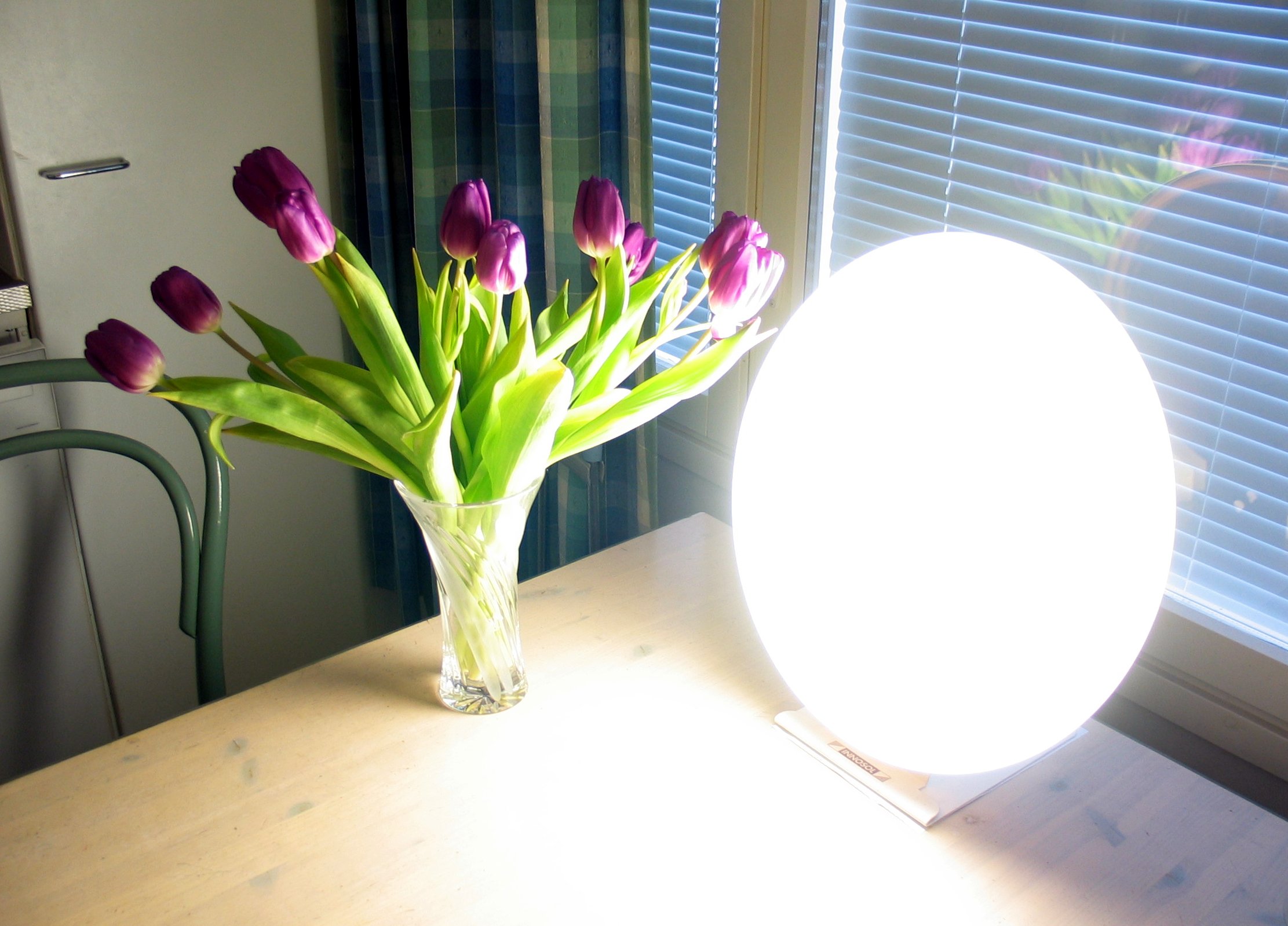
参考译文:亮光疗法有时用于治疗抑郁症,尤其适用于季节性抑郁症。
图片来源:User:Mysid
A meta-analysis of bright light therapy commissioned by the American Psychiatric Association found a significant reduction in depression symptom severity associated with bright light treatment. Benefit was found for both seasonal affective disorder and for nonseasonal depression, with effect sizes similar to those for conventional antidepressants. For non-seasonal depression, adding light therapy to the standard antidepressant treatment was not effective.[179]
【参考译文】美国精神医学学会委托进行的一项关于光照疗法的荟萃分析发现,光照治疗能显著降低抑郁症症状的严重程度。该疗法不仅对季节性情感障碍有效,对非季节性抑郁症同样有益,其效应量与常规抗抑郁药物相当。不过,对于非季节性抑郁症,在标准抗抑郁药物治疗的基础上额外增加光照疗法,并未显示出更好的效果[179]。
A meta-analysis of light therapy for non-seasonal depression conducted by Cochrane Collaboration, studied a different set of trials, where light was used mostly in combination with antidepressants or wake therapy. A moderate statistically significant effect of light therapy was found, with response significantly better than control treatment in high-quality studies, in studies that applied morning light treatment, and with patients who respond to total or partial sleep deprivation.[180]
【参考译文】考克兰协作组织(Cochrane Collaboration)针对非季节性抑郁症的光照疗法进行了另一项荟萃分析,他们研究了一组不同的临床试验,在这些试验中,光照疗法大多是与抗抑郁药或觉醒疗法(wake therapy)结合使用的。分析发现光照疗法具有中等程度的统计学显著疗效,且在高质量的试验中,其反应率显著优于对照组;此外,接受早晨光照治疗的患者,以及对完全或部分睡眠剥夺有反应的患者,疗效也更好[180]。
Both analyses noted poor quality of most studies and their small size, and urged caution in the interpretation of their results. The short 1–2 weeks duration of most trials makes it unclear whether the effect of light therapy could be sustained in the longer term.
【参考译文】两项分析均指出,大多数研究的质量不高且样本量较小,因此提醒人们在解读这些结果时需保持谨慎。此外,大多数试验的持续时间仅为1到2周,目前尚不清楚光照疗法的疗效能否在长期内持续保持。
4.2 运动 | Exercise

参考译文:体育锻炼是管理轻度抑郁症的推荐方法之一,例如踢足球。
图片来源:Soccer_football_informal_in_Manipur_India.jpg: Jackphotoproductions derivative work: Redtigerxyz (talk) – Soccer_football_informal_in_Manipur_India.jpg

The 2013 Cochrane Collaboration review (updated in 2026) on physical exercise for depression noted that, based upon limited evidence, it is moderately more effective than a control intervention and comparable to psychological or antidepressant drug therapies. Smaller effects were seen in more methodologically rigorous studies.[181]
【参考译文】考克兰协作组织(Cochrane Collaboration)在2013年发布(并于2026年更新)的关于体育锻炼治疗抑郁症的综述指出,基于有限的证据,体育锻炼在改善抑郁症状方面比对照干预措施(如不运动)要有效得多,且效果与心理疗法或抗抑郁药物治疗相当。不过,在那些方法学上更严谨的研究中,观察到的效果相对较小[181]。
Three subsequent 2014 systematic reviews that included the Cochrane review in their analysis concluded with similar findings: one indicated that physical exercise is effective as an adjunct treatment with antidepressant medication;[182] the other two indicated that physical exercise has marked antidepressant effects and recommended the inclusion of physical activity as an adjunct treatment for mild–moderate depression[183] and mental illness in general. These studies also found smaller effect sizes in more methodologically rigorous studies.[184] All four systematic reviews called for more research in order to determine the efficacy or optimal exercise intensity, duration, and modality.[181][182][183][184]
【参考译文】随后在2014年发表的三项系统综述(均纳入了上述考克兰综述的分析)也得出了类似的结论:其中一项表明,体育锻炼作为抗抑郁药物的辅助治疗是有效的[182];另外两项则指出,体育锻炼具有显著的抗抑郁作用,并建议将身体活动纳入轻度至中度抑郁症[183]以及一般精神疾病的辅助治疗方案中。这些研究同样发现,在方法学更严谨的试验中,运动带来的效果量会相对较小[184]。所有这四篇系统综述都呼吁需要开展更多的研究,以确定运动的最佳强度、持续时间和具体方式[181][182][183][184]。
A 2025 systematic review on the effectiveness of rock climbing for depression reported that indoor bouldering combined with mindfulness exercises may be an effective, clinically meaningful, safe, and sustainable adjunctive intervention for adults with moderate depression. However, the review found insufficient data to determine whether it was superior to other established treatments.[185]
【参考译文】一项2025年关于攀岩治疗抑郁症有效性的系统综述报告称,室内抱石攀岩结合正念练习,可能是一种有效、具有临床意义、安全且可持续的辅助干预手段,适用于患有中度抑郁症的成年人。不过,该综述也发现,目前的数据还不足以确定它是否优于其他已确立的治疗方法[185]。
The evidence for brain-derived neurotrophic factor (BDNF) in mediating some of the neurobiological effects of physical exercise[186][187][188] was noted in one review which hypothesized that increased BDNF signaling is responsible for the antidepressant effect.[182]
【参考译文】有一篇综述特别提到了脑源性神经营养因子(BDNF)在介导体育锻炼的部分神经生物学效应中的作用[186][187][188],并假设BDNF信号传导的增加正是体育锻炼产生抗抑郁效果的原因[182]。
A meta-analysis of 15 studies published in 2022 suggested a curvilinear dose-response relationship between exercise and depression risk, with low levels of exercise showing the best dose-response.[189]
【参考译文】2022年发表的一项包含15项研究的荟萃分析表明,运动与抑郁症风险之间呈曲线剂量-反应关系,其中低强度的运动显示出最佳的剂量反应效果[189]。
4.3 冥想 | Meditation

参考译文:在纽约市麦迪逊广场公园冥想的人们
图片来源:Beyond My Ken
Mindfulness meditation programs may help improve symptoms of depression, but they are no better than active treatments such as medication, exercise, and other behavioral therapies.[190]
【参考译文】正念冥想项目可能有助于改善抑郁症状,但它们的效果并不比药物治疗、运动以及其他行为疗法等积极的干预手段更好。[190]
4.4 音乐疗法 | Music therapy
A 2009 review found that 3 to 10 sessions of music therapy (when added to standard care) resulted in a noticeable improvement in depressive symptoms, with still greater improvement after 16 to 51 sessions.[191]
【参考译文】009年的一项综述发现,在标准护理的基础上增加3到10次音乐疗法,抑郁症状就会有明显的改善;如果增加到16到51次,改善效果会更加显著。
A 2017 cochrane systematic review found that music therapy added to the usual treatment of depression gives better outcome than the usual treatment alone: “The effect size translates to a difference of 9.8 points on the HAM-D”. It also found that there is no significant difference between active and receptive music therapy comparing depression outcome. It is also important to note that music therapy is not associated with more or fewer adverse events than treatment as usual.[192]
【参考译文】2017年考克兰协作组织(Cochrane)的一项系统综述发现,在抑郁症的常规治疗基础上加入音乐疗法,其效果要优于单纯的常规治疗:“其效应量换算下来,相当于在汉密尔顿抑郁量表(HAM-D)上降低了9.8分”。该综述还发现,在改善抑郁结果方面,主动式音乐疗法(如自己演奏、唱歌)和接受式音乐疗法(如单纯听音乐)之间并没有显著差异。另外值得注意的是,与常规治疗相比,音乐疗法并不会增加或减少不良反应的风险。
4.5 作业疗法 | Occupational therapy
Occupational therapy (OT) is a healthcare profession that involves the use of assessment and intervention to develop, recover, or maintain the meaningful activities, or occupations, of individuals, groups, or communities.[193] It is an independent health profession sometimes categorized as an allied health profession and consists of occupational therapists (OTs) and occupational therapy assistants (OTAs).[193] A person with depression may experience interruptions in sleep, difficulty completing self-care tasks, decreased motivation to participate in leisure activities, decreased concentration for school or job related work, and avoidance of social interactions. Occupational therapy practitioners possess the educational knowledge base in mental health and can contribute to the efforts in mental health promotion, prevention, and intervention.
【参考译文】作业疗法(OT)是一项医疗保健专业,它通过评估和干预,来帮助个人、群体或社区发展、恢复或维持那些有意义的活动(即“作业”)[193]。它是一门独立的健康专业,有时也被归类为辅助医疗专业,从业者包括作业治疗师(OTs)和作业治疗助理(OTAs)[193]。抑郁症患者可能会经历睡眠中断、难以完成自我照料任务、参与休闲活动的动力下降、难以集中精力应对学业或工作,以及回避社交互动等情况。作业治疗师具备扎实的心理健康教育知识储备,能够为心理健康的促进、预防和干预工作贡献力量。
Winston Churchill is a famous example of someone who treated his depression by occupying himself with work and other productive activities. Out of office, Churchill was prone to depression (his “black dog”) as he sensed his political talents being wasted and time passing him by – in all such times, writing provided the antidote.[194]
【参考译文】温斯顿·丘吉尔就是一个著名的例子,他通过让自己忙于工作和其他富有成效的活动来对抗抑郁。在卸任公职期间,丘吉尔很容易陷入抑郁(他称之为“黑狗”),因为他感到自己的政治才华被浪费,时光也在虚度——而在所有这些时刻,写作都成为了他的解药[194]。
4.6 睡眠 | Sleep
Depression is sometimes associated with insomnia (difficulty in falling asleep, early waking, or waking in the middle of the night). The combination of these two results, depression and insomnia, will only worsen the situation. Hence, good sleep hygiene is important to help break this vicious circle.[195] It would include measures such as regular sleep routines, avoidance of stimulants such as caffeine and management of sleeping disorders such as sleep apnea.[196]
【参考译文】抑郁症有时会伴随失眠(表现为难以入睡、早醒,或在半夜醒来)。抑郁症和失眠这两个问题叠加在一起,只会让情况雪上加霜。因此,保持良好的睡眠卫生对于打破这种恶性循环至关重要[195]。这包括采取一些具体措施,例如建立规律的睡眠作息、避免摄入咖啡因等兴奋剂,以及对睡眠呼吸暂停等睡眠障碍进行干预管理[196]。
4.7 戒烟 | Smoking cessation
Quitting smoking cigarettes is associated with reduced depression and anxiety, with the effect “equal or larger than” those of antidepressant treatments.[197]
【参考译文】戒烟与抑郁和焦虑症状的减轻有关,其效果“等同于甚至优于”抗抑郁药物治疗。
4.8 完全/部分睡眠剥夺 | Total/partial sleep deprivation
Main article: Wake therapy【主条目:觉醒疗法】
Sleep deprivation (skipping a night’s sleep) has been found to improve symptoms of depression in 40–60% of patients. Partial sleep deprivation in the second half of the night may be as effective as an all night sleep deprivation session. Improvement may last for weeks, though the majority (50–80%) relapse after recovery sleep. Shifting or reduction of sleep time, light therapy, antidepressant drugs, and lithium have been found to potentially stabilize sleep deprivation treatment effects.[198]
【参考译文】研究发现,睡眠剥夺(即熬一整夜不睡)能使40%到60%的抑郁症患者症状得到改善。而在后半夜进行部分睡眠剥夺,其效果可能与整夜不睡同样有效。这种改善效果可能会持续数周,不过大多数人(50%到80%)在补觉之后会出现复发。调整或减少睡眠时间、光照疗法、抗抑郁药物以及锂盐,被证实可能有助于稳定睡眠剥夺疗法的治疗效果。[198]
Shared care, when primary and specialty physicians have joint management of an individual’s health care, has been shown to alleviate depression outcomes.[199]
【参考译文】共同照护是指由初级保健医生(如社区全科医生)和专科医生共同管理患者的健康状况。这种模式已被证实能够改善抑郁症的治疗结果。[199]
5. 研究 | Research
See also: List of investigational antidepressants【另见:在研抗抑郁药物列表】
Trials are investigating whether botulinum toxin, when used to make a person appear to frown less, stops negative feedback from the face and affects depression.[200]
【参考译文】目前的临床试验正在探索,当使用肉毒杆菌毒素(俗称“肉毒素”)减少一个人的皱眉表情时,是否会阻断来自面部的负面反馈,从而对抑郁症产生影响。[200]
Psilocybin may have a beneficial role in the treatment of depression.[201][202]
【参考译文】裸盖菇素(Psilocybin,即“致幻蘑菇”中的主要活性成分)在抑郁症的治疗中可能具有积极的疗效。[201][202]
A 2019 meta-analysis found that hypnotherapy may be an effective way of alleviating the symptoms of depression.[203]
【参考译文】一项2019年的荟萃分析发现,催眠疗法或许也能成为缓解抑郁症状的有效手段。[203]
No model of depression in animals that fully explains the mechanism of depression has been found as of 2019.[204]
【参考译文】截至2019年,科学界尚未找到能完全解释抑郁症发病机制的动物抑郁模型。[204]
A. 参见(维基百科的相关词条)| See also
- Rapid-acting antidepressant【速效抗抑郁药】
- STAR*D【旨在缓解抑郁症的序贯治疗替代方案】
B. 英文词条参考文献 | References
- ^ Diagnostic and Statistical Manual of Mental Disorders (Fifth Edition (DSM-5) ed.). American Psychiatric Association. 2013.
- ^ Parker GB, Brotchie H, Graham RK (January 2017). “Vitamin D and depression”. Journal of Affective Disorders. 208: 56–61. doi:10.1016/j.jad.2016.08.082. PMID 27750060.
- ^ Orengo CA, Fullerton G, Tan R (October 2004). “Male depression: a review of gender concerns and testosterone therapy”. Geriatrics. 59 (10): 24–30. PMID 15508552.
- ^ Dale J, Sorour E, Milner G (2008). “Do psychiatrists perform appropriate physical investigations for their patients? A review of current practices in a general psychiatric inpatient and outpatient setting”. Journal of Mental Health. 17 (3): 293–98. doi:10.1080/09638230701498325. S2CID 72755878.
- ^ Carson VB (2000). Mental health nursing: the nurse-patient journey. W.B. Saunders. p. 423. ISBN 978-0-7216-8053-8. Archived from the original on 2023-01-11. Retrieved 2016-09-24.
- ^ Jump up to:a b “Psychotherapy”. The Merck Manual of Diagnosis and Therapy. Archived from the original on 2011-11-09. Retrieved 2011-11-09.
- ^ Khan A, Faucett J, Lichtenberg P, Kirsch I, Brown WA (July 30, 2012). “A systematic review of comparative efficacy of treatments and controls for depression”. PLOS ONE. 7 (7) e41778. Bibcode:2012PLoSO…741778K. doi:10.1371/journal.pone.0041778. PMC 3408478. PMID 22860015.
- ^ Jump up to:a b NICE (2005). NICE Guidelines:depression in children and adolescents. London: NICE. p. 5. ISBN 978-1-84629-074-9. Archived from the original on 2008-09-24. Retrieved 2008-08-16.
- ^ Thase ME (1999). “When are psychotherapy and pharmacotherapy combinations the treatment of choice for major depressive disorder?”. The Psychiatric Quarterly. 70 (4): 333–346. doi:10.1023/A:1022042316895. PMID 10587988. S2CID 45091134.
- ^ Jump up to:a b c Cuijpers P, Karyotaki E, Eckshtain D, Ng MY, Corteselli KA, Noma H, et al. (July 2020). “Psychotherapy for Depression Across Different Age Groups: A Systematic Review and Meta-analysis”. JAMA Psychiatry. 77 (7): 694–702. doi:10.1001/jamapsychiatry.2020.0164. PMC 7081149. PMID 32186668.
- ^ Roth A, Fonagy P (2006). “Cognitive-Behavioral Therapy Alone and in Combination with medication: University of Minnesota and University of Pennsylvania–Vanderbilt University Studies”. What Works for Whom?: A Critical Review of Psychotherapy Research (2nd ed.). Guilford Press. pp. 76–8. ISBN 978-1-59385-272-6.
- ^ Beck AT, Rush J, Shaw B, Emery G (1979). Cognitive therapy of depression. New York: Guilford Press.
- ^ Pagano J, Kyle BN, Johnson TL (February 2017). “A Manual by Any Other Name: Identifying Psychotherapy Manuals for Resident Training”. Academic Psychiatry. 41 (1): 44–50. doi:10.1007/s40596-016-0492-4. PMID 27048607. S2CID 26071140.
- ^ Pagano J, Kyle BN, Johnson TL, Saeed SA (June 2017). “Training Psychiatry Residents in Psychotherapy: The Role of Manualized Treatments”. The Psychiatric Quarterly. 88 (2): 285–294. doi:10.1007/s11126-016-9476-5. PMID 27785752. S2CID 3440253.
- ^ Beck JS (1995). Cognitive therapy: basics and beyond. New York: Guilford Press.
- ^ DeRubeis RJ, Beck AK (1988). “Cognitive therapy.”. In Dobson KS (ed.). Handbook of cognitive behavioral therapies. New York: Guilford Press. pp. 273–306.
- ^ Munoz RF, Miranda J (1986). Group therapy for cognitive behavioral treatment of depression. San Francisco: San Francisco General Hospital Depression Clinic.
- ^ Yost EB, Beutler LE, Corbishley MA, Allender JR (1986). Group cognitive therapy: a treatment approach for depressed older adults. Elmsford: Pergamon.
- ^ Johnsen TJ, Friborg O (July 2015). “The effects of cognitive behavioral therapy as an anti-depressive treatment is falling: A meta-analysis”. Psychological Bulletin. 141 (4): 747–768. doi:10.1037/bul0000015. PMID 25961373.
- ^ Bower P, Kontopantelis E, Sutton A, Kendrick T, Richards DA, Gilbody S, et al. (February 2013). “Influence of initial severity of depression on effectiveness of low intensity interventions: meta-analysis of individual patient data”. BMJ. 346: f540. doi:10.1136/bmj.f540. PMC 3582703. PMID 23444423.
- ^ FDA Newsroom (2024-04-02). “FDA Roundup: April 2nd, 2024”. FDA Press Releases. US Food and Drug Administration. Archived from the original on April 3, 2024. Retrieved 4 April 2024.
{{cite web}}:|last1=has generic name (help) - ^ March J, Silva S, Petrycki S, Curry J, Wells K, Fairbank J, et al. (August 2004). “Fluoxetine, cognitive-behavioral therapy, and their combination for adolescents with depression: Treatment for Adolescents With Depression Study (TADS) randomized controlled trial”. JAMA. 292 (7): 807–820. doi:10.1001/jama.292.7.807. PMID 15315995.
- ^ Goodyer I, Dubicka B, Wilkinson P, Kelvin R, Roberts C, Byford S, et al. (July 2007). “Selective serotonin reuptake inhibitors (SSRIs) and routine specialist care with and without cognitive behaviour therapy in adolescents with major depression: randomised controlled trial”. BMJ. 335 (7611): 142. doi:10.1136/bmj.39224.494340.55. PMC 1925185. PMID 17556431.
- ^ Goodyer IM, Dubicka B, Wilkinson P, Kelvin R, Roberts C, Byford S, et al. (May 2008). “A randomised controlled trial of cognitive behaviour therapy in adolescents with major depression treated by selective serotonin reuptake inhibitors. The ADAPT trial”. Health Technology Assessment. 12 (14): iii–iv, ix–60. doi:10.3310/hta12140. PMID 18462573.
- ^ Domino ME, Burns BJ, Silva SG, Kratochvil CJ, Vitiello B, Reinecke MA, et al. (May 2008). “Cost-effectiveness of treatments for adolescent depression: results from TADS”. The American Journal of Psychiatry. 165 (5): 588–596. doi:10.1176/appi.ajp.2008.07101610. PMID 18413703.
- ^ Hopko DR, Lejuez CW, LePage JP, Hopko SD, McNeil DW (September 2003). “A brief behavioral activation treatment for depression. A randomized pilot trial within an inpatient psychiatric hospital” (PDF). Behavior Modification. 27 (4): 458–469. doi:10.1177/0145445503255489. PMID 12971122. S2CID 30950124. Archived from the original (PDF) on 2015-04-02.
- ^ Spates CR, Pagoto SL, Kalata A (2006). “A Qualitative And Quantitative Review of Behavioral Activation Treatment of Major Depressive Disorder”. The Behavior Analyst Today. 7 (4): 508–518. doi:10.1037/h0100089. S2CID 3337916. Archived from the original on 2022-02-21. Retrieved 2019-07-14.
- ^ Bellack AS, Hersen M, Himmelhoch J (1981). “Social skills training for depression: a treatment manual”. J Select Ab Serv Cat Select Doc Psychol. 10: 36–92.
- ^ Jacobson NS, Martell CR, Dimidjian S (September 2001). “Behavioral activation treatment for depression: Returning to contextual roots”. Clinical Psychology: Science and Practice. 8 (3): 255–70. doi:10.1093/clipsy.8.3.255.
- ^ Cuijpers, P., Karyotaki, E., Harrer, M., & Stikkelbroek, Y. (2023). Individual behavioral activation in the treatment of depression: A meta analysis. Psychotherapy Research, 33(7), 886–897. https://doi.org/10.1080/10503307.2023.2197630
- ^ Greenberg LS, Rice LN, Elliott R (1993). Facilitating emotional change: the moment-by-moment process. New York: Guilford Press.
- ^ Ruiz FJ (2010). “A review of Acceptance and Commitment Therapy (ACT) empirical evidence: Correlational, experimental psychopathology, component and outcome studies”. International Journal of Psychology and Psychological Therapy. 10 (1): 125–62. Archived from the original on 2012-02-23. Retrieved 2013-04-30.
- ^ “APA website on empirical treatments”. Archived from the original on 2010-10-05. Retrieved 2009-09-01.
- ^ Hayes S. “State of the ACT Evidence”. ContextualPsychology.org. Archived from the original on 2013-01-22. Retrieved 2013-04-30.
- ^ Coelho HF, Canter PH, Ernst E (December 2007). “Mindfulness-based cognitive therapy: evaluating current evidence and informing future research”. Journal of Consulting and Clinical Psychology. 75 (6): 1000–1005. doi:10.1037/0022-006X.75.6.1000. PMID 18085916.
- ^ Segal ZV, Williams JM, Teasdale JD (2002). Mindfulness-based cognitive therapy for depression: a new approach to preventing relapse. New York: Guilford Press.
- ^ Klerman GL, Weissman MM, Rounsaville BJ, Chevron ES (1984). Interpersonal psychotherapy of depression. New York: Basic Books.
- ^ Lipsitz JD, Markowitz JC (December 2013). “Mechanisms of change in interpersonal therapy (IPT)”. Clinical Psychology Review. 33 (8): 1134–1147. doi:10.1016/j.cpr.2013.09.002. PMC 4109031. PMID 24100081.
- ^ Jump up to:a b c Cuijpers P, Geraedts AS, van Oppen P, Andersson G, Markowitz JC, van Straten A (June 2011). “Interpersonal psychotherapy for depression: a meta-analysis”. The American Journal of Psychiatry. 168 (6): 581–592. doi:10.1176/appi.ajp.2010.10101411. PMC 3646065. PMID 21362740.
- ^ Weissman MM, Markowitz JC, Klerman GL (2000). Comprehensive Guide to Interpersonal Psychotherapy. New York: Basic Books. ISBN 978-0-465-09566-7.
- ^ Jump up to:a b Barbato, Angelo; D’Avanzo, Barbara; Parabiaghi, Alberto (2018-06-08). “Couple therapy for depression”. The Cochrane Database of Systematic Reviews. 2018 (6) CD004188. doi:10.1002/14651858.CD004188.pub3. ISSN 1469-493X. PMC 6513419. PMID 29882960.
- ^ Dworetzky J (1997). Psychology. Pacific Grove, CA, USA: Brooks/Cole Pub. Co. p. 602. ISBN 978-0-314-20412-7.
- ^ Doidge N, Simon B, Lancee WJ, First M, Brunshaw J, Brauer L, et al. (2002). “Psychoanalytic patients in the U.S., Canada, and Australia: II. A DSM-III-R validation study”. Journal of the American Psychoanalytic Association. 50 (2): 615–627. doi:10.1177/00030651020500021101. PMID 12206545. S2CID 25110425.
- ^ Durand VM, Barlow D (1999). Abnormal psychology: An integrative approach. Pacific Grove, CA, USA: Brooks/Cole Pub. Co. ISBN 978-0-534-34742-0.
- ^ de Maat S, Dekker J, Schoevers R, van Aalst G, Gijsbers-van Wijk C, Hendriksen M, et al. (June 2007). “Short psychodynamic supportive psychotherapy, antidepressants, and their combination in the treatment of major depression: a mega-analysis based on three randomized clinical trials”. Depression and Anxiety. 25 (7): 565–574. doi:10.1002/da.20305. PMID 17557313. S2CID 20373635.
- ^ Sanda MG, Cadeddu JA, Kirkby E, Chen RC, Crispino T, Fontanarosa J, et al. (March 2018). “Clinically Localized Prostate Cancer: AUA/ASTRO/SUO Guideline. Part I: Risk Stratification, Shared Decision Making, and Care Options”. The Journal of Urology. 199 (3). Ovid Technologies (Wolters Kluwer Health): 683–690. doi:10.1016/j.juro.2017.11.095. PMID 29203269. S2CID 21405694.
- ^ Depression and Other Common Mental Disorders: Global Health Estimates (PDF) (Report). Geneva: World Health Organisation. 2017. p. 5. Archived (PDF) from the original on 20 January 2022. Retrieved 17 January 2022.
- ^ Walsh K, Sandars J (June 2017). “Shared decision-making tools: do they really involve patients?”. British Journal of Hospital Medicine. 78 (6). Mark Allen Group: 304–305. doi:10.12968/hmed.2017.78.6.304. PMID 28614022. Archived from the original on 2024-02-24. Retrieved 2022-06-11.
- ^ Sutherland JE, Sutherland SJ, Hoehns JD (March 2003). “Achieving the best outcome in treatment of depression”. The Journal of Family Practice. 52 (3): 201–209. PMID 12620174. Archived from the original on 2009-10-02.
- ^ Zisook S, Rush AJ, Haight BR, Clines DC, Rockett CB (February 2006). “Use of bupropion in combination with serotonin reuptake inhibitors”. Biological Psychiatry. 59 (3): 203–210. doi:10.1016/j.biopsych.2005.06.027. PMID 16165100. S2CID 20997303.
- ^ Rush AJ, Trivedi MH, Wisniewski SR, Stewart JW, Nierenberg AA, Thase ME, et al. (March 2006). “Bupropion-SR, sertraline, or venlafaxine-XR after failure of SSRIs for depression”. The New England Journal of Medicine. 354 (12): 1231–1242. doi:10.1056/NEJMoa052963. PMID 16554525.
- ^ Trivedi MH, Fava M, Wisniewski SR, Thase ME, Quitkin F, Warden D, et al. (March 2006). “Medication augmentation after the failure of SSRIs for depression”. The New England Journal of Medicine. 354 (12): 1243–1252. doi:10.1056/NEJMoa052964. PMID 16554526.
- ^ Mayers AG, Baldwin DS (December 2005). “Antidepressants and their effect on sleep”. Human Psychopharmacology. 20 (8): 533–559. doi:10.1002/hup.726. PMID 16229049. S2CID 17912673.
- ^ Winokur A, DeMartinis NA, McNally DP, Gary EM, Cormier JL, Gary KA (October 2003). “Comparative effects of mirtazapine and fluoxetine on sleep physiology measures in patients with major depression and insomnia”. The Journal of Clinical Psychiatry. 64 (10): 1224–1229. doi:10.4088/JCP.v64n1013. PMID 14658972.
- ^ Lawrence RW (August 2004). “Effect of mirtazapine versus fluoxetine on “sleep quality””. The Journal of Clinical Psychiatry. 65 (8): 1149–1150. doi:10.4088/JCP.v65n0818i. PMID 15323610.
- ^ “Prozac may be the best treatment for young people with depression – but more research is needed”. NIHR Evidence (Plain English summary). National Institute for Health and Care Research. 2020-10-12. doi:10.3310/alert_41917. S2CID 242952585. Archived from the original on 2022-11-06. Retrieved 2022-11-06.
- ^ Zhou X, Teng T, Zhang Y, Del Giovane C, Furukawa TA, Weisz JR, et al. (July 2020). “Comparative efficacy and acceptability of antidepressants, psychotherapies, and their combination for acute treatment of children and adolescents with depressive disorder: a systematic review and network meta-analysis”. The Lancet. Psychiatry. 7 (7): 581–601. doi:10.1016/S2215-0366(20)30137-1. PMC 7303954. PMID 32563306.
- ^ Boaden K, Tomlinson A, Cortese S, Cipriani A (2020-09-02). “Antidepressants in Children and Adolescents: Meta-Review of Efficacy, Tolerability and Suicidality in Acute Treatment”. Frontiers in Psychiatry. 11 717. doi:10.3389/fpsyt.2020.00717. PMC 7493620. PMID 32982805.
- ^ Jump up to:a b Hetrick SE, McKenzie JE, Bailey AP, Sharma V, Moller CI, Badcock PB, et al. (May 2021). Cochrane Common Mental Disorders Group (ed.). “New generation antidepressants for depression in children and adolescents: a network meta-analysis”. The Cochrane Database of Systematic Reviews. 2021 (5) CD013674. doi:10.1002/14651858.CD013674.pub2. PMC 8143444. PMID 34029378.
- ^ “Overview | Depression in children and young people: identification and management | Guidance | NICE”. www.nice.org.uk. 25 June 2019. Archived from the original on 2022-10-29. Retrieved 2022-11-06.
- ^ Nelson JC, Devanand DP (April 2011). “A systematic review and meta-analysis of placebo-controlled antidepressant studies in people with depression and dementia”. Journal of the American Geriatrics Society. 59 (4): 577–585. doi:10.1111/j.1532-5415.2011.03355.x. PMID 21453380. S2CID 2592434.
- ^ Cleveland Clinic medical. (2025, November 4). NDRIs: What are they?. Cleveland Clinic. https://my.clevelandclinic.org/health/treatments/ndri
- ^ Papakostas GI, Thase ME, Fava M, Nelson JC, Shelton RC (December 2007). “Are antidepressant drugs that combine serotonergic and noradrenergic mechanisms of action more effective than the selective serotonin reuptake inhibitors in treating major depressive disorder? A meta-analysis of studies of newer agents”. Biological Psychiatry. 62 (11): 1217–1227. doi:10.1016/j.biopsych.2007.03.027. PMID 17588546. S2CID 45621773.
- ^ Cipriani A, Geddes JR, Barbui C (February 2007). “Venlafaxine for major depression”. BMJ. 334 (7587): 215–216. doi:10.1136/bmj.39098.457720.BE. PMC 1790758. PMID 17272528.
- ^ “Depression in children and young people: identification and management in primary, community and secondary care”. NHS National Institute for Health and Clinical Excellence. September 2005. Archived from the original on 2022-10-17. Retrieved 2008-08-17.
- ^ Anderson IM (1998). “SSRIS versus tricyclic antidepressants in depressed inpatients: a meta-analysis of efficacy and tolerability”. Depression and Anxiety. 7 (S1): 11–17. doi:10.1002/(SICI)1520-6394(1998)7:1+<11::AID-DA4>3.0.CO;2-I. PMID 9597346. S2CID 25730459.
- ^ Anderson IM (April 2000). “Selective serotonin reuptake inhibitors versus tricyclic antidepressants: a meta-analysis of efficacy and tolerability”. Journal of Affective Disorders. 58 (1): 19–36. doi:10.1016/S0165-0327(99)00092-0. PMID 10760555.
- ^ Krishnan KR (2007). “Revisiting monoamine oxidase inhibitors”. The Journal of Clinical Psychiatry. 68 (Suppl 8): 35–41. PMID 17640156. Retrieved 2008-08-27.
- ^ Jump up to:a b Mottram P, Wilson K, Strobl J (January 2006). “Antidepressants for depressed elderly”. The Cochrane Database of Systematic Reviews. 2009 (1) CD003491. doi:10.1002/14651858.CD003491.pub2. PMC 8406818. PMID 16437456.
- ^ “What causes emotional blunting in people taking antidepressants?”. 2018-02-08. Archived from the original on 2019-04-09. Retrieved 2018-04-25.
- ^ Caddy C, Giaroli G, White TP, Shergill SS, Tracy DK (April 2014). “Ketamine as the prototype glutamatergic antidepressant: pharmacodynamic actions, and a systematic review and meta-analysis of efficacy”. Therapeutic Advances in Psychopharmacology. 4 (2): 75–99. doi:10.1177/2045125313507739. PMC 3952483. PMID 24688759.
- ^ Gastaldon C, Papola D, Ostuzzi G, Barbui C (December 2019). “Esketamine for treatment resistant depression: a trick of smoke and mirrors?”. Epidemiology and Psychiatric Sciences. 29 e79. Cambridge University Press (CUP). doi:10.1017/s2045796019000751. PMC 8061126. PMID 31841104.
- ^ “FDA approves new nasal spray medication for treatment-resistant depression; available only at a certified doctor’s office or clinic”. U.S. Food and Drug Administration. 5 March 2019. Archived from the original on 23 July 2021. Retrieved 12 August 2022.
- ^ Marcantoni, Walter S.; Akoumba, Bertine Sandra; Wassef, Maggy; Mayrand, Julie; Lai, Hinatea; Richard-Devantoy, Stéphane; Beauchamp, Sylvie (2020-12-01). “A systematic review and meta-analysis of the efficacy of intravenous ketamine infusion for treatment resistant depression: January 2009 – January 2019”. Journal of Affective Disorders. 277: 831–841. doi:10.1016/j.jad.2020.09.007. ISSN 1573-2517. PMID 33065824.
- ^ Bahji, Anees; Vazquez, Gustavo H.; Zarate, Carlos A. (2021-01-01). “Comparative efficacy of racemic ketamine and esketamine for depression: A systematic review and meta-analysis”. Journal of Affective Disorders. 278: 542–555. doi:10.1016/j.jad.2020.09.071. ISSN 1573-2517. PMC 7704936. PMID 33022440.
- ^ McCarthy B, Bunn H, Santalucia M, Wilmouth C, Muzyk A, Smith CM (November 2023). “Dextromethorphan-bupropion (Auvelity) for the Treatment of Major Depressive Disorder”. Clinical Psychopharmacology and Neuroscience. 21 (4): 609–616. doi:10.9758/cpn.23.1081. PMC 10591164. PMID 37859435.
- ^ Maserejian NN, Hall SA, McKinlay JB (February 2012). “Low dietary or supplemental zinc is associated with depression symptoms among women, but not men, in a population-based epidemiological survey”. Journal of Affective Disorders. 136 (3): 781–788. doi:10.1016/j.jad.2011.09.039. PMC 3272121. PMID 22030131.
- ^ Swardfager W, Herrmann N, Mazereeuw G, Goldberger K, Harimoto T, Lanctôt KL (December 2013). “Zinc in depression: a meta-analysis”. Biological Psychiatry. 74 (12): 872–878. doi:10.1016/j.biopsych.2013.05.008. PMID 23806573. S2CID 381132.
- ^ Lai J, Moxey A, Nowak G, Vashum K, Bailey K, McEvoy M (January 2012). “The efficacy of zinc supplementation in depression: systematic review of randomised controlled trials”. Journal of Affective Disorders. 136 (1–2): e31–e39. doi:10.1016/j.jad.2011.06.022. PMID 21798601.
- ^ Wang J, Um P, Dickerman BA, Liu J (May 2018). “Zinc, Magnesium, Selenium and Depression: A Review of the Evidence, Potential Mechanisms and Implications”. Nutrients. 10 (5): 584. doi:10.3390/nu10050584. PMC 5986464. PMID 29747386.
- ^ Prasad AS (June 2012). “Discovery of human zinc deficiency: 50 years later”. Journal of Trace Elements in Medicine and Biology. 26 (2–3): 66–69. Bibcode:2012JTEMB..26…66P. doi:10.1016/j.jtemb.2012.04.004. PMID 22664333.
- ^ Chasapis CT, Loutsidou AC, Spiliopoulou CA, Stefanidou ME (April 2012). “Zinc and human health: an update”. Archives of Toxicology. 86 (4): 521–534. Bibcode:2012ArTox..86..521C. doi:10.1007/s00204-011-0775-1. PMID 22071549. S2CID 18669835.
- ^ Millichap JG, Yee MM (February 2012). “The diet factor in attention-deficit/hyperactivity disorder”. Pediatrics. 129 (2): 330–337. doi:10.1542/peds.2011-2199. PMID 22232312. S2CID 14925322.
- ^ Swardfager W, Herrmann N, McIntyre RS, Mazereeuw G, Goldberger K, Cha DS, et al. (June 2013). “Potential roles of zinc in the pathophysiology and treatment of major depressive disorder”. Neuroscience and Biobehavioral Reviews. 37 (5): 911–929. doi:10.1016/j.neubiorev.2013.03.018. PMID 23567517. S2CID 1725139.
- ^ Nasca C, Bigio B, Lee FS, Young SP, Kautz MM, Albright A, et al. (August 2018). “Acetyl-l-carnitine deficiency in patients with major depressive disorder”. Proceedings of the National Academy of Sciences of the United States of America. 115 (34): 8627–8632. Bibcode:2018PNAS..115.8627N. doi:10.1073/pnas.1801609115. PMC 6112703. PMID 30061399.
- ^ Nasca C, Xenos D, Barone Y, Caruso A, Scaccianoce S, Matrisciano F, et al. (March 2013). “L-acetylcarnitine causes rapid antidepressant effects through the epigenetic induction of mGlu2 receptors”. Proceedings of the National Academy of Sciences of the United States of America. 110 (12): 4804–4809. Bibcode:2013PNAS..110.4804N. doi:10.1073/pnas.1216100110. PMC 3607061. PMID 23382250.
- ^ Veronese N, Stubbs B, Solmi M, Ajnakina O, Carvalho AF, Maggi S (Feb–Mar 2018). “Acetyl-L-Carnitine Supplementation and the Treatment of Depressive Symptoms: A Systematic Review and Meta-Analysis”. Psychosomatic Medicine. 80 (2): 154–159. doi:10.1097/PSY.0000000000000537. PMID 29076953. S2CID 7649619.
- ^ Valenstein M, McCarthy JF, Austin KL, Greden JF, Young EA, Blow FC (July 2006). “What happened to lithium? Antidepressant augmentation in clinical settings”. The American Journal of Psychiatry. 163 (7): 1219–1225. doi:10.1176/appi.ajp.163.7.1219. PMID 16816227.
- ^ Stahl SM (2011). The Prescriber’s Guide (Stahl’s Essential Psychopharmacology). Cambridge University Press. p. 39.
- ^ Kraus MF, Burch EA (October 1992). “Methylphenidate hydrochloride as an antidepressant: controversy, case studies, and review”. Southern Medical Journal. 85 (10): 985–991. doi:10.1097/00007611-199210000-00012. PMID 1411740.
- ^ Orr K, Taylor D (2007). “Psychostimulants in the treatment of depression: a review of the evidence”. CNS Drugs. 21 (3): 239–257. doi:10.2165/00023210-200721030-00004. PMID 17338594. S2CID 35761979.
- ^ Howland RH (May 2016). “Oxazepam for the Treatment of Substance Abuse and Depression: Is it Appropriate?”. Journal of Psychosocial Nursing and Mental Health Services. 54 (5). SLACK, Inc.: 21–24. doi:10.3928/02793695-20160420-03. PMID 27135891.
- ^ Bender KJ (2008-02-01). “Evidence Grows for Value of Antipsychotics as Antidepressant Adjuncts – Psychiatric Times”. Psychiatric Times. Archived from the original on 2020-06-13. Retrieved 2008-08-06.
- ^ Bschor T (June 2014). “Lithium in the treatment of major depressive disorder”. Drugs. 74 (8). Springer Science and Business Media LLC: 855–862. doi:10.1007/s40265-014-0220-x. PMID 24825489. S2CID 12892550.
- ^ Undurraga, Juan; Sim, Kang; Tondo, Leonardo; Gorodischer, Ariel; Azua, Emilio; Tay, Kai Hong; Tan, David; Baldessarini, Ross J. (February 2019). “Lithium treatment for unipolar major depressive disorder: Systematic review”. Journal of Psychopharmacology. 33 (2): 167–176. doi:10.1177/0269881118822161. ISSN 1461-7285. PMID 30698058.
- ^ Bauer, Michael; Adli, Mazda; Ricken, Roland; Severus, Emanuel; Pilhatsch, Maximilian (April 2014). “Role of lithium augmentation in the management of major depressive disorder”. CNS Drugs. 28 (4): 331–342. doi:10.1007/s40263-014-0152-8. ISSN 1179-1934. PMID 24590663.
- ^ Jump up to:a b Shelton RC, Osuntokun O, Heinloth AN, Corya SA (February 2010). “Therapeutic options for treatment-resistant depression”. CNS Drugs. 24 (2). Springer Science and Business Media LLC: 131–161. doi:10.2165/11530280-000000000-00000. PMID 20088620. S2CID 32936223.
- ^ Guzzetta F, Tondo L, Centorrino F, Baldessarini RJ (March 2007). “Lithium treatment reduces suicide risk in recurrent major depressive disorder”. The Journal of Clinical Psychiatry. 68 (3): 380–383. doi:10.4088/JCP.v68n0304. PMID 17388706.
- ^ Cipriani, Andrea; Pretty, Heather; Hawton, Keith; Geddes, John R. (October 2005). “Lithium in the Prevention of Suicidal Behavior and All-Cause Mortality in Patients With Mood Disorders: A Systematic Review of Randomized Trials”. American Journal of Psychiatry. 162 (10): 1805–1819. doi:10.1176/appi.ajp.162.10.1805. PMID 16199826.
- ^ Nierenberg AA, Fava M, Trivedi MH, Wisniewski SR, Thase ME, McGrath PJ, et al. (September 2006). “A comparison of lithium and T(3) augmentation following two failed medication treatments for depression: a STAR*D report”. The American Journal of Psychiatry. 163 (9): 1519–30, quiz 1665. doi:10.1176/appi.ajp.163.9.1519. PMID 16946176.
- ^ de Sousa RT, Zanetti MV, Brunoni AR, Machado-Vieira R (2015-10-13). “Challenging Treatment-Resistant Major Depressive Disorder: A Roadmap for Improved Therapeutics”. Current Neuropharmacology. 13 (5). Bentham Science Publishers Ltd.: 616–635. doi:10.2174/1570159×13666150630173522. PMC 4761633. PMID 26467411.
- ^ British National Formulary (BNF) 65. Pharmaceutical Pr; 2013.
- ^ “Therapeutic Goods Administration. TGA eBusiness Services [Internet]”. Australian Government Department of Health and Ageing. Archived from the original on 21 April 2013. Retrieved 13 September 2013.
- ^ Drugs@FDA. “FDA Approved Drug Products”. Archived from the original on 14 August 2012. Retrieved 13 September 2013.
- ^ Jump up to:a b c d e f g h Komossa K, Depping AM, Gaudchau A, Kissling W, Leucht S (December 2010). Leucht S (ed.). “Second-generation antipsychotics for major depressive disorder and dysthymia”. The Cochrane Database of Systematic Reviews. 2012 (12) CD008121. doi:10.1002/14651858.CD008121.pub2. PMC 11994262. PMID 21154393.
- ^ Bauer M, Dopfmer S (October 1999). “Lithium augmentation in treatment-resistant depression: meta-analysis of placebo-controlled studies”. Journal of Clinical Psychopharmacology. 19 (5): 427–434. doi:10.1097/00004714-199910000-00006. PMID 10505584.
- ^ Rossi, S, ed. (2013). Australian Medicines Handbook (2013 ed.). Adelaide: The Australian Medicines Handbook Unit Trust. ISBN 978-0-9805790-9-3.
- ^ Jump up to:a b Kirsch I, Deacon BJ, Huedo-Medina TB, Scoboria A, Moore TJ, Johnson BT (February 2008). “Initial severity and antidepressant benefits: a meta-analysis of data submitted to the Food and Drug Administration”. PLOS Medicine. 5 (2) e45. doi:10.1371/journal.pmed.0050045. PMC 2253608. PMID 18303940.
- ^ Turner EH, Matthews AM, Linardatos E, Tell RA, Rosenthal R (January 2008). “Selective publication of antidepressant trials and its influence on apparent efficacy”. The New England Journal of Medicine. 358 (3): 252–260. doi:10.1056/NEJMsa065779. PMID 18199864.
- ^ Elkin I, Shea MT, Watkins JT, Imber SD, Sotsky SM, Collins JF, et al. (November 1989). “National Institute of Mental Health Treatment of Depression Collaborative Research Program. General effectiveness of treatments”. Archives of General Psychiatry. 46 (11): 971–82, discussion 983. doi:10.1001/archpsyc.1989.01810110013002. PMID 2684085.
- ^ Elkin I, Gibbons RD, Shea MT, Sotsky SM, Watkins JT, Pilkonis PA, Hedeker D (October 1995). “Initial severity and differential treatment outcome in the National Institute of Mental Health Treatment of Depression Collaborative Research Program”. Journal of Consulting and Clinical Psychology. 63 (5): 841–847. doi:10.1037/0022-006X.63.5.841. PMID 7593878.
- ^ Sotsky SM, Glass DR, Shea MT, Pilkonis PA, Collins JF, Elkin I, et al. (August 1991). “Patient predictors of response to psychotherapy and pharmacotherapy: findings in the NIMH Treatment of Depression Collaborative Research Program”. The American Journal of Psychiatry. 148 (8): 997–1008. doi:10.1176/ajp.148.8.997. PMID 1853989.
- ^ Turner EH, Rosenthal R (March 2008). “Efficacy of antidepressants”. BMJ. 336 (7643): 516–517. doi:10.1136/bmj.39510.531597.80. PMC 2265347. PMID 18319297.
- ^ Jump up to:a b c Cuijpers P, van Straten A, van Oppen P, Andersson G (November 2008). “Are psychological and pharmacologic interventions equally effective in the treatment of adult depressive disorders? A meta-analysis of comparative studies”. The Journal of Clinical Psychiatry. 69 (11): e1–e11. doi:10.4088/jcp.v69n1102. PMID 18945396.
- ^ Jump up to:a b c Imel ZE, Malterer MB, McKay KM, Wampold BE (October 2008). “A meta-analysis of psychotherapy and medication in unipolar depression and dysthymia”. Journal of Affective Disorders. 110 (3): 197–206. doi:10.1016/j.jad.2008.03.018. PMID 18456340.
- ^ Jump up to:a b Van Voorhees BW, Smith S, Ewigman B (November 2008). “Treat depressed teens with medication and psychotherapy”. The Journal of Family Practice. 57 (11): 735–79a. PMC 3183842. PMID 19006622.
- ^ Cipriani A, Zhou X, Del Giovane C, Hetrick SE, Qin B, Whittington C, et al. (August 2016). “Comparative efficacy and tolerability of antidepressants for major depressive disorder in children and adolescents: a network meta-analysis”. Lancet. 388 (10047): 881–890. doi:10.1016/S0140-6736(16)30385-3. hdl:11380/1279478. PMID 27289172. S2CID 19728203. Archived from the original on 2021-10-27. Retrieved 2020-11-30.
- ^ Serretti A, Fabbri C (September 2014). “Factors that predispose patients to treatment-resistant depression”. Psychiatric Times. 31 (9). Archived from the original on 2018-04-25. Retrieved 2018-04-25.
- ^ Nunes AA, Dos Santos RG, Osório FL, Sanches RF, Crippa JA, Hallak JE (2016-05-26). “Effects of Ayahuasca and its Alkaloids on Drug Dependence: A Systematic Literature Review of Quantitative Studies in Animals and Humans”. Journal of Psychoactive Drugs. 48 (3). Informa UK Limited: 195–205. doi:10.1080/02791072.2016.1188225. hdl:11449/159021. PMID 27230395. S2CID 5840140.
- ^ Carbonaro TM, Gatch MB (September 2016). “Neuropharmacology of N,N-dimethyltryptamine”. Brain Research Bulletin. 126 (Pt 1). Elsevier BV: 74–88. doi:10.1016/j.brainresbull.2016.04.016. PMC 5048497. PMID 27126737.
- ^ Frecska E, Bokor P, Winkelman M (2016-03-02). “The Therapeutic Potentials of Ayahuasca: Possible Effects against Various Diseases of Civilization”. Frontiers in Pharmacology. 7. Frontiers Media SA: 35. doi:10.3389/fphar.2016.00035. PMC 4773875. PMID 26973523.
- ^ PAREA (2026-03-09). “Bretisilocin Becomes First Psychedelic in EMA PRIME Scheme for Depression”. Drug Policy Tracker. Retrieved 2026-03-29.
- ^ Foster, Bree (2025-09-04). “Could a short-acting psychedelic transform depression treatment?”. Drug Discovery News. Retrieved 2026-03-29.
- ^ Gilgamesh Pharmaceuticals (2026-02-05). A Phase 2a Study to Evaluate the Safety and Tolerability of Two Repeated Doses of GM-2505 at a 2-Week Interval in Patients With Major Depressive Disorder (Report). clinicaltrials.gov.
- ^ Marek, Gerard J.; Makai-Bölöni, Soma; Umbricht, Daniel; Christian, Edward P.; Winters, Jason; Dvorak, Dino; Raines, Shane; Hughes, Zoë A.; Austin, Eric W.; Klein, Adam K.; Leong, William; Krol, Fas J.; Graaf, Anne J. van der; Juachon, Maria J.; Otto, Marije E. (2025-10-16). “A novel psychedelic 5-HT2A receptor agonist GM-2505: The pharmacokinetic, safety, and pharmacodynamic profile from a randomized trial healthy volunteer”. Journal of Psychopharmacology (Oxford, England) 2698811251378512. doi:10.1177/02698811251378512. hdl:1887/4298848. ISSN 1461-7285. PMID 41099491.
- ^ Jump up to:a b c d Iovieno N, Dalton ED, Fava M, Mischoulon D (May 2011). “Second-tier natural antidepressants: review and critique”. Journal of Affective Disorders. 130 (3): 343–357. doi:10.1016/j.jad.2010.06.010. PMID 20579741.
- ^ Kious BM, Kondo DG, Renshaw PF (August 2019). “Creatine for the Treatment of Depression”. Biomolecules. 9 (9): 406. doi:10.3390/biom9090406. PMC 6769464. PMID 31450809.
- ^ Cunha MP, Machado DG, Capra JC, Jacinto J, Bettio LE, Rodrigues AL (November 2012). “Antidepressant-like effect of creatine in mice involves dopaminergic activation”. Journal of Psychopharmacology. 26 (11): 1489–1501. doi:10.1177/0269881112447989. PMID 22674968. S2CID 23293173.
- ^ Levine J, Barak Y, Gonzalves M, Szor H, Elizur A, Kofman O, Belmaker RH (May 1995). “Double-blind, controlled trial of inositol treatment of depression”. The American Journal of Psychiatry. 152 (5): 792–4. doi:10.1176/ajp.152.5.792. PMID 7726322.
- ^ Levine J, Gonsalves M, Babur I, Stier S, Elizur A, Kofman O, Belmaker RH (January 1993). “Inositol 6 g daily may be effective in depression but not in schizophrenia”. Human Psychopharmacology: Clinical and Experimental. 8 (1): 49–53. doi:10.1002/hup.470080109. S2CID 144478254.
- ^ Jump up to:a b Phelan D, Molero P, Martínez-González MA, Molendijk M (July 2018). “Magnesium and mood disorders: systematic review and meta-analysis”. BJPsych Open. 4 (4). Royal College of Psychiatrists: 167–179. doi:10.1192/bjo.2018.22. PMC 6034436. PMID 29897029.
- ^ You HJ, Cho SE, Kang SG, Cho SJ, Na KS (October 2018). “Decreased serum magnesium levels in depression: a systematic review and meta-analysis”. Nordic Journal of Psychiatry. 72 (7): 534–541. doi:10.1080/08039488.2018.1538388. PMID 30444158. S2CID 53564501.
- ^ Appleton KM, Voyias PD, Sallis HM, Dawson S, Ness AR, Churchill R, Perry R (November 2021). “Omega-3 fatty acids for depression in adults”. The Cochrane Database of Systematic Reviews. 2021 (11) CD004692. Wiley. doi:10.1002/14651858.cd004692.pub5. PMC 8612309. PMID 34817851.
- ^ Hallahan B, Ryan T, Hibbeln JR, Murray IT, Glynn S, Ramsden CE, et al. (September 2016). “Efficacy of omega-3 highly unsaturated fatty acids in the treatment of depression”. The British Journal of Psychiatry. 209 (3): 192–201. doi:10.1192/bjp.bp.114.160242. PMC 9406129. PMID 27103682.
- ^ Luo XD, Feng JS, Yang Z, Huang QT, Lin JD, Yang B, et al. (May 2020). “High-dose omega-3 polyunsaturated fatty acid supplementation might be more superior than low-dose for major depressive disorder in early therapy period: a network meta-analysis”. BMC Psychiatry. 20 (1) 248. Springer Science and Business Media LLC. doi:10.1186/s12888-020-02656-3. PMC 7238659. PMID 32434488.
- ^ Dunlop BW, Nemeroff CB (March 2007). “The role of dopamine in the pathophysiology of depression”. Archives of General Psychiatry. 64 (3): 327–337. doi:10.1001/archpsyc.64.3.327. PMID 17339521. S2CID 26550661.
- ^ Fernandes BS, Dean OM, Dodd S, Malhi GS, Berk M (April 2016). “N-Acetylcysteine in depressive symptoms and functionality: a systematic review and meta-analysis”. The Journal of Clinical Psychiatry. 77 (4): e457–e466. doi:10.4088/JCP.15r09984. PMID 27137430. S2CID 40688371.
- ^ Dean O, Giorlando F, Berk M (March 2011). “N-acetylcysteine in psychiatry: current therapeutic evidence and potential mechanisms of action”. Journal of Psychiatry & Neuroscience. 36 (2): 78–86. doi:10.1503/jpn.100057. PMC 3044191. PMID 21118657.
- ^ Daws RE, Timmermann C, Giribaldi B, Sexton JD, Wall MB, Erritzoe D, et al. (April 2022). “Increased global integration in the brain after psilocybin therapy for depression”. Nature Medicine. 28 (4): 844–851. doi:10.1038/s41591-022-01744-z. hdl:10044/1/95521. PMID 35411074. S2CID 248099554.
- ^ Marks M (11 October 2021). “A Strategy for Rescheduling Psilocybin”. Scientific American. Archived from the original on 13 August 2022. Retrieved 13 August 2022.
- ^ Linde K, Berner MM, Kriston L (October 2008). “St John’s wort for major depression”. The Cochrane Database of Systematic Reviews. 2008 (4) CD000448. doi:10.1002/14651858.CD000448.pub3. PMC 7032678. PMID 18843608.
- ^ “St John’s Wort and depression”. 2011-11-21. Archived from the original on 2015-02-05. Retrieved January 25, 2014.
- ^ Hausenblas HA, Saha D, Dubyak PJ, Anton SD (November 2013). “Saffron (Crocus sativus L.) and major depressive disorder: a meta-analysis of randomized clinical trials”. Journal of Integrative Medicine. 11 (6): 377–383. doi:10.3736/jintegrmed2013056. PMC 4643654. PMID 24299602.
- ^ Hausenblas HA, Heekin K, Mutchie HL, Anton S (July 2015). “A systematic review of randomized controlled trials examining the effectiveness of saffron (Crocus sativus L.) on psychological and behavioral outcomes”. Journal of Integrative Medicine. 13 (4): 231–240. doi:10.1016/S2095-4964(15)60176-5. PMC 5747362. PMID 26165367.
- ^ Bostan HB, Mehri S, Hosseinzadeh H (February 2017). “Toxicology effects of saffron and its constituents: a review”. Iranian Journal of Basic Medical Sciences. 20 (2): 110–121. doi:10.22038/ijbms.2017.8230. PMC 5339650. PMID 28293386.
- ^ Mischoulon D, Fava M (November 2002). “Role of S-adenosyl-L-methionine in the treatment of depression: a review of the evidence”. The American Journal of Clinical Nutrition. 76 (5): 1158S–1161S. doi:10.1093/ajcn/76.5.1158s. PMID 12420702.
- ^ Jump up to:a b c Shaw K, Turner J, Del Mar C (2002). “Tryptophan and 5-hydroxytryptophan for depression”. The Cochrane Database of Systematic Reviews. 2010 (1) CD003198. doi:10.1002/14651858.CD003198. PMC 8711266. PMID 11869656.
- ^ Jump up to:a b Ravindran AV, da Silva TL (September 2013). “Complementary and alternative therapies as add-on to pharmacotherapy for mood and anxiety disorders: a systematic review”. Journal of Affective Disorders. 150 (3): 707–719. doi:10.1016/j.jad.2013.05.042. PMID 23769610.
- ^ Walker EP (8 October 2010). “FDA Panel Looks at Trials of Devices to Treat Depression”. Washington: MedPage Today. Archived from the original on 12 October 2010. Retrieved 9 October 2010.
- ^ Pagnin D, de Queiroz V, Pini S, Cassano GB (2004). “Efficacy of ECT in depression: a meta-analytic review”. The Journal of ECT. 20 (1): 13–20. doi:10.1097/00124509-200403000-00004. PMID 15087991. S2CID 25843283.
- ^ Rudorfer MV, Henry ME, Sackeim HA (2003). “Electroconvulsive therapy” (PDF). In Tasman A, Kay J, Lieberman JA (eds.). Psychiatry (Second ed.). Chichester: John Wiley & Sons Ltd. pp. 1865–1901. Archived (PDF) from the original on 2007-08-10. Retrieved 2013-11-03.
- ^ Beloucif S (April 2013). “Informed consent for special procedures: electroconvulsive therapy and psychosurgery”. Current Opinion in Anesthesiology. 26 (2): 182–5. doi:10.1097/ACO.0b013e32835e7380. PMID 23385317. S2CID 36643014.
- ^ Jump up to:a b c “FDA Executive Summary” (PDF). U.S. Food and Drug Administration. Archived from the original (PDF) on 2015-09-24. Retrieved 2019-12-16.
Prepared for the January 27–28, 2011 meeting of the Neurological Devices Panel Meeting to Discuss the Classification of Electroconvulsive Therapy Devices (ECT). Quote, p38: “Three major practice guidelines have been published on ECT. These guidelines include: APA Task Force on ECT (2001); Third report of the Royal College of Psychiatrists’ Special Committee on ECT (2004); National Institute for Health and Clinical Excellence (NICE 2003; NICE 2009). There is significant agreement between the three sets of recommendations.”
- ^ Van der Wurff FB, Stek ML, Hoogendijk WL, Beekman AT (2003). “Electroconvulsive therapy for the depressed elderly”. The Cochrane Database of Systematic Reviews. 2015 (2) CD003593. doi:10.1002/14651858.CD003593. PMC 8722425. PMID 12804479.
- ^ Dierckx B, Heijnen WT, van den Broek WW, Birkenhäger TK (March 2012). “Efficacy of electroconvulsive therapy in bipolar versus unipolar major depression: a meta-analysis”. Bipolar Disorders. 14 (2): 146–50. doi:10.1111/j.1399-5618.2012.00997.x. PMID 22420590. S2CID 44280002.
- ^ Jelovac A, Kolshus E, McLoughlin DM (November 2013). “Relapse following successful electroconvulsive therapy for major depression: a meta-analysis”. Neuropsychopharmacology. 38 (12): 2467–74. doi:10.1038/npp.2013.149. PMC 3799066. PMID 23774532.
- ^ Surgeon General (1999). “Chapter 4”. Mental Health: A Report of the Surgeon General. Archived from the original on 2007-01-12. Retrieved 2015-01-07.
- ^ American Psychiatric Association, et al. (Committee on Electroconvulsive Therapy) (2001). Weiner RD (ed.). The practice of electroconvulsive therapy: recommendations for treatment, training, and privileging (2nd ed.). Washington, DC: American Psychiatric Publishing. ISBN 978-0-89042-206-9. Archived from the original on 2024-02-24. Retrieved 2016-09-24.
- ^ Pompili M, Dominici G, Giordano G, Longo L, Serafini G, Lester D, Amore M, Girardi P (December 2014). “Electroconvulsive treatment during pregnancy: a systematic review”. Expert Review of Neurotherapeutics. 14 (12): 1377–90. doi:10.1586/14737175.2014.972373. PMID 25346216. S2CID 31209001.
- ^ “5 Outdated Beliefs About ECT”. Psych Central.com. 2016-05-17. Archived from the original on 2013-08-08. Retrieved 2013-11-03.
- ^ Abbott CC, Gallegos P, Rediske N, Lemke NT, Quinn DK (March 2014). “A review of longitudinal electroconvulsive therapy: neuroimaging investigations”. Journal of Geriatric Psychiatry and Neurology. 27 (1): 33–46. doi:10.1177/0891988713516542. PMC 6624835. PMID 24381234.
- ^ Jump up to:a b Marangell LB, Martinez M, Jurdi RA, Zboyan H (September 2007). “Neurostimulation therapies in depression: a review of new modalities”. Acta Psychiatrica Scandinavica. 116 (3): 174–81. doi:10.1111/j.1600-0447.2007.01033.x. PMID 17655558. S2CID 38081703.
- ^ Underwood E (November 2013). “Short-circuiting depression”. Science. 342 (6158): 548–51. Bibcode:2013Sci…342..548U. doi:10.1126/science.342.6158.548. PMID 24179199.
- ^ Lakhan SE, Callaway E (March 2010). “Deep brain stimulation for obsessive-compulsive disorder and treatment-resistant depression: systematic review”. BMC Research Notes. 3 60. doi:10.1186/1756-0500-3-60. PMC 2838907. PMID 20202203.
- ^ “Brain Stimulation Therapies”. National Institute of Mental Health. U.S. Department of Health and Human Services. Archived from the original on 2013-11-13. Retrieved 2013-11-21.
- ^ “Transcranial magnetic stimulation for treating and preventing migraine”. NiCE. January 2014. Archived from the original on 2015-10-04.
- ^ Miller MC (26 July 2012). “Magnetic stimulation: a new approach to treating depression?”. Harvard Health Publications. Archived from the original on 29 October 2017. Retrieved 2 January 2015.
- ^ Melkerson MN (2008-12-16). “Special Premarket 510(k) Notification for NeuroStar® TMS Therapy System for Major Depressive Disorder” (PDF). Food and Drug Administration. Archived from the original (PDF) on 2010-03-31. Retrieved 2010-07-16.
- ^ Lefaucheur JP, André-Obadia N, Antal A, Ayache SS, Baeken C, Benninger DH, Cantello RM, Cincotta M, de Carvalho M, De Ridder D, Devanne H, Di Lazzaro V, Filipović SR, Hummel FC, Jääskeläinen SK, Kimiskidis VK, Koch G, Langguth B, Nyffeler T, Oliviero A, Padberg F, Poulet E, Rossi S, Rossini PM, Rothwell JC, Schönfeldt-Lecuona C, Siebner HR, Slotema CW, Stagg CJ, Valls-Sole J, Ziemann U, Paulus W, Garcia-Larrea L (November 2014). “Evidence-based guidelines on the therapeutic use of repetitive transcranial magnetic stimulation (rTMS)” (PDF). Clinical Neurophysiology. 125 (11): 2150–2206. doi:10.1016/j.clinph.2014.05.021. PMID 25034472. S2CID 206798663. Archived (PDF) from the original on 2022-07-23. Retrieved 2022-07-26.
- ^ George MS, Post RM (April 2011). “Daily left prefrontal repetitive transcranial magnetic stimulation for acute treatment of medication-resistant depression”. The American Journal of Psychiatry. 168 (4): 356–64. doi:10.1176/appi.ajp.2010.10060864. PMID 21474597.
(6) Gaynes BN, Lux L, Lloyd S, Hansen RA, Gartlehner G, Thieda P, Brode S, Swinson Evans T, Jonas D, Crotty K, Viswanathan M, Lohr KN (September 2011). “Nonpharmacologic Interventions for Treatment-Resistant Depression in Adults. Comparative Effectiveness Review Number 33. (Prepared by RTI International-University of North Carolina (RTI-UNC) Evidence-based Practice Center)” (PDF). AHRQ Publication No. 11-EHC056-EF. Rockville, Maryland: Agency for Healthcare Research and Quality. p. 36. Archived from the original (PDF) on 2012-05-16. Retrieved 2011-10-11. - ^ Gelenberg AJ, Freeman MP, Markowitz JC, Rosenbaum JF, Thase ME, Trivedi MH, Van Rhoads RS, eds. (2010). “Practice Guidelines for the Treatment of Patients with Major Depressive Disorder” (PDF). American Psychiatric Association (3rd ed.). Archived (PDF) from the original on 2017-06-23. Retrieved 2015-01-02.
- ^ Kennedy SH, Lam RW, Parikh SV, Patten SB, Ravindran AV (October 2009). “Canadian Network for Mood and Anxiety Treatments (CANMAT) clinical guidelines for the management of major depressive disorder in adults. Introduction” (PDF). Journal of Affective Disorders. 117 (Suppl 1): S1-2. doi:10.1016/j.jad.2009.06.043. PMID 19682750. Archived from the original (PDF) on 2015-08-23.
- ^ Practice and Partnerships Committee (2013). “Position Statement 79. Repetitive Transcranial Magnetic Stimulation”. The Royal Australian and New Zealand College of Psychiatrists. Archived from the original on 2017-08-29. Retrieved 2015-01-02.
- ^ Cheng CM, Li CT, Tsai SJ (2021). “Current Updates on Newer Forms of Transcranial Magnetic Stimulation in Major Depression”. Major Depressive Disorder. Advances in Experimental Medicine and Biology. Vol. 1305. Singapore: Springer Singapore. pp. 333–349. doi:10.1007/978-981-33-6044-0_18. ISBN 978-981-336-043-3. ISSN 0065-2598. PMID 33834408. S2CID 233194002.
- ^ Tasman A, Kay J, Lieberman JA, First MB, Riba MB, eds. (2015-03-23). Psychiatry. Chichester, UK: John Wiley & Sons, Ltd. doi:10.1002/9781118753378. ISBN 978-1-118-75337-8.
- ^ Rush AJ, Marangell LB, Sackeim HA, George MS, Brannan SK, Davis SM, Howland R, Kling MA, Rittberg BR, Burke WJ, Rapaport MH, Zajecka J, Nierenberg AA, Husain MM, Ginsberg D, Cooke RG (September 2005). “Vagus nerve stimulation for treatment-resistant depression: a randomized, controlled acute phase trial”. Biological Psychiatry. 58 (5): 347–54. doi:10.1016/j.biopsych.2005.05.025. PMID 16139580. S2CID 22066326. Archived from the original on 2019-02-27. Retrieved 2019-07-14.
- ^ Kavirajan HC, Lueck K, Chuang K (July 2014). “Alternating current cranial electrotherapy stimulation (CES) for depression”. The Cochrane Database of Systematic Reviews. 2014 (7) CD010521. doi:10.1002/14651858.CD010521.pub2. PMC 10554095. PMID 25000907.
- ^ Palm U, Hasan A, Strube W, Padberg F (December 2016). “tDCS for the treatment of depression: a comprehensive review”. European Archives of Psychiatry and Clinical Neuroscience. 266 (8): 681–694. doi:10.1007/s00406-016-0674-9. PMID 26842422. S2CID 1104287.
- ^ Golden RN, Gaynes BN, Ekstrom RD, Hamer RM, Jacobsen FM, Suppes T, et al. (April 2005). “The efficacy of light therapy in the treatment of mood disorders: a review and meta-analysis of the evidence”. The American Journal of Psychiatry. 162 (4): 656–662. doi:10.1176/appi.ajp.162.4.656. PMID 15800134.
- ^ Tuunainen A, Kripke DF, Endo T (2004). Tuunainen A (ed.). “Light therapy for non-seasonal depression”. The Cochrane Database of Systematic Reviews. 2004 (2) CD004050. doi:10.1002/14651858.CD004050.pub2. PMC 6669243. PMID 15106233.
- ^ Jump up to:a b Clegg, Andrew J.; Hill, James E.; Mullin, Donncha S.; Harris, Catherine; Smith, Chris J.; Lightbody, C. Elizabeth; Dwan, Kerry; Cooney, Gary M.; Mead, Gillian E.; Watkins, Caroline L. (2026-01-08). “Exercise for depression”. The Cochrane Database of Systematic Reviews. 1 (1) CD004366. doi:10.1002/14651858.CD004366.pub7. ISSN 1469-493X. PMC 12779368. PMID 41500513.
- ^ Jump up to:a b c Mura G, Moro MF, Patten SB, Carta MG (December 2014). “Exercise as an add-on strategy for the treatment of major depressive disorder: a systematic review”. CNS Spectrums. 19 (6): 496–508. doi:10.1017/S1092852913000953. PMID 24589012. S2CID 32304140.
Considered overall, the studies included in the present review showed a strong effectiveness of exercise combined with antidepressants. … Conclusions
This is the first review to have focused on exercise as an add-on strategy in the treatment of MDD. Our findings corroborate some previous observations that were based on few studies and which were difficult to generalize.41,51,73,92,93 Given the results of the present article, it seems that exercise might be an effective strategy to enhance the antidepressant effect of medication treatments. Moreover, we hypothesize that the main role of exercise on treatment-resistant depression is in inducing neurogenesis by increasing BDNF expression, as was demonstrated by several recent studies. - ^ Jump up to:a b Josefsson T, Lindwall M, Archer T (April 2014). “Physical exercise intervention in depressive disorders: meta-analysis and systematic review”. Scandinavian Journal of Medicine & Science in Sports. 24 (2): 259–272. doi:10.1111/sms.12050. PMID 23362828. S2CID 29351791.
Physical activity has also become increasingly and firmly associated with improvements in mental health and psychological well-being (Mutrie, 2000; Landers & Arent, 2007). In particular, exercise is believed to be effective in preventing depression and also to significantly reduce depressive symptoms in clinical as well as in nonclinical populations (O’Neal et al., 2000; Landers & Arent, 2007). Several correlational studies show that exercise is negatively related to depressive symptoms (e.g., Galper et al., 2006; Hassmén et al., 2000). Moreover, a considerably large number of intervention studies have by now investigated the effect of various exercise programs on depression and the vast majority of them indicate that exercise significantly reduces depression (e.g., Blumenthal et al., 2007; Martinsen et al., 1985; Singh et al., 1997). … To date, it is not possible to determine exactly how effective exercise is in reducing depression symptoms in clinical and nonclinical depressed populations, respectively. However, the results from the present meta-analysis as well as from seven earlier meta-analyses (North et al., 1990; Craft & Landers, 1998; Lawlor & Hopker, 2001; Stathopoulou et al., 2006; Mead et al., 2009; Rethorst et al., 2009; Krogh et al., 2011) indicate that exercise has a moderate to large antidepressant effect. Some meta-analytic results (e.g., Rethorst et al., 2009) suggest that exercise may be even more efficacious for clinically depressed people. … In short, our final conclusion is that exercise may well be recommended for people with mild and moderate depression who are willing, motivated, and physically healthy enough to engage in such a program.
- ^ Jump up to:a b Rosenbaum S, Tiedemann A, Sherrington C, Curtis J, Ward PB (September 2014). “Physical activity interventions for people with mental illness: a systematic review and meta-analysis”. The Journal of Clinical Psychiatry. 75 (9): 964–974. doi:10.4088/JCP.13r08765. hdl:1959.4/unsworks_37295. PMID 24813261.
This systematic review and meta-analysis found that physical activity reduced depressive symptoms among people with a psychiatric illness. The current meta-analysis differs from previous studies, as it included participants with depressive symptoms with a variety of psychiatric diagnoses (except dysthymia and eating disorders). … This review provides strong evidence for the antidepressant effect of physical activity; however, the optimal exercise modality, volume, and intensity remain to be determined. … Conclusion
Few interventions exist whereby patients can hope to achieve improvements in both psychiatric symptoms and physical health simultaneously without significant risks of adverse effects. Physical activity offers substantial promise for improving outcomes for people living with mental illness, and the inclusion of physical activity and exercise programs within treatment facilities is warranted given the results of this review. - ^ Larsson, Robin; Larsson, Anette; Nordeman, Lena (2025-09-23). “Effectiveness of indoor rock climbing and bouldering as treatment for depression – a systematic review”. BMC Psychiatry. 25 (1) 858. doi:10.1186/s12888-025-07292-3. ISSN 1471-244X. PMC 12459035. PMID 40988014.
- ^ Denham J, Marques FZ, O’Brien BJ, Charchar FJ (February 2014). “Exercise: putting action into our epigenome”. Sports Medicine. 44 (2): 189–209. doi:10.1007/s40279-013-0114-1. PMID 24163284. S2CID 30210091.
Aerobic physical exercise produces numerous health benefits in the brain. Regular engagement in physical exercise enhances cognitive functioning, increases brain neurotrophic proteins, such as brain-derived neurotrophic factor (BDNF), and prevents cognitive diseases [76–78]. Recent findings highlight a role for aerobic exercise in modulating chromatin remodelers [21, 79–82]. … These results were the first to demonstrate that acute and relatively short aerobic exercise modulates epigenetic modifications. The transient epigenetic modifications observed due to chronic running training have also been associated with improved learning and stress-coping strategies, epigenetic changes and increased c-Fos-positive neurons … Nonetheless, these studies demonstrate the existence of epigenetic changes after acute and chronic exercise and show they are associated with improved cognitive function and elevated markers of neurotrophic factors and neuronal activity (BDNF and c-Fos). … The aerobic exercise training-induced changes to miRNA profile in the brain seem to be intensity-dependent [164]. These few studies provide a basis for further exploration into potential miRNAs involved in brain and neuronal development and recovery via aerobic exercise.
- ^ Phillips C, Baktir MA, Srivatsan M, Salehi A (2014). “Neuroprotective effects of physical activity on the brain: a closer look at trophic factor signaling”. Frontiers in Cellular Neuroscience. 8: 170. doi:10.3389/fncel.2014.00170. PMC 4064707. PMID 24999318.
Moreover, recent evidence suggests that myokines released by exercising muscles affect the expression of brain-derived neurotrophic factor synthesis in the dentate gyrus of the hippocampus, a finding that could lead to the identification of new and therapeutically important mediating factors. … Studies have demonstrated the intensity of exercise training is positively correlated with BDNF plasma levels in young, healthy individuals (Ferris et al., 2007). Resistance exercise has also been shown to elevate serum BDNF levels in young individuals (Yarrow et al., 2010). Moreover, it has been shown that moderate levels of physical activity in people with AD significantly increased plasma levels of BDNF (Coelho et al., 2014). … In humans, it has been shown that 4 h of rowing activity leads to increased levels of plasma BDNF from the internal jugular (an indicator of central release from the brain) and radial artery (an indicator of peripheral release; Rasmussen et al., 2009). Seifert et al. (2010) reported that basal release of BDNF increases following 3 months endurance training in young and healthy individuals, as measured from the jugular vein. These trends are augmented by rodent studies showing that endurance training leads to increased synthesis of BDNF in the hippocampal formation (Neeper et al., 1995, 1996). … Both BDNF and IGF-1 play a significant role in cognition and motor function in humans. … Multiple large-scale studies in humans have shown that serum levels of IGF-1 are correlated with fitness and as well as body mass indices (Poehlman and Copeland, 1990). Furthermore, animal studies have shown that exercise in rats is associated with increased amounts of IGF-1 in the CSF.
- ^ Heinonen I, Kalliokoski KK, Hannukainen JC, Duncker DJ, Nuutila P, Knuuti J (November 2014). “Organ-specific physiological responses to acute physical exercise and long-term training in humans”. Physiology. 29 (6): 421–436. doi:10.1152/physiol.00067.2013. PMID 25362636.
The Effects of Long-Term Exercise Training
[A] physically active lifestyle has been shown to lead to higher cognitive performance and delayed or prevented neurological conditions in humans (71, 101, 143, 191). … The production of brain-derived neurotrophic factor (BDNF), a key protein regulating maintenance and growth of neurons, is known to be stimulated by acute exercise (145), which may contribute to learning and memory. BDNF is released from the brain already at rest but increases two- to threefold during exercise, which contributes 70–80% of circulating BDNF (145). - ^ Pearce M, Garcia L, Abbas A, Strain T, Schuch FB, Golubic R, et al. (June 2022). “Association Between Physical Activity and Risk of Depression: A Systematic Review and Meta-analysis”. JAMA Psychiatry. 79 (6): 550–559. doi:10.1001/jamapsychiatry.2022.0609. PMC 9008579. PMID 35416941.
- ^ Goyal M, Singh S, Sibinga EM, Gould NF, Rowland-Seymour A, Sharma R, et al. (March 2014). “Meditation programs for psychological stress and well-being: a systematic review and meta-analysis”. JAMA Internal Medicine. 174 (3): 357–368. doi:10.1001/jamainternmed.2013.13018. PMC 4142584. PMID 24395196.
- ^ Gold C, Solli HP, Krüger V, Lie SA (April 2009). “Dose-response relationship in music therapy for people with serious mental disorders: systematic review and meta-analysis”. Clinical Psychology Review. 29 (3): 193–207. doi:10.1016/j.cpr.2009.01.001. PMID 19269725.
- ^ Aalbers S, Fusar-Poli L, Freeman RE, Spreen M, Ket JC, Vink AC, et al. (November 2017). “Music therapy for depression”. The Cochrane Database of Systematic Reviews. 2017 (11) CD004517. Wiley. doi:10.1002/14651858.cd004517.pub3. PMC 6486188. PMID 29144545.
- ^ Jump up to:a b “What is Occupational Therapy”. Canadian Association of Occupational Therapists | Association canadienne des ergothérapeutes. Archived from the original on 2017-06-06. Retrieved 2017-05-24.
- ^ Jenkins, Roy (2001). Churchill. London: Macmillan Press. pp. 466, 819. ISBN 978-03-30488-05-1.
- ^ “Depression: Management of depression in primary and secondary care, Clinical Guideline 23” (PDF). National Collaborating Centre for Mental Health. London: National Institute for Clinical Excellence (NICE). December 2004. Archived from the original (PDF) on 10 February 2012.
- ^ Wirz-Justice A, Benedetti F, Berger M, Lam RW, Martiny K, Terman M, Wu JC (July 2005). “Chronotherapeutics (light and wake therapy) in affective disorders”. Psychological Medicine. 35 (7): 939–944. doi:10.1017/S003329170500437X. PMID 16045060.
- ^ Taylor G, McNeill A, Girling A, Farley A, Lindson-Hawley N, Aveyard P (February 2014). “Change in mental health after smoking cessation: systematic review and meta-analysis”. BMJ. 348 g1151. doi:10.1136/bmj.g1151. PMC 3923980. PMID 24524926.
- ^ Giedke H, Schwärzler F (October 2002). “Therapeutic use of sleep deprivation in depression”. Sleep Medicine Reviews. 6 (5): 361–377. doi:10.1053/smrv.2002.0235. PMID 12531127.
- ^ Smith SM, Cousins G, Clyne B, Allwright S, O’Dowd T (February 2017). “Shared care across the interface between primary and specialty care in management of long term conditions”. The Cochrane Database of Systematic Reviews. 2017 (2) CD004910. doi:10.1002/14651858.CD004910.pub3. PMC 6473196. PMID 28230899.
- ^ Schulze J, Neumann I, Magid M, Finzi E, Sinke C, Wollmer MA, Krüger TH (March 2021). “Botulinum toxin for the management of depression: An updated review of the evidence and meta-analysis”. Journal of Psychiatric Research. 135: 332–340. doi:10.1016/j.jpsychires.2021.01.016. PMID 33578275. S2CID 231911095.
- ^ Goldberg SB, Pace BT, Nicholas CR, Raison CL, Hutson PR (February 2020). “The experimental effects of psilocybin on symptoms of anxiety and depression: A meta-analysis”. Psychiatry Research. 284 112749. doi:10.1016/j.psychres.2020.112749. PMID 31931272. S2CID 209527316.
- ^ Vargas AS, Luís Â, Barroso M, Gallardo E, Pereira L (September 2020). “Psilocybin as a New Approach to Treat Depression and Anxiety in the Context of Life-Threatening Diseases-A Systematic Review and Meta-Analysis of Clinical Trials”. Biomedicines. 8 (9): 331. doi:10.3390/biomedicines8090331. PMC 7554922. PMID 32899469.
- ^ Milling LS, Valentine KE, McCarley HS, LoStimolo LM (January 2019). “A Meta-Analysis of Hypnotic Interventions for Depression Symptoms: High Hopes for Hypnosis?”. The American Journal of Clinical Hypnosis. 61 (3): 227–243. doi:10.1080/00029157.2018.1489777. PMID 34874235. S2CID 149965049.
- ^ Hao Y, Ge H, Sun M, Gao Y (September 2019). “Selecting an Appropriate Animal Model of Depression”. International Journal of Molecular Sciences. 20 (19): 4827. doi:10.3390/ijms20194827. PMC 6801385. PMID 31569393.
C. 外部链接 | External links
- Media related to Treatment of depression at Wikimedia Commons

分享到: